City Guide
Trogir
Croatie · Best time to visit: May-Oct.
Day-by-day plan
Choose your pace
Durée du voyage
08:30
Landmark
Begin where every traveler has entered Trogir for six centuries — the lone landward gate, capped by the Venetian lion and a statue of patron saint Ivan Orsini. Cross the small stone bridge from the mainland car park and the entire UNESCO old town opens behind one limestone arch. Look up: the Republic of Venice's winged lion still stares back from 1656.
Tip: Arrive before 09:00 — the gate funnels every day-tripper bus from Split, and from 10:00 onward you cannot get a clean shot of the arch without a dozen people inside it. Shoot from the bridge side facing south: morning light hits the lion relief from the front.
Open in Google Maps →09:00
Religious
Walk straight down the cobbled spine — Gradska ulica — for three minutes and the main square (Trg Ivana Pavla II) opens on your left, with the cathedral's bell tower spearing the sky. Skip the interior and the bell-tower climb; the masterpiece is on the facade. Master Radovan's 1240 portal is the single greatest piece of medieval stone carving in the Adriatic — Adam and Eve standing on lions, the twelve months as peasants chopping wood and pressing grapes, hunters, monsters, prophets. Spend a slow half-hour reading it like a comic strip.
Tip: Stand in the square's southeast corner around 09:15 — the morning sun rakes the portal at a low angle and every chisel mark from Radovan's hand throws its own shadow. By noon the facade is in shade and the carving flattens to a beige wall. The Cipiko Palace facade and the open Town Loggia (with the Kairos relief inside) are 20 m away across the square — five free minutes well spent.
Open in Google Maps →10:30
Landmark
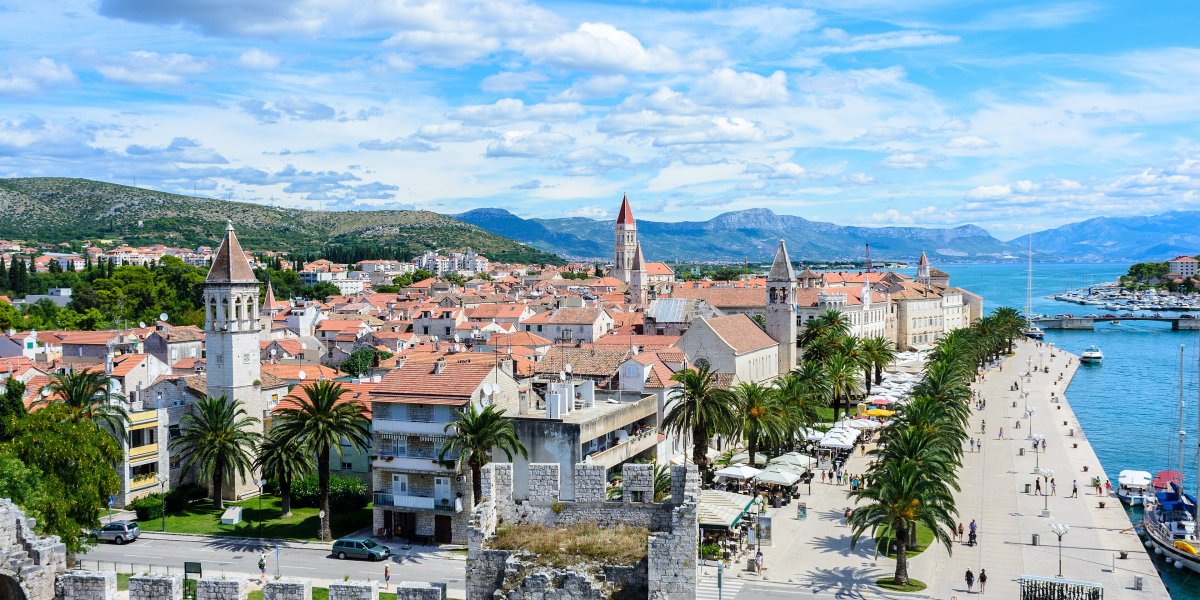
Leave the square heading west on Gradska — three minutes through narrowing alleys, past the Cipiko coat of arms and the old fish-market arcade — and the lanes spill you out onto the western tip of the island, where the 15th-century Venetian sea-fortress sits with its feet in the harbour. Don't bother paying to climb the empty interior; instead walk the full perimeter along the waterfront for the postcard angles — the round corner bastion, palm trees, fishing boats moored at the seawall. This is the shot everyone remembers Trogir by.
Tip: Walk the seafront path on the south side of the fortress, not the inland side — at 11:00 the sun is behind you and the entire west-facing wall glows pale gold against deep blue Adriatic. The little fenced football pitch tucked beside the fortress (the Marmont garden) is where local kids actually play; a 30-second peek over the wall is more 'real Trogir' than any guidebook stop.
Open in Google Maps →12:00
Food
Backtrack along the seafront Riva for four minutes — pelicans of moored sailboats on your right, stone palazzi on your left — and duck into Budislavićeva alley just behind the promenade. Mirkec has been the locals' weekday lunch spot for thirty years, run by the Mirko family and famous in Dalmatia for stuffed pizza — a calzone-style folded pizza closed around prosciutto, cheese and tomato. Order one Mirkec stuffed pizza (€11) or the black cuttlefish-ink risotto crni rižot (€13), a glass of house Pošip white (€4), and you're done in 45 minutes.
Tip: Sit inside or on the side terrace — not the front row facing the Riva, which catches noon sun and tour-group noise. The stuffed pizza is the only thing to order on a first visit; ignore the long menu. No reservation needed before 12:30; after that it fills with returning regulars and you'll wait 20 minutes.
Open in Google Maps →13:30
Neighborhood
Step out of the alley onto the Riva and turn left — east along the seafront in two minutes you reach the small swing bridge to Čiovo Island. Cross it, then turn right and follow the coastal path westward along Čiovo's north shore: it loops the entire facing side of the bay with Trogir's bell tower framed across the water the whole way. Walk as far as Slatine village if you have the legs (a steady 9 km one-way along a mostly flat seafront road dotted with pine coves and tiny pebble beaches), then turn around and come back the same way. This is the long, golden, lung-filling stretch of the day — the moment the trip stops being a checklist and starts being a memory.
Tip: Time your turnaround for 17:30 so you walk back westward with the descending sun lighting Trogir's silhouette across the water — the bell tower glows orange against the mainland mountains behind it. Bring a 1.5 L water bottle from a konzum mini-mart before crossing the bridge; the coastal path has only two cafés in the first 4 km and they double prices in afternoon.
Open in Google Maps →19:00
Food
Cross the Čiovo bridge back into the old town, then weave inland through the alleys for six minutes — turn into the tiny lane of Matije Gupca and a stone doorway opens into a candlelit vine-covered courtyard. Konoba Trs is what every coastal-Croatia restaurant pretends to be: a 14th-century house run by one family, with handwritten daily catch on a chalkboard. Order the octopus peka — slow-cooked under an iron bell with potatoes and rosemary (€32, you must phone ahead by 14:00 the same day) — or, if no peka, the grilled fresh sea bass at market weight (~€55/kg, one fish feeds two). Black risotto here is the best on the island (€16). Finish with a glass of homemade prošek dessert wine on the house.
Tip: Reserve same-morning by phone (+385 21 796 956) for the 19:00 seating — the courtyard has 8 tables and walk-ins after 19:30 are turned away in summer. Pitfall warning: never sit at the Riva-front restaurants with English-speaking touts pulling you in by the elbow (Capo, Pizzeria Roko's terrace etc.) — they are 40% pricier than the inland konobas and serve frozen fish flagged as 'fresh local catch'. The rule in Trogir is simple: the further from the seafront sign, the better the kitchen.
Open in Google Maps →
Trip builder
Plan this trip around Trogir
Turn this guide into a bookable rail itinerary with FlipEarth.
Keep exploring
Related cities
More in the same country
FAQ
Frequently asked questions
How many days do you need in Trogir?
Most travelers enjoy Trogir in 1 days, with enough time for headline sights and a slower meal or museum stop.
What's the best time to visit Trogir?
The easiest season for most travelers is May-Oct, especially if you want good weather and manageable crowds.
What's the daily budget for Trogir?
A practical starting point is about €85 per person per day before hotels, then adjust based on museums, dining, and transport.
What are the must-see attractions in Trogir?
A good first shortlist for Trogir includes North Land Gate (Kopnena Vrata), Kamerlengo Fortress (Exterior Circuit).