City Guide
A Coruña
Espagne · Best time to visit: May-Sep.
Day-by-day plan
Choose your pace
Durée du voyage
09:45
Landmark
Begin at the only Roman lighthouse on Earth still guiding ships — UNESCO-listed and burning for nearly nineteen centuries. The 234-step spiral inside is single-file and steep; the reward is an unbroken Atlantic horizon broken only by trawlers heading for the Grand Sol fishing grounds. Spend the second half wandering the headland sculpture park at the base, where the granite compass rose and the Celtic-Phoenician menhirs catch the low morning sun far better than the view from the top.
Tip: Be at the gate by 09:55 — it opens at 10:00 and the single-file staircase becomes a 20-minute backup once the first coach lands at 10:30. If the wind is over 50 km/h (frequent here), they close the top platform with no refund; in that case skip the climb and head straight to the sculpture park — the compass rose is the photo people actually remember anyway.
Open in Google Maps →11:30
Park
Exit the Tower park by the southwest gate and pick up the Paseo Marítimo — one of the longest continuous seafront promenades in Europe — heading south with the ocean on your right the whole way. You'll pass the curved sail-shaped facade of the Domus museum (no need to go in) and a long sequence of cliff-edge benches before the Paseo curves into the urban half-moon of Riazor. Walk the full length of the beach on the sand if the tide is out; the surf school and the Deportivo stadium frame the southern end.
Tip: Walk on the seaward pavement, not the inland one — the inland side runs alongside four lanes of traffic and you lose the whole point of the route. Just before reaching Riazor, the free outdoor terrace at the back of the Aquarium Finisterrae gives you the only angle where you can frame the Tower of Hercules behind you and the Riazor crescent ahead in a single shot.
Open in Google Maps →13:00
Food
Cut inland from Riazor along Calle Juan Flórez — ten minutes east through the city's main shopping spine — and you'll arrive at the stone arches of San Agustín, the working food market of A Coruña since 1932. Skip the upstairs tourist stalls and go straight to the ground-floor fish counters, where the percebes and centollo come off the boat the same morning. A plate of pulpo a feira runs €12-14, a wedge of empanada gallega de zamburiñas (scallop empanada) is €3.50, and a glass of crisp Albariño €2.50 — eat standing at a counter, the way every local does at lunch.
Tip: Most fish counters partner with an adjacent bar — point at what you want raw, and they'll send it to be steamed or grilled for €3-5. This is the only way locals eat market lunch and it's invisible to anyone who hasn't been told. Avoid the sit-down restaurants on the upper gallery — same fish, double the price, and the kitchen is the same one downstairs.
Open in Google Maps →14:30
Neighborhood
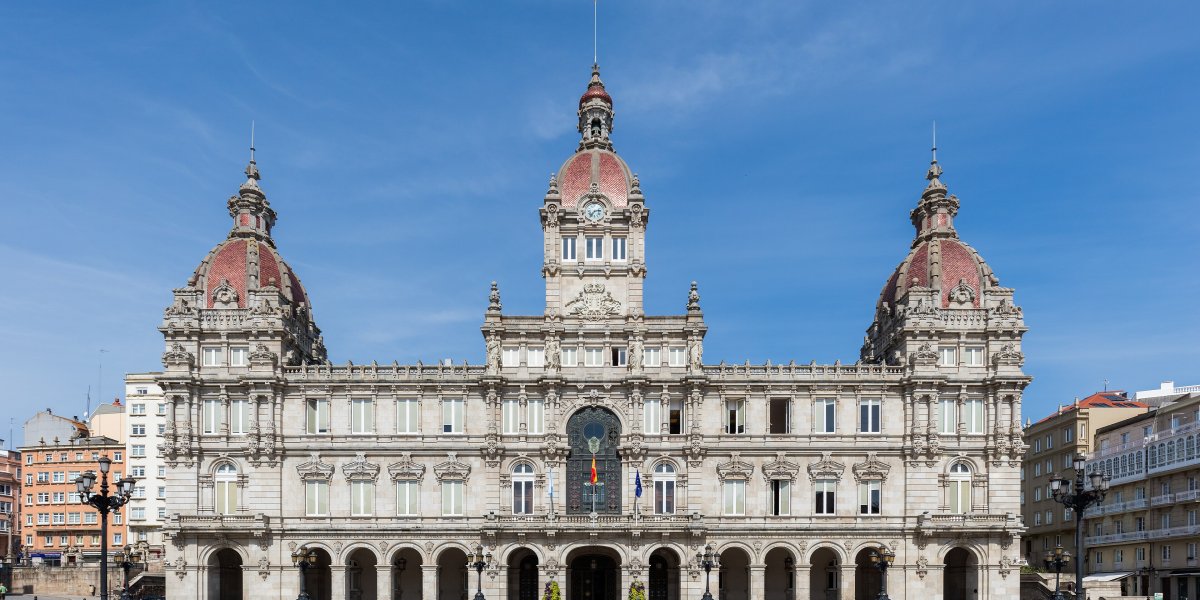
Leave the market by the east door, walk three minutes along Calle San Andrés and you spill into Plaza de María Pita — the city's grand arcaded square, named for the local woman who in 1589 grabbed a fallen English standard and rallied the defense against Francis Drake. Cross the square diagonally and enter the old town via Calle de la Estrella rather than the obvious Calle Real: it opens onto the lemon-shaded Plaza de Azcárraga and the Romanesque church of Santiago (12th c.), the oldest in the city. From there a five-minute climb through Calle Damas brings you out at the bastion of Jardín de San Carlos, a sunken cypress-walled garden built around the tomb of British general Sir John Moore.
Tip: The mid-afternoon hour is deliberate — the old town is empty between 14:30 and 17:00 because the Spanish are still at lunch. Enter the church of Santiago through the lateral north door, not the locked west portal everyone tries first; it's quietly open on weekday afternoons until 18:00 and the interior carved capitals are the real Romanesque treasure, not the facade.
Open in Google Maps →17:00
Landmark
Walk one block south from Plaza de María Pita to Avenida de la Marina — under a minute — and the full 700-metre wall of white-framed glass balconies opens in front of you. These are the galerías that earned A Coruña its nickname "the city of glass": 19th-century wooden bay windows fitted to face the harbour wind. Walk the harbour-side promenade north to south for the unbroken view, then continue another 700 metres to the squat octagonal Castillo de San Antón on its own islet — the 16th-century sea fortress that locked the bay against pirates. The exterior loop around the moat is the photo; you don't need to go inside.
Tip: The galerías face east, so contrary to expectations sunset is the wrong hour — at full sunset they're in shadow. The window is 17:00-18:30 in summer (15:30-16:30 winter), when the side-light from the west still catches the white wood frames and makes them pop against deep blue sky. Stand on the harbour-side bench across from Hotel Maycar to get the entire glass wall in one unbroken frame — every other angle clips it.
Open in Google Maps →20:30
Food
Walk back up to Plaza de María Pita — two minutes — and La Penela is under the arcade at number 12, the local stronghold of the square since the 1970s. This is where Coruñeses bring visiting relatives: tortilla de Betanzos (€14, the regional version, served deliberately runny in the middle — that's correct, not undercooked), pulpo a feira with pimentón and Galician sea salt (€18), and percebes when in season from September to May at €25 per 100g. Order a bottle of cold Albariño from Rías Baixas (€18-22), finish with tarta de Santiago. Plan around €40-50 per person.
Tip: Tourist-trap warning for the square: ignore the restaurants on Plaza de María Pita with photo menus, plastic-laminated signs and waiters chasing you down the arcade — they are frozen-seafood mills charging €28 for thawed pulpo. La Penela doesn't hustle outside; the door is unmarked except by a small sign. Walk in without reservation before 21:00 and you'll seat in 5 minutes; after 21:30 expect 30. If percebes are off the menu, the kitchen won't substitute frozen — that refusal is itself the sign you're in the right place.
Open in Google Maps →Aller au jour
09:00
Landmark
Begin the city exactly where it beats loudest — at 09:00 the white arcades of the Ayuntamiento glow pink in the rising Atlantic sun, while the square is still empty before the 11:00 coach groups roll in. Stand in the south-west corner with your back to the cafés: the full façade and the bronze statue of María Pita herself line up in one frame. You will pass through here three more times in two days — this is the city's living room.
Tip: Skip the over-priced café terraces facing the Ayuntamiento (€4 espressos). Walk one block north into Calle de los Olmos — same quality, half the price, and where coruñeses actually take their morning café con leche.
Open in Google Maps →10:00
Neighborhood
Leave María Pita through the stone arch at its north-east corner — ten paces in, the noise drops away and you are inside the medieval Ciudad Vieja. Walk uphill to the Romanesque Colegiata de Santa María del Campo, the old fishermen's parish, then finish on the cypress-shaded ramparts of the Jardín de San Carlos, where 19th-century British general Sir John Moore lies buried in a tomb turned to face the harbour. The garden is built on a former gunpowder bastion: every bench looks down on the port those guns once defended.
Tip: Photograph the Jardín de San Carlos from the upper terrace looking south-east — you frame the cypresses, Moore's tomb, and the harbour cranes in one diagonal. Coruñeses come here at 11:00 to read the paper; tour groups never make it this far inside the old town.
Open in Google Maps →12:30
Food
Walk five minutes south-west out of the old town along Calle Real, and you arrive at the wood-and-tile front of A Pulpeira de Melide on Cantón Grande — the address where coruñeses send anyone serious about pulpo a feira. The dish is non-negotiable: a wooden plate of octopus (€15-18) boiled tender by the pulpeira at the front window, dusted with paprika, drowned in green Galician olive oil and served over smoky cachelos potatoes (€4). Pair it with cold Ribeiro white in a ceramic cuncha (€2.50), exactly as it has been drunk here for four hundred years.
Tip: Arrive at 12:30 sharp, not 13:30 — by 13:15 the queue is out the door. Order the media ración of pulpo (€12) plus a slice of empanada de zorza (€4) rather than a full plate: it leaves room to also try the percebes — goose barnacles — if she has them that day, which is the other dish Galicia is built on.
Open in Google Maps →14:30
Landmark
Walk three minutes north-east from lunch and you are on the Avenida de la Marina — the half-kilometre curtain of white-painted glazed galleries that earned A Coruña the name Cidade de Cristal. Mid-afternoon is the deliberate hour: the sun has swung south-west, hits the glass head-on, and the entire façade lights up like a sheet of broken sugar. Cross to the port side of Cantón Grande, walk the full length, then turn back along the arcade — only from below do you see how the wooden window frames are different on every single building.
Tip: Photograph the galleries from the small roundabout in front of the post office at the corner of Cantón Grande and Calle Real — the curve of the avenue is at its most dramatic from there, and the modernist gas lamps lead the eye perfectly. Ignore the 'free polaroid' photographers near the harbour railing — they demand €20 once the photo is taken.
Open in Google Maps →16:00
Landmark
Take bus 3 or 3A from Cantón Grande (8 minutes) — or, if you have the legs, walk the dramatic 2.5 km north along the Paseo Marítimo past the cliffs of Punta Herminia. The Tower of Hercules is the only Roman lighthouse on Earth still doing the job — 1,900 years old, UNESCO listed, and has lit Atlantic storms since the reign of Trajan. Pay €3, climb the 234 steps, and step onto the lantern terrace as the late-afternoon sun turns the granite and the Sculpture Park below into copper.
Tip: Aim to be on the lantern at 17:30 in summer or 16:30 in winter — that is the precise window when the sun hits the lighthouse from the west and the tower's own shadow falls dramatically eastward across the headland. Skip the indoor museum at the base; instead walk the cliff loop behind the tower, where the Atlantic crashes into the Menhirs sculpture and almost no one walks.
Open in Google Maps →20:00
Food
Bus 3A back into town (or a €7 taxi) and walk ten minutes west to Calle Novoa Santos 15 — the discreet door of Casa Pardo, A Coruña's most respected white-tablecloth seafood house, three generations deep and where coruñeses bring their in-laws. The kitchen owns the percebes (goose barnacles, €18 ración — the dish that defines Galician seafood) and the rodaballo a la plancha (grilled wild turbot, €38) pulled that morning from the Costa da Morte. Budget €50-65 per head with a glass of Albariño; the dining room is small, formal but warm, and you will hear Galician at three of the six tables.
Tip: Reserve 48 hours ahead — six tables, and no walk-ins on a Saturday night. Skip the printed menu: ask the waiter what came in from the lonja (fish market) that morning, the way every regular here orders. Tourist-trap warning: the all-night 'seafood paella' joints on nearby Calle Estrella are bagged-frozen, microwave-finished tourist menus at €40 — no coruñés will set foot on those terraces.
Open in Google Maps →09:30
Park
Start the morning on the long curve of Playa de Riazor — at low tide a kilometre of pale gold sand, and at 09:30 it belongs entirely to dog-walkers and surfers. Begin at the southern end by the Hesperia Finisterre hotel and walk north-east along the Paseo Marítimo, the longest seafront promenade in Europe (13 km end to end). To your left, the open Atlantic and the Roman-style sea baths cut into the rock; to your right, the curve of mid-century apartment blocks where coruñeses actually live.
Tip: Walk on the lower wooden boardwalk, not the upper sidewalk — it sits two metres above the sand and gives you the wave-spray and the photographer's angle without the joggers. At low tide drop onto the beach itself between Riazor and Orzán and look back at the headland: Old Town, Marina, and yesterday's Tower line up along the horizon in a single frame — that is the photograph of A Coruña.
Open in Google Maps →11:00
Museum
At the northern end of Orzán beach the cliff rises into a curved slate wave — that is the Domus, Arata Isozaki's 1995 building, looking from below like a fossil cresting out of the rock. Step inside (€2, opens 10:00 but the crowds don't arrive until 11:30) and you find a science museum entirely about the human body: a mirror-floor that distorts you, a heart drum-machine you operate by tapping, a chess match against the computer that beat Kasparov. It pretends to be for children and then quietly stops every adult in their tracks.
Tip: Go straight to the top floor first and walk down — that reverses the standard visitor flow, so you have the best installations (the fingerprint panel, the Isozaki rooftop view back over Orzán) entirely to yourself. The rooftop balcony is free to access without a museum ticket — useful to know if the queue is long that day.
Open in Google Maps →13:00
Food
Walk fifteen minutes south through the leafy Cantón Pequeño to Calle Marcial del Adalid 2 — the small wood-fronted dining room of Bido, A Coruña's most quietly ambitious tapas kitchen, opened by chef Álex Iglesias after he came home from Madrid. The format is small plates from a daily-printed menu: order the croqueta de pulpo (€3.50 each — the kitchen's signature, unlike any pulpo croqueta you have eaten), the steak tartare on potato crisp (€14), and a glass of mencía from the Ribeira Sacra (€4). Two diners eat well for €55.
Tip: Walk in at 13:00 sharp — they hold the four bar stools for walk-ins; the dining room books a week ahead. Take the bar: you watch the pass, talk to the cooks, and order one tapa at a time rather than committing to a full menu. Skip dessert here — save room for tarta de Santiago and black coffee around the corner at La Bombilla on the way out.
Open in Google Maps →15:00
Entertainment
Walk twenty-five minutes north along the Paseo Marítimo (or a €7 taxi) to the Aquarium Finisterrae, set directly on the cliffs where the Bay of Orzán meets the open Atlantic. The headline tank — the Nautilus — is a converted underground cistern where you stand inside an oval glass dome surrounded on all sides by sharks, conger eels, and a 1.5-metre wreckfish that floats past your face at eye level. Half-hourly seal feedings happen on the outdoor cliff terrace, with the Atlantic breaking thirty metres directly below.
Tip: Time your visit for the 16:30 seal feeding on the outdoor cliff terrace — the seals are simply fed in their natural pool, but it puts you fifteen metres above the surf at exactly the hour the light begins to turn for the lighthouse on the horizon. Skip the small ray touch-pool at the entrance: school groups bottleneck it, while the real magic is the Nautilus dome that most tour groups race past.
Open in Google Maps →17:00
Landmark
Take bus 14 (or a €7 taxi — the climb is steep) and in fifteen minutes you are on top of Monte de San Pedro, the wooded headland that closes the city to the west. Up here: a giant rusting Cold-War coastal gun (the largest on the Iberian Peninsula, decommissioned 1990), a glass-and-steel mirador dome you ride up via a panoramic elevator (€3 return), and a view that takes in every kilometre of A Coruña below you — Tower, Marina, Old Town, beaches, Domus, the full 13-km arc. Stay until the sun begins to drop dead west of the lookout, and the lighthouse you climbed yesterday starts to flash on cue.
Tip: Stand at the rusted gun emplacement on the western edge — not at the glassed-in dome — twenty minutes before sundown: the gun frames the city beautifully in the foreground and you can actually feel the Atlantic wind. Last bus 14 back to town is around 21:00 in summer; if you stay through full darkness, walk fifteen minutes east to Avenida de Labañou where taxis pick up — do not try the unlit cliff road back. Tourist-trap warning: skip the souvenir bottles of 'authentic Galician Albariño' in the dome gift shop — they are tourist-marked 4× over; any Galician supermarket sells the same bottle for €5.
Open in Google Maps →20:00
Food
Bus or taxi fifteen minutes back to the centre and walk to Calle Real 77 — the warm cherry-wood front of A Mundiña, the modern Galician kitchen that coruñeses under forty have made their own. Order the zamburiñas a la plancha (grilled queen scallops in their shell, €16), the arroz meloso de bogavante (creamy lobster rice, €28 for two), and a bottle of Adega Algueira mencía from the Ribeira Sacra (€28). Budget €45-55 per head; the room is buzzy by 20:30 and the open kitchen sits in plain view of every table.
Tip: Reserve same-day by phone — they keep two bar tables for walk-ins but those go by 20:15. Ask specifically for the arroz meloso even if it is not chalked up on the daily board: they cook it daily but only mention it to regulars. Tourist-trap warning: avoid the 'menú del día turístico' boards along nearby Calle Estrella and Calle Olmos — they advertise pulpo at €8 but it is frozen Moroccan octopus, not Galician; coruñeses never eat from those terraces.
Open in Google Maps →
Trip builder
Plan this trip around A Coruña
Turn this guide into a bookable rail itinerary with FlipEarth.
Keep exploring
Related cities
More in the same country
FAQ
Frequently asked questions
How many days do you need in A Coruña?
Most travelers enjoy A Coruña in 1 days, with enough time for headline sights and a slower meal or museum stop.
What's the best time to visit A Coruña?
The easiest season for most travelers is May-Sep, especially if you want good weather and manageable crowds.
What's the daily budget for A Coruña?
A practical starting point is about €100 per person per day before hotels, then adjust based on museums, dining, and transport.
What are the must-see attractions in A Coruña?
A good first shortlist for A Coruña includes Torre de Hércules (Tower of Hercules), Galerías de la Marina and Castillo de San Antón (exterior).