City Guide
Palma de Mallorca
Espagne · Best time to visit: Apr-Jun, Sep-Oct.
Day-by-day plan
Choose your pace
Durée du voyage
09:00
Landmark
Take bus 46 from Plaça d'Espanya to the foot of Bellver Hill, then follow the forest path upward through ancient Aleppo pines — the morning air is thick with resin and sea salt, and the only sound is birdsong. Europe's only circular Gothic castle crowns the hilltop at 112 meters, its round towers giving you an unbroken 360-degree panorama of Palma's cathedral, the shimmering bay, the Serra de Tramuntana mountains, and on clear mornings, the dark silhouette of Cabrera island. The courtyard's double-tiered arcade of honey-colored arches is one of the most photogenic spaces on the island.
Tip: Arrive right at 09:00 when the gates open and you will have the rooftop ramparts entirely to yourself. The best photo faces southeast — La Seu cathedral appears tiny on the horizon with the entire harbor fanning out below. Skip the history museum rooms inside; every minute is better spent on the roof.
Open in Google Maps →10:30
Landmark
Walk downhill through the pine forest and turn east onto Passeig Marítim — the 25-minute harbor promenade passes mega-yachts and traditional Mallorcan llaüt fishing boats bobbing in the same sparkling water. Sa Llotja is Palma's masterpiece of Gothic civil architecture: a 15th-century merchants' exchange whose six interior columns twist like wrung cloth, visible through the soaring windows. The exterior is a study in restrained power — octagonal turrets, an angel-guarded portal, and gargoyles that have watched over Mediterranean trade for six hundred years.
Tip: The most dramatic photo angle is from Plaça de la Llotja on the south side, where the full Gothic facade fills your frame with palm trees in the foreground. Walk around the entire building — the north side reveals carved merchant shields you will not see in any guidebook photo.
Open in Google Maps →11:15
Religious
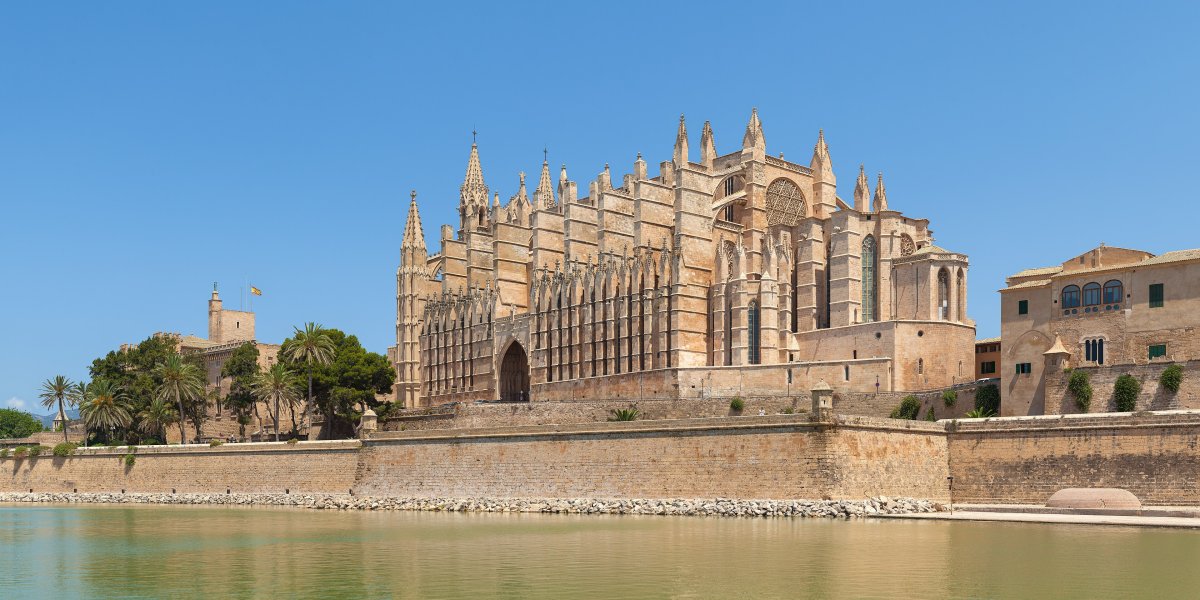
Walk east along Passeig Sagrera past the old sea gate — the cathedral's flying buttresses loom larger with every step, an 8-minute walk that builds anticipation perfectly. Cross Avinguda d'Antoni Maura and descend into Parc de la Mar, where the reflecting pool frames La Seu against a cloudless sky in what may be the most photographed view in all of Mallorca. The south facade drops 44 meters straight to the old city wall, a sheer cliff of golden sandstone that glows like warm honey in the late-morning sun.
Tip: Between 11:00 and 12:00 the sun is high enough to illuminate the entire south facade evenly — earlier, the eastern half sits in shadow. Walk to the far end of the reflecting pool for the mirror shot. For a second killer angle, climb the steps to Dalt Murada behind the Royal Palace — you look down at the buttresses with the harbor stretching behind them.
Open in Google Maps →12:15
Food
Walk north from the cathedral through the Portal del Mirador and wind into the old town — laundry hangs between balconies, bougainvillea cascades over sandstone walls — a 7-minute stroll that feels like stepping back two centuries. Palma's oldest café has been pouring thick hot chocolate since 1700, its marble tables worn smooth by three hundred years of elbows. Order the coca de trempó (a savory Mallorcan flatbread of roasted peppers, tomato, and onion, €5.50) and follow it with an ensaïmada de cabell d'àngel, the island's signature spiral pastry filled with candied pumpkin threads (€4.50).
Tip: Go to the original location on Carrer de Can Sanç 10, not the newer branch. Order at the counter, grab a marble table, and ask for the ensaïmada 'acabada de fer' — fresh from the oven, still warm, the dough peels apart in translucent layers. Budget 10-12 euros for a full savory-and-sweet Mallorcan lunch.
Open in Google Maps →13:30
Neighborhood
Step outside Ca'n Joan de s'Aigo and turn south along Carrer de Can Sanç — you are now in the heart of Palma's aristocratic quarter. Behind the heavy wooden doors of centuries-old mansions, over forty Renaissance and Baroque courtyards hide in plain sight, each visible through ornate iron gates: grand stone staircases spiraling upward, potted palms reaching for a square of sky, and the cool silence of another century. Walk Carrer de Morey for the richest concentration, then Carrer de la Portella past the ancient Arab Baths, and weave through Carrer de Can Savellà toward the tree-lined promenade of Passeig des Born.
Tip: Carrer de Morey 9 (Can Oleza) has arguably the most beautiful courtyard in Palma — peer through the gate at the Renaissance loggia and the hanging garden on the upper floor. The afternoon sun between 13:00 and 15:00 is the only time light reaches the floors of these narrow streets, making it the one window for courtyard photography. End your walk at Passeig des Born under the plane trees — this is Palma's living room.
Open in Google Maps →19:00
Food
From Passeig des Born, walk northeast through the old town past Plaça del Mercat — a 12-minute stroll through streets filling with the amber light of a Mediterranean evening. Celler Sa Premsa is a Palma institution since 1958: a cavernous dining hall lined with massive oak wine barrels, paper tablecloths, and the happy noise of Mallorcan families eating together. This is the antithesis of a tourist restaurant — the menu is handwritten, the portions are absurdly generous, and the waiter will greet you in Mallorquín before switching to Castellano.
Tip: Order the tumbet (layered Mallorcan ratatouille of fried aubergine, potato, and peppers in tomato sauce, €9) and the frito mallorquín (rich pan-fry of lamb with potatoes and wild fennel, €12). Pair with a copa of vi negre from Binissalem (€3). Arrive at 19:00 sharp — by 20:00 every table is full and there is a queue at the door. Fair warning: the restaurant terraces along Passeig des Born with trilingual menus and €18 paella are tourist traps that no local would touch.
Open in Google Maps →Aller au jour
09:00
Park
From anywhere in central Palma, walk south toward the harbor — every lane leads downhill to this waterfront park below the medieval city walls. The saltwater reflecting pool mirrors the full mass of La Seu Cathedral, and in the soft morning light before tour buses arrive, this postcard shot is yours alone. Follow the palm-lined promenade east along the sea wall to take in the cathedral's scale from below.
Tip: Stand at the southeast corner of the lake for the cleanest reflection — the cathedral, palm trees, and water align perfectly in one frame. By 09:30 the first coach groups spill out across the promenade and the stillness is gone.
Open in Google Maps →10:00
Religious
Walk up the stone ramp from the park through the royal palm garden — three minutes and you're standing beneath the largest Gothic rose window in the world. Enter right at opening when the nave is nearly empty and morning sun pours kaleidoscopic color through the eastern rosette onto sandstone columns 44 meters high. The interior is a three-act drama: Gaudí's suspended baldachin hovering over the altar, Miquel Barceló's dripping ceramic chapel wall alive with marine forms, and the staggering vertical emptiness of the central nave.
Tip: Walk to the Chapel of the Holy Sacrament (right side) first — Barceló's mural is the most photographed detail inside and visitors cluster there quickly. The cathedral closes at 14:15 on Saturdays and is open only for mass on Sundays, so weekday mornings give you the fullest experience.
Open in Google Maps →11:45
Landmark
Exit the cathedral's main portal and turn left — the palace entrance is a two-minute walk along the same clifftop terrace above the harbor. This 14th-century royal residence, built atop a Moorish alcázar and still officially used by the King of Spain, preserves Gothic state rooms with coffered ceilings and Flemish tapestries above Arab-era basement arches. Step onto the Terrassa del Rei for a panorama straight down to the working port and across the bay to the Tramuntana foothills.
Tip: Most visitors rush the ground floor — go directly upstairs to the Queen's chambers and the Officers' Hall, where the light through the arched windows and the harbor panorama are the real draw. Free entry on Wednesdays and Sundays for EU citizens.
Open in Google Maps →13:00
Food
Walk north from the palace through Carrer de la Almudaina and Carrer de Jaume II — ten minutes through Palma's pedestrianized old town, past the carved stone facades of medieval merchants' houses. The city's central market since 1951 buzzes with a working fish auction hall, a butcher's counter, and several stand-up bars where chefs eat between shifts. Pull up a stool at the seafood bar, order the gambas al ajillo searing hot from the pan (€9) with a pa amb oli — Mallorca's essential bread rubbed with ripe tomato and drizzled with local olive oil (€5).
Tip: The fish bar in the northeast corner has the fastest turnover and freshest product — look for the counter with the longest local queue. Avoid the sit-down restaurants flanking the market's exterior; they charge double for the same fish you can eat at the standing bars inside.
Open in Google Maps →14:30
Landmark
Head south from the market along Carrer de Sant Miquel — one of Palma's oldest streets, lined with baroque churches and heavy wooden doors — and in eight minutes you reach the quiet lanes around Carrer de Can Serra where the Arab Baths hide behind an unmarked garden gate. The 10th-century domed chamber, resting on mismatched Roman columns beneath horseshoe arches, takes only twenty minutes, but it primes you for what follows: wander south through Carrer de Morey and Carrer del Sol, where grand mansion doors stand open in the afternoon heat, revealing Renaissance courtyards with stone staircases, potted palms, and wrought-iron galleries invisible from the street. This is Palma's secret architecture — the city behind the city.
Tip: The doors of Can Oleza (Carrer de Morey 9) and Can Vivot (Carrer de Can Savellà 4) are usually open until 17:00 — step into the courtyard quietly and look up. These Renaissance patios are more impressive than many paid museums. Beware the 'free' walking tour guides who station themselves at the Arab Baths exit and pressure tourists for tips of €15 or more.
Open in Google Maps →19:30
Food
Walk west from the old town along Carrer dels Oms for ten minutes, past quiet neighborhood bars where locals nurse evening vermut, to a century-old wine cellar where giant oak barrels line the walls and the menu hasn't changed philosophies in a generation. Celler Sa Premsa is loud, packed with Mallorcan families, and serves portions designed for agricultural appetites. Order the frit mallorquí — fried lamb offal with potatoes, fennel, and hot peppers (€14) — and the arròs brut, Mallorca's saffron-dark 'dirty rice' loaded with pork and wild mushrooms (€15), with a jug of house red (€6).
Tip: No reservations — first come, first served. Arrive at 19:30 sharp; by 20:00 the queue stretches to the street. Sit in the main dining hall under the barrels, not the side room. Skip the tourist restaurants on Passeig des Born charging €22 for mediocre frozen paella — Sa Premsa delivers twice the food at half the price, and this is where palmesanos actually celebrate Sunday lunch.
Open in Google Maps →09:00
Neighborhood
From central Palma, walk west past Plaça d'Espanya into the low-rise grid of Santa Catalina — twelve minutes and the neighborhood's colorful shutters and café terraces signal a different rhythm entirely. This compact market is where Santa Catalina's residents and chefs do their daily shopping: wheels of mahón cheese, strings of sobrassada sausage, buckets of herbs, and silvery Mediterranean fish arranged by fishmongers at dawn. Grab a café con leche and a freshly baked ensaimada — the spiral pastry dusted with powdered sugar that is Mallorca's edible emblem (€3) — at one of the standing counters.
Tip: The fish section at the back of the market has the best photo opportunity — vivid displays of the morning's Mediterranean catch arranged on ice. Saturday mornings are the most atmospheric, but avoid arriving past 10:30 when stalls begin closing.
Open in Google Maps →10:15
Landmark
Take bus #3 from Plaça del Progrés in Santa Catalina (every 15 minutes, €2) or grab a short taxi to the castle hill, then climb the shaded stone path through pine forest for ten minutes to the entrance. One of only three circular castles in Europe, Bellver's round 14th-century courtyard with its two-tier Gothic arcade and the rooftop terrace deliver a full 360-degree panorama: the Bay of Palma, the cathedral in the distance, the port, and the jagged Serra de Tramuntana ridgeline on the northern horizon. Morning light rakes across the bay from the east, making this the single best vantage point for photographing the entire city.
Tip: Go directly to the rooftop terrace first — it is the entire point of the visit. The City History Museum inside the castle rooms is skippable unless you have particular interest in Roman artifacts. Closed Mondays; Sunday hours end at 15:00.
Open in Google Maps →12:30
Food
Head back down the hill through the Bellver pine forest — fifteen minutes of shaded downhill walking deposits you back in Santa Catalina's café-lined streets. This tiny, wine-stained vermouth bar on Carrer de la Rosa is where the neighborhood's creative crowd squeezes in for an unhurried lunch that changes with whatever the market delivered that morning. Order the anchoas del Cantábrico on toast with roasted peppers (€9), the croquetas de jamón (€7), and a house vermouth on tap with a strip of orange peel (€4.50) — simple, salty, and exactly right after a morning of climbing.
Tip: Only about 25 seats — arrive at 12:30 or expect a 20-minute wait. Sit at the marble counter by the window for the best atmosphere. Don't order the large plates; the tapas portions are better calibrated and let you try three or four things.
Open in Google Maps →14:00
Museum
Walk south from La Rosa along Carrer de Sant Magí for five minutes until you see the old city walls — Es Baluard is literally built into the Renaissance-era bastion overlooking the port. The galleries weave through ancient fortification stone and white exhibition rooms, with a permanent collection spanning Picasso, Miró, and Barceló — all artists with deep Mallorcan ties. But it's the rooftop sculpture terrace that justifies the visit: a wide stone platform with an uninterrupted panorama of the harbor, the cathedral, and Bellver Castle behind the city.
Tip: Go directly to the rooftop terrace (floor 2, then exterior stairs) for the view while afternoon light is still strong, then work your way down through the galleries. The Miró room on the lower level is small but powerful. Closed Mondays.
Open in Google Maps →16:00
Landmark
Exit Es Baluard through the lower gate and walk east along the old port wall — La Llotja's ornate Gothic spires appear after five minutes, past fishermen on the quay. Palma's 15th-century maritime trading exchange is among the finest Gothic civil buildings in the Mediterranean: six twisting stone columns support the ribbed vault like petrified palm trunks, and the effect is more forest than architecture — it opens only during exhibitions, but the carved portal and gargoyles reward a slow circuit of the exterior. From here, stroll the Passeig Marítim along the harbor as the afternoon light turns golden — fishing boats, superyachts, and the cathedral in the distance compose the image of Palma you will carry home.
Tip: The best photo of La Llotja's facade is from the small Plaça de la Llotja at around 16:30, when the sinking sun lights the sandstone to deep amber. Do not eat at any of the waterfront restaurants between here and Porto Pi — they are the worst price-to-quality ratio in Palma, targeting cruise ship passengers with €18 frozen paella and surly service.
Open in Google Maps →19:00
Food
Double back from the waterfront into the old town via Carrer de Sant Joan — an eight-minute walk to a converted 18th-century bakery glowing behind trailing jasmine. Forn de Sant Joan straddles the line between neighborhood bistro and destination restaurant: polished Mediterranean cooking with Mallorcan roots, a local wine list, and an open courtyard under climbing plants that feels like dining in someone's private garden. Start with the tumbet gratinat — Mallorca's ratatouille baked with cheese (€12) — then the fresh catch a la plancha with sea salt and lemon (€22), and a glass of Binissalem red from the Tramuntana foothills (€6).
Tip: Reserve a courtyard table when you book — the interior dining room is pleasant but the courtyard under the open sky is the entire experience. Book the day before or by midday same-day; walk-ins rarely get courtyard seats past 19:30. Save room for the homemade almond cake with Sóller orange sorbet (€9) — a proper Mallorcan farewell.
Open in Google Maps →Aller au jour
09:00
Religious
Start at the Parc de la Mar esplanade just below the old town — the cathedral's sandstone buttresses rise above the reflecting pool like a Gothic cliff face. Enter right at opening to watch the morning sun pour through the colossal rose window before the first coach tours arrive. Gaudí's unfinished ceramic canopy over the high altar is a jarring, beautiful surprise inside a medieval shell.
Tip: Book the Terraces ticket online in advance (€15) — the first rooftop group at 10:00 is capped at 15 people and lets you walk along the flying buttresses with the bay below. Inside, stand in the center of the nave at 09:15 when the sun hits the rose window directly — the light fills the eastern wall like a kaleidoscope.
Open in Google Maps →11:15
Landmark
Exit the cathedral through the main portal and turn left — the palace shares the same clifftop terrace, a two-minute walk away. This former Moorish alcázar became the seat of the Kingdom of Mallorca and remains an official royal residence today. The Arab arch at the entrance, the Gothic throne room, and the courtyard gardens overlooking Parc de la Mar all reward a slow, unhurried pace.
Tip: The south-facing courtyard garden has the best angle for photographing La Seu's buttresses framed through the palace's arched gallery — arrive before noon when the light is direct. Audio guides are included free and cover details about the Moorish-era rooms that the signage omits entirely.
Open in Google Maps →13:00
Food
Descend the stone steps through Parc de la Mar and follow the Muelle Viejo toward the fishing port — Ca'n Eduardo occupies the top floor of the old fish auction building, with panoramic windows over the harbor (10-minute walk). Palma's most storied seafood restaurant has served the day's catch since 1943, sourced from the market directly below. The dining room smells like salt air and seared garlic.
Tip: Order the arroz brut first (Mallorca's signature 'dirty rice' with pork, rabbit, and saffron, ~€18) — it takes 25 minutes to prepare. The caldereta de langosta (lobster stew, ~€38/person, minimum two) requires pre-ordering when you reserve. Book a window table on the harbor side. Budget: €30–45 per person.
Open in Google Maps →14:30
Landmark
Walk back up into the old town via Carrer del Forn de la Glòria — the narrow streets funnel you past bakeries and iron-balconied houses (8-minute walk). The Banys Àrabs are a tiny 10th-century Moorish bathhouse hidden behind a walled garden — horseshoe arches, a domed skylight, and twelve mismatched columns salvaged from Roman and Byzantine ruins. Afterward, wander the old town labyrinth: peer through the gates of Can Oleza and Can Vivot, aristocratic mansions with stunning open-air patios.
Tip: On Carrer de la Portella and Carrer de Can Savellà, many palau gates are open during business hours — step inside for free to see Italianate staircases and palm-filled courtyards. Can Marquès (€5 entry) is a fully furnished 19th-century noble house worth the detour.
Open in Google Maps →19:30
Food
Walk northeast through Carrer dels Oms past Plaça d'Espanya — Sa Premsa sits on a quiet square behind the main road (12-minute walk). Palma's most beloved celler has served under barrel-vaulted ceilings since 1958, with enormous oak wine casks lining every wall and portions built for Mallorcan appetites. Regulars greet the waiters by name; tourists who find it never forget it.
Tip: Order the frito mallorquín (lamb offal and vegetables fried in olive oil, ~€14) — the dish that defines Mallorcan cooking. The tumbet (~€10) is the island's answer to ratatouille. No reservations; arrive by 19:30 or expect a wait. House wine is €4 a carafe. Budget: €18–28. Skip the 'traditional Mallorcan' restaurants clustered on Carrer dels Apuntadors near the port — most serve reheated tourist versions of the dishes Sa Premsa makes from scratch.
Open in Google Maps →09:00
Landmark
Take bus 4 from Plaça de la Reina (every 15 minutes, €2) and ride ten minutes uphill through the Bellver pine forest to the castle entrance. This 14th-century fortress is unique in Spain — perfectly circular, with a freestanding central tower connected by a single arched bridge. The rooftop terrace provides a 360-degree panorama: La Seu across the water, the Tramuntana mountains to the north, and on clear mornings the island of Cabrera floating on the southern horizon.
Tip: Walk the full upper terrace counterclockwise — the bay view at the northwest point, with La Seu visible across the water, is the single best panoramic photo in Palma. Morning light hits the east-facing tower perfectly between 09:00 and 10:00. The ground-floor history museum is skippable unless you love Roman pottery.
Open in Google Maps →11:00
Museum
Walk downhill through the pine forest to Avinguda de Gabriel Roca, then east along the seafront to Plaça de la Porta de Santa Catalina — a 25-minute downhill walk through shaded paths with harbor glimpses between the trees. Es Baluard is built into a Renaissance-era bastion: whitewashed galleries cut through ancient stone walls, and a rooftop terrace frames the cathedral across the old port. The permanent collection spans Miró, Picasso, and contemporary Balearic artists.
Tip: Go to the rooftop terrace first — it is free even without a ticket and has the most painterly view of La Seu across the old port. The Miró room on level 2 contains large-format works not displayed in Barcelona's Fundació. On Fridays the museum stays open until 20:00.
Open in Google Maps →13:30
Food
Exit Es Baluard from the south gate and walk north through Carrer de Sant Magí — the market hall is three blocks inland (7-minute walk). This covered market is where Palma's chefs shop every morning, and the stalls inside double as tapas counters: fresh oysters shucked to order, cured Ibérico sliced paper-thin, and freshly squeezed orange juice. Skip the sit-down restaurants outside and eat standing at the counters like locals do.
Tip: Joan Frau's charcuterie stall (look for the longest queue) has the best sobrassada on the island — ask for sobrassada amb mel (with local honey, ~€4 a tapa). Pair it with a glass of Binissalem red (€3). Two to three tapas and a drink cost €15–22. The market closes at 14:00 on Saturdays and is closed Sundays.
Open in Google Maps →15:00
Neighborhood
Step out of the market and let the streets pull you in — Santa Catalina is Palma's most photogenic residential quarter, with low-rise buildings painted in terracotta, sea-green, and sun-bleached yellow, bougainvillea cascading over ironwork balconies. Carrer de Sant Magí and Carrer de Cotoner are the main arteries, lined with independent boutiques, vinyl shops, and vermouth bars. End at the western stretch of Passeig Marítim for late-afternoon light across the bay toward the cathedral.
Tip: Carrer de Fàbrica has the most concentrated stretch of colorful facades for photos. The street art around Carrer de l'Anníbal changes seasonally and is by local Mallorcan artists. Avoid the restaurants lining Passeig Marítim between the port and Porto Pi — they are tourist-oriented chains with frozen seafood; the real food scene is two blocks inland.
Open in Google Maps →19:30
Food
Walk east along the waterfront and cut up into the old town at Avinguda d'Antoni Maura — Forn de Sant Joan is on a narrow lane just off Passeig del Born (15-minute walk). This former bakery has been reimagined as a sophisticated restaurant with exposed stone walls, an open kitchen, and a menu that riffs on Mallorcan tradition with modern technique. The stone-vaulted back room — the original bread oven — is the best seat in the house.
Tip: Start with the coca de trampó (Mallorcan flatbread with roasted vegetables, ~€12) and follow with the lechona (slow-roast suckling pig, ~€24). Reserve at least a day in advance and request the back room. Budget: €35–45 per person. If someone on Passeig del Born offers free tapas tours or restaurant tips, they work on commission — the places they push pay the highest kickback, not serve the best food.
Open in Google Maps →09:30
Shopping
Start your final morning with a five-minute walk north from Plaça d'Espanya to Palma's largest covered market. Mercat de l'Olivar is where Palmesanos do their weekly shop — fish vendors shout orders across the hall, butchers slice sobrassada from hanging legs, and produce stalls stack heirloom tomàtigues de ramellet dried on strings. You will hear more Mallorquín than Castilian here.
Tip: The fish hall in the northeast corner is the most photogenic section — silvery dorada and spiny langoustines on crushed ice make surprisingly striking photos. Buy a bag of galletas d'Inca (almond biscuits, ~€5) from the bakery stall near the south entrance as a souvenir — they keep for weeks and taste like Mallorca.
Open in Google Maps →10:45
Museum
Walk south through Carrer de Sant Miquel — one of the old town's main pedestrian streets, always lively with shoppers — and the museum entrance appears on your right inside a stately 17th-century mansion (8-minute walk). This small, immaculate gallery holds a permanent collection of 20th-century Spanish masters — Picasso, Dalí, Miró, Juan Gris, Antoni Tàpies — in intimate rooms with original ceiling beams. Admission is free, making it one of Europe's best-kept art secrets.
Tip: The Miró lithographs on the lower level are the highlight — large-format works you will not find elsewhere. The mansion's interior courtyard is a textbook Palma palau patio: take a moment to look up at the stone arches and wooden galleries above. Allow at least 45 minutes.
Open in Google Maps →12:30
Food
Continue south through the old town toward Plaça de la Llonja — La Bóveda sits on Carrer de la Boteria, steps from the Gothic stock exchange (5-minute walk). This no-frills tapas institution has fed Palma's office workers and port fishermen since the 1980s: hams hang from the ceiling, wine flows from the barrel, and daily specials are chalked on a blackboard by the bar.
Tip: Order the chipirones a la plancha (grilled baby squid, ~€12) and the tortilla española (thick, just-set in the center, ~€8). Skip the printed menu and ask for 'lo del día' — the daily special is always the freshest option. A glass of house Binissalem white is €3.50. Budget: €18–28 per person.
Open in Google Maps →14:00
Neighborhood
Walk north to the elegant Passeig del Born — Palma's answer to Barcelona's Rambla, shaded by towering plane trees and lined with historic mansions (3-minute walk). Stroll the full length, then cut east into the old town's quiet residential blocks: Carrer de Can Savellà, Carrer de Morey, and Carrer de la Portella hide the grandest aristocratic patios behind heavy wooden doors. Many gates are open during afternoon hours — peer in to see Italianate staircases, palm-filled courtyards, and centuries-old coats of arms carved in stone.
Tip: Can Solleric (free entry) on Passeig del Born itself is an 18th-century palace with a magnificent Baroque staircase and rotating contemporary art exhibitions — the easiest patio to access. On Carrer de Morey, gates at numbers 1, 3, 7, and 9 are usually open during business hours. This is your 30 minutes of unplanned wandering — let the alleys lead.
Open in Google Maps →19:00
Food
Walk west to Passeig de Mallorca — a wide, tree-lined avenue that follows the old dry riverbed (10-minute walk from the Born). Chef Adrián Quetglas brings Mediterranean and Eastern European influences together in a refined but warm dining room — he trained in Moscow and St. Petersburg before returning home to Mallorca. This is your farewell dinner: the cooking is ambitious, the wine list is all-Balearic, and the mood is the right note to end three days on.
Tip: The seven-course tasting menu (€55) is the best way to experience the kitchen's full range — it changes seasonally and always includes a Mallorcan ingredient you will not expect. À la carte, the beef cheek with red wine reduction (~€26) is outstanding. Reserve at least 2 days ahead. Budget: €40–55 per person. If heading to the airport tomorrow, ignore taxi drivers at tourist spots quoting €35+ — use the official rank or call RadioTaxi (971 401 414); the real fare is €15–20.
Open in Google Maps →
Trip builder
Plan this trip around Palma de Mallorca
Turn this guide into a bookable rail itinerary with FlipEarth.
Keep exploring
Related cities
More in the same country
FAQ
Frequently asked questions
How many days do you need in Palma de Mallorca?
Most travelers enjoy Palma de Mallorca in 1 days, with enough time for headline sights and a slower meal or museum stop.
What's the best time to visit Palma de Mallorca?
The easiest season for most travelers is Apr-Jun, Sep-Oct, especially if you want good weather and manageable crowds.
What's the daily budget for Palma de Mallorca?
A practical starting point is about €55 per person per day before hotels, then adjust based on museums, dining, and transport.
What are the must-see attractions in Palma de Mallorca?
A good first shortlist for Palma de Mallorca includes Castell de Bellver, Sa Llotja.