City Guide
Girona
Espagne · Best time to visit: Apr-Jun, Sep-Oct.
Day-by-day plan
Choose your pace
Durée du voyage
09:00
Landmark
From Girona station, cross the Onyar River heading east — the colorful houses reflected in the water on your left are a preview of the finale. Climb to the ramparts at the Portal de Sant Cristòfol entrance and begin walking south atop 9th-century Carolingian fortifications. For the next kilometer you have uninterrupted views over a sea of terracotta rooftops, the Cathedral's bell tower breaking the skyline, and on clear mornings the snow-capped Pyrenees on the horizon. At this hour the walls are virtually empty, and the silence up here makes the city below feel like a painting.
Tip: The lookout platform between Torre de Sant Domènec and Torre Gironella offers the widest panorama — frame the Cathedral dead center with the Pyrenees behind it. This single elevated shot is the proof-of-Girona photo that no one gets from street level. Wear shoes with grip; a few sections of the wall path are uneven medieval stone.
Open in Google Maps →10:45
Religious
Exit the walls near Jardins dels Alemanys and walk south for two minutes until the immense baroque staircase appears — 86 stone steps rising to the widest Gothic nave ever built at 22.98 meters, broader than Notre-Dame or Milan's Duomo. This is the Great Sept of Baelor from Game of Thrones, and in mid-morning the staircase is still quiet enough to claim as your own. Stand at the bottom for the full theatrical scale, then climb slowly: each landing reveals a deeper view over the old town rooftops behind you.
Tip: The most dramatic photo angle is dead center at the base of the staircase, shooting straight up with a wide lens — this is the framing the show's cinematographers used. At the top, turn around: the rooftop panorama stretching to the Pyrenees is the shot most visitors forget to take. If you change your mind about interiors, the museum houses the 11th-century Tapestry of Creation and tickets are €7.
Open in Google Maps →12:00
Neighborhood
From the Cathedral's south flank, take Carrer de la Força — the medieval main street of Girona's Jewish community — and let gravity pull you downhill through stone corridors so narrow two people can barely pass. El Call thrived here from the 9th to 15th century and is now one of the most intact Jewish quarters in Europe. Every turn reveals an arch, a hidden courtyard, or a staircase that dead-ends in another century. Halfway down on your left sits the Centre Bonastruc ça Porta, the former synagogue and community heart, its courtyard still hushed and contemplative.
Tip: Branch east off Carrer de la Força into Carrer de Sant Llorenç — barely a meter wide, dead silent, and completely missed by the crowds funneling straight down the main alley. This is the single most atmospheric passage in El Call and the best place to feel what it was like to live here seven centuries ago.
Open in Google Maps →12:45
Food
Emerge from El Call's southern end onto Carrer de Santa Clara and the whimsical storefront of Rocambolesc appears on your right. This is Jordi Roca's walk-up outpost — the youngest of the three brothers behind El Celler de Can Roca, repeatedly crowned the world's best restaurant. The format is street-food fast: a signature ice cream cone sculpted with wild toppings like caramelized olive oil and toasted pine nuts (€5.50), or a layered crêpe with house-made chocolate and seasonal fruit (€7). It is not a sit-down lunch, and that is the point — Girona's culinary identity distilled into something you eat standing on a medieval sidewalk.
Tip: Skip the display menu and ask the staff what is new — Jordi Roca rotates experimental flavors that never make the signboard. If you need something more substantial first, grab a bocadillo de jamón at any of the cafés lining Rambla de la Llibertat one block west, then come back here for dessert. Budget an extra €5-8 for the sandwich.
Open in Google Maps →14:00
Landmark
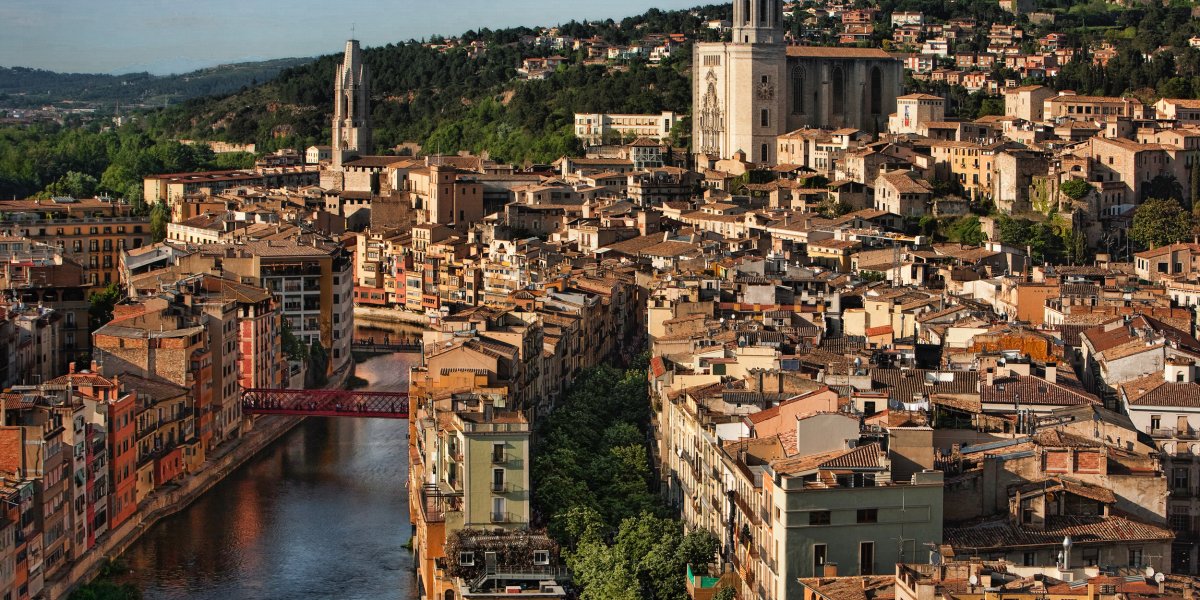
Walk one block west to the Onyar riverbank and Girona's most famous image appears — a wall of ochre, terracotta, and sky-blue houses rising straight from the water like a Catalan Cinque Terre. Cross onto the Pont de les Peixateries Velles, a slender red iron bridge built by the Eiffel company in 1877 — twelve years before they raised their tower in Paris. At its center the houses mirror perfectly in the river below, and the afternoon light turns the warm facades incandescent against the cool water. Walk slowly across all four pedestrian bridges to see how the palette shifts with every angle.
Tip: The best photo is from Pont de Sant Agustí looking south — you get both banks of colorful houses with the Cathedral tower rising in the background. On your way between bridges, stop at the Lleona sculpture on Pont de Sant Feliu and touch the stone lioness — legend says it guarantees your return to Girona. After the bridges, the Rambla de la Llibertat on the east bank has shaded terrace cafés perfect for resting until dinner.
Open in Google Maps →19:00
Food
Cross the Pont de Pedra to Plaça de la Independència — Girona's grand neoclassical square ringed by arcaded buildings — and take a table at Casa Marieta, feeding this city since 1884. The kitchen does Catalan comfort food with no shortcuts: start with the escalivada, fire-roasted peppers and eggplant drizzled in arbequina olive oil (€9), then the botifarra amb mongetes — a thick grilled Catalan sausage with slow-cooked white beans (€14), the dish every Gironí grew up eating. Budget €25-35 per person with wine. The terrace seats facing the square fill fast after 20:00, so arriving at 19:00 gets you the best spot and no wait.
Tip: Resist the string of flashy restaurants ringing the rest of the square — several are tourist-oriented with inflated prices and microwaved ingredients. Casa Marieta's longevity is not nostalgia, it is consistency. If the terrace is full, the dining room upstairs has arched windows overlooking the square and is often half-empty early in the evening. Order the crema catalana for dessert — it originated in this region, and theirs sets the standard.
Open in Google Maps →Aller au jour
09:00
Neighborhood
Begin in the labyrinth of El Call, one of the best-preserved Jewish quarters in Europe — narrow stone lanes barely wide enough for two people, where Kabbalist scholars once debated beneath the same archways you now walk through. The Centre Bonastruc ça Porta houses the Museum of Jewish History, built over the foundations of a 15th-century synagogue. At 9 AM the alleys are silent and shadow-striped, with morning light slanting through the gaps overhead — an atmosphere impossible to find once tour groups flood in after 11.
Tip: Enter through the unmarked doorway at Carrer de la Força, 8 — most visitors walk right past it. Inside, the basement level preserves the original mikveh (ritual bath); take the stairs down or you'll miss it entirely.
Open in Google Maps →10:30
Religious
From the Centre Bonastruc ça Porta, walk north along Carrer de la Força — in two minutes you emerge at the foot of the famous 86-step Baroque staircase, the same steps used as the Great Sept of Baelor in Game of Thrones. At the top waits the widest Gothic nave in the world at 22.98 meters — wider than any in France or Italy. The Treasury holds the 11th-century Tapestry of Creation, an embroidered cosmological masterpiece that alone justifies the visit. Arriving right at opening means you'll have the immense nave nearly to yourself; by noon the echo of tour groups fills the space.
Tip: Buy the combined ticket (nave + museum + cloister) at the entrance — it's only a euro or two more and the Romanesque cloister is exceptional. For the best photo of the nave's staggering scale, stand flush against the back wall and shoot straight down the center axis with a wide lens.
Open in Google Maps →12:30
Food
Descend the Cathedral steps and follow Carrer de la Força south past the Jewish Quarter, then turn right at Carrer Cort Reial — you'll spot the pintxos spread through the window within three minutes. This Basque-style pintxos bar is where Girona's office workers crowd in for a standing lunch: the counter piled high with skewered bites, each one a small work of art. Choose whatever catches your eye and the bartender tallies your toothpicks at the end — fast, social, and exactly how locals eat when hungry and short on time.
Tip: Pair a cold txakoli (Basque white wine, ~€3) with the bacalao croqueta (€2.50) and the anchovy-and-pepper gilda (€2.50). Arrive before 13:00 or you'll fight for counter space. Budget €12–18 per person.
Open in Google Maps →14:00
Landmark
Walk back up Carrer de la Força, then right on Carrer Ferran el Catòlic — the Arab Baths are a five-minute uphill stroll past the Cathedral apse, with rooftop views opening up along the way. Despite the name, this is a 12th-century Romanesque bathhouse inspired by Roman and Moorish designs, not actually Arab-built. The apodyterium — a vaulted hall with an octagonal pool ringed by slender columns beneath a natural skylight — is the most photogenic room in all of Girona. The afternoon sun filters through the central oculus and catches the steam-worn stone in warm gold.
Tip: The iconic photo is taken from the left-side doorway, shooting diagonally across the pool to catch the skylight reflection in the water. The upper-level garden terrace has a hidden view of the Cathedral apse that most visitors skip — take the stairs at the back of the building.
Open in Google Maps →15:30
Religious
Exit the baths and walk two minutes downhill along Carrer Ferran el Catòlic, then left on Pujada de Sant Feliu — the basilica's distinctive truncated bell tower appears at the bottom of the Cathedral steps. Older than the Cathedral itself, Sant Feliu was Girona's first cathedral and holds eight early Christian sarcophagi from the 3rd–4th century, still embedded in the chancel walls. The bell tower lost its spire to lightning in 1581 and was never rebuilt — a beautiful imperfection that has become the city's most recognizable silhouette.
Tip: Outside the entrance, find the Lleona de Girona — a small stone lioness climbing a column. Tradition says you must kiss the lion's rear to guarantee your return to Girona. After the visit, take the free afternoon to decompress along the river or grab an aperitif on Plaça de Sant Feliu. Avoid the overpriced terrace restaurants on Carrer de la Força near the tourist office — they charge double for half the quality that any side-street bar delivers.
Open in Google Maps →19:30
Food
From Sant Feliu, walk through Plaça de Sant Feliu and cross the Onyar via Pont de Sant Feliu — Plaça de la Independència opens up five minutes along the west bank, ringed by neoclassical arcades glowing in the evening light. Casa Marieta has occupied the same corner since 1892, making it the oldest continuously operating restaurant in Girona. The dining room feels like stepping into your Catalan grandmother's house if she had impeccable taste — linen tablecloths, tile floors, and plates of food that haven't changed in a generation because they never needed to.
Tip: Order the botifarra amb mongetes (Catalan sausage with white beans, ~€14) — it's the house signature and the definitive version in Girona. Finish with crema catalana (~€6) torched to order. Budget €25–35 with wine. Reserve for 19:30 on weekends; weekdays you can walk in. If you booked El Celler de Can Roca months ahead (2 km west), lucky you — for everyone else, Casa Marieta is where Girona's soul lives.
Open in Google Maps →09:00
Landmark
Begin at the wall entrance near Jardins dels Alemanys, a two-minute walk east from the Cathedral apse — stone steps lead up to the rampart walkway. These restored Carolingian walls date to the 9th century, raised to repel Moorish raids on the Frankish border. Walk north along the ramparts as the entire old town unfolds below — terracotta rooftops, the Cathedral spire, the Pyrenean foothills on the horizon. At 9 AM the morning light rakes across the cityscape from the east, painting every surface in warm amber, and you'll share the path with no one but swallows.
Tip: Near the Torre Gironella ruins, watch for an unmarked spiral staircase leading to a 360-degree viewpoint — it's the highest publicly accessible point in the old town. Wear proper shoes; the stone paths are uneven and slippery after rain.
Open in Google Maps →10:30
Museum
Descend the wall at the northern Porta de Sant Cristòfol and follow the Galligants stream to the right — the monastery sits across a shaded square two minutes away. This 12th-century Romanesque Benedictine monastery now houses the Archaeology Museum of Catalonia's Girona collection, but the real treasure is the cloister: double columns topped with carved capitals depicting biblical scenes, mythological beasts, and botanical motifs preserved with startling sharpness. Game of Thrones used the cloister and nave as settings in Braavos — you'll recognize them immediately.
Tip: Climb to the second-floor gallery of the cloister — it's almost always deserted and gives you an overhead view of the carved capitals without the ground-floor crowds. The small garden between the church and the river has a bench with a perfect view of the apse's Lombard bands, one of the purest Romanesque compositions in Catalonia.
Open in Google Maps →12:30
Food
Walk south through the old town along Carrer de la Força, descending toward the river — the Rambla de la Llibertat appears in ten minutes, and L'Arcada sits beneath the medieval stone arcades that give the promenade its sheltered character. Cooled by the river breeze and shaded by centuries-old arches, this is where locals grab a quick midday meal before the afternoon heat settles in. The menu leans on seasonal Catalan market cooking — simple, ingredient-driven plates that change with whatever was fresh at the Mercat del Lleó that morning.
Tip: Ask for the menú del dia (~€14–16) — it's always the best value and often includes an off-menu dish. The esqueixada (shredded salt cod salad, ~€9) is the perfect light lunch for a warm day. Sit under the arcades facing the river for the breeze. Budget €14–20.
Open in Google Maps →14:00
Museum
Cross the Pont de Pedra to the west bank and walk one block south along Carrer de la Sèquia — the Cinema Museum is on your right, a three-minute walk. Based on the extraordinary private collection of Tomàs Mallol, this museum traces the history of moving images from Chinese shadow puppets through magic lanterns to the Lumière brothers, with interactive stations where you operate 19th-century optical devices yourself. It's a cool, quiet afternoon retreat that works perfectly when your legs need a break from cobblestones — and genuinely one of the most surprising small museums in Spain.
Tip: The basement level has a recreation of a 1920s cinema projection booth with original equipment — most visitors turn around before reaching it. Allow extra time for the zoetrope and praxinoscope stations on the second floor; they're genuinely mesmerizing, not just for children.
Open in Google Maps →16:00
Neighborhood
Exit the museum and turn left — walk two minutes back toward the river to reach the Pont de les Peixateries Velles, an iron bridge built by Gustave Eiffel's company in 1877, thirteen years before his famous tower. From here the ochre, terracotta, and blue houses stacked along the east bank of the Onyar create Girona's most iconic image — and at 4 PM the afternoon sun sits behind you in the west, lighting up the painted facades at full intensity, their reflections shimmering in the water below. Then stroll south along the Rambla de la Llibertat, Girona's main promenade beneath arcaded buildings, where locals take their evening passeig.
Tip: The best photo angle is from the Pont de les Peixateries Velles itself, shooting north along the river with the houses stacked on both sides — between 16:00 and 17:00 the light is ideal. Stop at Rocambolesc (Carrer de Santa Clara, 50) for the most famous €4 scoop in Catalonia — Jordi Roca's ice cream shop with flavors like violet-blackberry and muscatel that change seasonally. Beware of souvenir shops on the Rambla selling 'handmade' ceramics at triple the price — the same pieces are available at Mercat del Lleó for far less.
Open in Google Maps →19:00
Food
The Rambla ends at Pont de Pedra — cross it and you're on Plaça de la Independència in two minutes, where the evening crowd gathers beneath neoclassical arcades as the last light catches the upper facades. Boira occupies a prime terrace spot on the square, filling with locals unwinding after work. The cooking is modern Catalan with deep market roots — seasonal vegetables treated with care, fresh fish from the Costa Brava, and rice dishes that justify their twenty-minute wait.
Tip: Order the arròs de ceps i botifarra negra (mushroom rice with black sausage, ~€16) — it's the farewell dish Girona deserves. The local Empordà wines are half the Barcelona price for the same bottle; ask for a vi negre from DO Empordà (~€4/glass). Reserve a terrace table for 19:00 to catch golden hour on the square. Budget €28–38 with wine.
Open in Google Maps →
Trip builder
Plan this trip around Girona
Turn this guide into a bookable rail itinerary with FlipEarth.
Keep exploring
Related cities
More in the same country
FAQ
Frequently asked questions
How many days do you need in Girona?
Most travelers enjoy Girona in 1 days, with enough time for headline sights and a slower meal or museum stop.
What's the best time to visit Girona?
The easiest season for most travelers is Apr-Jun, Sep-Oct, especially if you want good weather and manageable crowds.
What's the daily budget for Girona?
A practical starting point is about €60 per person per day before hotels, then adjust based on museums, dining, and transport.
What are the must-see attractions in Girona?
A good first shortlist for Girona includes Passeig de la Muralla, Cases de l'Onyar and Pont de les Peixateries Velles.