City Guide
Vicenza
Italia · Best time to visit: Apr-Oct.
Day-by-day plan
Choose your pace
Duración del viaje
09:00
Landmark
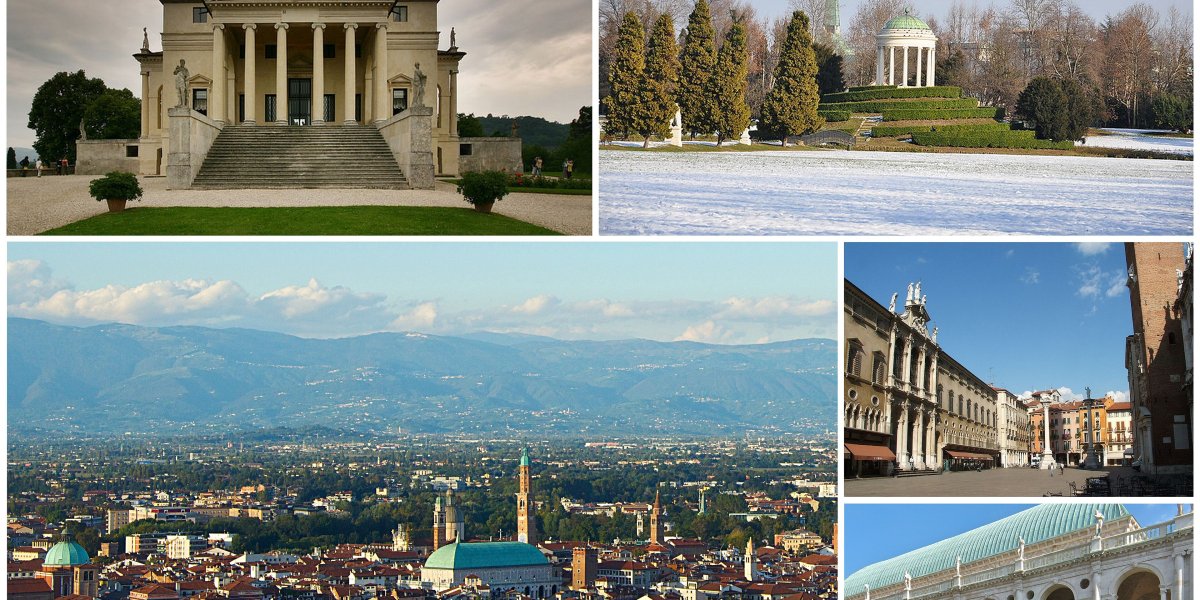
From Vicenza train station, walk 12 minutes north along Viale Roma and through the medieval gate — you arrive at Piazza Matteotti, where Palladio's two last gifts to the city face each other. Teatro Olimpico is the oldest surviving indoor theater on earth (1585), and across the square, the two-tiered façade of Palazzo Chiericati is the building that announced Palladio's genius to the world. Morning light from the east strikes both at the same angle — this is the only hour you can photograph the whole square without shadow.
Tip: Before 10 AM the square is nearly empty; stand at the corner of Contrà Santo Stefano to frame Chiericati's loggia in the foreground with the theater's brick wall behind. Skip the interior ticket on a layover day — the magic of Teatro Olimpico is best given two hours, which you don't have.
Open in Google Maps →10:30
Landmark
Walk south down Contrà Santa Corona and turn right onto Corso Andrea Palladio — Vicenza's main spine, a 700-meter open-air gallery of Palladian palaces (Palazzo Thiene, Palazzo Bonin) you'll glimpse without breaking stride. The corso opens onto Piazza dei Signori and the white-marble miracle that made Palladio's name: a Gothic medieval town hall wrapped in a perfect Roman loggia. Climb the (free, in non-exhibition periods) terrace for a rooftop sea of red tiles spreading toward the Dolomites.
Tip: Avoid Tuesday and Thursday mornings unless you love crowded markets — the piazza fills with stalls and the loggia's symmetry vanishes in tarpaulin. Best photo angle is from the foot of Torre Bissara looking up; for the postcard shot of the whole basilica, walk one block south to Piazza delle Erbe and shoot from across the canal.
Open in Google Maps →12:30
Food
Cross Piazza dei Signori and walk three minutes west along Contrà Pasini to Piazza del Duomo, where Righetti has been Vicenza's beloved self-service trattoria since 1969. You grab a tray, point at dishes, and pay at the end — locals have eaten here for two generations and the lunchtime queue is the city's most honest restaurant review. Order baccalà alla vicentina (salt cod slow-cooked in milk and onions over white polenta, €9, the regional dish), bigoli con l'arna (thick fresh pasta with duck ragù, €8), and a glass of Soave for €3.
Tip: Arrive by 12:25 sharp — Vicentini break for lunch at 1:00 and the line wraps the piazza by 12:45. The baccalà is the only dish to order; everything else is good, that one is unmissable. Cash is faster than card.
Open in Google Maps →14:00
Landmark
Walk south on Viale X Giugno, past the Giardini Salvi, then follow the quiet country road below Monte Berico — 35 minutes through olive groves and cypress hedges, a route Palladio himself walked. The villa rises on its low hill exactly as he intended: a perfect cube crowned with a dome, four identical temple façades facing the four winds. This is the most copied building on earth — Jefferson's Monticello, the White House rotunda, dozens of American plantations and European country houses all trace back to this hill.
Tip: Garden access is €5 (Tue-Sun); the interior opens only Wed and Sat afternoons in season — don't reshape your day for it, the exterior is the masterpiece. Walk the full perimeter once: the southwest façade in afternoon light is the photograph everyone tries to make, and the cypresses on the south lawn give you the foreground that makes the picture work.
Open in Google Maps →16:30
Religious
Walk back via the lane past Villa Valmarana ai Nani (admire its garden wall topped with the stone dwarves), then up the Portici di Monte Berico — a 17th-century covered staircase of 192 arches rising 700 meters to the sanctuary. 25 minutes of gentle climb and you stand on the terrace with the best panoramic view in the Veneto: the entire red-roofed historic center below, the Berici hills behind, the Dolomites on the horizon. Locals come here at dusk to walk off the day; you come for the moment the light turns the city gold.
Tip: Stand on the terrace 45 minutes before sunset — the sun drops behind the Dolomites and the entire city, every Palladian roof, glows amber for about ten minutes. The basilica interior is fine but the view is the point; don't go inside until after the light has gone.
Open in Google Maps →19:30
Food
Descend the Portici, cross Viale Eretenio and the river Retrone, then walk ten minutes north into the heart of the old town to Contrà Ponte delle Bele. The wood-paneled trattoria has been run by the same family for decades, serving the heavy alpine-Vicentine cooking the rest of Italy has forgotten — order bigoli con l'arna (duck-ragù pasta, €14) followed by baccalà alla vicentina with grilled polenta (€18), and ask for a glass of Tai Rosso, the Berici hills' own red. The kitchen takes the same dishes Righetti serves at lunch and gives them the slow, proper evening version.
Tip: Reserve one day ahead — there are barely 30 seats and the dining room fills with regulars by 8 PM. Skip dessert here (it's the weak course); walk five minutes back toward Corso Palladio to Sorarù, Vicenza's 1900s pasticceria, for a fugassa slice. Pitfall warning: avoid any restaurant on Corso Palladio advertising menus in four languages — those are tourist traps charging €25 for frozen, microwaved versions of the dishes Ponte delle Bele makes properly.
Open in Google Maps →Saltar al día
09:00
Museum
The world's oldest surviving indoor theater (1585) and Palladio's final work — Scamozzi's wooden stage set creates a forced-perspective illusion of seven streets of Thebes receding into infinity. Arriving at the 09:00 opening you'll have the auditorium nearly to yourself before the Venice coach tours descend at 11:30. Goethe sat in this room and wrote that he wept; you may understand why.
Tip: The optical illusion is only fully revealed during the multimedia projection (roughly every 30 min) when the stage lights up sequentially — sit in row 4 or 5, dead center, for the deepest perspective effect. Buy the Card Musei (€15) here rather than a single ticket; it covers four of today's other stops.
Open in Google Maps →10:45
Museum
Walk diagonally across Piazza Matteotti — 90 seconds, and you're at Palladio's 1551 aristocratic palazzo, now Vicenza's civic gallery. The ground-floor loggia is itself a textbook of Palladian proportion; the piano nobile holds Veronese, Tintoretto, and the local master Bartolomeo Montagna. The Sala del Firmamento ceiling by Domenico Brusasorzi is the room visitors miss because they're already looking at the paintings.
Tip: Walk up the staircase clockwise — the gallery is laid out chronologically that way and the painting sequence makes far more sense than the official route the docents push. Allow extra time for room VII (Veronese's Madonna of the Stars) and skip the modern wing if pressed for time.
Open in Google Maps →12:45
Food
Walk south along Corso Palladio for 4 minutes, turn right at Piazza dei Signori toward the Duomo — Righetti has been the city's most beloved self-service trattoria since 1968, the place locals come on their lunch break in suits and overalls alike. Order baccalà alla vicentina (the iconic salt-cod-and-polenta dish, €9) with a glass of Tai Bianco (€3); on Tuesdays they make bigoli con l'arna, duck-ragù pasta, that disappears by 13:30.
Tip: Arrive by 12:45 — the queue down Stradella dei Stalli forms hard by 13:15. Take a tray, point at what you want at the counter (no menus in English, just gesture), then sit in the back room which is cooler and emptier. Cash strongly preferred; they round to the euro.
Open in Google Maps →14:30
Landmark
Six-minute walk back through Piazza dei Signori — Palladio's career-launching work, the white Istrian-stone double loggia he wrapped around the old crumbling Gothic town hall in 1549 to save it. Climb directly to the rooftop terrace for the city's best panorama and the architecture-photo angle every guidebook uses. Afternoon light hits the marble at exactly the right angle from 15:00 onward; this is why we don't come here in the morning.
Tip: The terrace closes 30 minutes before the great salon below — go up first, come down second. Around 16:00 the Torre Bissara on the south side casts a clean diagonal shadow across the terrace floor; that's the photo. The terrace alone is €2; skip the paid exhibition inside unless the current show interests you specifically.
Open in Google Maps →16:30
Museum
Exit the Basilica north-west and walk 3 minutes along Contrà Porti — another Palladio palazzo, this one the actual research headquarters of the international Centro Studi Palladio. Original wooden architectural models built in Palladio's own workshop, drawings in his hand, and reconstructions of buildings he designed but never built. After a day of seeing the finished works, this is where you finally understand how he thought.
Tip: Go straight to the basement first for the 15-minute video on Palladio's brick-and-stucco construction technique (English subtitles available) — once you see how he faked marble with painted plaster, you'll spot it on every facade for the rest of your trip. Included with Card Musei.
Open in Google Maps →19:30
Food
Walk 4 minutes northwest along Contrà Porti to Contrà Ponte delle Bele — a rare and beloved Vicentino-Tyrolean hybrid kitchen, run by the same family since 1965 in a candlelit, wood-paneled room that fills with locals on anniversaries. Order stinco di maiale al forno (slow-roasted pork shank with grain mustard, €19) and open with a plate of speck and fresh horseradish (€11); the cellar's Pinot Nero from Alto Adige is the move.
Tip: Reserve 24 hours ahead — only 40 seats and Friday-Saturday they turn people away at the door. Ask for 'una tavola al piano superiore' — the upstairs timbered room is the quieter one. Pitfall warning: avoid the restaurants on Piazza dei Signori with English and Chinese menus posted outside — they sell frozen-fish baccalà at tourist prices; the real Vicentino kitchens are always one block off the square, like this one.
Open in Google Maps →09:30
Landmark
Take Bus #8 from Viale Roma (10 min) or walk south through Borgo Berga (25 min, scenic along the Bacchiglione river) — Palladio's most influential building, the perfect square with four identical Ionic porticos, completed in 1592 by his pupil Scamozzi. These are the proportions Jefferson copied for Monticello and Latrobe used for the U.S. Capitol drum. Walk a full circle around the building before entering the grounds: every facade is identical, which is exactly why he called it 'la Rotonda.'
Tip: The interior (with the frescoed central dome) is open only Wednesday, Saturday, and Sunday — if your visit falls outside those days, the exterior + gardens (€12) is still the essential experience and the cypress-framed view from the south-east corner at 10:00 is the iconic photo. Bring water; there's no café on site.
Open in Google Maps →11:15
Landmark
Walk 5 minutes east through the cypress lane connecting the two villas — a smaller, more intimate 17th-century estate famous for two things: the Tiepolo frescoes (father Giambattista and son Giandomenico, both painted here in a single summer in 1757) and the 17 stone dwarves on the garden wall that give the place its name. The Palazzina has GB's mythological scenes; the Foresteria has Domenico's carnival paintings — together, a complete shift in 18th-century taste preserved in two adjacent rooms.
Tip: Tiepolo's frescoes are luminous between 11:00 and 12:00 when soft side-window light reaches them — earlier they're dim, later the midday glare washes them out. Don't skip the Foresteria building behind the main villa — most visitors only see the Palazzina and miss Domenico's far stranger, more modern carnival cycle.
Open in Google Maps →13:00
Religious
Walk 15 minutes uphill via Via Massimo d'Azeglio and through the Portici — the 18th-century covered arcade with 150 arches that pilgrims have climbed for three centuries to reach the Madonna's hilltop basilica. The terrace in front of the church gives the postcard panorama of Vicenza spread below with the Dolomites visible on clear days. Inside, hidden in the refectory, find Veronese's 'Supper of St. Gregory the Great' (1572) — slashed by Austrian soldiers' bayonets in 1848 and painstakingly restitched.
Tip: Enter via the side door marked 'Refettorio' (not the main church) to find the Veronese — 90% of tourists miss it entirely. The terrace photo works best at 13:30 with the sun over your shoulder lighting the red rooftops below. The church is free; the refectory takes a €3 donation.
Open in Google Maps →14:30
Food
Walk 12 minutes downhill along the Portici back into the historic core, then turn into Contrà delle Morette — Vicenza's oldest osteria, founded in 1200 in a building that was originally a Malvasia-wine warehouse with the 13th-century vaulted brick ceiling still intact above your head. Order risotto all'Amarone (€14) and close with the house-made torta della nonna with pine nuts and almond cream (€6).
Tip: They stop seating lunch at 14:30 sharp — arrive by 14:20 or you'll be turned away. Ask the host for the back room ('la sala delle botti') where the original wine barrels are still mounted — it's quieter and the brickwork is older. Budget: €25-35 per person.
Open in Google Maps →16:30
Landmark
Walk 4 minutes south to Contrà Pigafetta — the late-Gothic Venetian palazzo (1481) where Antonio Pigafetta was born, the Vicentino nobleman who sailed with Magellan in 1519 and survived as one of only 18 men to complete the first circumnavigation of the globe. His chronicle is the sole eyewitness record of the voyage. Read the motto carved over the doorway — 'Il n'est rose sans espine' — then walk the full length of Corso Palladio at golden hour, palazzo by palazzo, ending at the unfinished Loggia del Capitaniato on Piazza dei Signori.
Tip: Start the walk exactly 45 minutes before sunset — the warm light bouncing off the Loggia del Capitaniato (Palladio's last work, deliberately left unfinished when his patron died in 1572) is the softest orange you'll find anywhere in the Veneto. Look up at the columns: you can see the unfinished half where the carving stops mid-block.
Open in Google Maps →19:30
Food
Five-minute walk north to Contrà Riale — a tiny temple to Vicentino traditional cooking, the kind of place locals reserve for their own birthdays. Order bigoli all'anatra (hand-rolled thick spaghetti with duck ragù, €14) and, if you're feeling brave, the bollito misto with mostarda di Cremona (€22) — yes, even in summer; this is how the Veneto does it. Marco's mother is in the kitchen and the wine list is entirely Veneto.
Tip: Reserve 48 hours ahead — eight tables only, closed Sunday and Monday. Ask the waiter for 'un Tai Rosso di Barbarano' — the indigenous Berici-hills grape, made only within 20 km of where you're sitting and almost never exported. Pitfall warning: never accept a 'menu turistico' in any Vicenza restaurant — it's invariably yesterday's leftovers at tomorrow's price; order à la carte even if it's just one pasta and a glass of wine, you'll eat far better and pay nearly the same.
Open in Google Maps →
Trip builder
Plan this trip around Vicenza
Turn this guide into a bookable rail itinerary with FlipEarth.
Keep exploring
Related cities
More in the same country
FAQ
Frequently asked questions
How many days do you need in Vicenza?
Most travelers enjoy Vicenza in 1 days, with enough time for headline sights and a slower meal or museum stop.
What's the best time to visit Vicenza?
The easiest season for most travelers is Apr-Oct, especially if you want good weather and manageable crowds.
What's the daily budget for Vicenza?
A practical starting point is about €90 per person per day before hotels, then adjust based on museums, dining, and transport.
What are the must-see attractions in Vicenza?
A good first shortlist for Vicenza includes Teatro Olimpico & Palazzo Chiericati, Basilica Palladiana & Piazza dei Signori, Villa La Rotonda.