City Guide
Aarhus
Dinamarca · Best time to visit: May-Sep.
Day-by-day plan
Choose your pace
Duración del viaje
10:00
Landmark
From Aarhus station, walk northwest along Viborgvej for 15 minutes — the Botanical Garden flanks your right as city noise fades into birdsong. Seventy-five heritage buildings have been dismantled across Denmark and reassembled here into cobblestone streets spanning four centuries of daily life: a merchant's manor, a working bakery, an apothecary with original glass jars. No display cases, no velvet ropes — the entire town is the exhibit. Wander the 1864 quarter for rose-covered half-timbered houses, then cut through the 1927 jazz-age district before exiting south toward the city centre.
Tip: Enter at the Viborgvej gate and turn right immediately into the 1864 quarter — the yellow half-timbered houses with climbing roses are the most photogenic stretch, and at opening you'll have the lane to yourself for a full 20 minutes. Exit through the south gate to keep your route linear toward ARoS.
Open in Google Maps →11:30
Landmark
Exit Den Gamle By's south gate and walk east along Vester Allé for 8 minutes — the massive red-brick cube of ARoS rises ahead with its rainbow halo already visible against the sky. Olafur Eliasson's 150-metre circular skywalk wraps the rooftop in a continuous spectrum of coloured glass. Buy a ticket at the ground floor, skip the galleries entirely, and take the elevator to the 10th floor then stairs to the roof. Aarhus unfolds below — the harbour, the cathedral spire, the forests to the south — all shifting through rose, amber, chartreuse, and cyan as you complete the loop.
Tip: Walk counter-clockwise — the warm-spectrum panes (red through yellow) face east and catch late-morning light most intensely. Before noon the walkway is nearly empty. Stand in the deep-blue section facing west for the best silhouette portrait with the city behind you.
Open in Google Maps →12:30
Food
Leave ARoS from the main entrance and walk northeast downhill through the pedestrian shopping streets — 10 minutes into the Latin Quarter, where Klostergade's cobblestones announce a different pace. A neighbourhood fixture since 1984 with mismatched furniture and local art on the walls, this is where Aarhus University professors come for weekend lunch. Order the loaded club sandwich with Danish cheese (DKK 135 / €19) or the classic smørrebrød with pickled herring on rye (DKK 95 / €13), washed down with a draught from local Aarhus Bryghus. Budget €12–20 per person.
Tip: Grab a seat in the hidden back courtyard if the weather allows — it's invisible from the street and feels like a private garden. No reservation needed before 12:30; after that, expect a short wait for the outdoor tables.
Open in Google Maps →13:15
Neighborhood
Step out of Smagløs and you're already in the thick of it — Klostergade unfurls into a grid of narrow lanes lined with independent bookshops, ceramic studios, and century-old facades. Walk north along Guldsmedgade, then detour one block east into Møllestien — a hidden lane of pastel 18th-century cottages draped in roses, the single most photographed street in Aarhus. Loop south to Aarhus Domkirke: at 93 metres it is Denmark's longest church, its red-brick Gothic tower commanding the old-town skyline since the 1200s. The broad square in front, Store Torv, opens the view toward the harbour — your next destination.
Tip: Møllestien runs roughly east-west — afternoon sun illuminates the pastel facades perfectly and warms the rose blooms for close-up shots. The lane takes five minutes end to end. At the cathedral, walk around to the south side for the best angle of the full tower framed against open sky.
Open in Google Maps →15:00
Landmark
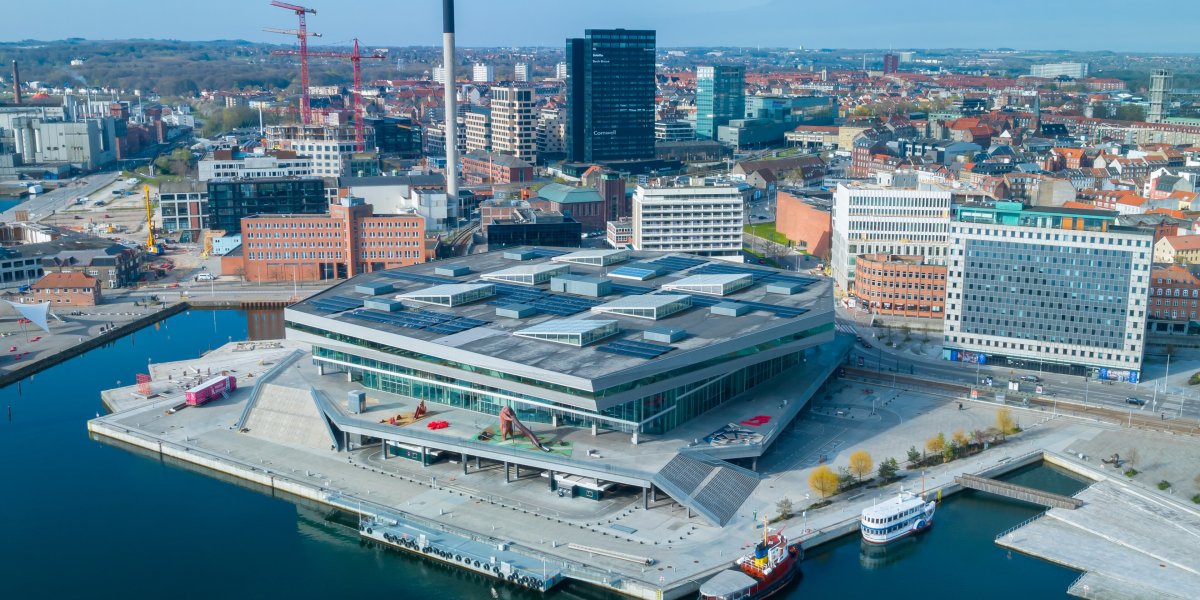
From the cathedral, walk south across Store Torv and through Immervad — the medieval streets open to the waterfront in 10 minutes, and the angular glass prow of Dokk1 announces a completely different Aarhus. This award-winning library building cantilevers over the harbour like a ship's hull; walk through its ground-floor public plaza for a perfectly framed panorama of the bay. Continue east along the harbour promenade, past the open-air swimming jetties, into Aarhus Ø where Isbjerget rises — a cluster of angular white residential towers that looks like a glacier calving into the sea. The promenade is flat and wide, a welcome ease for tired legs.
Tip: The best photo angle of Isbjerget is from the wooden pier directly south of the buildings — angular white facades against the water with sailing boats in the foreground. Afternoon light from the west gives the surfaces a warm glow that earns the 'iceberg' name. Allow 20 minutes for the walk out to Isbjerget and back.
Open in Google Maps →17:00
Food
From the harbour promenade, walk southwest through Badstuegade toward the city centre — 12 minutes to Skolegade, where Teater Bodega's warm windows glow directly across from the Aarhus Theatre. This is your natural path back to the train station, which sits five minutes beyond. Aarhus's most storied restaurant has occupied this corner since the early 1900s, and the menu is unashamed Danish comfort. Their stegt flæsk med persillesovs — crispy pork belly with parsley sauce (DKK 175 / €25) — is the national dish done to perfection, and the three-piece smørrebrød platter (DKK 195 / €28) lets you taste classic open-faced sandwiches in one sitting. Dark wood, candlelight, draught beer, zero pretension. Budget €25–35 per person.
Tip: Ask for a window table facing the illuminated Aarhus Theatre — it turns dinner into a scene. Arrive by 17:00 and you'll walk straight in; by 18:00 the after-work crowd claims every seat. One warning for the day: the restaurants lining Store Torv and Åboulevarden charge tourist premiums behind pretty facades — Teater Bodega is where the theatre actors across the street actually eat.
Open in Google Maps →Saltar al día
10:00
Museum
From the city center, walk west along Vester Allé — the cubist red-brick museum announces itself from three blocks away, a 10-minute stroll. Olafur Eliasson's Your Rainbow Panorama wraps around the rooftop: a 150-meter circular walkway in every color of the spectrum, framing Aarhus's skyline through tinted glass. On the ground floor, Ron Mueck's five-meter crouching Boy is so lifelike it stops every visitor mid-step.
Tip: Head straight to the rooftop the moment you enter — by 10:30 selfie queues form in the red and orange sections. The best photograph is from the blue-violet segment facing west, where harbor cranes and sky merge through the glass. Closed Mondays; on Wednesdays ARoS stays open until 22:00 and the rainbow at sunset is unforgettable.
Open in Google Maps →12:15
Food
Exit ARoS and walk east along Vester Allé, then turn right into Søndergade — the cobblestone pedestrian street leads you past buskers and shopfronts for 10 minutes straight to Bispetorvet square. Café Faust occupies a handsome vaulted room on the square, directly facing the Cathedral. Try the pickled herring smørrebrød (89 DKK/€12) or the stegt flæsk with parsley sauce and potatoes (139 DKK/€19) — honest, classic Danish lunch.
Tip: Arrive before 12:30 to beat the office-worker rush and grab a window seat facing the Cathedral. The herring smørrebrød is the one dish that tastes exactly like Denmark is supposed to — rye bread, pickled onion, capers, the works. Budget 100-150 DKK for a full lunch with coffee.
Open in Google Maps →13:30
Religious
Step directly across Bispetorvet from the café — the Cathedral entrance is less than a minute away. At 93 meters, this is Denmark's longest and tallest church, its whitewashed Gothic nave stretching further than you expect. Medieval frescoes on the walls were painted over during the Reformation and only rediscovered in the 1800s — saints, ships, and sea monsters emerge from the plaster in faded ochre and blue.
Tip: Look up for the model ship hanging from the ceiling — a centuries-old Danish tradition where churches hang ship models as prayers for sailors at sea. The frescoes in the Chapel of Our Lady behind the main altar are the most intact; head there first, as the rest of the nave is comparatively bare.
Open in Google Maps →14:30
Neighborhood
Exit the Cathedral's north door and cross Store Torv — within two blocks you are in Aarhus's oldest neighborhood. Narrow cobblestone streets wind between half-timbered houses now home to independent boutiques, ceramics studios, and vinyl record shops. Mejlgade and Volden are the main arteries; afternoon light slanting between the rooflines turns every alley golden.
Tip: For the best coffee in Aarhus, find La Cabra in the Latin Quarter — the specialty roaster that put this city on the global coffee map. Their flat white alone is worth the detour and costs half what you would pay in Copenhagen.
Open in Google Maps →16:00
Neighborhood
From the northern end of the Latin Quarter, follow Graven street northeast for five minutes — the road narrows and suddenly you are on the most photographed street in Aarhus. A single row of tiny, brightly painted half-timbered cottages from the 1700s lines a cobblestone lane barely wide enough for two people. In summer, climbing roses and hollyhocks spill over every fence in a riot of color.
Tip: Shoot from the eastern end looking west — at 16:00 the light turns the yellow and rose-colored walls golden. The street is residential, so keep your voice down and stay on the lane. If the hollyhocks are blooming (June through August), you have the most Instagrammed frame in all of Jutland.
Open in Google Maps →19:00
Food
Walk south from Møllestien back through the center, crossing Søndergade toward Frederiks Allé — a tree-lined boulevard 15 minutes on foot. Hærværk is a candlelit wine bar and kitchen whose name means vandalism, a nod to its rule-breaking approach to Nordic small plates. The menu changes weekly: expect dishes like smoked beetroot with whey and hazelnuts (95 DKK/€13) or dry-aged pork with fermented cabbage (145 DKK/€19), paired with natural wines from small European growers.
Tip: Reserve at least a day ahead — there are roughly 30 seats and word has spread. Let the staff pick your wine pairing; they know every bottle personally. Avoid the generic pizza-and-kebab joints clustered around Park Allé near the bus station — they survive on tourist foot traffic and charge Copenhagen prices for microwaved food.
Open in Google Maps →10:00
Museum
From the center, walk northwest along Vestergade then turn onto Viborgvej — 15 minutes through quiet residential streets bring you to the timbered entrance gate. Den Gamle By is an open-air museum of more than 75 original buildings transplanted from across Denmark, arranged into three eras: a merchant town of the 1700s, a provincial town of the 1900s, and a neighborhood frozen in 1974. At opening the cobblestone lanes are nearly empty — peer into the apothecary, the bookbinder's workshop, and the mayor's parlor in near-silence.
Tip: Most visitors skip the 1974 neighborhood on the north side, but it is the most unexpectedly moving section — an uncannily preserved flat with orange wallpaper, analog television, and coffee cups as if someone just stepped out. The bakery in the 1864 district sells rolls from a 19th-century recipe; grab one warm.
Open in Google Maps →12:15
Park
Exit Den Gamle By through the east gate and you step directly into the Botanical Garden — the two flow into each other seamlessly. The garden drapes across a steep hillside ravine with winding paths through Scandinavian wildflowers, medicinal herbs, and a domed tropical greenhouse filled with palms and orchids. At midday the light falls through the greenhouse glass at its warmest angle.
Tip: The greenhouse dome is the highlight — free entry, humid and fragrant, a welcome contrast to the Danish air outside. Follow the steep path downhill through the ravine for a canopy view from above; most visitors loop the flat paths at the top and miss the lower gorge entirely.
Open in Google Maps →13:15
Food
Walk downhill from the garden toward the river — in 10 minutes you reach Åboulevarden, the riverside dining strip where locals claim the outdoor terraces at the first sign of sun. Ferdinand is a well-loved brasserie with a terrace on the water, serving honest Danish fare. Go for the smørrebrød platter with three toppings (119 DKK/€16) or their club sandwich with hand-cut fries (129 DKK/€17).
Tip: Sit on the canal-side terrace if the weather allows — this stretch of the river is where Aarhus feels most like itself. Order a draft Mikkeller; it is brewed across the Øresund and costs half what it would in Copenhagen. Budget 100-140 DKK for lunch.
Open in Google Maps →14:30
Landmark
Walk east from Åboulevarden toward the harbor — Dokk1's angular glass-and-steel silhouette appears after 10 minutes. Scandinavia's largest public library functions more like a living room for the city: open staircases, harbor-view reading lounges, and a ground-floor art installation that strikes a resonant gong every time a baby is born at the nearby university hospital. The architecture alone — a vast cantilevered polygon hovering above the waterfront — is worth the visit.
Tip: Take the escalator to the top floor and walk onto the harbor-side terrace for a panoramic view across the water to Aarhus Ø — this is your preview of the next stop. The automated book-sorting machine on the ground floor is oddly mesmerizing; give it a minute.
Open in Google Maps →15:45
Neighborhood
Exit Dokk1 and follow the harbor promenade east — a flat, 12-minute waterfront walk past sailboats and kayakers leads into Aarhus Ø, the city's bold new harbor district. The Iceberg residential building juts from the quay in angular white blocks like a fractured glacier, the most striking piece of modern architecture in Denmark outside Copenhagen. Wander the quays, watch the boats, and if it is summer, locals will be swimming right off the docks at the harbor bath.
Tip: The best angle for The Iceberg is from the southern quay looking north — the zigzag roofline reads most dramatically against the sky. The harbor bath is free and open June through September; bring a towel for a late-afternoon dip in surprisingly clean seawater.
Open in Google Maps →19:00
Food
Walk back west from Aarhus Ø along the harbor, then through the center toward Frederiks Allé — 20 minutes at an easy pace with the evening light gilding the water behind you. Substans is an intimate Nordic restaurant that builds its menu around whatever arrived from Jutland farms that morning. A four-course dinner (395 DKK/€53) might feature Limfjord oysters, slow-roasted root vegetables with brown butter, and a sea-buckthorn dessert, all paired with natural wines from small producers.
Tip: Reserve at least two days ahead — there are only about 30 seats and weekend tables vanish fast. Let the kitchen choose your courses if offered; the surprise menu is how the regulars eat. Skip the souvenir shops around the harbor charging tourist prices for generic Scandinavian design — the real finds are in the Latin Quarter's independent studios.
Open in Google Maps →
Trip builder
Plan this trip around Aarhus
Turn this guide into a bookable rail itinerary with FlipEarth.
Keep exploring
Related cities
More in the same country
FAQ
Frequently asked questions
How many days do you need in Aarhus?
Most travelers enjoy Aarhus in 1 days, with enough time for headline sights and a slower meal or museum stop.
What's the best time to visit Aarhus?
The easiest season for most travelers is May-Sep, especially if you want good weather and manageable crowds.
What's the daily budget for Aarhus?
A practical starting point is about €100 per person per day before hotels, then adjust based on museums, dining, and transport.
What are the must-see attractions in Aarhus?
A good first shortlist for Aarhus includes Den Gamle By, ARoS Aarhus Art Museum — Your Rainbow Panorama, Aarhus Harbour and Dokk1.