City Guide
Salerno
Italia · Best time to visit: Apr-Oct.
Day-by-day plan
Choose your pace
Duración del viaje
09:00
Religious
From Piazza Vittorio Veneto at the train station, walk eight minutes up Via Roma into the old town until the lion-flanked staircase of the cathedral atrium rises in front of you. Arrive just as the 11th-century bronze doors — cast in Constantinople and shipped home by a wealthy Salernitano in 1099 — are pulled open for the morning. The Quadriportico, a colonnaded courtyard of 28 spolia Roman columns lifted from nearby Paestum, holds a deep slanting shadow at this hour that no afternoon visitor will ever see.
Tip: Slip through the small door beneath the campanile into the crypt — Saint Matthew's relics rest under a Baroque marble explosion of cherubs and inlaid stone, and you will almost certainly have the room to yourself before 10:00. Skip the 'official photographer' at the atrium gate; the columns photograph cleanest from the southwest corner with the bell tower framed top-right.
Open in Google Maps →11:00
Park
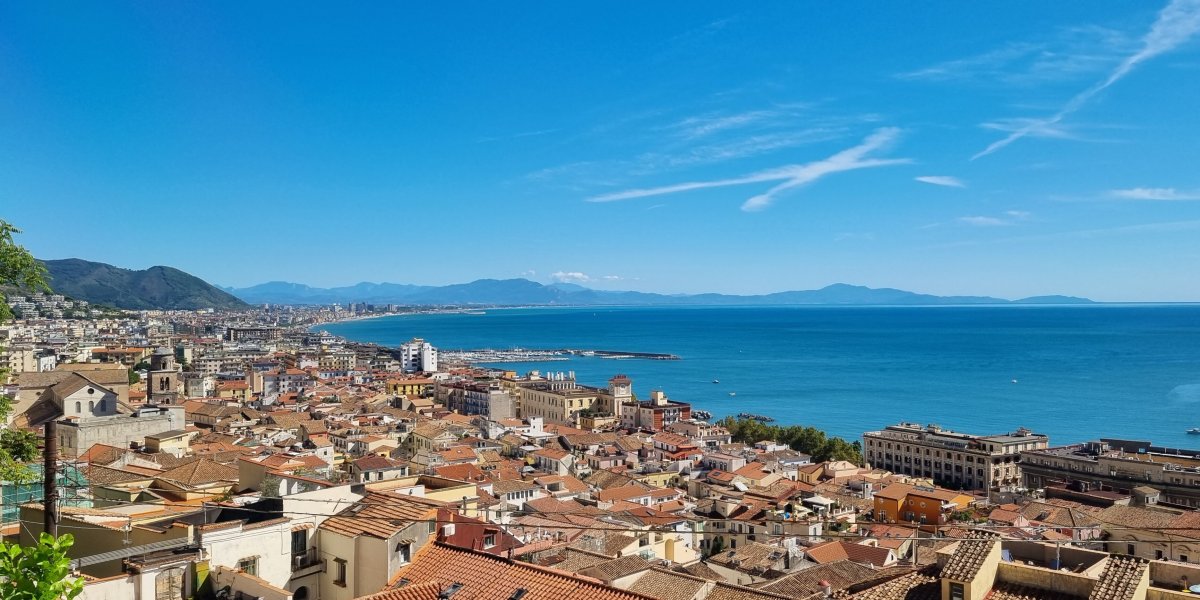
Exit the atrium under the campanile and climb Via Trotula de Ruggiero for five minutes — the narrow basalt lane named after Salerno's 11th-century female physician who taught at the Schola Medica Salernitana. This is the first medicinal garden in the Western world: in 1300 the master Matteo Silvatico planted these five terraces with the same herbs his students later pressed into theriacs and decoctions. Each level steps higher up the hillside, opening a wider blue slice of the Gulf of Salerno behind your shoulder.
Tip: Climb to the very top pergola — wisteria in spring, grape leaves in autumn — for the postcard frame: cathedral dome, terracotta roofs, gulf, Amalfi headlands, all stacked in one shot. The on-site tisaneria pours a €2 cup of the same medicinal infusions Matteo taught; ask for the 'tisana digestiva' and drink it on the upper bench, not at the indoor table.
Open in Google Maps →13:00
Food
Walk back down through the garden gate and turn west onto Via dei Mercanti — the medieval spine of Salerno, paved in basalt and lined with palazzi whose carved doorways have outlasted six earthquakes. At number 75 sits Pasticceria Pantaleone, run by the same family since 1868. Eat standing at the marble counter with the lawyers and notaries on their lunch break: one Scazzetta del Cardinale (the house's red-domed sponge with strawberry liqueur and Chantilly, €4), one warm Sfogliatella riccia (€3.50), and a caffè at the bar (€1.20).
Tip: Never sit at a table here — the table surcharge nearly doubles your bill. The locals' move: stand at the marble bar, finish in fifteen minutes, then walk out with a paper-wrapped cuoppo of fried polenta and zucchini blossoms (€5) for the climb to the castle. The Scazzetta is non-negotiable; it was invented for Cardinal Marini in 1953 and exists nowhere else in Italy.
Open in Google Maps →14:30
Landmark
From Piazza XXIV Maggio at the western end of Via dei Mercanti, board the orange Bus 19 (€1.30, every 30 minutes) up the switchbacks of Monte Bonadies — 263 meters of altitude in twenty minutes through olive groves and broom flower. The Lombard prince Arechi II moved his court inside these walls in AD 774 after Charlemagne pressed in from the north, and the curtain walls have held this exact horizon ever since. The viewing terrace fronts a 270-degree arc from the Cilento peninsula on the right, across the Amalfi mountains, all the way to Vesuvius smudged on the northern horizon.
Tip: Skip the small interior museum — the entire reason to be up here is outside the walls. Walk the ramparts clockwise to the northwest tower; it is the only spot where the Cilento, the Bay of Salerno, and the Lattari Mountains compose into one frame. The castle café charges €4 for a bottle of water — fill up at the public fountain by the parking lot before you enter.
Open in Google Maps →17:30
Neighborhood
Skip the return bus and walk the descent on foot — Via Croce and Via dei Principati drop you three kilometers through pine shade and olive terraces, with the sea rising into view at every switchback. At the bottom, the palm-lined Lungomare Trieste runs nearly two kilometers along the gulf, regularly cited as one of the prettiest urban seafronts in Europe. Turn east and walk with the sun behind you: the light paints the Amalfi headlands rose-gold around 18:30 in summer and 17:00 in autumn, and the Cilento mountains glow violet on the opposite arc.
Tip: The Stazione Marittima at the west end of the promenade is Zaha Hadid's final completed Italian work — a low white concrete oyster that looks like it is breathing. Photograph it from the breakwater opposite (Molo Manfredi) at golden hour, not from the front entrance: the curve only reveals itself in profile, and almost no tourist knows to cross over for the angle.
Open in Google Maps →20:00
Food
Leave the promenade at Piazza della Concordia and climb Via Roma north for five minutes back into the old town's lamplit lanes. Hosteria Il Brigante hides behind a wooden door on Via Linguiti 4 — Cilento home cooking, no printed menu, the owner reciting the night's dishes table by table beneath strings of dried peperoncini. Order the Acquasale (Cilento peasant bread soup with tomato, oregano, and olive oil, €7), the Pasta al ragù della nonna (€10), and the Polpette di sua mamma (his mother's meatballs in slow-cooked tomato, €9). House Aglianico arrives in a half-liter clay jug for €6.
Tip: Reserve by phone before 19:00 — the room holds sixteen seats and locals book the same evening; walk-ins after 20:30 are turned away. Bring cash; no cards accepted. Final Salerno warning: every pizzeria directly facing Lungomare Trieste with a multilingual photo menu and a 'turisti benvenuti' chalkboard charges roughly double for noticeably worse food, and the marina-front 'fresh fish' displays are often defrosted — every restaurant worth your money in this city is in the alleys at least one block behind the seafront.
Open in Google Maps →
Trip builder
Plan this trip around Salerno
Turn this guide into a bookable rail itinerary with FlipEarth.
Keep exploring
Related cities
More in the same country
FAQ
Frequently asked questions
How many days do you need in Salerno?
Most travelers enjoy Salerno in 1 days, with enough time for headline sights and a slower meal or museum stop.
What's the best time to visit Salerno?
The easiest season for most travelers is Apr-Oct, especially if you want good weather and manageable crowds.
What's the daily budget for Salerno?
A practical starting point is about €70 per person per day before hotels, then adjust based on museums, dining, and transport.
What are the must-see attractions in Salerno?
A good first shortlist for Salerno includes Castello di Arechi.