City Guide
Mantua
Italia · Best time to visit: Apr-Oct.
Day-by-day plan
Choose your pace
Duración del viaje
09:00
Landmark
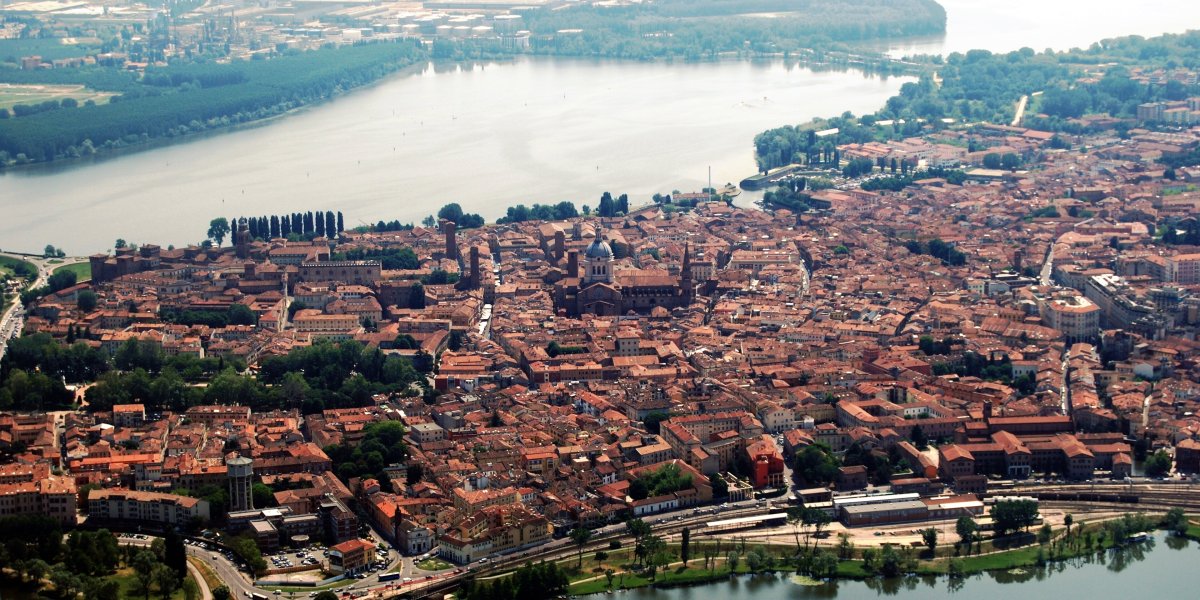
Begin at the cathedral end of Piazza Sordello and let the scale of the Palazzo Ducale sink in — Europe's third-largest palace, a 35,000 m² brick city-within-a-city built across four centuries of Gonzaga rule. You won't go inside today, but walk the full perimeter clockwise to feel its weight, then continue east across Ponte San Giorgio for Mantua's defining image: the silhouette of towers, domes and crenellated walls floating in reverse on Lago di Mezzo, as if Mantegna had painted the city directly onto the water.
Tip: Cross Ponte San Giorgio before 10:00 while the eastern sun lights the lakeside façade head-on and the water is still glass. Stand at the bridge's exact midpoint looking back west toward the Castello di San Giorgio — that is the postcard angle every Renaissance traveler has photographed for two centuries, and after 10:30 the breeze breaks the mirror and tour boats start cutting wakes across it.
Open in Google Maps →11:00
Religious
From the Palazzo Ducale's south flank, slip through the Voltone di San Pietro — a covered medieval passage that empties straight onto Piazza Mantegna in five minutes. Three of Mantua's defining buildings face each other inside a 200-metre radius: Alberti's Basilica di Sant'Andrea (1472), whose triumphal-arch façade reinvented the Renaissance church and shelters a relic said to be the Blood of Christ; the half-sunken Rotonda di San Lorenzo (11th century), excavated only in 1908 after centuries buried beneath houses; and the 13th-century clock tower presiding over Piazza delle Erbe's market arcades.
Tip: Step into the Rotonda — entry is free, the visit takes 5 minutes, and most tourists walk past without noticing the door is open; its raw unrestored brick interior is unlike anything else you'll see today. Then sit on its stone steps to frame Sant'Andrea's façade with the clock tower behind it: between 11:00 and 12:00 the south light rakes Alberti's brick at its richest. Ignore the horse-drawn carriages waiting on the square — they overcharge wildly and add nothing you can't see on foot.
Open in Google Maps →12:30
Food
Two doors down from the Rotonda, the bottle-green wooden façade of Pasticceria Caravatti has watched over Piazza delle Erbe since 1865, and Mantovani still arrive at noon for the same ritual at the marble counter. Order the Americano alla Caravatti (€6) — the bitter copper-coloured cocktail this café claims to have invented in the 19th century — paired with a wedge of sbrisolona (€4), the crumbly almond-and-cornmeal cake that is Mantua's signature pastry. For a more filling bite, ask the staff to heat a tramezzino from the deli case (€4-5). Budget €15 for the full Mantuan ritual, standing up, and you're back on the cobbles in thirty minutes, fed and faintly buzzing.
Tip: Stand at the bar, don't sit — table service nearly doubles the price and the whole point is the counter itself, the same marble Verdi reportedly leaned on during his trips to Mantua. Caravatti sells whole sbrisolone in beautiful wooden boxes for €12-18, which travels home in a suitcase better than any fridge magnet and is the one Mantua souvenir worth carrying.
Open in Google Maps →13:30
Landmark
Leave Piazza delle Erbe heading south along Via Roma into Via Acerbi — the historic Gonzaga axis that once linked the court to the Te pleasure villa, lined with quiet shuttered palazzi few day-trippers reach. After fifteen minutes you arrive at Andrea Mantegna's own house, a stark cube of brick wrapped around a perfectly circular inner courtyard the painter designed for himself in 1476. Directly across the road stands Alberti's Tempio di San Sebastiano (begun 1460), a radical Greek-cross church whose centrally-planned geometry quietly fathered every Renaissance dome that followed.
Tip: Step through the open gate of Casa del Mantegna into the inner courtyard — it's free, and the interplay of a perfect circle inscribed in a perfect square (Mantegna's mathematical obsession) is only legible from inside; from the street the building looks like nothing. Look straight up through the open oculus — that is the exact same compositional trick Mantegna painted on the Camera degli Sposi ceiling, which is the closest you'll get to that masterpiece today without a Palazzo Ducale ticket.
Open in Google Maps →15:00
Landmark
Cross Viale Te and Palazzo Te appears two minutes south, sprawling across the lawns of what was once a marshy island. Approach from the Esedra side first — the long curving colonnade comes into view like a stage set Giulio Romano deliberately built onto the wrong building. You're skipping the Sala dei Giganti inside, but the exterior is the real treatise: a Mannerist façade where keystones slip downward, triglyphs drop out of the frieze, and every classical rule Romano had codified under Raphael gets broken with a wink. After an hour walking the perimeter and the Esedra, head back to the centre via Viale Mincio onto the Lungolago dei Gonzaga path along Lago Inferiore — a 30-minute waterside walk that gives you the Mantua skyline from outside-in, exactly the view 16th-century travellers had as they arrived.
Tip: The Esedra and the full outer perimeter of Palazzo Te are publicly accessible without a ticket — circle in from the Piazzale Veneto side rather than the museum entrance. Time your loop for 16:30, when the low western sun rakes across the rusticated stone and throws the Doric columns into deep theatrical shadow — this is the hour photographers wait for, and the tour buses are already pulling out. There is no café or fountain inside the grounds, so refill your water in the centre before walking south.
Open in Google Maps →19:30
Food
From the Lungolago, cut west into the centro storico — Trattoria Ochina Bianca sits on Via Finzi just north of Piazza Sordello, a five-minute walk behind an easy-to-miss wooden door. This is where Mantovani actually eat their tortelli di zucca: the pumpkin filling balanced with amaretto crumb, mostarda mantovana and aged Parmigiano (€14), the recipe set in the 16th-century Gonzaga kitchens and barely retouched since. Pair it with risotto alla pilota with crumbled salsiccia (€16), the second dish you cannot leave Mantua without trying, and a glass of Lambrusco Mantovano Secco from the producer list. Budget €40-50 per person for two courses, wine and water.
Tip: Reserve the same morning — the dining room has eight tables and locals fill them by 19:45. Finish with a wedge of sbrisolona broken by hand (the rule is never cut it with a knife) and a small glass of grappa di Recioto: that is the Mantuan night-cap ritual and most tourists never ask for it. Pitfall warning: avoid every restaurant advertising tortelli directly on Piazza Sordello, Piazza delle Erbe and around the Castello — almost all are tourist traps charging €22-25 for a frozen mass-market version that has nothing to do with the real dish. The Mantua rule is simple: if there's a menu in five languages outside, walk on.
Open in Google Maps →
Trip builder
Plan this trip around Mantua
Turn this guide into a bookable rail itinerary with FlipEarth.
Keep exploring
Related cities
More in the same country
FAQ
Frequently asked questions
How many days do you need in Mantua?
Most travelers enjoy Mantua in 1 days, with enough time for headline sights and a slower meal or museum stop.
What's the best time to visit Mantua?
The easiest season for most travelers is Apr-Oct, especially if you want good weather and manageable crowds.
What's the daily budget for Mantua?
A practical starting point is about €120 per person per day before hotels, then adjust based on museums, dining, and transport.
What are the must-see attractions in Mantua?
A good first shortlist for Mantua includes Piazza Sordello, Palazzo Ducale Exterior & Ponte San Giorgio, Casa del Mantegna & Tempio di San Sebastiano, Palazzo Te Exterior & Lungolago Walk Back.