City Guide
Ferrara
Italia · Best time to visit: Apr-Oct.
Day-by-day plan
Choose your pace
Duración del viaje
09:00
Landmark
From Ferrara station, walk 15 minutes east down Viale Cavour into the Addizione Erculea — the urban expansion Biagio Rossetti drew in 1492 and the world's first planned modern district. At 9 am the rising eastern sun rakes across the 8,500 marble pyramids of the facade and every diamond casts its own shadow; by 10 the wall flattens out. Skip the gallery inside — the building itself is the masterpiece, and the piazza is empty before tour buses arrive.
Tip: Stand at the exact corner of Corso Ercole I d'Este and Corso Rossetti — it's the only spot in the city where two diamond-faceted facades meet at a single right angle, a perspective joke Rossetti planted to mark the heart of his grid.
Open in Google Maps →10:30
Landmark
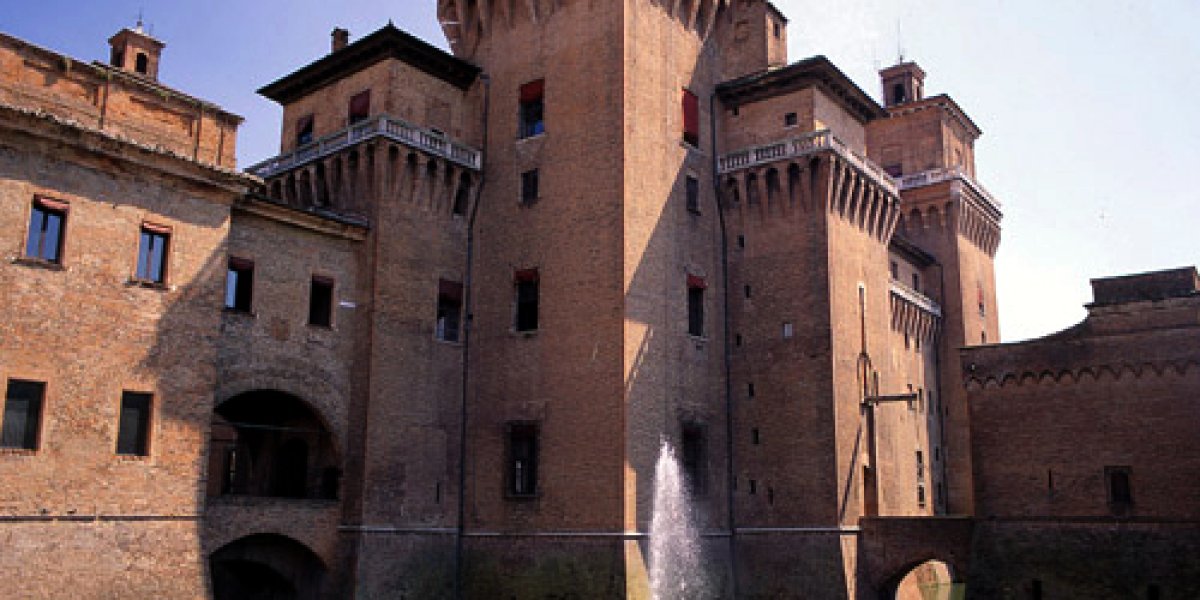
Walk south down Corso Ercole I d'Este, Rossetti's perfectly straight Renaissance arrow of a street, for 8 minutes — and the four-towered red-brick fortress rises straight out of its green moat. Cross the wooden drawbridge into the courtyard, then circle the entire castle at moat level: the brick reflects in the water, carriage horses still pass twice an hour, and you'll see why the Este dukes ruled this city for 300 years. Don't go inside; the silhouette from outside is the whole point.
Tip: Cross to the northwest corner of the moat near the Coffee House Estense — that single angle gives you all four towers stacked behind a single drawbridge, the postcard shot. Late morning sun sits overhead so the towers don't backlight.
Open in Google Maps →12:00
Food
Walk 4 minutes south behind the cathedral apse through narrow Via degli Adelardi to the door of the world's oldest documented osteria — pouring wine continuously since 1435, where Copernicus, Cellini and Tasso all drank. Order one plate of cappellacci di zucca al ragù (€12) and a glass of Bosco Eliceo white from the nearby Po delta sands (€5); skip the menu, ask for exactly that. Tell the waiter you have a train and they will turn the table in 45 minutes.
Tip: Sit at the standing wine counter inside rather than the outdoor tables — service is twice as fast and you face the original 15th-century brick wall with bottles racked straight into the masonry. Avoid ordering a full secondo here; do that at dinner.
Open in Google Maps →13:30
Neighborhood
Step out of the osteria and you are already in Piazza Trento e Trieste, the cathedral's striped Romanesque-Gothic facade rising in front of you — three tiers of marble arcades stacked like a wedding cake. Photograph it from the south side of the square, then duck down Via San Romano into Via delle Volte: an 800-meter medieval canyon of low brick arches that once linked the river warehouses to the merchant houses above. At 2 pm the sun cuts through every arch in sequence, and this is the photograph you came to Ferrara to take.
Tip: Walk Via delle Volte from east to west — only that direction frames a clean receding perspective of the arches without backlight. Pause at number 25, Casa di Stella dell'Assassino, the single 13th-century house on the street that survived intact.
Open in Google Maps →15:30
Park
From the western end of Via delle Volte, walk 10 minutes east along Via Borgo di Sotto to the southeastern rampart at Porta Paola, then climb the grass slope onto the wall itself — the only fully intact 9 km Renaissance wall circuit in Europe. Walk the eastern stretch counter-clockwise toward Porta degli Angeli (about 4 km, 75 minutes) along a green corridor of 400-year-old oaks where locals jog and walk dogs 12 meters above the city. Late afternoon light turns the brick coral pink and you'll understand why Ferrara invented urban planning.
Tip: Rent a bike at Pirani e Bagni just inside Porta Paola (€3/hour, cash only) — the full 9 km loop takes 50 minutes pedaling and is the only way to grasp the entire grid plan. Re-enter the city through Porta degli Angeli, the gate Lucrezia Borgia rode through in 1502 to marry Alfonso d'Este.
Open in Google Maps →19:30
Food
From Porta degli Angeli, walk 15 minutes southwest into the Jewish Ghetto along Via Mazzini — the quarter Giorgio Bassani turned into literature in The Garden of the Finzi-Continis. Da Noemi sits on Via Ragno with eight tables and a grandmother still rolling cappellacci by hand in the back kitchen. Order the pasticcio di maccheroni (€14) — the Este court's pastry-wrapped pasta that Stendhal called the eighth wonder of dining — and the salama da sugo on mashed potato (€16), Ferrara's iconic dense pork sausage cooked six hours. Two courses with wine, around €45.
Tip: Reserve 24 hours ahead by phone — they keep only eight tables and turn no one away who booked. Closed Mondays. Pitfall: avoid any restaurant on Via Mazzini with English-language sandwich boards on the pavement (especially Hostaria del Diavolo) — they charge €18 for industrially-made cappellacci that locals never touch; the rule in the Ghetto is that the real places have hand-written menus in Italian only.
Open in Google Maps →Saltar al día
09:30
Landmark
Italy's only intact moated city-castle still rises from the geometric center of Ferrara, drawbridges down, dungeons open, and the Este court's Renaissance chambers preserved from a 14th-century dynasty. Climb the Torre dei Leoni for the panorama where you realize the grid below is Europe's first planned city. Opening at 9:30 means the Sala dell'Aurora and the painted lemon-grove ceiling are almost yours alone before the tour groups arrive.
Tip: Buy the combined Castello + Palazzo Schifanoia ticket (€16 instead of €25) at the castle desk — it stays valid for three days, so you'll use the Schifanoia half tomorrow.
Open in Google Maps →11:45
Religious
Cross Piazza della Repubblica heading south — three minutes and the pink-and-white striped Romanesque facade fills your view, its 12th-century arcades carved with grotesques you'd miss from across the square. The pavement-level loggia along Via San Romano was medieval Ferrara's original shopping street and still functions as one. The recently restored interior is bright and almost theatrical compared to the somber exterior.
Tip: The Museo della Cattedrale around the corner on Via San Romano holds Cosmè Tura's two San Giorgio panels — €6, almost always empty, ten minutes inside worth more than an hour in many bigger museums.
Open in Google Maps →13:00
Food
Walk west on Via Cortevecchia for four minutes to Via Ragno — the alley narrows and the city's medieval bones reappear. Da Noemi has served Ferrara's signature cappellacci di zucca (€12 — pumpkin-stuffed pasta in sage butter, sweet enough to brush against dessert) for three generations from a small dining room with handwritten menus. Order the salama da sugo as a primo to share (€9, a slow-cooked pork sausage over mashed potato — wartime food turned local pride).
Tip: Reserve a day ahead — they only seat about 20 and locals fill it by 13:15. Ask for the table by the window on the right for natural light if you want to photograph the cappellacci.
Open in Google Maps →15:00
Museum
Head north up Corso Ercole I d'Este — the world's first urban-planned boulevard (1492), once private to the Este court, still without a single shop or sign along its full kilometer. Ten minutes of broad calm and you reach the Quadrivio degli Angeli intersection, where the facade of 8,500 marble diamonds emerges on the corner. Inside, the Pinacoteca Nazionale's Ferrarese Renaissance painters — Tura, Cossa, de' Roberti — rival anything in Venice and draw a fraction of the crowds.
Tip: Stand at the southwest corner on Corso Ercole and look up along the diamond facade — the stones change geometry from this angle, the way Biagio Rossetti designed for. Most photographers miss it and shoot the flat front.
Open in Google Maps →16:45
Neighborhood
From the Diamanti, continue north along Corso Ercole I d'Este all the way to Porta degli Angeli on the walls, then circle back — the boulevard runs dead straight to the Renaissance gate where the Este dukes left for hunting. The late-afternoon light hits the noble palazzo facades head-on, and the absence of commerce means an unbroken line of sight no other Italian city offers. This is what 'urban design' meant before it was a discipline.
Tip: Walk the east sidewalk going north — the diamond facade falls into shadow after 4pm but the east side stays sunlit and bounces light back onto it. Reverse for the return walk.
Open in Google Maps →19:30
Food
Walk south down Corso Ercole I d'Este and Corso Martiri della Libertà — fifteen minutes back to the cathedral quarter. Il Brindisi has poured wine since 1435, claims the title of world's oldest osteria, and the documented guest list includes Copernicus, Cellini, Pope Pius II, and Titian. Order the cappelletti in brodo (€10) and a glass of Bosco Eliceo Fortana (€5) — the Este court's house red, grown on the coast just east of here.
Tip: Skip the back-page tasting menu — it pads with average antipasti and bread; order single dishes from the front instead. And avoid every café on Piazza della Cattedrale: menus within 30 m of the duomo run 30% higher with uniformly mediocre cooking — a classic Ferrara tourist trap.
Open in Google Maps →09:00
Park
Pick up a bike at the Pirata Bike rental near Piazza Travaglio (€10/day) and ride the 9 km Mura Estensi circuit — the only continuous Renaissance city walls in Italy still walkable on top. Morning haze burns off slowly over the bastions, and the north stretch passes the Jewish cemetery where Bassani set the closing scene of The Garden of the Finzi-Continis. Few tourists climb up here; locals jog the path and walk dogs along the rampart.
Tip: Ride clockwise from Porta degli Angeli — you'll hit the eastern bastion (Baluardo di San Giorgio) with the morning sun behind you, the only stretch where you can photograph the wall, the moat, and the cathedral dome in one frame.
Open in Google Maps →11:00
Museum
Return the bike near Piazza Travaglio and walk east on Via Madama for six minutes through quiet residential lanes to the palazzo gate. The Salone dei Mesi is the reason you came: a 15th-century fresco cycle of the twelve months, each divided into bands of zodiac, mortal labor, and the gods riding triumphal chariots. Francesco del Cossa's March, April, and May survived five centuries almost intact and are the high point of Ferrarese painting.
Tip: The frescoes sit four meters up — use your phone zoom or borrow the free room binoculars at the desk. Stand directly under March (left wall as you enter) and look up at Venus's smile; flash-free photos are allowed.
Open in Google Maps →13:00
Food
Walk five minutes north on Via Scandiana and Via Savonarola to Piazza Savonarola, the friar's statue glaring down. The hostaria's terrace looks across at medieval Casa Romei — you eat with your next stop in view. Order pasticcio ferrarese (€14 — a sweet-pastry-crusted macaroni pie with béchamel, ragù, and truffle, unique to this city) and pair it with a small carafe of Lambrusco di Sorbara (€6).
Tip: Sit outside even if it's slightly cool — the indoor room runs loud at lunch. Pasticcio takes about 30 minutes in the oven, so order it the moment you sit down.
Open in Google Maps →15:00
Museum
Cross Piazza Savonarola eastward — thirty seconds to the door. Casa Romei is a 1440s merchant's house, the only intact Renaissance domestic interior in Ferrara: frescoed ceilings, a vine-shaded courtyard, and 16th-century terracotta floors you walk directly on. It's almost always empty, costs €5, and shows you how a wealthy Ferrarese actually lived in the streets between the castle and the cathedral.
Tip: The upstairs Sala delle Sibille keeps the original 1440s frescoes — the staff often forgets to mention it. Ask 'la sala delle sibille, per favore?' and they'll unlock the door.
Open in Google Maps →16:30
Neighborhood
Walk west on Via Savonarola then south on Via Mazzini for ten minutes — you're entering the former Jewish ghetto, walled off from 1627 to 1859, now an open weave of narrow streets, kosher bakery signs, and the old synagogue at Via Mazzini 95. Continue west to MEIS (Museo Nazionale dell'Ebraismo Italiano e della Shoah), housed in the former prison on Via Piangipane. The permanent exhibition 'Jews, an Italian Story' spans 2,200 years and deserves a full hour.
Tip: Pause at the corner of Via Vittoria and Via Vignatagliata — the small plaque marks the school where Giorgio Bassani himself taught after the 1938 racial laws barred Jewish teachers from state schools. The literal setting of The Garden of the Finzi-Continis.
Open in Google Maps →19:30
Food
Walk east through Via delle Volte — Ferrara's medieval covered street, arched and dim, most atmospheric at dusk when lanterns kick on. Eight minutes brings you to Via Castelnuovo. Quel Fantastico Giovedì serves Ferrarese cuisine refined to fine-dining level: cappellacci with brown butter and amaretto crumb (€18), guinea fowl with mostarda (€26), and a wine list deep in local Bosco Eliceo and Lambrusco di Sorbara.
Tip: Reserve at least 24 hours ahead — the room is small and locals book the same Thursday-named tables out. And don't fall for the souvenir trinket shops along Via Mazzini or the 'gelaterie artigianali' near the castle that aren't — Ferrara's real gelato is at K2 on Corso Porta Reno; the 'longest covered street in Europe' tag on Via delle Volte is folklore (Bologna's are longer), so visit it for atmosphere, not the record.
Open in Google Maps →
Trip builder
Plan this trip around Ferrara
Turn this guide into a bookable rail itinerary with FlipEarth.
Keep exploring
Related cities
More in the same country
FAQ
Frequently asked questions
How many days do you need in Ferrara?
Most travelers enjoy Ferrara in 1 days, with enough time for headline sights and a slower meal or museum stop.
What's the best time to visit Ferrara?
The easiest season for most travelers is Apr-Oct, especially if you want good weather and manageable crowds.
What's the daily budget for Ferrara?
A practical starting point is about €110 per person per day before hotels, then adjust based on museums, dining, and transport.
What are the must-see attractions in Ferrara?
A good first shortlist for Ferrara includes Palazzo dei Diamanti, Castello Estense.