City Guide
Cefalu
Italia · Best time to visit: May-Oct.
Day-by-day plan
Choose your pace
Duración del viaje
09:00
Landmark
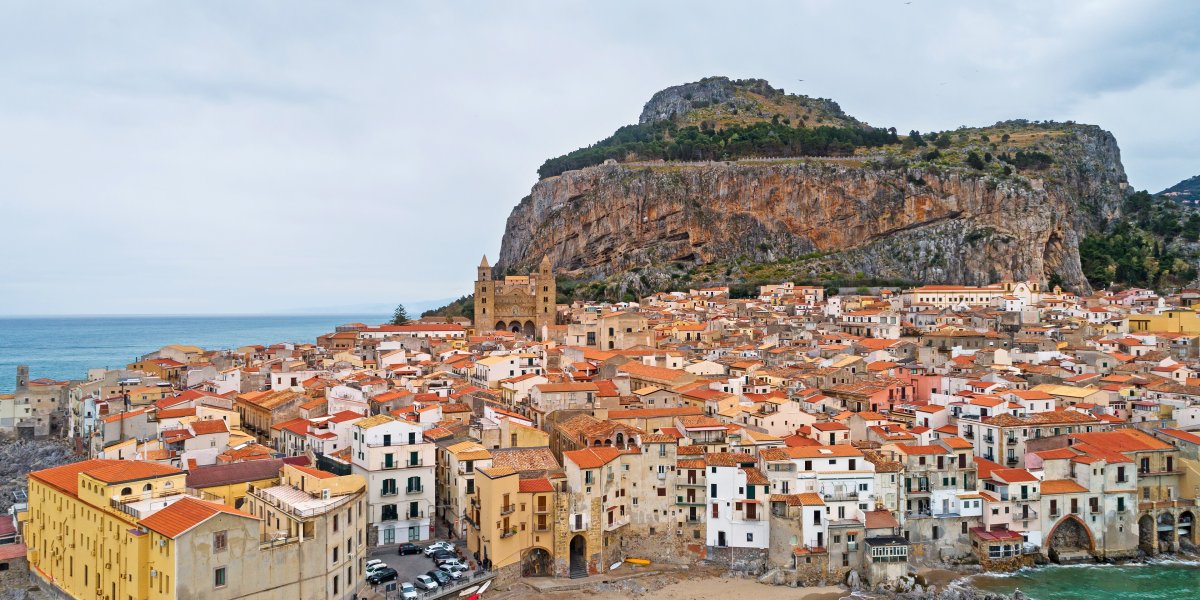
From the train station, walk 8 minutes north along Via Aldo Moro and turn into Vicolo Saraceno — you'll see hand-painted arrows pointing up. The climb starts as cobbled lanes between houses, then becomes a switchback path through wild fennel and prickly pear. Twenty minutes in you pass the 4th-century BC Temple of Diana megalith; another 25 minutes to the Norman castle ruins on the summit, where the entire medieval grid of Cefalù unfolds 270 meters below against a turquoise sea.
Tip: Be at the ticket gate at 09:00 sharp — by 11:00 the south-facing rock face becomes a furnace and the descent is the harder direction in heat. Carry one full liter of water; there is no fountain on the summit. Wear actual grip-soled shoes, not sandals: the limestone polished smooth by centuries of footsteps is genuinely slippery.
Open in Google Maps →11:45
Religious
Come off La Rocca down the Salita Saraceni steps; 8 minutes later you spill out directly onto Piazza del Duomo and the cathedral's twin Norman towers slam into view. King Roger II built this in 1131 as thanks for surviving a shipwreck, and the entire UNESCO Arab-Norman complex hinges on what waits inside the apse: a 12th-century Byzantine mosaic of Christ Pantocrator, one hand raised in blessing, his eyes locking onto yours from every angle in the nave.
Tip: Walk straight up the central nave without looking up — only when you reach the third bay should you raise your eyes. The Pantocrator was engineered for exactly that moment of impact and ruining it by peeking from the door is the one mistake travelers make here. Shoulders and knees must be covered; the staff turns away anyone in shorts.
Open in Google Maps →12:45
Food
Exit the cathedral, cross the piazza diagonally and walk 90 seconds down Via Vittorio Emanuele — the warm-bread smell finds you before the sign does. This is where Cefalù's fishermen and shopkeepers eat lunch standing at the counter: arancina al ragù (Sicilian feminine, €2.50 — note these are rounder and softer than Catania's pointed version), a square of sfincione tomato-onion focaccia (€3), and an espresso (€1.20). No table, no menu in English, no fuss.
Tip: Order at the cash desk first, get your white scontrino receipt, then take it to the counter — doing it in reverse marks you as a tourist and slows everyone down. Ask for the arancina 'al burro' if it's on the tray that day: butter, ham and mozzarella, a Palermo classic the kitchen makes most Tuesdays and Fridays.
Open in Google Maps →13:45
Landmark
Continue 4 minutes south down Via Vittorio Emanuele — watch for an unmarked black lava-stone staircase descending below street level on your right. You'll feel the temperature drop 5 degrees before you see anything. At the bottom is the 16th-century washhouse where the local Cefalù River still bubbles up through 22 cast-iron lion heads into stone basins; women scrubbed laundry here until the 1950s. The vaulted half-light, the smell of cold stone and the trickle of spring water make this the most cinematic 4 minutes in town.
Tip: Stand at the back wall with the lion-head fountains framing the staircase opening and shoot upward at 14:00 — a single shaft of overhead sun cuts straight down the stairwell at that hour and the water surface throws ripples across the vault. Anyone who tells you the Cinema Paradiso square scene was filmed here is wrong; that was Palazzo Adriano. But Tornatore drew his Sicily from places exactly like this one.
Open in Google Maps →14:45
Landmark
Walk back up to Corso Ruggero, turn left and follow it 6 minutes to the sea — the corso ends at this stubby Spanish-era cannon bastion jutting over the rocks. From the wall you see the entire crescent of Cefalù: golden honey-stone houses with feet in the water, the cathedral towers planted dead-center, La Rocca rearing up behind. Then drop down the side staircase to Spiaggia di Cefalù and walk the full 1.5 km arc of sand barefoot — by late afternoon the crowds thin, the light turns peach, and the cathedral facade glows on your left the whole way back.
Tip: Return to the bastion 45 minutes before sunset (check the day's exact time — in June it's near 20:30, in October near 18:30). The sun drops behind the western headland, not into open sea, but the reflected light turns La Rocca into a wall of fire for about 8 minutes. PITFALL WARNING: every restaurant along Lungomare Giardina with picture menus and a host waving at you is a tourist trap — €18 frozen pasta, €25 thawed swordfish. Walk past all of them without making eye contact.
Open in Google Maps →19:30
Food
From the bastion descend the stone steps 2 minutes to the old fishing harbor — the trattoria sits directly on Via Carlo Ortolani di Bordonaro with the wooden boats bobbing 4 meters from your table. The Liotta family has run it since the 1970s and the menu is dictated by what the harbor brought in that morning: pasta con le sarde (wild fennel, sardines, pine nuts, saffron — €14), spaghetti ai ricci di mare when sea urchins are in season Oct-Apr (€18), and grilled gambero rosso di Mazara prawns (€22). Budget €40-50 with house white Grillo and water.
Tip: Reserve by phone the day before for a 19:30 seating on the outer terrace — the inside room has no view and the 21:00 second seating loses the dusk light over the harbor. If the waiter pushes the 'menù turistico' fixed price, decline politely and order à la carte: the kitchen is the same, the tourist menu skips the day's actual catch in favor of frozen backups.
Open in Google Maps →Saltar al día
09:00
Religious
Sicily's Arab-Norman crown jewel, where Christ Pantocrator stares down from the apse in seven million gold tesserae set in 1148 — the oldest and most arresting Pantocrator mosaic in the world. The bishop who commissioned it wanted you frightened, then reverent; eight centuries on, both still happen. Pay the small extra for the cloister upstairs — twin columns, Mediterranean breeze, no crowds.
Tip: Walk straight to the apse before tour groups arrive at 10:30; the morning sun comes through the eastern window and lights the gold tesserae from the side, the only hour when Christ's face seems to move. Cathedral entry is free, but the €5 cloister and rooftop ticket is the day's best spend — buy at the side door on Piazza del Duomo, not the main entrance queue.
Open in Google Maps →10:45
Museum
Exit the Cathedral, cross Piazza del Duomo and take Via Mandralisca on the right — a 90-second walk past the bishop's palace. Inside this 19th-century baron's house hangs Antonello da Messina's Portrait of an Unknown Man (1465), a single painting Sicilians travel hours to see — that half-smile predates the Mona Lisa by forty years and arguably outdoes it. Two small floors, Greek vases, and a famous painted krater showing tuna fishermen — done in 90 minutes.
Tip: Skip the audio guide and head straight upstairs to the Antonello — it sits in its own dim room, and morning is the only time you'll have it to yourself. Don't leave without studying the cracked Greek krater on the ground floor showing tuna fishermen — one of the only surviving images of ancient Mediterranean fishing, and most visitors walk right past it.
Open in Google Maps →12:30
Food
From the museum, walk one block south to Via XXV Novembre — under two minutes. This narrow stand-up bar fries arancini, panelle and crocchè in front of you all afternoon and is where Cefalù's shopkeepers actually eat. Order an arancino al ragù (€3) and a panino con panelle (€4) and stand at the counter like everyone else.
Tip: The under-the-radar winner is the arancino al pistacchio with mortadella (€3.50) — ask for it freshly fried and they'll drop one in the oil for you. Cash only. Skip the soft drinks and order an almond milk (latte di mandorla, €2.50) — it's cold-pressed from Noto almonds and changes how you think about the dish.
Open in Google Maps →14:00
Landmark
Head west on Via Vittorio Emanuele for four minutes — the entrance is a stone arch on your right, easy to miss. A wide curving lava-stone staircase descends into a 16th-century communal washhouse, the basins still fed by the cold Cefalino river that once ran openly through town. The temperature drops eight degrees the moment you reach the bottom — Sicily's most photogenic refuge from the afternoon heat.
Tip: Touch the water — it stays around 14°C all year, and the women who washed clothes here had cracked hands by thirty. Best photo is from the third step down, looking across the basins toward the back arch where the river still flows out to sea. Free and never closes; come right after lunch when the post-meal crowd is still at the cathedral.
Open in Google Maps →15:30
Landmark
Continue west on Via Vittorio Emanuele for two minutes — a low medieval gate opens to your left, framing the working fishing port like a postcard. Walk through Porta Pescara onto the original 14th-century pebble landing where Cefalù's blue-and-white wooden boats are still pulled up by hand, then wander the lanes immediately behind the gate — Piazza Crispi, Vicolo dei Saraceni — the oldest and quietest in town. The whole pocket is barely 200 metres across; let yourself get lost.
Tip: Late afternoon (16:30-18:00) is when fishermen return through Porta Pescara to mend nets and unload — the only hour the gate frames a real working scene rather than a posed one. Stand right inside the arch and shoot back out toward the boats with the sea behind: most-photographed angle in Cefalù, and at 17:00 the sun is behind you so the gate isn't a silhouette. Trap warning: every restaurant directly on the seafront here hawks 'tourist menu €30' with photos of pasta — they reheat frozen fish and water the wine. Walk one block inland for anything you eat in this town.
Open in Google Maps →19:30
Food
Walk back through Corso Ruggero, turn right onto Via Umberto I — six minutes through the lit-up old town. Ti Vitti is the dinner Sicilians send their visiting cousins to: a single low-ceilinged room, white tablecloths, the chef's mother shouting orders from the open kitchen. Sicilian seafood with no shortcuts — busiate al pesto trapanese (€13), swordfish involtini (€18), house tiramisù with Marsala (€6).
Tip: Reserve in the morning by phone — the dining room seats only 24 and locals book a week ahead in summer. Order the busiate, not the spaghetti — busiate is the hand-twisted Trapani pasta that holds the almond-tomato pesto far better, and it's the dish the kitchen is proudest of. House Nero d'Avola is €4 a glass and tastes better than most of the bottle list.
Open in Google Maps →08:30
Landmark
The hike begins at Salita Saraceni, a stepped lane climbing off Corso Ruggero — 700 stone steps up the limestone fortress that has guarded Cefalù since the Greeks. Halfway up, the ruins of the 9th-century BC Tempio di Diana sit on a terrace where the cathedral towers reappear directly below you. The summit reveals Norman castle ruins and a panorama of the entire Tyrrhenian coast — on clear days, the silhouettes of the Aeolian volcanoes line the eastern horizon.
Tip: Start by 09:00 — the south-facing rock turns into an oven by 11:00 and there's almost no shade above the Tempio di Diana. Bring a one-litre water bottle minimum; the kiosk at the trailhead sells tickets (€5) but the next water is back in town. The best photo of Cefalù from above is not at the summit but from the wooden lookout 50 metres before — the cathedral, the curve of the beach and the medieval roofs all stack into one frame.
Open in Google Maps →12:30
Food
Descend La Rocca via Salita Saraceni back to Corso Ruggero — 25 minutes downhill, easy on tired legs — then one block south to Via XXV Novembre. Tinchité is the small Sicilian tavola calda where La Rocca hikers refuel: a wooden counter, a chalkboard menu, real Palermo street food without the Palermo crowds. Order a panino con la milza (spleen sandwich, €5) if you're brave, an arancina al burro (€3.50) if you're not, and a glass of Sicilian beer (€3).
Tip: The sfincione (€3) — a thick spongy Palermo focaccia with anchovy, onion and caciocavallo — comes out of the oven at 12:45 and is gone by 13:30; time your descent for it. Eat at the standing counter rather than the few outdoor tables; turnover is faster and the locals are at the counter, which is half the experience.
Open in Google Maps →14:00
Park
From Tinchité, walk three blocks south to the seafront — under five minutes. Cefalù's main beach is the rare Sicilian beach right inside the historic town: 1.5 kilometres of fine pale sand against turquoise water, with the cathedral towers and La Rocca rising directly behind you. The eastern half is free; the western half is rented umbrellas and beach clubs.
Tip: Walk 100 metres east of the central staircase to find the free stretch — bring your own towel, the rental clubs there charge €15 for a chair. Wade out 30 metres into the shallows and look back at the town; that view, with the cathedral and La Rocca framed together, is the postcard everyone wants and you can only see it from the water. Sea is warmest 14:00-16:00.
Open in Google Maps →17:00
Neighborhood
Leave the beach at the central staircase, cross Piazza Marina, and you're already on Corso Ruggero — three minutes. The pedestrian spine of the medieval town is now in full aperitivo mode: shops reopen after siesta, locals walk arm in arm, the Norman façades glow in the low sun. This is the stretch Giuseppe Tornatore filmed for Cinema Paradiso — the famous square scene was shot looking down toward the cathedral from the corner of Via Mandralisca.
Tip: Stop at Pasticceria Serio for one cannolo (€2.50) filled to order — never buy a pre-filled cannolo anywhere in Sicily, the shell goes soggy in ten minutes. The Cinema Paradiso shooting angle is exactly at the junction with Via Amendola; stand there at 18:00 and the warm side-light matches the film almost frame-for-frame.
Open in Google Maps →18:45
Landmark
From Corso Ruggero, take Vicolo Madonna degli Angeli west to the seafront — five minutes. The Bastione di Capo Marchiafava is a 16th-century Spanish bastion repurposed as Cefalù's best sea balcony, jutting out over the rocks at the western tip of the old town. It faces dead west into the open Tyrrhenian, which makes it the unrivalled sunset spot — and on clear evenings the silhouette of the Aeolian Islands appears 80 kilometres offshore.
Tip: Sunset hits around 19:30 in May, 20:30 in July — arrive 30 minutes early to claim the corner stone bench at the far western tip, the seat locals fight over. Once the sun drops, the bastion clears within ten minutes; stay another fifteen for the blue-hour shot of the cathedral lit up behind you, the town's most underrated photograph and the one almost no tourist waits around for.
Open in Google Maps →20:15
Food
Backtrack along the seafront and turn into Via Nicola Botta — four minutes; the courtyard entrance is set back from the street through an old stone arch. Cortile Pepe is Cefalù's quiet fine-dining address: chef Giovanni Lullo cooks contemporary Sicilian dishes in a candlelit interior courtyard that feels nothing like the rest of the old town. Highlights: red prawn raw with citrus salt (€22), tagliolini with sea urchin (€26), and a pistachio sphere dessert (€10) that other Sicilian restaurants are still trying to copy.
Tip: Reserve at least two days ahead in summer; the courtyard seats 30 and tables turn only once a night. Order à la carte, not the tasting menu — three courses with one glass of Etna Bianco runs €70 and gives you the kitchen's best dishes without the filler. Trap warning: the pier-side cafés you'll pass on the way back hawk €40 'romantic dinners with sea view' to anyone walking with luggage or a date — they water the house wine and reheat the fish. Walk the four extra minutes inland; this is the dinner that ends Cefalù right.
Open in Google Maps →
Trip builder
Plan this trip around Cefalu
Turn this guide into a bookable rail itinerary with FlipEarth.
Keep exploring
Related cities
More in the same country
FAQ
Frequently asked questions
How many days do you need in Cefalu?
Most travelers enjoy Cefalu in 1 days, with enough time for headline sights and a slower meal or museum stop.
What's the best time to visit Cefalu?
The easiest season for most travelers is May-Oct, especially if you want good weather and manageable crowds.
What's the daily budget for Cefalu?
A practical starting point is about €85 per person per day before hotels, then adjust based on museums, dining, and transport.
What are the must-see attractions in Cefalu?
A good first shortlist for Cefalu includes La Rocca, Lavatoio Medievale, Bastione di Capo Marchiafava.