City Guide
Bayeux
Francia · Best time to visit: May-Sep.
Day-by-day plan
Choose your pace
Duración del viaje
09:00
Religious
From the train station, walk ten minutes up Rue Larcher into the old town — the twin Romanesque towers rise above the rooftops before you ever see the square. Consecrated in 1077 in the presence of William the Conqueror, this is where the Bayeux Tapestry hung for seven centuries, draped along the nave each summer. Step inside (free) to see the chapter-house Last Judgment fresco and the 11th-century crypt — at 9 am the cathedral is yours alone, before the first coach tours roll in around 10:30.
Tip: The postcard angle is from Place de la Liberté looking up at the south transept — but the magic shot is from the small garden behind on Rue Lambert-Leforestier, where the flying buttresses frame the bell tower. The crypt entrance is in the south aisle, easy to miss; almost no one goes down there.
Open in Google Maps →10:45
Neighborhood
Exit the cathedral's south door, cross the square, and follow Rue de Nesmond — three minutes through medieval lanes lined with half-timbered houses brings you to the former Grand Séminaire, now home to the Bayeux Tapestry. The building itself is the story: it survived 1944 because the Allies deliberately spared Bayeux, making it the first liberated French town. Photograph the façade from the inner courtyard (free to enter the grounds), then loop back via Rue Saint-Jean and the leaning timbered houses of Rue des Cuisiniers.
Tip: Rue Saint-Jean is the viral half-timbered street, but Rue des Cuisiniers two blocks north has the same crooked 14th-century houses with a fraction of the crowd. Look up at no. 6 Rue des Cuisiniers — the carved wooden post is original 1480s woodwork, not a restoration.
Open in Google Maps →12:30
Food
Loop back up Rue Saint-Martin — four minutes — and the gilded Belle Époque storefront of La Reine Mathilde appears on your right. Half pâtisserie, half crêperie, it has fed Bayeusains since 1898 under the same painted glass ceiling. Order at the counter for fast service: the Complète galette (buckwheat with ham, egg, Gruyère, €9.50) is the local classic, washed down with a bolée of Normandy cider (€4). Save room for the tarte normande (apple-Calvados, €5.50) at the counter on the way out.
Tip: Arrive by 12:15 — the lunch queue starts at 12:40 and the small front salon fills first. Ask for the back room under the original 1898 painted ceiling: most tourists don't know it exists and sit by the window.
Open in Google Maps →14:00
Park
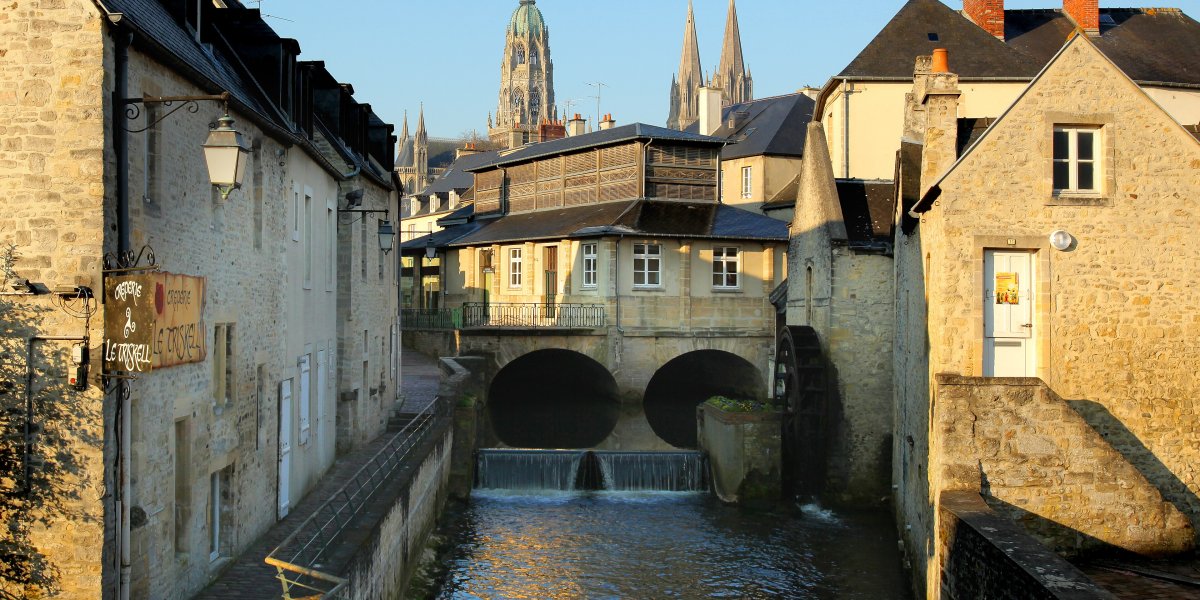
Step out and follow the Aure downstream along Rue Aux Coqs for two minutes — the river suddenly drops between stone embankments and the first wooden waterwheel appears, still turning behind a row of geranium-fronted houses. This was the working heart of medieval Bayeux: tanners, dyers, and millers crowded the banks. Walk the loop via Pont Saint-Jean, Quai de l'Aure, and the Botanical Garden gates, then sit on the bench by the second wheel where the afternoon light cuts through the willows.
Tip: The textbook shot is from Pont Saint-Jean looking upstream, but the better one is from the small unmarked footbridge 80 m further on — the second waterwheel, the stone arch, and the cathedral tower line up perfectly between 14:30 and 15:30 when the sun is over your right shoulder.
Open in Google Maps →16:00
Landmark
Pick up Boulevard Fabian Ware and head south — a quiet 15-minute walk along plane trees brings you to the largest Commonwealth war cemetery in France. 4,648 white headstones stretch in perfect rows; opposite, the Memorial wall lists 1,800 missing soldiers under the Latin inscription 'Nos a Gulielmo victi victoris patriam liberavimus' — 'We, once conquered by William, have liberated the Conqueror's homeland.' Late afternoon is when the low sun rakes across the stones and the cemetery empties of school groups.
Tip: Always open, always free. Look for the German section at the southern end — 466 enemy soldiers buried with the same dignity, a deliberate British choice in 1945 that most visitors miss entirely. Bring a 2-euro coin for the visitor book stamp at the entrance pavilion.
Open in Google Maps →19:30
Food
Walk back into the old town along Rue Larcher — 15 minutes through the dimming streets, lamps flickering on around the cathedral. La Rapière occupies a 15th-century stone manor at 53 Rue Saint-Jean, all exposed beams, flagstone floors, and a fire in the hearth from September onward. The kitchen is unapologetically Norman: order the magret de canard with apple-Calvados jus (€24) or the slow-braised joue de bœuf in cider (€22). The three-course menu at €38 is the move — it includes the trou normand, a shot of Calvados between courses to 'make room.'
Tip: Reserve 24 hours ahead in summer — there are only 28 covers. Pitfall warning: the restaurants on Place de la Liberté with English-only photo menus and pavement hawkers hike prices 30-40% in June around the D-Day anniversary; if a host stands outside trying to wave you in, keep walking. Locals eat on Rue Saint-Jean or Rue Saint-Martin, never on the cathedral square.
Open in Google Maps →
Trip builder
Plan this trip around Bayeux
Turn this guide into a bookable rail itinerary with FlipEarth.
Keep exploring
Related cities
More in the same country




FAQ
Frequently asked questions
How many days do you need in Bayeux?
Most travelers enjoy Bayeux in 1 days, with enough time for headline sights and a slower meal or museum stop.
What's the best time to visit Bayeux?
The easiest season for most travelers is May-Sep, especially if you want good weather and manageable crowds.
What's the daily budget for Bayeux?
A practical starting point is about €85 per person per day before hotels, then adjust based on museums, dining, and transport.
What are the must-see attractions in Bayeux?
A good first shortlist for Bayeux includes Bayeux War Cemetery (Commonwealth).