City Guide
Albi
Francia · Best time to visit: Apr-Oct.
Day-by-day plan
Choose your pace
Duración del viaje
09:00
Religious
From the steps of Place Sainte-Cécile the cathedral hits you like a fortress — the world's largest brick building, all austere red walls outside. Step through the carved porch and the entire interior is painted floor-to-vault: the Last Judgment fresco behind the choir is the largest and oldest in France, and the polychrome rood screen is Gothic lace cut from stone. Nothing else in southern France prepares you for this contrast.
Tip: Enter at 09:00 sharp — for the first 30 minutes the nave is empty and you can stand alone before the Last Judgment with no shoulders in your photo. The €6 ticket to the choir and treasury is non-negotiable; the painted screen is the entire reason you came to Albi, and it is hidden behind the free zone.
Open in Google Maps →10:45
Park
Exit the cathedral's north door and slip through the archway at its flank — a 2-minute walk and the old archbishop's palace looms ahead like a Romanesque keep above the Tarn. The formal French parterre is fine, but the true reward is the upper terrace: the river bends below, the Pont Vieux arcs across in red brick, and the south bank rolls away in green. Free, often nearly empty, the best free view in the Tarn.
Tip: Climb the watchtower stairs at the east end of the terrace — most visitors miss them entirely. From the top you frame Pont Vieux through the garden's box hedges, the postcard shot every Albigeois knows but no guidebook publishes; mid-morning light is sidelit and ideal.
Open in Google Maps →12:15
Food
Three minutes south of the cathedral, the 19th-century covered market hall sits in the heart of old Albi. Producers from across the Tarn fill the aisles — Roquefort wheels, jambon noir de Bigorre, fresh fougasse warm from the oven. Buy a duck-confit baguette from the rotisserie (€7), a slice of saucisson sec (€4), and eat at the stand-up counters by the door or carry it to a bench in Place Sainte-Cécile.
Tip: Arrive before 13:00 — the rotisserie sells out by mid-afternoon and the hall closes at 14:00 sharp every day. The market is dark all day Monday; if your trip falls on a Monday, walk two blocks to Boulangerie Galy on rue Mariès instead. Bring small bills; most stalls refuse cards under €15.
Open in Google Maps →13:30
Neighborhood
Head south down rue Mariès into the medieval lanes — a 4-minute walk and the city quiets to footsteps on cobbles. The Collégiale Saint-Salvi is older than the cathedral; its cloister, half Romanesque half Gothic, is wrapped in wisteria and almost always empty. Loop on through rue Toulouse-Lautrec past the timber-framed Maison du Vieil Alby and the Hôtel du Bosc, where Henri de Toulouse-Lautrec was born in 1864 — the plaque is unassuming, the building is private, the exterior is the photo.
Tip: The Saint-Salvi cloister is free and its gate closes at 17:00 — go now while afternoon light pours through the arches. From the cloister's northeast corner you get the only ground-level view of the cathedral's east buttresses framed by Romanesque columns; nobody publishes this shot because nobody bothers to walk in.
Open in Google Maps →15:45
Landmark
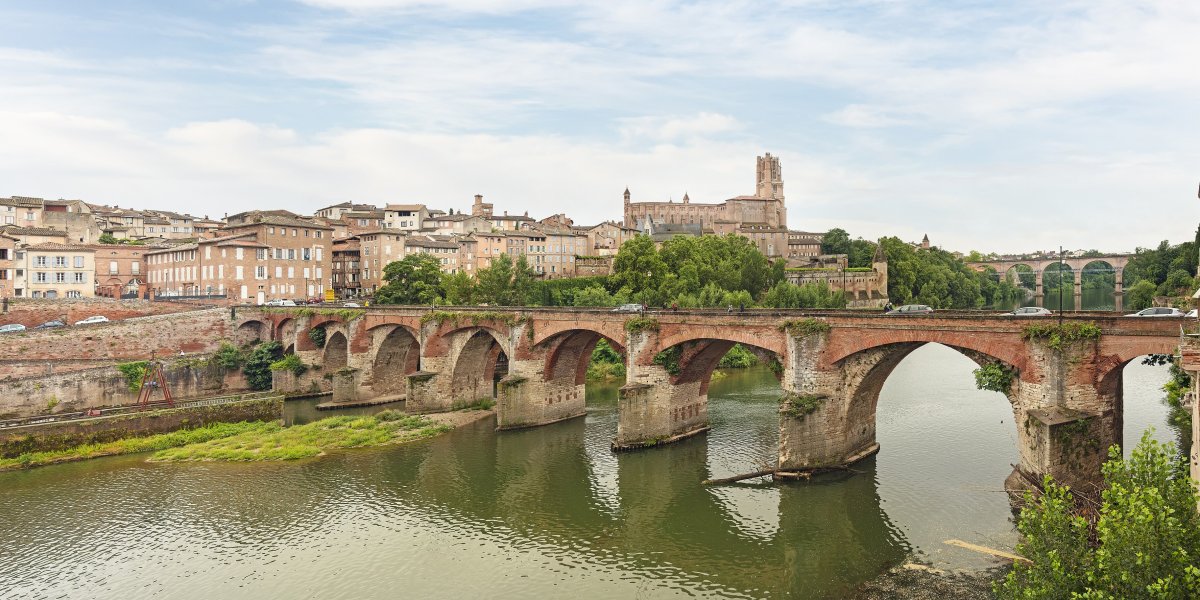
Walk east on rue Saint-Julien onto the 11th-century Pont Vieux — 8 minutes, and halfway across stop at the stone bulge where medieval houses once jutted out: the cathedral rises full-frontal above the Berbie gardens. Cross to the south bank, descend the stone ramp to the Berges du Tarn riverside path, and follow it downstream to the foot of the Pont Neuf. This is THE Albi skyline — all red brick, mirrored in slow water — and the walk itself is half the experience.
Tip: Stand on the south bank between 17:00 and 18:00 in summer (16:00–17:00 in April/October) — the western sun lights the cathedral's south flank in pure carmine red. Walk 200 m downstream of Pont Vieux to the small reed cove for the cleanest mirror reflection; the spot directly under the bridge looks better in photos than it does in real life.
Open in Google Maps →19:30
Food
Cross back over Pont Vieux and into the old town — a 10-minute walk through lit medieval lanes that feel scrubbed clean of the day's tourists. Le Lautrec sits on the street named for Albi's most famous son, inside a vaulted 15th-century house with a stone courtyard. Order the cassoulet de Castelnaudary (€22) and a glass of Gaillac red — both come from within 50 km — and let a proper sit-down dinner close a power-walk day.
Tip: Phone-reserve the courtyard table 24 hours ahead if the night is clear; the app booking platforms don't show it. Avoid the cluster of identical 'menu régional' restaurants directly on Place Sainte-Cécile facing the cathedral — they exist purely to ambush day-trippers with €15 prix-fixes of frozen duck and microwaved cassoulet, and every Albigeois will tell you the same. Le Lautrec costs more, but the cassoulet was actually simmered.
Open in Google Maps →Saltar al día
09:00
Religious
Begin the morning at the cathedral's main bronze portal on Place Sainte-Cecile, arriving five minutes before the 09:00 opening so you slip in with the first dozen visitors. For the next half hour the world's largest brick church — built as a Cathar-crushing fortress — is nearly silent, and the Italian-painted vault (the largest 16th-century ceiling fresco in Europe) reads in full from the central nave. Pay the small extra to enter the rood-screen choir: the polychrome stone Last Judgment is what nobody who arrives after 11 ever gets to study alone.
Tip: Buy the combined Choeur + Tresor ticket (8€) at the desk just inside the south door — most tour groups skip the choir entirely, and the polychrome stone screen is the single most underrated artwork in southwest France. Photography is allowed without flash; the angle from beneath the organ loft toward the choir is the only one that captures both ceiling and stone screen in one frame.
Open in Google Maps →10:45
Landmark
Exit through the cathedral's north transept and turn left along the cobbled lane — the Berbie gates are a 90-second walk away. The 13th-century fortified bishop's palace hides Albi's most photographed parterre, a geometric French garden laid against the red ramparts; late-morning sun finally clears the wall and lights the box hedges from the southeast. Walk all the way east along the elevated rampart promenade for the cliff-edge panorama over the Tarn — this is the postcard frame.
Tip: The garden and rampart walk are completely free and accessed through a separate gate marked 'Jardins de la Berbie' — not the museum entrance. Most visitors stop at the parterre; keep going to the far eastern bastion (Tour Saint-Catherine) where you can lean over the parapet 30m above the river — this is THE viewing platform locals use for the river panorama.
Open in Google Maps →11:45
Museum
Walk back across the palace courtyard to the museum entrance — 3 minutes from the rampart, signposted from the gardens. Housed in the Berbie's vaulted episcopal halls, this is the largest Toulouse-Lautrec collection on earth (over 1,000 works, donated by his mother to his hometown), and the lunch hour is the only window when the cabaret-poster room isn't shoulder-to-shoulder. The Moulin Rouge lithographs and the early Montmartre brothel studies are the rooms to slow down in.
Tip: Walk straight to Room 8 (the lithograph and poster gallery on the upper floor) FIRST — every group enters chronologically and bottlenecks in the early rooms, so reversing the route gives you the famous Moulin Rouge / Jane Avril posters with nobody in the frame. Allow time at the rooftop terrace exit — it opens onto the rampart with a different cathedral angle than the gardens.
Open in Google Maps →14:00
Food
Exit the museum onto Rue Henri de Toulouse-Lautrec — the restaurant sits 60m up the lane on the right, with a vine-shaded inner courtyard inside a 15th-century mansion. This is where Albigeois actually eat at lunch; arriving at 14:00 (not 13:00) gets you a courtyard table just as the local lunch crowd is finishing. Order the Cassoulet du Tarn (24€, slow-cooked two days with duck confit and Tarbais beans — heavier on duck than the Castelnaudary version) and the Gimblettes d'Albi (4€, the city's signature anise ring biscuit) for dessert; a half-pichet of Gaillac rouge (14€) is the right pairing.
Tip: Phone two days ahead (+33 5 63 54 86 55) and specifically ask for 'une table dans la cour' — walk-ins are routed indoors to the front room, which has none of the charm. Skip the menu midi if you only have two days in Albi; pay the few euros extra for the Cassoulet a la carte — the prix-fixe version uses a lighter stew, not the real two-day confit.
Open in Google Maps →16:00
Landmark
Walk west from the restaurant down Rue Saint-Clair, then drop onto Quai Choiseul along the river — an 8-minute downhill stroll past the medieval brick houses leaning over the water. The Pont Vieux dates from 1035 AD and is still France's oldest bridge in continuous daily use; you'll cross it on foot, lean over the upstream parapet, and watch the brick cathedral catch the slanting late-afternoon sun. From 16:00 to 17:30 the south-facing Berbie facade glows; harsh midday light flattens it, and after dusk the floodlights are too warm.
Tip: Shoot the cathedral from the THIRD arch from the south side of the Pont Vieux (not from the centre, where the iron lampposts cut across the composition). For an even cleaner shot, drop down to Berges du Tarn south bank directly under the bridge — there's a small public pebble beach where local fishermen sit, and the water reflection completes the frame.
Open in Google Maps →19:30
Food
From the Pont Vieux walk 4 minutes west along Quai Choiseul — the restaurant's terrace sits at #11 directly facing the river. L'Esprit du Vin is Albi's standout modern table and holds one of the deepest wine cellars in the Tarn; the menu Decouverte (58€, 4 courses) is the right introduction. Order it with the pigeonneau du Lauragais and finish with the Roquefort souffle glace — both are the chef's recurring signatures.
Tip: Request an upstairs window table when booking — the cathedral floodlights turn on at exactly 21:30 and the upper dining room frames both Pont Vieux and the Berbie cliff in one view. PITFALL: ignore the sandwich-board 'menu typique d'Albi — cassoulet 14€' restaurants ringing Place Sainte-Cecile — those are almost all reheated frozen cassoulet aimed at coach tours; authentic two-day confit costs at least 22€ on any honest menu in this town, and any cassoulet under 18€ in central Albi is a tell.
Open in Google Maps →09:00
Neighborhood
Start the morning at the covered market on Place du Marche, a 1903 iron-and-brick hall five minutes south of the cathedral square. Arrive at 09:00 — this is the producers' hour when growers from the Tarn countryside are still stacking heirloom tomatoes and slicing jambon noir, an hour before the local lunch shoppers fill the aisles. The market has been the city's daily ritual for 120 years and absolutely no tourists come this early.
Tip: Stop at the Vidal cheese stall (back-left corner) for 100g of Roquefort affine 6 mois (about 5€) and pick up a slice of fougasse d'Albi (sweet anise-flavoured local bread, 3€) from the boulangerie counter — both stash perfectly for an afternoon snack on the river. The hall is CLOSED on Mondays and shuts at 13:30 every other day; don't try to come back later.
Open in Google Maps →10:15
Religious
Exit the market north onto Rue Mariès and walk 4 minutes through the medieval lane to Albi's second UNESCO masterpiece. Saint-Salvi is the city's older soul — half Romanesque (the brick-and-stone bell tower), half flamboyant Gothic, with the only intact medieval cloister still standing in town. Between 10:00 and 11:00 the eastern morning sun fires through the cloister's brick arcade onto the central garden — it's the only window when the photo works.
Tip: The cloister entrance is a small wooden door tucked into the north aisle of the nave — there's no signage from outside, which is why 80% of visitors only see the church. Push the door, it's free, and you'll have one of southwest France's quietest medieval gardens to yourself.
Open in Google Maps →11:30
Neighborhood
Leave Saint-Salvi by the south door onto Rue Saint-Julien and let yourself wander west through Vieil Alby. In 90 minutes you thread past the Maison du Vieil Alby (a 15th-century half-timbered house on the corner of Rue Croix-Blanche, the photo-icon of medieval Albi), Hotel Reynès on Rue Timbal, and the pastel facades of Rue Mariès — late-morning shadow falls at the exact angle that makes the half-timbering legible. End at Place du Vigan, the local meeting square.
Tip: Look UP as you walk Rue Mariès — the medieval rammed-earth-and-brick wall layering only shows above the first storey, hidden by modern shopfronts at street level. The half-timbered Maison du Vieil Alby is best shot from the diagonal across Rue Puech-Berenguier, not head-on (the head-on angle puts a modern shop awning in the frame).
Open in Google Maps →13:15
Food
From Place du Vigan walk 5 minutes south on Rue de la Souque — the bistro sits in a tiny vaulted-cellar dining room. This is where Albigeois office workers and shopkeepers actually have lunch; the chalkboard changes every day on what the morning market provided. Order the Tripous d'Albi (the city's signature dish — small lamb-tripe parcels slow-stewed in white wine and tomato, 18€) — it's the one thing locals tease tourists for never trying — and the Saucisse de Toulouse aux haricots tarbais (16€) if the table next to you is sharing it.
Tip: Arrive at 13:15 not 12:30 — the first wave clears at 13:00 and you'll walk in just as a small table opens without reservation. Ask for the verre du jour of Gaillac blanc (around 4€) — Gaillac is grown 20km north of Albi and you won't find it on any wine list outside the Tarn.
Open in Google Maps →15:30
Museum
Walk north up Rue Sainte-Cecile, then west onto Pont Vieux — 10 minutes of cobbled descent before the bridge crosses to La Madeleine on the north bank. Past the bridge, the small Musee La Perouse on Place La Perouse tells the story of Albi's most famous son after Toulouse-Lautrec — the explorer Jean-Francois de La Perouse, who vanished in the Pacific in 1788; the model ships and Pacific-voyage maps fit comfortably in 75 minutes. Afterwards walk five minutes east along Berges du Tarn Nord for THE shot of the day — the entire Episcopal City, cathedral and Berbie palace rising as one red wall across the river, the view that exists nowhere else.
Tip: After the museum, walk to the small wooden pier at Berges du Tarn Nord (10 minutes east of Place La Perouse, just past the public garden) — between 17:00 and 18:00 the brick wall opposite hits its richest red, and you'll have the bench locals call 'le banc du peintre' to yourself. The museum is CLOSED on Mondays and Tuesdays — verify before crossing.
Open in Google Maps →19:30
Food
Recross the Pont Vieux southbound — 6 minutes back to Rue Porta where La Table du Sommelier sits at #20, a wine-driven bistro inside a converted 17th-century townhouse. It's the city's best value serious table: a small, hand-printed menu that pivots on the Tarn cellar (Gaillac, Cahors, Madiran) with food built around the bottles, not the other way around. Order the assiette de cochonnailles du Tarn (charcuterie plate, 14€) to start, then the magret de canard fume aux figues (26€), and let the sommelier choose the pairing flight (18€ for three glasses).
Tip: Book at least one day ahead by phone — the room has only 30 covers and Friday-Saturday fills by Wednesday. PITFALL: do not be tempted by the riverside terraces along Quai Choiseul advertising 'menu touristique 18€' between Pont Vieux and Pont du 22 Aout — those are coach-trade kitchens; the entire run of three side-by-side bistros there serves the same frozen-supply menu under different signs. The real bistros are all one block inland on Rue Porta and Rue Mariès.
Open in Google Maps →
Trip builder
Plan this trip around Albi
Turn this guide into a bookable rail itinerary with FlipEarth.
Keep exploring
Related cities
More in the same country
FAQ
Frequently asked questions
How many days do you need in Albi?
Most travelers enjoy Albi in 1 days, with enough time for headline sights and a slower meal or museum stop.
What's the best time to visit Albi?
The easiest season for most travelers is Apr-Oct, especially if you want good weather and manageable crowds.
What's the daily budget for Albi?
A practical starting point is about €85 per person per day before hotels, then adjust based on museums, dining, and transport.
What are the must-see attractions in Albi?
A good first shortlist for Albi includes Pont Vieux & Berges du Tarn South Bank.