City Guide
Arles
Francia · Best time to visit: Apr-Oct.
Day-by-day plan
Choose your pace
Duración del viaje
09:00
Landmark
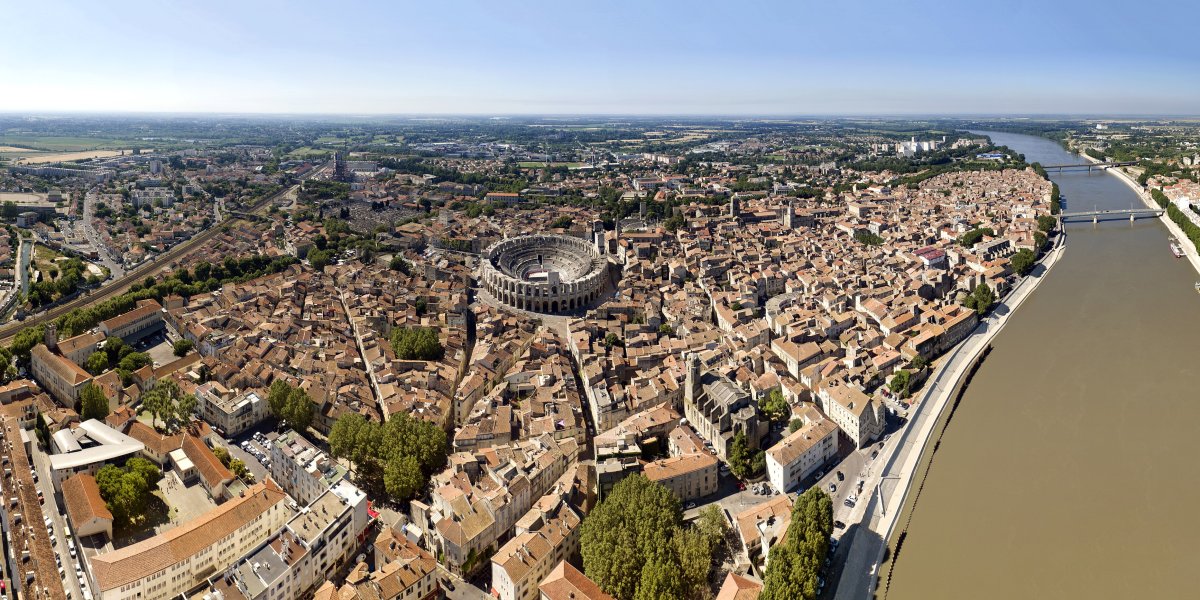
Begin at Place de la Major, the small church square just north of the arena — locals call it the balcony of the Arènes, and this is the angle Provençal painters have chosen for two centuries. Walk a full lap around the ochre stone walls of the 90 AD amphitheater while the morning sun still rakes across the eastern arches. The crenellated medieval towers were added during the Saracen raids, when entire families lived inside the arena as a fortress.
Tip: Skip the €9 ticket — the strongest photos are from outside. Stand on the steps of Église Notre-Dame-de-la-Major (NE corner) and on Rue Voltaire (south side), where the medieval tower lines up perfectly with the stacked arches. Be back outside before 11:00 — that's when cruise-ship coaches arrive from Marseille and the perimeter gets clogged.
Open in Google Maps →10:30
Landmark
Walk three minutes south down Rue de la Calade — you'll spot two solitary marble columns rising from a field of cut stones, the only fragments left of the Roman stage built under Augustus. The Arlésiens call them les Deux Veuves, 'the Two Widows.' This 1st-century-BC theatre is older than the Colosseum and still hosts the summer Suds festival.
Tip: The free angle that locals never share with tourists: from the corner of Rue de la Calade and Rue du Cloître, the open service gate frames both Widow columns and the stacked stone tiers — no fence in the shot, no ticket required. Late morning, the columns cast clean shadows across the orchestra pit.
Open in Google Maps →11:45
Food
From the theatre, walk three minutes northwest along Rue de la Calade to Place de la République, then duck behind the basilica to 21 Rue des Carmes. À Côté is Jean-Luc Rabanel's casual little sister to his two-star Michelin next door — same kitchen, half the formality, a tiny terrace under a fig tree. Order at the slate-and-chalk bar: a €23 plat du jour built around whatever Provençal vegetable hit the morning market, with optional Camargue red rice or bull-meat daube.
Tip: The plat du jour is always the move — written on the slate by the door. Ask for the natural Costières-de-Nîmes by the glass (€5), not the printed Côtes du Rhône list. If the terrace is full, sit at the inside bar — you'll be out in 45 minutes flat and the kitchen pass is right there to watch.
Open in Google Maps →13:30
Neighborhood
Walk two minutes north up Rue du Sauvage to Place du Forum — the small leafy square where Van Gogh sat in September 1888 and painted Café Terrace at Night. Stand on the south side beside the bronze of Frédéric Mistral and you're looking at almost the exact composition of the painting; the café was repainted that exact chrome yellow in the 1990s for the pilgrims. Then walk five minutes south to Espace Van Gogh — the old hospital courtyard he was committed to after the ear incident, whose yellow-and-purple garden he painted in 1889 and which you can stand inside for free.
Tip: Don't drink or eat at Café Van Gogh — it's the most overpriced espresso in Provence (€7 for instant Lavazza) and the kitchen microwaves frozen pasta. Photograph the yellow facade from across the square and move on. At Espace Van Gogh, step up to the first-floor arcaded gallery (free, open daily) — that slightly elevated angle matches Van Gogh's painting frame-for-frame, while ground-level photos lose the purple iris border.
Open in Google Maps →15:30
Landmark
Walk twelve minutes south along Boulevard des Lices and Avenue Victor Hugo — the twisted silver tower appears first as a glint above the rooftops, then suddenly fills your view as you cross into Parc des Ateliers. Frank Gehry's 56-meter tower opened in 2021: 11,000 stainless-steel panels twisting upward like a tornado of mirrors, anchored on a glass drum. The grounds are free to walk 24/7 — a meadow of Camargue grasses and round water mirrors that double the tower upside down.
Tip: The tower's panels catch fire about 90 minutes before sunset — every facet turns copper-pink and the whole shape seems to liquefy. Walk a full 360° loop around the base; from the southwest corner you'll see the tower reflected upside-down in the circular black pond, the cleanest shot of the day. After dark the interior is lit and slowly cycles through five colors — worth lingering until 21:30 in summer before you walk to dinner.
Open in Google Maps →19:30
Food
Walk twelve minutes back into the old town along Rue Émile Fassin and Rue Molière — the warm streetlights along Boulevard des Lices come on around 20:30 in summer and the cicadas don't quit until midnight. L'Affenage occupies an old horse stable on a quiet lane near the Roman ramparts, with vaulted stone ceilings and a courtyard for warm nights. Order a main and you get unlimited access to the buffet de hors-d'œuvres — twenty earthenware bowls of Provençal starters from tapenade and anchoïade to rouille-stuffed peppers — followed by the gardiane de taureau (Camargue bull stew with red rice, €26) or daube provençale.
Tip: Reserve before 17:00 the same day — only 40 covers, no walk-ins after 19:30. Order the gardiane (bull, not beef — this is Camargue, the meat has done miles in the salt marshes) with a glass of Costières-de-Nîmes rosé; skip dessert because the buffet already includes the famous riz au lait. Pitfall warning: never eat directly on Place du Forum — Café Van Gogh, Le Plaza, La Paillote are pure tourist traps charging €30 for reheated pasta and €7 for instant coffee. Every honest Arles bistro is one street back, on Rue du Docteur Fanton or Rue Molière, half the price and three times the cooking.
Open in Google Maps →Saltar al día
09:00
Landmark
Be at the gate the moment it opens at 9:00 — by 10:30 the coaches from Marseille and Avignon start unloading. Built in 90 AD and still drumming with bullfights every Easter and feria, the amphitheater's limestone glows honey-amber in slanted morning light, and the upper tier gives you the most photographed roofline in the Rhône delta. Two thousand years of crowd noise hum out of these stones; arrive alone and you can almost hear them.
Tip: Buy the Pass Avantage (€19) at this entrance — it covers all six Roman monuments plus the Musée Bleu for six months, paying for itself by Cryptoporticus. Climb the Tour Roland at the north corner first; the medieval staircase is a one-person bottleneck once tour groups arrive.
Open in Google Maps →10:45
Landmark
Walk south two minutes down Rue de la Calade — the Roman Theatre is the next gate on your right, downhill behind a low cypress hedge. Two lone marble columns are all that remain of a stage that once seated 10,000, and those columns in late-morning light have a haunting solitude that the amphitheater's grandeur lacks. Most visitors blow through in fifteen minutes; sit on the sun-warmed stone tiers and let the silence settle.
Tip: Walk down behind the stage to the small lapidary garden — most visitors never spot it. The carved Roman heads lying in the grass were dug up from the site itself, and you'll often have them entirely to yourself.
Open in Google Maps →12:30
Food
From the theatre, walk five minutes west along Rue de la Calade and Rue Dulau — through quiet residential streets no guidebook bothers with. L'Autruche is a twenty-seat bistro where the chef shops the morning market and chalks each day's plates on a slate behind the bar; Arlésiens book their birthdays here. The lunch formule is the secret weapon — half the dinner price for the same kitchen.
Tip: Order the bull-meat daube if it's chalked on the slate — Camargue beef braised four hours in red wine, around €19. Reserve by phone the day before; online booking is dinner-only and the room is too small to walk in past 12:45.
Open in Google Maps →14:30
Religious
Backtrack three minutes east to Place de la République — Saint-Trophime's Romanesque portal is the obelisk's western neighbor. The 12th-century carvings on the doorway are a stone bible: saints, prophets, and a Last Judgment scene where the damned are very specifically being devoured. Skip the church nave (five minutes is enough) and pay for the cloister — the upper gallery in afternoon side-light is the city's most photogenic quiet corner.
Tip: On the southwest pillar of the cloister, Saint Trophime is carved holding his own decapitated head at eye level — nearly everyone misses it. Climb the staircase to the upper gallery for the framed roofline shot Henri Cartier-Bresson made in 1959.
Open in Google Maps →16:00
Landmark
Step across the square to the Hôtel de Ville — the cryptoporticus entrance is inside the town hall lobby, signposted on the right. Descend twelve metres into a triple-galleried Roman granary, two millennia old, where the temperature holds at 14°C even in August heat. The underground geometry is what every Arles-based architect comes here to photograph; arrive at 16:00 and you'll often have the whole U-shaped tunnel to yourself.
Tip: Stand at the U-bend at the southern end of the gallery around 16:30 — a single shaft of natural light cuts through the ventilation slot for roughly ten minutes. Brace your camera on the stone shelf for a long exposure; flash photos look flat and ruin the moment for everyone else.
Open in Google Maps →19:30
Food
From Place de la République, walk four minutes north up Rue du Président Wilson — past the small antique fountain — to a corner bistro spilling onto a plane-tree-shaded terrace. Le Galoubet is where Arlésiens go for a proper evening: a noisy candle-lit room, a blackboard menu, and a chef who shouts orders in Provençal. Arrive at 19:15 to claim the corner two-top under the tree before it's gone for the night.
Tip: Order the duck breast with figs (€26) and ask for 'vin de la maison rouge' — a Costières de Nîmes the patron pours by the carafe at half the bottle price. PITFALL — do NOT eat at Café La Nuit, the yellow Van Gogh terrace on Place du Forum: it is the city's most notorious tourist trap, overpriced and mediocre, kept in business solely as photo bait.
Open in Google Maps →10:00
Museum
Be at the foundation's red-brick door on Rue du Docteur Fanton ten minutes before the 10:00 opening — by 11:30 a school group will have absorbed the smallness of the rooms. Inside, two or three original Van Goghs anchor a rotating contemporary exhibition that talks back to his work — never the same show twice in two years. The rooftop terrace at the end of the visit is the city's secret viewpoint: Roman tile roofs, Saint-Trophime spire, the Alpilles on a clear day.
Tip: The basement screening room shows a 12-minute film about Vincent's 444 days in Arles — most visitors skip it; sit through it before going upstairs and every canvas hits twice as hard. Photography is allowed but no flash, even on the contemporary works.
Open in Google Maps →12:00
Landmark
Exit the foundation, turn right on Rue du Docteur Fanton, and walk three minutes south to the former hospital where Vincent recovered after slicing his ear in December 1888. The courtyard garden has been replanted to match his 1889 canvas exactly — irises, geraniums, the yellow trim on the arcades — and a placard at the entrance shows the painting beside the view. Stand on the marked tile, hold the placard up at eye level, and your photo is the painting.
Tip: The upper gallery of the courtyard is now a free public library — the windows face down into the garden at the exact angle Vincent painted. Climb up and shoot from above; nobody up there ever asks why.
Open in Google Maps →12:45
Food
Walk four minutes east from Espace Van Gogh, through Rue de la République to Rue des Arènes — Chardon is the small bistrot on your left, windows steamed with kitchen heat. The young couple running it trained in Paris and came home to cook with Camargue rice, Aubrac beef, and whatever the morning market offered. The lunch blackboard is two starters, two mains, two desserts — around €26 for the lot.
Tip: Order the riz rouge de Camargue if it's on the slate — the chef parboils it in shellfish stock, a dish you won't find outside the delta. They take reservations only by Instagram DM, not phone; message them the night before.
Open in Google Maps →14:30
Landmark
From Chardon, walk ten minutes southeast down Boulevard des Lices and Avenue des Alyscamps — the necropolis is at the end of a long avenue of plane trees. Van Gogh and Gauguin painted here side by side in late October 1888; the autumn-light avenue of stone sarcophagi Vincent captured in four canvases is the exact view you'll walk. Come in afternoon side-light, when the sarcophagi cast long shadows down the gravel alley.
Tip: Walk the avenue all the way to the Saint-Honorat chapel at the far end — most visitors photograph the first fifty metres and turn around. The chapel's roofless nave with late sun cutting through the broken arches is the canvas no one else gets.
Open in Google Maps →16:00
Museum
Exit Alyscamps at the south gate and walk four minutes west — Frank Gehry's twisting stainless-steel tower is impossible to miss against the sky. Inside, ten floors of contemporary art experiments tumble through Maja Hoffmann's vision of a Rhône-delta cultural lab. The building itself is the masterpiece — every elevator ride reveals a new geometry of stair, light, and rivet.
Tip: Ride the central Carsten Höller spiral slide at least once — it's free with admission and lands you in the ground-floor cafe with a courtyard view. Save energy for the salt-crystal mirror wall on level three: the Camargue's salt pans rendered as architecture, and it photographs best with the late-afternoon sun behind you.
Open in Google Maps →19:30
Food
Walk fifteen minutes north back to the old town — through Boulevard Émile Combes and into the lanes behind the amphitheater — to a tiny wine bar on Rue des Porcelets. Le Gibolin is a natural-wine cave with eight tables, run by a husband-wife pair who pour what they love and cook what their grandmother cooked. There is no printed menu; you eat what arrives, and what arrives is always right.
Tip: Show up at 19:15 sharp — by 19:45 the eight tables are gone for the night and they don't take reservations. PITFALL — around Place du Forum after dark, ignore touts on terraces handing out menus in five languages; those are all tourist traps. Real Arlésien restaurants never recruit on the sidewalk.
Open in Google Maps →
Trip builder
Plan this trip around Arles
Turn this guide into a bookable rail itinerary with FlipEarth.
Keep exploring
Related cities
More in the same country
FAQ
Frequently asked questions
How many days do you need in Arles?
Most travelers enjoy Arles in 1 days, with enough time for headline sights and a slower meal or museum stop.
What's the best time to visit Arles?
The easiest season for most travelers is Apr-Oct, especially if you want good weather and manageable crowds.
What's the daily budget for Arles?
A practical starting point is about €120 per person per day before hotels, then adjust based on museums, dining, and transport.
What are the must-see attractions in Arles?
A good first shortlist for Arles includes Arènes d'Arles (Roman Amphitheater), Théâtre Antique (Roman Theatre), LUMA Arles & Parc des Ateliers.