City Guide
Zaragoza
Espagne · Best time to visit: Apr-Jun, Sep-Oct.
Day-by-day plan
Choose your pace
Durée du voyage
09:00
Landmark
From Delicias station or central hotels, head west along Avenida de Navarra — the honey-colored crenellated walls rise above the dry moat well before you arrive. At nine in the morning the sun rakes low across the north facade, lighting the Taifa-era alabaster gold while the Gothic battlements added by Ferdinand and Isabella cast crisp shadows — this is the only Moorish palace of this caliber surviving outside Andalusia. Walk the full perimeter along the moat; the scale hits hardest at the southwest corner where eleventh-century Islamic stone meets fifteenth-century Christian ramparts in a single wall.
Tip: Skip the interior tour today — you don't have the hours and the real drama is the exterior layering of three dynasties. The photograph you want: stand on the pedestrian bridge at the northeast corner of the moat and shoot southwest, with the Torre del Trovador (the oldest tower, built by a poet-king in 1065) centered against the pale morning sky. The crowds from the 11:00 group tours haven't arrived yet — you'll have the moat path almost to yourself.
Open in Google Maps →12:30
Food
Walk east along Avenida de Madrid and Conde de Aranda for about thirty minutes — you'll pass the cast-iron Mercado Central on your left, then slip into the tapas maze of El Tubo via Calle Libertad. This bar has been pushing exactly one dish since 1953: a skewer of champiñones al ajillo crowned with chorizo and set on a slice of bread that catches every drop of the garlic oil. You stand at the zinc bar shoulder-to-shoulder with mechanics and lawyers, order one skewer and a caña, and you're done in twenty minutes.
Tip: Order exactly one champi skewer (€2.80) plus a caña — this isn't a place to make a full meal; the turnover is the point. Elbow in at the bar, don't try to sit. Ignore the near-identical tapas bars on the same alley that copy the formula for tourists — this is the 1953 original and the only one locals will name-check.
Open in Google Maps →14:00
Religious
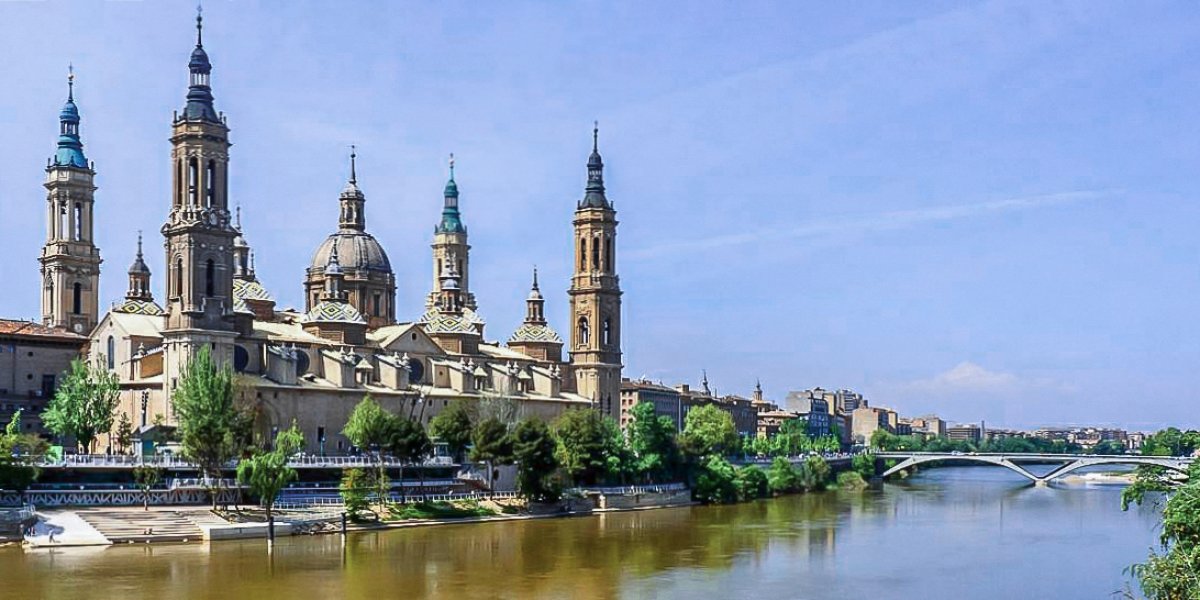
From El Champi walk north up Calle Don Jaime I for six minutes — the street is a narrow Baroque corridor that opens without warning onto Plaza del Pilar, the longest pedestrian square in Europe. The basilica's eleven domes with their green, blue, yellow and white tilework rise like a painted mountain range, best read from the plaza's south end where the whole 130-meter facade fits in a single frame. Slip inside for five minutes to see the Goya fresco on the Regina Martyrum dome (he painted it at twenty-five, unpaid, just to get his foot in the door) — but save the real time for the west front, which faces the river and has been Spain's most-photographed church facade since the invention of the camera.
Tip: On the outside of the Capilla de San Pedro Arbués (west facade, facing the river), look for two dark iron spheres embedded in the wall at shoulder height — they are cannonballs from the 1808 French siege that struck the basilica and never detonated; locals still call it the Miracle of the Pillar. Don't try to photograph the full eleven-dome roofline from inside the square — you can't get the distance. The postcard shot is from the Puente de Piedra at your next stop.
Open in Google Maps →15:30
Landmark
Exit Plaza del Pilar at its north edge and the bridge is in front of you in ninety seconds. This fifteenth-century stone bridge is where the Zaragoza photograph is made — walk to the middle, turn back, and the eleven domes of the basilica rise behind the Ebro's muddy current like a stack of ceramic fruit. Mid-afternoon light, between roughly 15:30 and 16:30 in the shoulder seasons, drops full sun onto the west facade while the river holds just enough shine to mirror the towers — morning and evening the facade is in shadow.
Tip: Don't stop at the middle of the bridge — cross fully to the north bank and walk fifty meters east along the Paseo Echegaray embankment. From that spot you get the bridge arches, the bronze lion on the north parapet, AND the full basilica in one frame, which you cannot achieve from the bridge deck or from the south bank. The four lions are 20th-century but have become the city's unofficial mascot; touch the closest one's paw — locals do it for luck before crossing back.
Open in Google Maps →17:00
Landmark
Recross the Puente de Piedra and cut south through the old town via Calle San Jorge — eight minutes, straight through a warren of stone alleys laid directly on top of the Roman street grid. The theater appears suddenly below sidewalk level, as though the pavement peeled back to reveal a six-thousand-seat semicircle where first-century Zaragozans watched Plautus under a canvas awning. You can read the whole structure from the free elevated walkway that rings the excavation — the modern glass canopy overhead is ugly, but the limestone seating, the orchestra pit, and the stage wall below are genuine Caesaraugusta, buried for seventeen centuries and only rediscovered in 1972.
Tip: Skip the ticketed interpretation museum today — the theater itself is entirely visible from the free public walkway that circles the excavation; the paid section adds context panels, not access. The best vantage is the southwest corner where you see the stage layout and the modern apartment balconies hanging surreally over the Roman tiers. Two minutes west on Calle Estébanes puts you at the mouth of El Tubo: the restaurants on the Calle Méndez Núñez corner with English menu boards and photos of paella are tourist traps — genuine El Tubo bars have no menus on the street and you read chalkboards inside.
Open in Google Maps →20:00
Food
Three minutes on foot from the Roman Theater — walk north on Calle Estébanes, then left onto Calle Mártires. Casa Lac has operated continuously since 1825, which makes it officially the oldest restaurant in Spain still holding its original license, a plaque by the door and a gold-framed decree to prove it. The upstairs comedor is a lacquered belle-époque time capsule of mirrors, velvet banquettes and chandeliers; order the ternasco asado (slow-roasted suckling lamb from the Pyrenees foothills, €28), which is the Aragonese dish the region is known for, paired with a glass of Garnacha from Campo de Borja.
Tip: Reserve the upstairs comedor two to three days ahead — walk-ins are seated at the downstairs tapas bar, which is fine but misses the point of coming here. Share the ternasco if you're two and start with borrajas (borage greens, a regional vegetable you will not find outside Aragón). Warning: restaurants on Plaza del Pilar and along Calle Alfonso I advertise 'ternasco' in five languages for €15 — that is frozen industrial lamb, not the real thing; the authentic roasted ternasco is here and at El Fuelle on Calle Mayor, and almost nowhere else in the center. Skip dessert — walk four minutes to Pastelería Fantoba on Calle Don Jaime I (open since 1856) for their adoquines, the paving-stone-shaped candy Zaragozans take home.
Open in Google Maps →Aller au jour
09:00
Religious
Start here before the tour coaches descend on the plaza at 10:00. The 17th-century basilica's eleven domes are painted with frescoes by Goya and his brothers-in-law, and Goya's famously unfinished corner in the Coreto de la Virgen is the most human thing about the whole building. Ride the tower lift when it opens at 10:00 sharp for the only view in Zaragoza that takes in both the Ebro and the Mudejar skyline in a single frame.
Tip: Enter through the Puerta Baja on the river side, not the main plaza doors where the queue forms. The Virgen del Pilar statue is behind a small oval opening in the jasper column — queue on the right side of the Coreto chapel between 09:15 and 09:45 to kiss it without a wait, a ritual the locals do before any important date.
Open in Google Maps →11:15
Museum
Exit the basilica and walk 90 seconds southeast across Plaza del Pilar — the glass pavilion set into the pavement is the entrance. Beneath your feet are the surviving market stalls of Caesaraugusta, the Roman name Augustus personally gave this city in 14 BC. A seven-minute projection maps the lost forum back onto the real stones, the rare kind of small museum that rewards quiet attention.
Tip: Buy the combined 'Ruta de Caesaraugusta' ticket (€7) at this first stop — it covers the Forum, Port, Baths, and Theater, and you will hit two more of those sites in the next 30 hours. The stand-alone tickets add up to nearly double.
Open in Google Maps →13:00
Food
Cut south from the Forum Museum for six minutes through the tight grid of Calle Libertad and Calle Estebanes — this compressed tapas warren is El Tubo, and every doorway smells of grilling garlic. Bar El Champi is a counter-and-four-stools place that has served essentially one dish since 1960: a grilled mushroom cap stacked on toast, topped with a spear of garlic prawn and parsley oil (€2.80 each, order three). Chase them with a caña of Ambar, the local beer brewed a kilometer upriver.
Tip: Never sit down in El Tubo — the rhythm is stand, eat two bites, move. After Bar El Champi, walk 40 seconds to Casa Pascualillo for a pincho moruno (€2.80), then Bodegas Almau for a glass of old-vine Garnacha from Campo de Borja poured from a barrel — total damage under €20 and you have tasted the three pillars of the alley.
Open in Google Maps →15:00
Religious
Walk east from El Tubo for six minutes along Calle Don Jaime I — you will emerge on Plaza de la Seo and immediately face the cathedral's northern Mudejar wall, a riot of geometric brickwork lit dead-on by mid-afternoon sun. La Seo is built directly atop Caesaraugusta's forum and the city's former Great Mosque, so you are standing on 2,000 years of continuous worship. The tapestry museum inside holds the finest Flemish collection in Spain, and almost no one upstairs at this hour.
Tip: The exterior northern apse is the best-preserved Mudejar-Christian facade in Spain — photograph it from the café terraces on Plaza de la Seo between 14:45 and 15:30 when the sun rakes the brick directly. Inside, the alabaster retablo mayor hides 15th-century polychrome figures behind it; ask the guard at the ambulatory door to unlatch the rope for a closer look.
Open in Google Maps →16:45
Museum
Walk four minutes south from La Seo down Calle San Valero, then left onto Calle San Jorge — you will pass the Mudejar tower of La Magdalena church on the way. This Roman theater seated 6,000 in the 1st century AD, nearly matching Mérida's — and nobody knew it existed here until a 1972 construction crew dug into it. The translucent canopy overhead diffuses late-afternoon sun onto the stone seats and makes the whole cavea glow amber, which is precisely why the architect designed it that way.
Tip: Skip the ground-floor walkway and go straight up to the mezzanine at the back of the exhibition hall — it's the only place where you see the entire semicircle of the cavea in one sweep, and the angle reveals how the Romans carved it into the hillside. Free to enter Sunday afternoons if you missed the combined ticket.
Open in Google Maps →20:00
Food
Walk five minutes west from the theater along Calle Mayor to number 59 — a wooden door you could walk past a dozen times before noticing. El Fuelle is a cavernous 19th-century tavern with wine casks stacked to the ceiling, hams swinging over the bar, and waiters in long aprons who have worked here since the peseta. Must order: ternasco asado (roast milk-fed Aragonese lamb, €24) and migas aragonesas (fried crumbs with grapes, chorizo, and a fried egg on top, €14), paired with a bottle of Somontano red.
Tip: They don't take online bookings — call that morning to reserve a table in the back rustic room (the front room is pleasant but generic). Pitfall warning for the whole old town: ignore any tapas-tour flyer pushed at you on Plaza del Pilar or outside the basilica. These routes funnel visitors into commission-paying bars with microwaved pinchos; a real Zaragozano never eats on Plaza del Pilar proper — always one street inward.
Open in Google Maps →10:00
Landmark
Take tram T1 from Plaza España (stop: Aljafería, 12 minutes) — the palace sits alone in parkland 2 km west of the old town, its sandstone ramparts glowing the color of honey. The Aljaferia is the northernmost surviving Moorish palace in Europe, built by the 11th-century Banu Hud emirs of Taifa Zaragoza — the same dynasty that fought El Cid. Morning light at 10:00 slants through the polylobed arches of the Salón Dorado directly onto the carved stucco medallions; by 11:30 the sun flattens out and the plasterwork loses its dimensionality.
Tip: Book online the night before and choose the 10:30 Spanish-language guided slot — it is the only way into the 16th-century Catholic Monarchs' rooms upstairs, which are locked to individual visitors. The Santa Isabel chapel and the golden coffered ceiling of the Salón del Trono upstairs are the two things you cannot miss; the courtyards alone do not tell the full story.
Open in Google Maps →12:30
Food
Walk 12 minutes east from the Aljafería along Avenida de Madrid — you will pass under the railway bridge and approach the neighborhood where Zaragoza's own people eat lunch. Casa Emilio has been a working-class tavern since 1944 and was famously where prime minister Zapatero used to eat when he was in town; the dining room is tiled, fluorescent, utterly unpretentious. Must order: huevos rotos con jamón de Teruel (broken eggs over potatoes with local ham, €18) and borrajas con almejas (Aragonese borage greens with clams, €22).
Tip: Eat at the bar downstairs with the taxi drivers and market workers, not upstairs in the formal comedor — the downstairs menú costs half as much and the food comes out of the same kitchen. Ask for the carta rather than the menú del día; the day menu hides their best dishes because they reserve those for regulars.
Open in Google Maps →14:30
Landmark
From Casa Emilio, walk four minutes east along Avenida Madrid to the small green median on Paseo María Agustín — the Puerta del Carmen stands isolated in its plaza, pockmarked from waist to roofline with French cannon fire from 1808. This is one of only two surviving gates of Zaragoza's medieval walls, and the city refuses to repair the damage because this is where 50,000 civilians held off Napoleon's army through two sieges that cost 34,000 lives. From here walk 20 minutes east down the arcaded Paseo de la Independencia — Zaragoza's grandest 19th-century boulevard — and collapse into a café terrace on Plaza España for an hour of siesta coffee before the museums reopen.
Tip: The cannonball hole at chest height on the eastern face (the one closest to the city) is the most photographed, but look up at the keystone on the interior arch — the 1808 and 1809 dates are still legible in worked iron. For the café stop, aim for Gran Café Zaragoza under the arcades on Paseo Independencia rather than the chains on Plaza España; order a carajillo and watch locals walk past at exactly the pace the city was built for.
Open in Google Maps →17:00
Museum
Walk four minutes north from Plaza España down Calle Don Jaime I to Calle Espoz y Mina 23 — the museum occupies a 16th-century Renaissance palace whose courtyard alone is worth the entry. Inside hangs the only complete set, in sequence, of all four Goya engraving series — Los Caprichos, Los Desastres de la Guerra, La Tauromaquia, and Los Disparates — over 200 original prints. The 17:00 evening session is half as crowded as morning; you can walk the Desastres gallery alone and actually stop in front of 'Grande hazaña! Con muertos!' without a tour group pressing at your back.
Tip: Start on the top floor (19th-century paintings) and work downward so you end on Los Caprichos — reading them in Goya's intended sequence rather than chronologically reversed multiplies their bite. The shop sells museum-quality single-print reproductions of individual Caprichos for €12 in protective sleeves — a ten-times better souvenir than anything on Plaza del Pilar, and the only one you won't regret buying.
Open in Google Maps →19:00
Landmark
Exit the museum and walk six minutes north down Calle Alfonso I — Zaragoza's most photogenic pedestrian street, cut with the Basilica del Pilar framed perfectly at the far end. Cross halfway onto the 15th-century Puente de Piedra; 20 minutes before sundown the river reflects the pink sandstone of the basilica walls and backlights all eleven domes in a way that no photograph on Instagram quite captures. Stay until the church bells at 20:00 — the flock of pigeons that lifts off the Puerta del Ángel with the first bell is the closing image of the trip.
Tip: The best vantage is not on the bridge itself but on the grass bank below the bridge's north (Arrabal) end — descend the stone steps past the bronze lion and walk 30 m west along the dirt footpath for an unobstructed reflection of the full basilica in the river. Pitfall warning: the 'artisan stalls' on the Mercado Central side push mass-produced 'Goya' magnets and imported ceramics. Real Aragonese crafts (Muel ceramics, Calatorao alabaster) are sold at the tiny cooperative shop on Calle Espoz y Mina across from the Goya Museum you just left.
Open in Google Maps →20:30
Food
From the Puente de Piedra, walk six minutes south to Calle Mártires 12 — a discreet door that opens onto Spain's oldest officially licensed restaurant (1825, continuously operating, with the original royal patent still framed on the wall). Climb straight to the upstairs comedor del siglo XIX: mirrored walls, painted ceilings, brass lamps, tables where Hemingway, Dalí, and four generations of Zaragoza families have eaten the same menu. Must order: bacalao al pilpil (cod emulsified in its own garlic oil, €28) and ternasco a la pastora (slow-roast lamb shoulder with potatoes and paprika, €32); close with a trenza de Almudévar pastry and a glass of moscatel.
Tip: Call two days ahead and specifically request the 'comedor de arriba' (the 19th-century upstairs room) — the downstairs tapas bar is pleasant but ordinary and gets the overflow. Arrive precisely at 20:30 when they open dinner service; the maître d' greets every first-timer personally and walks you through the family's two-century history while the kitchen warms up, a welcome you don't get if you slip in at 22:00 like locals do.
Open in Google Maps →
Trip builder
Plan this trip around Zaragoza
Turn this guide into a bookable rail itinerary with FlipEarth.
Keep exploring
Related cities
More in the same country
FAQ
Frequently asked questions
How many days do you need in Zaragoza?
Most travelers enjoy Zaragoza in 1 days, with enough time for headline sights and a slower meal or museum stop.
What's the best time to visit Zaragoza?
The easiest season for most travelers is Apr-Jun, Sep-Oct, especially if you want good weather and manageable crowds.
What's the daily budget for Zaragoza?
A practical starting point is about €70 per person per day before hotels, then adjust based on museums, dining, and transport.
What are the must-see attractions in Zaragoza?
A good first shortlist for Zaragoza includes Aljaferia Palace, Puente de Piedra, Caesaraugusta Roman Theater.