City Guide
Skiathos
Grèce · Best time to visit: May-Oct.
Day-by-day plan
Choose your pace
Durée du voyage
07:30
Landmark
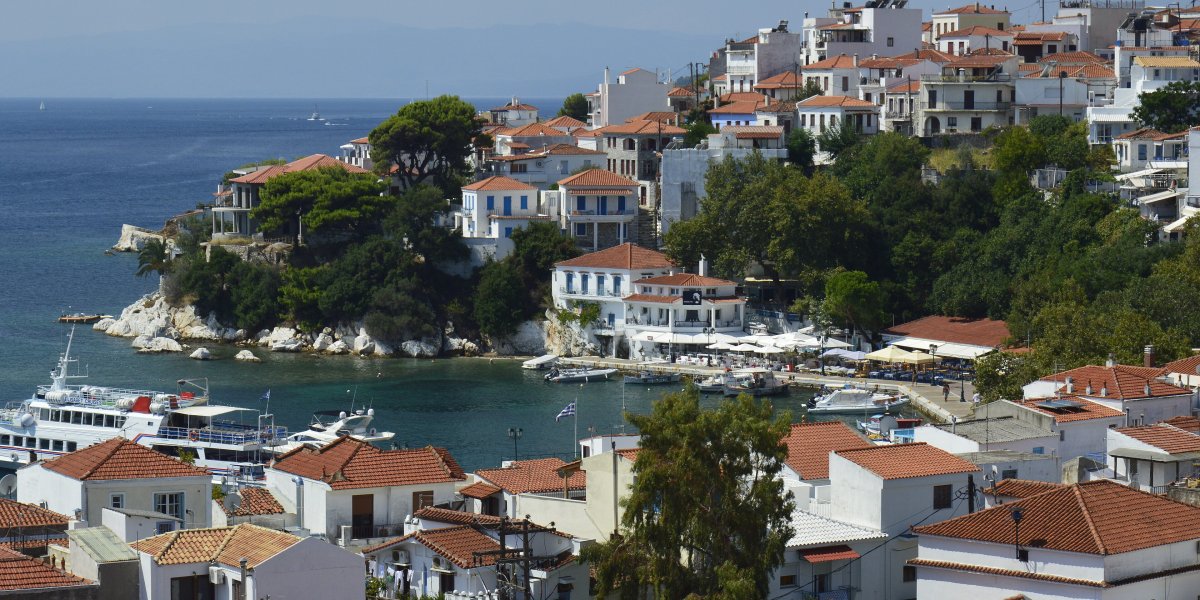
From the waterfront promenade, follow the cobbled causeway five minutes out onto the tiny fortified peninsula that splits Skiathos harbor in two — wooden caïques drifting on one side, the New Port ferries on the other. At this hour the cruise day-trippers haven't landed and the morning sun catches the eastern pines, throwing long shadows across the 13th-century Venetian fortress walls and the open-air stone theatre. Walk to the seaward tip for the cleanest 360° harbor shot you'll get all day — Chora's whitewashed houses spilling down the slope behind you, the silhouettes of Tsougria and Tsougriaki islets out across the water.
Tip: The peninsula is unlocked 24/7 and completely empty before 09:00 — by 10:30 the first cruises from Skopelos and the Pelion mainland dump 300 visitors through the gate. Stand on the southwestern tip (left as you walk out) to frame Chora and the Three Windmills in a single shot with morning light hitting them head-on; from the eastern tip the camera shoots straight into the sun and the photo is blown out.
Open in Google Maps →09:00
Landmark
Walk back off the causeway and turn right along the Old Port quay for 200 meters — fishing boats unloading the night's catch on your left — then take the marble staircase signposted 'Agios Nikolaos.' Eighty steps up, the blue-domed whitewashed chapel sits on the highest point of Chora, ringed by three restored stone windmills (Anemomyloi). Climb now while your legs are fresh: the panorama spans the entire harbor, Bourtzi below you, the pine-covered islets out to sea, and on clear mornings the long shoulder of Skopelos behind them.
Tip: The west-facing windmill is the postcard angle — wait for a fishing boat to enter the frame below for scale. The church interior is usually shut on weekday mornings; don't waste energy hovering. There's a single wooden bench at the back of the chapel platform behind the second windmill — sit there five minutes with a coffee from the kiosk halfway up the stairs, it's the quietest viewpoint on the island and almost no day-tripper finds it.
Open in Google Maps →10:30
Neighborhood
Descend the windmill stairs and drop straight into the warren of whitewashed alleys behind the Old Port — no map needed, just keep heading downhill and slightly west. This is the writer Alexandros Papadiamantis's old neighborhood, the literary heart of modern Greece: bougainvillea spilling over cobalt-blue shutters, cats sleeping on warm doorsteps, hidden chapels barely two meters wide. Pass the Papadiamantis House on its small square (exterior only — a low stone cottage with green wooden doors), then weave through the back lanes of Limnia inland of it before popping out onto Papadiamantis Street and walking it end-to-end down to the harbor.
Tip: Skip the souvenir shops directly on Papadiamantis Street — every one of them is tourist markup. The real finds are one alley parallel inland: Galerie Varsakis (vintage textiles and antique kilims that the Athens dealers come down to buy) and the tiny Loulaki ceramic studio. Keep your eyes raised constantly — the painted wooden balconies above first-floor level are the photogenic layer everyone scrolling their phones misses.
Open in Google Maps →12:00
Food
From the foot of Papadiamantis Street, walk one block back inland to the corner kiosk — the unmissable charcoal smoke and the queue of Greek men in fishing caps tells you you've found it. Stathis has been spinning pork and chicken on the same vertical spit for over thirty years, and locals order at the window without ever looking at the menu. This is exactly the right kind of lunch before a long coastal walk: fast, salty, finishes in your hand, no waiter to flag down.
Tip: Order the pork gyros pita (€4) with extra tzatziki — ask for it 'apo'ola' (with everything: tomato, onion, fries inside the pita). Add a single grilled loukaniko sausage on the side (€5) for protein before the long walk. Eat standing at the marble counter outside; sitting at the two indoor tables incurs a 15% service surcharge for table service. There's a public fountain in the square 50m down, fill your water bottle there instead of paying €2 at the kiosk.
Open in Google Maps →13:00
Park
Walk west out of the Old Port along the seafront promenade past Megali Ammos, then stay on the coastal road southwest — the next 12 kilometers are the walk you came here to do. The road hugs the south coast through Achladies, Tzaneria, Vromolimnos, and Banana beaches, slipping in and out of shaded Aleppo-pine stretches with the Aegean glittering on your left the entire way (allow 3 hours at a steady power-walk pace; ankle-supportive shoes, not flip-flops). The road delivers you straight into Koukounaries: a 1.2 km arc of fine pale sand backed by the densest stand of pines in the Mediterranean, with the protected Strofilia wetlands lagoon directly behind it. Drop your pack, swim until the light turns amber, then walk the full length of the sand barefoot for sunset — the sun drops behind the southwestern headland and sets the pine canopy on fire from below.
Tip: Beach access is free; sunbed-and-umbrella sets cost €15-20 from the central concessions — skip them. Walk to the far western end of the beach (ten minutes past the last umbrella row) where the pines come right down to the sand and the crowd thins to almost nothing — this is also where the sunset light through the trunks is strongest. The water shelves gently for 30 meters before deepening, so the late-afternoon light through the shallows is the photo everyone wants. Public bus #1 runs back to Chora every 20 minutes from the Koukounaries terminal until 23:30 (€2.50) if your legs refuse the return walk.
Open in Google Maps →19:30
Food
Walk inland off the sand 400 meters along the beach access road — Maistrali sits on the right under a canopy of bamboo and grapevine, the charcoal smoke from the grill visible before the sign is. This is the Koukounaries taverna that the bus drivers and lifeguards actually eat at after their shifts, family-run since the 1980s, with grilled meze brought to the table without ceremony. The white wine comes in a copper carafe straight from the barrel and the bread is still warm.
Tip: Order the grilled octopus (€18 — charred outside, gelatinous inside, served with olive oil and oregano on the side) and the local 'gouna' sun-dried mackerel grilled over coals (€14) — these are the two dishes Skiathos fishermen actually eat at home. Skip the moussaka here, it's reheated. Arrive by 19:30 sharp to grab a corner table under the grapevine before the 20:30 bus-tour wave lands. Final warning for the day: every taverna with sea-view tables directly ON Koukounaries beach itself (Cabana, Galini, the beach-bar row) is a tourist trap with €30 fish-and-chips and watered-down cocktails — the 400m inland walk to Maistrali halves your bill and doubles the quality of every plate.
Open in Google Maps →Aller au jour
09:00
Landmark
Begin the day on the pine-shaded peninsula that splits Skiathos Town's twin harbors. Walk the short wooden causeway out to the 13th-century Venetian fort ruins, where the cypress trees frame postcard views of fishing caïques on one side and the cruise pier on the other. At 09:00 the morning ferries are loading on the western flank, painting the limewashed houses gold while the eastern Old Port stays glassy and quiet — you get both moods in a single 200-metre stroll.
Tip: Stand on the eastern tip of Bourtzi and shoot back toward the Old Port — the sun rises behind you and lights the white chapels of Plakes hill from the side. By 10:30 cruise excursionists arrive and the peninsula becomes a selfie queue; you'll have it almost to yourself before then.
Open in Google Maps →10:30
Museum
Retrace the wooden pier back to land and walk 4 minutes through the marina onto Plateia Papadiamanti — the tiny pedestrian square named after Greece's most beloved short-story writer is on your right. The 1860s stone cottage where he was born and died is now a single-floor museum: his iron-frame bed, the inkwell he wrote 'The Murderess' on, faded family photographs. Greek visitors pause here with the reverence Americans reserve for Hemingway's Key West — for islanders, this is the literary soul of the Sporades.
Tip: The museum is closed Mondays and only open 09:30-13:00 and 17:00-20:00 — morning is the only realistic slot if you also want a sit-down lunch. The bilingual one-page handout at the entrance is the only English context inside; read it first, otherwise the displays feel like a stranger's attic.
Open in Google Maps →12:30
Food
Step out of the museum and cut 90 seconds uphill into the back lanes — Bakaliko sits on a vine-shaded corner where you can hear the bell of the cathedral but not the harbor crowds. The kitchen is an old grocery (bakaliko) converted into a meze taverna, and locals come for the slow-cooked rooster with hilopites pasta (€14) and the smoked-mackerel salad with caper leaves (€9). Order the mountain-greens pie with the housemade phyllo (€8) — it's the dish Skiathos grandmothers still make on Sundays.
Tip: No reservations — arrive by 12:30 sharp to claim a corner table on the upper terrace before the 13:30 rush from the boat tours. Skip the bottled water; ask for 'kanata nero' (a carafe of cold tap water) — it's free and standard for Greeks, but tourists are often defaulted to €4 Sanpellegrino.
Open in Google Maps →14:30
Neighborhood
From the taverna, climb the stepped lane of Evangelistrias for 6 minutes — the air cools as bougainvillea spills over whitewashed walls and stray cats sleep on doorsteps. You emerge into Plakes, the upper old town where Skiathiots still actually live: laundry on lines, basil pots on every windowsill, no souvenir shops. The 1846 cathedral of the Three Hierarchs sits at the crown of the hill with a carved wooden iconostasis brought from Mount Athos and a courtyard view down to Bourtzi that no postcard captures correctly.
Tip: Afternoon light here is exceptional between 15:00 and 16:30 — the low sun rakes sideways across the whitewashed alleys and turns the blue shutters luminous. The cathedral closes at 13:00 for siesta but reopens at 17:00; if you want to see the interior, swap the order and do Plakes after Agios Nikolaos.
Open in Google Maps →16:30
Religious
Wander 8 minutes along the ridge path north from the cathedral — you'll pass two windmills (one converted into a private home) before the blue-domed Agios Nikolaos comes into view perched on its own rocky outcrop. Climb the 60 stone steps to the belltower terrace: from here the entire crescent of Skiathos Town spreads below you, Bourtzi juts into the water like a green thumb, and on a clear afternoon you can see Skopelos and Alonissos floating to the east. This is the spot every islander brings out-of-town friends to at golden hour.
Tip: Sunset in summer falls behind your left shoulder around 20:45 — the light turns the harbor amber from roughly 19:00 onward. Bring a light layer; the northerly meltemi wind funnels straight across this terrace and the temperature drops 5°C the moment the sun touches the horizon.
Open in Google Maps →20:00
Food
Descend the stepped lanes back into Plakes for 7 minutes — Marmita's lantern-lit courtyard hides behind a wooden gate on Evangelistrias Street, with bougainvillea overhead and gravel underfoot. The chef revisits Skiathiot recipes with modern restraint: the rooster cooked in red wine with handmade trahanas pasta (€22) is the signature, and the local goat slow-braised with mountain thyme (€26) is what regulars order on a second visit. Pair with a half-litre of the house Limnio red from neighbouring Limnos (€12).
Tip: Reserve 48 hours ahead in high season (June-September) — the courtyard has only 14 tables and turns away walk-ins by 20:30. Avoid the harbor-front 'tourist menu' restaurants below with multilingual photo menus and English-speaking touts at the door; they typically run 40% pricier and serve frozen calamari sold as 'fresh catch.' Real locals eat one street back from the waterfront — Plakes and Papadiamanti Square are where Skiathiots themselves dine.
Open in Google Maps →09:00
Park
Catch the 08:15 bus from Skiathos Town's seafront bus stop (line to Koukounaries, €2.50, every 20 minutes); it terminates at the beach entrance after a 25-minute ride along the south coast. A 90-second walk through the protected umbrella-pine grove brings you onto the kilometre-long crescent of pale gold sand — consistently ranked among Europe's top three beaches and the reason most travelers come to Skiathos in the first place. At 09:00 the loungers are still being raked and the water is so still you can see your toes in two metres of turquoise.
Tip: Walk to the far western end of the beach (a 10-minute stroll along the sand) — the loungers there are €10/pair instead of €25 closer to the bar, and the snorkeling along the rocky cape is the best on the south coast. The water turns choppy after 13:00 when the meltemi wind picks up; swim before noon.
Open in Google Maps →11:30
Park
Behind Koukounaries Beach, a wooden boardwalk slips into the umbrella-pine forest — 3 minutes in, you emerge at the brackish Strofilia Lagoon, a Natura 2000 wetland that almost no day-tripper bothers to find. Loop the 1.2-km perimeter trail in shade and silence; you'll spot herons stalking the shallows, terrapins sunning on logs, and yellow water lilies in the inland corners. The contrast with the beach 200 metres away — crowds replaced by birdsong — is the day's quiet surprise.
Tip: Take the inland (northern) fork at the trail split — it passes the freshwater spring where local horses still come to drink and is 5°C cooler than the boardwalk in midsummer. Mosquito repellent is essential after rainy weeks; the lagoon's microclimate is otherwise the only relief from the August sun on the island.
Open in Google Maps →13:00
Food
Walk 6 minutes east along the pine-shaded coastal road — Elia sits one terrace above the sand on the eastern lip of Koukounaries, with olive trees growing through the deck and a postcard view down the bay. The kitchen is famous for the Skiathos-style lobster pasta with handmade tagliatelle (€32 for two to share) and the grilled octopus with fava bean purée (€16). For a lighter midday option, the prawn-saganaki in tomato-feta crust (€18) and a Greek salad with the island's caper leaves (€10) is exactly the lunch this beach deserves.
Tip: Book a 13:00 table the night before — Elia opens at 12:30 and is full by 13:15 in July-August. Ask specifically for the front terrace ('proti seira') — the inside dining room has the same kitchen but loses the view that makes the meal.
Open in Google Maps →15:00
Park
From Elia, follow the small marked footpath that climbs west over the Pounta headland — 15 minutes through cyclamen and wild oregano brings you to a sudden overlook above Krassa, a horseshoe of fine white sand wedged between two pine-covered cliffs. The water here drops to deep cobalt within five metres of the shore, which is why Krassa is the south coast's prime swimming and snorkeling cove. It's busier than Koukounaries was at dawn, but the energy is buoyant rather than packed — beach bar, paddleboards, and a younger crowd.
Tip: The right-hand (western) end of the beach is the quieter, more local stretch — the bar dominates the centre but the loungers thin out 80 metres west. Don't rent a paddleboard from the beach bar (€20/hour); the kiosk at the trail entrance charges €12 for the identical board.
Open in Google Maps →17:30
Park
Take the marked path that climbs east from Krassa over the next small headland — 12 minutes through fragrant pine brings you down to Spartochori, the smaller and wilder cousin known locally as Little Banana. This is the south coast's clothing-optional beach and so the crowd is older, quieter, and entirely about the water rather than the scene. Late afternoon light catches the cliffs from the west and turns the whole cove pink-gold; the meltemi has usually settled by 17:30 and the sea returns to glass.
Tip: Bring water — Spartochori has no bar and no shop, and the climb back over the headland in the heat catches people out. The last bus from Koukounaries back to town runs at 23:15 in summer; the 19:00 service is the easiest to catch from the beach-entrance stop after a sundown swim.
Open in Google Maps →20:00
Food
Walk 18 minutes back across the headland path to the Koukounaries beach road — Infinity Blue is on the second-floor terrace at the eastern end of the bay, with an unbroken horizon view across the Aegean toward Skopelos. The kitchen leans modern-Greek with serious technique: the lamb shank slow-cooked in Mavrodaphne wine with smoked aubergine (€28), and the sea-bass fillet with samphire and lemon-thyme oil (€26). Order the deconstructed baklava with mastic ice cream (€9) and watch the lights of the night ferries crossing to Volos.
Tip: Reserve the day before and request the corner terrace table marked 'T1' — it sits directly above the pine canopy with no rail in your sightline. One last pitfall to know: at the bus stop and Old Port you'll be approached all weekend by men offering 'private speedboat to Lalaria Beach' for €100/person — these are unlicensed and uninsured. The only safe option is the licensed group caïques from Skiathos Old Port (€35 with cave stops, departing 10:00 daily). Equally, beach loungers across the island officially cost €10-15/pair but operators routinely quote tourists €30-40 — agree on the price before sitting down and pay only on departure.
Open in Google Maps →
Trip builder
Plan this trip around Skiathos
Turn this guide into a bookable rail itinerary with FlipEarth.
Keep exploring
Related cities
More in the same country
FAQ
Frequently asked questions
How many days do you need in Skiathos?
Most travelers enjoy Skiathos in 1 days, with enough time for headline sights and a slower meal or museum stop.
What's the best time to visit Skiathos?
The easiest season for most travelers is May-Oct, especially if you want good weather and manageable crowds.
What's the daily budget for Skiathos?
A practical starting point is about €75 per person per day before hotels, then adjust based on museums, dining, and transport.
What are the must-see attractions in Skiathos?
A good first shortlist for Skiathos includes Bourtzi Peninsula, Agios Nikolaos Church & The Three Windmills.