City Guide
Corfu
Grèce · Best time to visit: May-Oct.
Day-by-day plan
Choose your pace
Durée du voyage
09:00
Landmark
From the old port, walk uphill past the fish market — the fortress entrance is a five-minute climb through a stone tunnel that opens onto the ramparts. Built by the Venetians in 1577 as a last line of defense against the Ottomans, the New Fortress rewards the climb with the single best panorama on the island: terracotta rooftops tumbling toward the harbor, the Albanian mountains floating just two kilometers across the turquoise strait, and the Old Fortress guarding the opposite headland like a stone fist. Do this climb first while your legs are fresh — it is the steepest ascent of the day, and the morning sun flooding the town below turns every rooftop to copper.
Tip: Arrive right at opening and you'll own the ramparts for a solid 20 minutes before the first cruise-ship groups lumber up the hill. The best photo angle is from the northeast bastion, where the Old Town rooftops and Old Fortress line up with the Albanian coastline behind them. Skip the small café at the top — better coffee waits in the old town below.
Open in Google Maps →10:45
Neighborhood
Exit the fortress from the lower gate and within two minutes you are swallowed by Campiello, the oldest residential quarter in Corfu. The kantounia — alleys so narrow your shoulders nearly brush both walls — twist past four-story Venetian townhouses with crumbling ochre facades, iron balconies heavy with jasmine, and laundry strung between shuttered windows. Follow the tallest bell tower on the island to the Church of Saint Spyridon, patron saint of Corfu, whose deep red tower against the blue sky is the most photographed silhouette on the island. Let yourself get genuinely lost — every wrong turn in Campiello leads to a sun-drenched courtyard or a cat asleep on a marble wellhead.
Tip: The most photogenic alley connects Guilford Street to Filarmonikis — look for the stone archway draped in ivy with laundry overhead. Before 11:30, the sun filters through the narrow gaps between buildings in dramatic golden shafts that vanish entirely by midday. If you spot an open courtyard door, peek inside — Campiello residents rarely mind a polite visitor admiring their hidden gardens.
Open in Google Maps →12:30
Food
Walk south through the old market street for three minutes — Rouvas is the unmarked storefront with a glass counter and plastic chairs that every shopkeeper in the neighborhood has eaten at since the 1940s. There is no website, no English sign, and no Instagram presence — just trays of daily-cooked dishes behind glass. Point at what looks good: the pastitsada, braised beef in cinnamon-spiced tomato sauce over thick tubular pasta (€8), is arguably the best-value version on the island. The moussaka (€7) arrives in portions sized for dockworkers. Order at the counter, sit down, and you are back on your feet in twenty minutes having spent under €12.
Tip: Arrive before 12:30 or the best trays will be half empty. There is no English menu — point and smile. Tap water in Corfu is clean and free, so skip the bottled water. If the pastitsada tray is already gone, the daily gemista (stuffed tomatoes and peppers, €6) is the next best move.
Open in Google Maps →13:30
Landmark
Walk east from Rouvas through the old market street — after five minutes the cramped alleys explode into Spianada, the largest public square in the Balkans. Napoleon's engineers modeled the Liston arcade after the Rue de Rivoli: a long colonnade of honey-colored arches sheltering the most elegant café terraces in Greece. Under the arcades, Corfiots nurse a single ginger beer for hours while the world rushes past. Across the green, a cricket pitch — yes, cricket, a relic of British rule that Corfiots adopted with genuine passion — stretches toward the Maitland Rotunda gleaming at the southern end. Walk the full length of the Liston slowly: the early-afternoon sun strikes the arches head-on, turning the stone to warm gold.
Tip: Order a tsitsibira (Corfiot ginger beer, €3–4) at any Liston café — this hyper-local specialty exists nowhere else in Greece and has been brewed here since the British garrison days. Grab a table under the deepest arch for shade and the best people-watching angle. Do not confuse the Liston with the cheaper café strip one block west — the arches are the real thing.
Open in Google Maps →15:00
Landmark
Walk east across the Spianada past the cricket pitch — the bridge to the Old Fortress spans a Venetian-carved sea moat, and the approach alone, with sheer walls rising from turquoise water on both sides, is one of the most dramatic entrances on any Greek island. This headland has been fortified since the sixth century; the Venetians rebuilt it into the impregnable citadel before you. Two rocky peaks define the skyline — the word Corfu itself derives from the Greek koryphai, meaning peaks. Climb to the lighthouse on the higher summit for a view that sweeps from the island's eastern beaches to the mountains of mainland Epirus. At this hour, the afternoon light turns the fortress stone to amber and the Ionian below deepens from pale turquoise to cobalt.
Tip: Head straight for the lighthouse summit on the taller peak — skip the lower Church of Agios Georgios, a 19th-century British rebuilding with no original character, and save your legs for the panorama that justifies the entrance fee. The eastern ramparts catch a cooling breeze even on the hottest August afternoons. Bring water — there is no shade on the upper path and no vendor at the top.
Open in Google Maps →19:00
Food
Cross back over the fortress bridge and walk three minutes along the Spianada's northern edge — Rex occupies a neoclassical corner where the Liston meets the square, its terrace framing the fortress you just conquered. A Corfu institution since 1932, this is where you eat the dish the island is famous for: sofrito, thin veal slices slow-braised in white wine, garlic, and white pepper, served over mashed potatoes so impossibly creamy they deserve their own postcard (€16). Start with bourdeto, the spicy scorpionfish stew that fishermen's wives invented to use up the morning's unsold catch (€14), and pair it all with a glass of local Kakotrygis white wine (€5). Budget €30–40 for a proper farewell to Corfu.
Tip: Reserve a terrace table for 19:00 — the fortress glows in golden hour and the Spianada fills with Corfiots on their evening volta, making it the best free show in town. Order from the regular menu, not the laminated tourist menu some waiters present first — it costs more and tastes less. One warning to carry with you: the string of waterfront restaurants lining the old port below the New Fortress are tourist traps serving microwaved moussaka at double the price with half the soul — you have already eaten at the right places today, so do not let a harbor view undo your good judgment on the way back to the ship.
Open in Google Maps →Aller au jour
09:00
Landmark
Cross the bridge over the Venetian-carved sea moat from the east edge of Spianada Square — sheer stone walls dropping into turquoise water on both sides make this one of the most dramatic fortress entrances in the Mediterranean. This citadel stopped the Ottoman Empire at the gates of Western Europe; the name Corfu itself comes from the Greek koryphai, meaning the two peaks that define this headland. Climb the zigzag stone path to the lighthouse on the higher summit for a 360-degree panorama: Albanian mountains across the strait, Old Town's terracotta roofs tumbling westward, and the Ionian stretching south toward Paxos. The morning sun paints the eastern ramparts honey-gold while the interior paths remain cool and empty.
Tip: Head directly up to the lighthouse summit — the lower Church of Agios Georgios is a bland 19th-century British rebuild not worth the detour. The climb takes 15 minutes but the view is the entire reason to come. Arrive right at 09:00 opening and you'll own the ramparts for a solid half hour before the first cruise-ship groups lumber up the hill.
Open in Google Maps →10:45
Neighborhood
Exit the fortress, cross back over the bridge, and plunge into Old Town's narrow kantounia — turn right on Filellinon street and let the maze swallow you, using the red-domed bell tower of Saint Spyridon, the tallest in Corfu, as your compass. The alleys of Campiello are so narrow your shoulders nearly brush both walls of four-story Venetian townhouses with crumbling ochre facades, iron balconies heavy with jasmine, and laundry strung between shuttered windows. Follow the bell tower to the Church of Saint Spyridon, where the embalmed body of Corfu's patron saint rests in a jewel-studded silver reliquary — locals believe he has saved the island from plague, famine, and Turkish invasion four times, and priests replace his slippers each year because legend says he wears them out walking the island at night. Let yourself get genuinely lost afterward — every wrong turn leads to a sun-drenched courtyard or a cat asleep on a marble wellhead.
Tip: The most photogenic alley connects Guilford Street to Filarmonikis — look for the stone archway draped in ivy with laundry overhead. Before 11:30, the sun slices through the narrow gaps between buildings in dramatic golden shafts that vanish entirely by midday. Inside the church, the incense-heavy interior with its painted ceiling is most atmospheric right before noon when light streams through the side windows.
Open in Google Maps →12:30
Food
Walk south through the old market street for three minutes — Rouvas is the unmarked storefront with a glass counter and plastic chairs that every shopkeeper in the neighborhood has eaten at since the 1940s. There is no website, no English sign, and no Instagram presence — just trays of daily-cooked dishes behind glass. Point at what looks good: the pastitsada, braised beef in cinnamon-spiced tomato sauce over thick tubular pasta (€8), is the best-value version on the island, and the moussaka (€7) arrives in portions sized for dockworkers. Order at the counter, sit down, and you are back on your feet in twenty minutes having spent under €12.
Tip: Arrive before 12:30 or the best trays will be half empty. There is no English menu — point and smile. Tap water in Corfu is clean and free, so skip the bottled water. If the pastitsada tray is already gone, the daily gemista (stuffed tomatoes and peppers, €6) is the next best move.
Open in Google Maps →13:15
Landmark
Walk east from Rouvas through the old market street — in five minutes the cramped alleys explode into Spianada, the largest public square in the Balkans, with the honey-colored arcades of the Liston stretching before you. Napoleon's engineers modeled the Liston after the Rue de Rivoli in 1807, a long colonnade of arches sheltering the most elegant café terraces in Greece — originally restricted to nobility listed in the Libro d'Oro. Cross the green to find the Victorian bandstand and the cricket pitch — yes, cricket, a relic of British rule that Corfiots adopted with genuine passion and still play every weekend. The early-afternoon sun strikes the arches head-on, turning the stone to warm gold and making this the single best hour for photographs of the arcade.
Tip: Order a tsitsibira (Corfiot ginger beer, €3-4) at any Liston café — this hyper-local specialty exists nowhere else in Greece and has been brewed here since the British garrison days. The best photo angle of the full Liston arcade is from the Spianada bandstand, shooting west in the afternoon light. Do not confuse the Liston arches with the cheaper café strip one block west — the colonnade is the real thing.
Open in Google Maps →14:45
Landmark
From the north end of Spianada, walk west into the market streets — follow Solomou street uphill for 10 minutes through the everyday Corfu of butcher shops and vegetable stalls until the massive Venetian walls loom above you. Built in 1577 to complement the Old Fortress, the Neo Frourio rewards the climb with something its older sibling cannot offer: the view back over Old Town itself, a cascade of terracotta roofs, bell towers, and laundry strung between buildings tumbling toward the harbor. The interior is raw and atmospheric — tunnels, stone chambers, hidden staircases — with none of the museum-ification of the Old Fortress across the square. Climb to the highest bastion for a panorama stretching from the Old Fortress headland to the green slopes of Mount Pantokrator, with the Albanian coastline floating across the strait and the western light making the massive walls glow amber.
Tip: The entrance is confusingly signed — take the ramp on the left side of the fortress facing from town, not the steps on the right which lead to a dead end. The rooftop café at the summit serves cold Mythos beer (€4) with arguably the best view in Corfu, and most visitors miss it entirely. Save this fortress for the afternoon: by now the tour groups have left, and the golden-hour light on Old Town below is at its most photogenic.
Open in Google Maps →19:00
Food
Descend from the New Fortress back into Old Town — weave south through the kantounia for 12 minutes, following narrow Agios Spyridonos street downhill until you emerge into the tiny, hidden Plateia Kremasti, where lanterns are already being lit around an ancient stone well. This is the most romantic dinner in Corfu and one of the best restaurants in the Ionian islands: the chef reworks Corfiot traditions with precision, and the courtyard setting around the centuries-old wellhead is intimate without being precious. The slow-cooked lamb with Corfiot kumquat glaze (€22) is meltingly tender, and the seared octopus with fava purée (€18) is a masterclass in restraint. The wine list features rare Corfiot varieties like Kakotrygis and Petrokoritho that you will not find off-island — ask for a glass of each and taste what this volcanic soil produces.
Tip: Reserve at least two days ahead for an outdoor courtyard table — there are only eight, and they fill by 19:30 every evening from May through September. Order the sofrito if you missed it at lunch — the Venetian Well's version, with white pepper and a whisper of vinegar, is the most refined on the island. One warning to carry through your trip: the string of waterfront restaurants lining the old port below the New Fortress are tourist traps serving microwaved moussaka at double the price with laminated photo menus — a reliable sign to keep walking.
Open in Google Maps →09:00
Museum
Take the Green KTEL bus from San Rocco Square (Benitses direction, every 30-40 minutes, €1.80) — the 25-minute ride climbs through silver-green olive groves to the hilltop village of Gastouri, where signs point uphill for a five-minute walk to the palace gates. Empress Elisabeth of Austria — the restless, poetry-obsessed Sisi — built this palace in 1890 as her escape from the suffocating Habsburg court, filling the terraced gardens with statues of her personal hero Achilles. The grounds cascade toward the sea with views to the Greek mainland, and the Dying Achilles statue on the lowest terrace — Sisi's own commission, depicting the hero in his final vulnerable moment — is one of the most emotionally powerful sculptures on any Greek island. Inside, imperial rooms hold ceiling frescoes, Sisi's private chapel, and the desk where Kaiser Wilhelm II later plotted wartime strategy after purchasing the palace.
Tip: Turn right immediately after entering and go to the gardens first — the palace rooms are interesting but the gardens are transcendent in soft morning light, and by 10:30 cruise-ship buses arrive in waves. The colossal Victorious Achilles at the north end was Kaiser Wilhelm's bombastic addition; Sisi's original Dying Achilles on the lower terrace is the one that stops people in their tracks. Allow 30 minutes in the gardens alone before heading indoors.
Open in Google Maps →11:00
Landmark
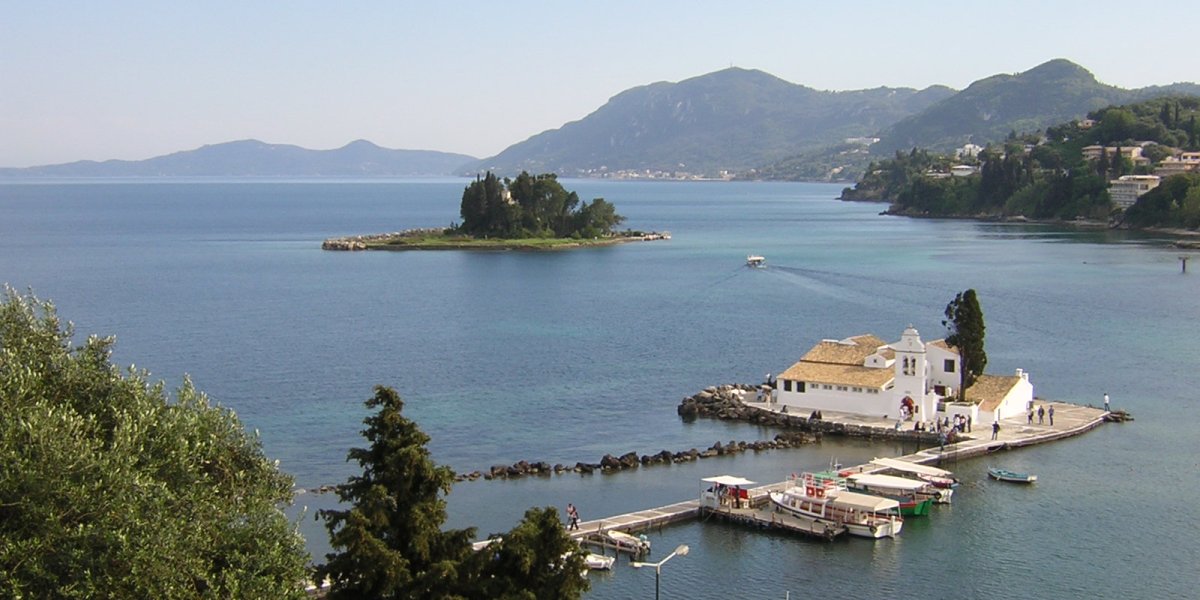
From Achilleion, take a taxi (€12, 15 minutes) winding through green hillsides with flashes of sea between the cypress trees — or take the bus back to San Rocco and Blue Bus #6 to Kanoni if you prefer to save a few euros. Stand at the Kanoni terrace and you are looking at the most photographed scene in the Ionian: the whitewashed Vlacherna Monastery perched on its narrow causeway, and just beyond, the cypress-crowned islet of Pontikonisi — Mouse Island — said to be the petrified ship of Odysseus. Walk down the stone steps and across the causeway to Vlacherna itself: the tiny chapel surrounded by turquoise shallows feels like standing at the edge of a myth, while planes from the adjacent runway roar overhead at treetop level every fifteen minutes, adding an absurd cinematic thrill that no photograph can capture.
Tip: Skip the crowded viewpoint terrace at the top — walk all the way down the steps and across the causeway to Vlacherna for photographs looking back at the hillside and out to Mouse Island. A small boat (€3 return) runs to Pontikonisi from the jetty, but the chapel on the islet is usually locked and the view from Vlacherna is better than the reality of landing. The low-flying planes are most frequent around midday, so your timing is ideal for that iconic plane-over-monastery shot.
Open in Google Maps →12:15
Food
From Kanoni, walk north along the coastal path — a flat, breezy 25-minute stroll past neoclassical villas along the Garitsa Bay waterfront and fishing boats bobbing in the shallows, entering Old Town through the southern gate and emerging onto the Liston. A Corfu institution since 1932, Rex sits under the Liston arches overlooking Spianada Square — the ideal place to rest your legs after a morning across southern Corfu. This is where you eat the island's signature dish: sofrito, thin veal slices slow-braised in white wine, garlic, and white pepper over impossibly creamy mashed potatoes (€16), paired with a glass of local Kakotrygis white wine (€5) for the quintessential Corfiot lunch under €25.
Tip: Sit on the upper floor balcony facing Spianada — it is the best people-watching seat on the island. Order from the regular Greek menu, not the laminated tourist version some waiters offer first; the regular menu has better dishes at lower prices. Budget €18-25 per person including wine. If sofrito is sold out, the bourdeto (scorpionfish in spicy paprika-tomato broth, €14) is the next best Corfiot classic.
Open in Google Maps →13:30
Park
From Rex, walk south along the palm-lined Dimokratias avenue for 15 minutes — the road hugs the Garitsa Bay waterfront with views to the mainland mountains, then curves through iron gates into the deep shade of the estate grounds. This elegant Regency-era villa set in 258 acres of botanical gardens was built for the British High Commissioner in 1831 and later became the Greek royal family's summer residence — Prince Philip, Duke of Edinburgh, was born in the dining room in 1921. The grounds outshine the building: ancient ruins of the Temple of Artemis and fragments of a Doric colonnade peek through the undergrowth, and walking paths wind through old-growth forest to hidden sea overlooks. After a morning of transit and sun, the cool canopy of ancient trees is the perfect early-afternoon recovery.
Tip: Skip the museum if pressed for time — the magic is in the grounds. Take the path south from the villa to the ruins of the Kardaki Temple on the cliff edge: a crumbling colonnade framed by cypress trees overlooking the sea, with almost no one around — Corfu's most atmospheric ruin, and most Mon Repos visitors never find it. The estate occasionally closes on Mondays; verify opening days if visiting early in the week.
Open in Google Maps →15:30
Museum
Exit Mon Repos and walk north along the Garitsa Bay waterfront — a pleasant 20-minute stroll past grand neoclassical mansions leads back into Old Town, where the colonnaded palace commands the north end of Spianada Square. This stately British-era building houses the most unexpected museum in Greece: a world-class collection of over 15,000 pieces of Asian art, from Gandhara Buddhist sculptures to samurai armor to Chinese jade, amassed by a Greek diplomat across four decades. Built in 1819 as the residence of the British High Commissioner, the Greek Revival interior is a masterpiece in its own right — the juxtaposition of Japanese woodblock prints in a Regency ballroom on a Greek island is wonderfully disorienting and a fitting reminder that Corfu has always been a place where civilizations collide.
Tip: Head straight to the Japanese collection on the upper floor — the woodblock prints and samurai armor are the highlights, and most visitors get stuck browsing the less compelling ground-floor displays. The museum closes on Mondays; verify hours if visiting early in the week. The internal courtyard café serves excellent Greek coffee and is one of Old Town's most peaceful spots to decompress before your farewell dinner.
Open in Google Maps →19:00
Food
Exit the palace onto Spianada Square, walk south through the Liston, and duck into the narrow alleys behind Saint Spyridon church — a seven-minute stroll into the quiet heart of Old Town where this intimate wine bar glows behind a stone doorway. Your farewell dinner pairs Corfiot small plates with rare Greek island wines sourced from tiny producers the sommelier has visited personally. The slow-braised pork cheeks with kumquat chutney (€16) are meltingly tender, and the grilled halloumi with local thyme honey and walnuts (€9) is a perfect wine companion — ask for a glass of Robola from neighboring Kefalonia (€7), a brilliant mineral white that captures the Ionian in a glass.
Tip: Sit at the bar if you are a couple — the bartender knows the wine list cold and will pour generous tasting portions of bottles you have never heard of. Budget €28-35 per person for several small plates and two glasses of wine. Do not buy olive oil or kumquat liqueur from the tourist shops on the main alleys near the port — they are mass-produced imports relabeled for visitors. A final Corfu rule: any restaurant displaying photos of its food on a sidewalk sandwich board is charging you double for half the quality — you have eaten at the right places these two days, so trust your instincts on the walk back.
Open in Google Maps →
Trip builder
Plan this trip around Corfu
Turn this guide into a bookable rail itinerary with FlipEarth.
Keep exploring
Related cities
More in the same country
FAQ
Frequently asked questions
How many days do you need in Corfu?
Most travelers enjoy Corfu in 1 days, with enough time for headline sights and a slower meal or museum stop.
What's the best time to visit Corfu?
The easiest season for most travelers is May-Oct, especially if you want good weather and manageable crowds.
What's the daily budget for Corfu?
A practical starting point is about €80 per person per day before hotels, then adjust based on museums, dining, and transport.
What are the must-see attractions in Corfu?
A good first shortlist for Corfu includes New Fortress (Neo Frourio), Liston Promenade and Spianada Square, Old Fortress (Palaio Frourio).