City Guide
Chania
Grèce · Best time to visit: Apr-Oct.
Day-by-day plan
Choose your pace
Durée du voyage
09:00
Neighborhood
Begin in Crete's Ottoman heart while it is still quiet — Greek grandmothers airing carpets from second-floor windows above 17th-century stone arches. Plateia 1821 is anchored by Agios Nikolaos church, the only building in Greece to wear both a minaret and a bell tower side by side (it was once the Janissaries' Mosque). The labyrinth behind the square hides forgotten Turkish fountains, grapevine-shaded courtyards, and almost no tour groups before 11:00.
Tip: Order a freddo espresso (€3) at Café Kipos under the giant plane tree on the square at 09:30 and watch the morning vegetable delivery — the most authentic 'living square' moment in the city. Walk the alleys behind the church (Daliani, Kanevarou) before you leave; this is where the cruise crowd never reaches.
Open in Google Maps →10:45
Shopping
Walk south from Plateia 1821 down Daskalogianni Street for 5 minutes, passing tailor shops and the 19th-century Hassan Pasha fountain on your right, until the cross-shaped Belle Époque hall rises ahead. Modeled on Marseille's Vieux Port market and inaugurated in 1913, the Agora's 76 stalls fan out from a central axis: mountain herbs (dittany, malotira tea), barrel-aged graviera, sea urchins still pulsing on ice, and shots of homemade tsikoudia (raki) that vendors press into your hand before you've decided to buy. This is not a tourist market — it is where Chania actually shops.
Tip: Walk the full cross-shape clockwise first without buying. Then circle back to the Sklavakis cheese stall (north arm) for 200g of two-year graviera (€18/kg) and to the green-awning herb stall opposite for a bag of dittany — together they are the most portable taste of Crete you can carry home. Avoid the rakomelo 'free shot' stalls near the entrance; they expect a €5 'thanks' purchase.
Open in Google Maps →12:30
Food
Step out the market's south exit onto Apokoronou Street — Iordanis is 30 seconds across the road, marked by a small orange sign and a queue of locals. A 1924 institution serving exactly one thing: bougatsa Hanioti, a flaky filo pie wrapped around warm myzithra (fresh local sheep's cheese), dusted with powdered sugar and cinnamon. The fourth-generation family still rolls the dough by hand on the marble counter you can watch through the window. A full portion (€4.50) plus a small Greek coffee (€2) is the complete Cretan breakfast every grandmother on the island ate as a child.
Tip: Order it μισό-μισό ('half-half') — half powdered sugar, half plain. The unsweetened side lets the salty cheese sing and is the way locals eat it. Stand at the marble counter rather than sitting outside; counter service takes 3 minutes, table service takes 20. Iordanis closes at 14:30 sharp — do not arrive after 13:45 or you will find the shutters down.
Open in Google Maps →13:30
Religious
Cross back over Apokoronou and angle northwest into the old town along Skridlof Street — known to locals as Leather Lane, ten minutes of saddlemakers, knife-grinders and ouzo merchants before the harbor reveals itself. Slip into the narrow Parodos Kondilaki to find Etz Hayyim, the only surviving Jewish site in all of Crete: a tiny 15th-century synagogue and mikvah hidden behind a courtyard gate. The community was deported in 1944 and the building was restored by survivors and friends in 1999. Continue west through the Topanas (Venetian) quarter to Firkas Fortress at the harbor mouth, where the Greek flag was first raised over Crete in 1913.
Tip: Etz Hayyim opens Mon-Fri 10-18 (closed Saturday for Shabbat, Sunday closed). Entry is free; leave €2 in the donation box. Do not photograph the interior — sit on the bench by the mikvah, and if the caretaker Anja is there she will tell the story when asked quietly. The bookshop sells Nikos Stavroulakis' slim memoir for €15: the single best souvenir you can carry out of this city.
Open in Google Maps →16:30
Landmark
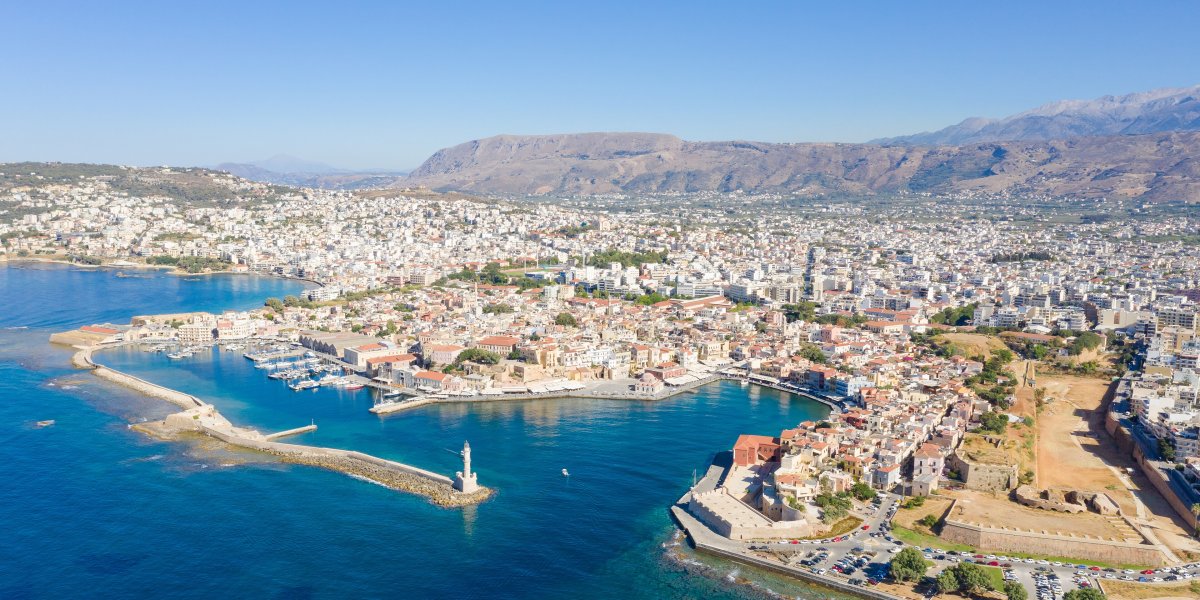
From Firkas, follow the curving stone breakwater eastward — 1.4 km of open Aegean on your left, the inner harbor lined with bobbing wooden caïques on your right. The 21-meter lighthouse at the tip is the postcard image of Crete: originally Venetian (1500s), rebuilt in its current minaret-like form during the brief Egyptian occupation of 1830-1840. You cannot climb it, but you don't need to — the reward is the 360° turnaround view of the entire Venetian harbor crescent with the snow-laced White Mountains glowing behind. This is why you came to Chania.
Tip: Time arrival for 18:00 — the breakwater faces west, so the lighthouse itself catches direct golden light from 18:30 onward (sunset ~20:10 in May, ~20:40 in July). Walk outbound while the sun is high; walk back when the harbor lamps switch on and the lighthouse silhouettes against the sky. Skip the small boats hawking 'lighthouse tours' from the harbor for €15 — it is a free 20-minute walk. There is no shade and no water along the breakwater; carry a bottle.
Open in Google Maps →19:45
Food
Leave the breakwater, follow the harbor west past the domed Mosque of the Janissaries, and turn left into narrow Zambeliou Street — Tamam is 5 minutes in on the right, a low arched doorway in pale stone. Cretan cooking served inside a restored 16th-century Turkish hammam, the original marble basins still set into the walls. The kitchen draws from Asia Minor recipes that arrived with the 1923 population exchange. Order the lamb kleftiko slow-roasted in clay paper (€16.50) and the boureki — the Chania-only dish of zucchini, potato, mizithra cheese and mint baked in filo (€11). House wine is local Vidiano, €4.50 a glass; a full dinner with wine lands around €32.
Tip: Reserve 24 hours ahead at +30 28210 96080 and ask for indoor seating 'by the marble' — the street tables miss the entire point of dining inside a 500-year-old bathhouse. Arrive at 19:45 to claim the room before the 21:00 local rush. PITFALL: avoid every single restaurant on the inner Venetian harbor crescent facing the lighthouse — they pay touts to wave laminated menus at you and charge €28 for a Greek salad. Tamam, two streets back, costs half and is where Chaniotes actually eat.
Open in Google Maps →Aller au jour
09:00
Museum
Begin where the harbor begins. The Maritime Museum sits inside the 16th-century Firkas bastion at the harbor mouth, holding model ships, WWII Battle of Crete dioramas, and a long balcony window framing the entire Venetian crescent. Arrive at the 9 a.m. opening before the day's first cruise group lands — for forty minutes the upper-floor windows are entirely yours.
Tip: Ask for the combined Maritime Museum + Firkas Fortress ticket at the desk (€4 total) — buying them separately costs more. The Cretan flagship model is tucked behind a doorway on the right of the naval-history room; most visitors walk past it.
Open in Google Maps →10:45
Landmark
Walk three minutes through the museum's inner door into Firkas itself — the cannon platform on the seaward rampart gives you the entire harbor and the Egyptian Lighthouse in one frame, which is the postcard of Chania. At this hour the morning sun strikes the lighthouse face-on, while every afternoon visitor will be shooting it back-lit and silhouetted.
Tip: Stand at the eastern rampart corner for the cleanest panorama; the western side has a Greek flag pole that always lands in the frame. The plaque marking where the modern Greek flag was first raised on Crete in 1913 is by the inner staircase — easy to miss.
Open in Google Maps →11:45
Landmark
Exit Firkas back onto the quay, turn right and follow the long stone breakwater all the way around the harbor — fifteen minutes past fishing skiffs and Venetian arsenal arches to one of the oldest lighthouses still standing in the Mediterranean, rebuilt in the 1830s during Egyptian rule. The return walk along the inner harbor at noon, with the ochre and pink Venetian facades doubled in the water, is what every traveler remembers about Chania.
Tip: The lighthouse is closed to entry, but the lower stone shelf at its base gives a horizon-level shot back at the town that no harbor café can match. The breakwater has no shade, no railings, and is wave-swept in north winds — skip it entirely on a meltemi day, the spray is not romantic.
Open in Google Maps →13:00
Food
Cut three minutes inland from the harbor up Halidon Street, then right onto Apokoronou — the unmarked marble counter at number 24 has been serving Chania's most famous bougatsa since 1924. There is one real item on the menu: warm phyllo wrapped around fresh local mizithra cheese, sliced in front of you, dusted with cinnamon.
Tip: Order the bougatsa me mizithra (€4.50), not the custard version — the salted cheese is what locals queue for, and the contrast with cinnamon is the whole point. Eat standing at the marble bar inside; pavement seats fill with tourists after 13:00. They sometimes close when the morning batch of mizithra runs out, so don't arrive after 13:30.
Open in Google Maps →15:30
Neighborhood
Walk back down Halidon and slip into the lanes west of it — Zampeliou, Theotokopoulou, Moschon, Kondylaki — a deliberately disorientating Venetian-Ottoman maze of bougainvillea, leather workshops, and crumbling Venetian mansions with carved family crests above doorways. Hidden on Parodos Kondylaki is the Etz Hayyim Synagogue, the only surviving Jewish site on Crete, restored from ruin after the entire community was deported and lost at sea in 1944; the courtyard fountain and the memorial wall are the most quietly affecting twenty minutes of the day.
Tip: The synagogue closes 13:00-15:30 daily — arriving right at the 15:30 reopening means you walk in with the staff. Entry is free but a donation is expected (€2-3). Skip Skridlof Street ('Leather Lane') — it's tourist-grade Pakistani import; the actual leather workshops are on Sifaka Street further east, where Cretans still buy shepherd boots.
Open in Google Maps →20:00
Food
Walk two minutes from the synagogue onto Zampeliou Street — Tamam occupies a 17th-century Ottoman hammam with vaulted stone ceilings and a kitchen that crosses Cretan and Anatolian flavors in a way no other Chania restaurant does. Order the boureki (zucchini, potato and mizithra pie, €11) and lamb tsigariasto slow-cooked in its own fat (€18), with a half-litre of house Vidiano white.
Tip: Reserve a day ahead and request the inner vaulted stone room — the outdoor tables in the lane fill with passing tour groups after 21:00 and the conversation noise drowns the meal. Avoid every harbor-front restaurant with a flaming-cheese photo on its menu: those €25 plates are reheated and identical between rival doormen — the alleys two streets inland is where you actually eat well in Chania.
Open in Google Maps →08:30
Museum
Catch the number 5 city bus east along Eleftheriou Venizelou to Halepa, where the new Archaeological Museum opened in 2022 — a vast, light-filled hall of Minoan clay tablets, Roman mosaics, and the famous Master Impression seal showing a king above a Minoan city. Arrive at the 8:30 opening before any tour group lands; the Hellenistic gold-leaf wreath in room 4 is the kind of object you find yourself walking back to twice.
Tip: The bus stop is right outside (line 5 toward Mournies, €1.70, every 20 min); a taxi from the harbor is €6. Closed Tuesdays — confirm before you go. Photography is allowed without flash, and the natural side-light on the Master Impression seal between 9:30 and 10:30 is the only window when its tiny carved details actually read in a photo.
Open in Google Maps →11:00
Shopping
Walk twenty-five minutes west back along Tzanakaki Street — a flat, plane-tree-lined route through the modern city — to the cross-shaped Agora, a 1913 covered market modeled on Marseille's Vieux Port halles. Wheel-sized rounds of aged graviera, hanging octopi, raki vendors handing out tasting shots before noon: this is the city's working pantry, not a souvenir bazaar.
Tip: Walk the cross's south arm first (cheese and charcuterie) and end at the east arm for raki and honey. Karydakis on the east arm sells genuine thyme honey from the Akrotiri peninsula (€8 a jar) — the only honey stall locals point you to. Skip the 'saffron tasting' and packaged olive-oil stalls flanking the main door: marked-up tourist supply, often not Cretan at all.
Open in Google Maps →13:00
Food
Two minutes south of the market on Daskalogianni Street, Kouzina E.P.E. is a no-decor, locals-only canteen where the cook chalks the day's six dishes on a board each morning — stuffed tomatoes, snails in rosemary, rabbit stifado, slow-cooked goat. Point at what looks good in the pan and lunch arrives in five minutes for €10-12.
Tip: Arrive by 13:00 — by 13:30 the best three dishes are gone. The Cretan snails (chochlioi boubouristi, €8) are the dish most tourists fear and miss; ask for them first, they are crisp and addictive in olive oil and rosemary. Say 'nero vrysis' for free tap water; bottled is an upsell every Greek restaurant tries on visitors.
Open in Google Maps →14:30
Neighborhood
Cross Daskalogianni eastward and step into Splantzia, the old Ottoman quarter — quieter than the harbor, with the Ahmet Aga minaret rising above terracotta rooftops and Plateia 1821 unfolding under one enormous plane tree, where in 1821 a bishop was hanged by the Ottomans and the square now holds a ring of cafés. Find the church of Agios Nikolaos, which uniquely carries both a minaret and a bell tower from its dual life as church and mosque, and the half-ruined hammam on Daliani Street behind its green metal gate.
Tip: Sit on the church side of the square (not the café side) for a freddo espresso (€3) — that single angle gives you the minaret, the bell tower, and the plane tree in one frame. The Daliani Street hammam isn't signposted; push the green metal gate gently, it's unlocked most afternoons. Don't photograph residents on their doorsteps — Splantzia is a lived-in neighborhood, not a film set, and people will tell you so.
Open in Google Maps →16:45
Neighborhood
Walk fifteen minutes east along the seafront, past Koum Kapi's small beach and the Enetiko café, to Tabakaria — the abandoned 19th-century leather-tanning quarter built straight onto the rocks, where stone workshops still stand open to the sea, half-roofed, half-collapsed. Late-afternoon light comes in low from the west and turns the stone gold; this is Chania's most atmospheric and least-visited corner, and you may have it entirely to yourself.
Tip: Stop at Enetiko café on the way for a frappé (€3.50) — it has the only true sea-level terrace before the tanneries. The buildings are privately owned; the seaward path is public, but don't enter any structure with a collapsed roof, the floors are rotten. The rocks become slippery the moment a wave breaks over them — keep your distance from the edge.
Open in Google Maps →20:00
Food
Walk ten minutes back uphill into Splantzia to Kalinikou Sarpaki Street — the Well of the Turk hides inside a former Ottoman house, with the courtyard built around an original working well. The kitchen is one woman cooking quietly bold Middle-Eastern-Cretan fusion: lamb with apricot and coriander (€19), smoked aubergine mezze (€8), and a rosewater semolina cake that finishes the trip.
Tip: Reserve a day ahead and ask specifically for the courtyard table by the well — the indoor stone room is beautiful but airless in summer. Closed Mondays. Walking back to the harbor at 22:00, stay on lit streets — Splantzia is safe but its lanes are disorientingly dark, and Google Maps loses signal inside the old walls. Skip every harbor-front cocktail bar on the way back to your hotel: their €14 drinks are watered down and the bills routinely add a 'service charge' that isn't legal — have your last raki at a Splantzia café instead.
Open in Google Maps →
Trip builder
Plan this trip around Chania
Turn this guide into a bookable rail itinerary with FlipEarth.
Keep exploring
Related cities
More in the same country
FAQ
Frequently asked questions
How many days do you need in Chania?
Most travelers enjoy Chania in 1 days, with enough time for headline sights and a slower meal or museum stop.
What's the best time to visit Chania?
The easiest season for most travelers is Apr-Oct, especially if you want good weather and manageable crowds.
What's the daily budget for Chania?
A practical starting point is about €120 per person per day before hotels, then adjust based on museums, dining, and transport.
What are the must-see attractions in Chania?
A good first shortlist for Chania includes Egyptian Lighthouse (Faros).