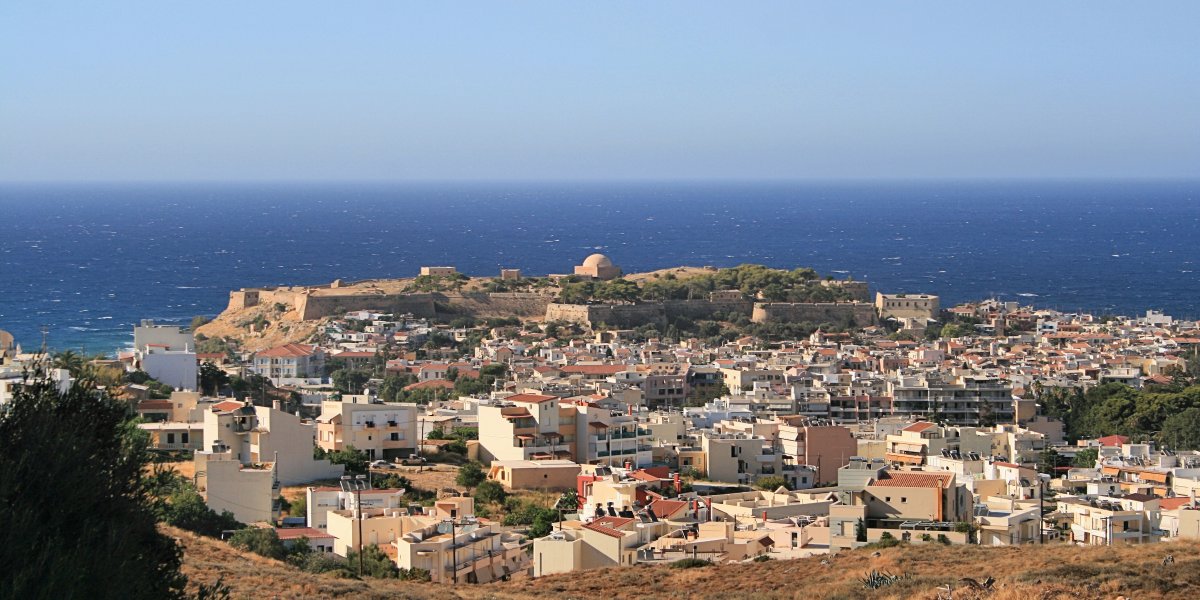
City Guide
Rethymno
Grèce · Best time to visit: Apr-Oct.
Day-by-day plan
Choose your pace
Durée du voyage
09:00
Landmark
Start at the headland — climb the cobbled Katechaki ramp uphill, ten minutes through whitewashed lanes that smell of fig leaves and jasmine before the gate rises above you. The Fortezza is the largest Venetian fortress ever built on Crete, a star-shaped citadel wrapping the entire hill, and the early hour catches its honey-colored stone before the cruise groups arrive from Heraklion. Walk the ramparts counter-clockwise — the Santa Maria bastion delivers a 270-degree view of the harbor, the old town's tile roofs, and the Cretan Sea curving toward Mount Ida.
Tip: Enter the moment doors open (08:00 in summer, 08:30 in winter) and head LEFT to climb the Santa Maria bastion first — by 10:30 every guided group plants itself there and the panorama becomes a queue. There's no shade up top; bring a hat and a 1L water bottle, the cisterns run dry by mid-morning.
Open in Google Maps →11:15
Landmark
Leave Fortezza through the main gate and wind down Salaminos and Melissinou streets — eight minutes downhill, past Venetian doorways carved with family crests and stray cats sunning on stone thresholds. You'll spill out at a perfect horseshoe of a harbor: fishing caïques in primary colors tied along the quay, the slender Egyptian-built lighthouse anchoring the far breakwater. This is the most photographed stone curve in Crete, and right now fishermen are still mending nets — no tour buses yet.
Tip: Walk to the very tip of the breakwater and turn back toward the lighthouse with the Fortezza rising behind — this is THE Rethymno postcard frame, and at 11:30 the sun lights the lighthouse face directly. Do NOT sit at any harbour-front café for a coffee; they charge 6 EUR for a frappé that's 2.50 EUR three streets inland.
Open in Google Maps →12:45
Food
Three minutes south of the harbour on Eleftheriou Venizelou — a tiny marble-countered shop with no outdoor chairs, family-run since 1924. They make exactly one thing: bougatsa, hot phyllo pastry filled with fresh Cretan mizithra cheese, dusted with sugar and cinnamon the moment it lands in front of you. Eat it standing at the counter the way truck drivers and grandmothers have been doing here for a hundred years — there is no Crete experience more authentic than this five-euro stop.
Tip: Order one bougatsa with mizithra (3.50 EUR) and one Greek coffee (1.80 EUR) — that's the entire decision, no menu exists. They sell out by 14:30 most days, so don't dawdle. If you take it to go, eat within ten minutes; once it cools the magic dies.
Open in Google Maps →13:45
Neighborhood
Two minutes south through Petichaki Square — pastry-yellow shutters, bougainvillea pouring over the lanes — and you reach Rimondi Fountain, where three Venetian lion heads have been pouring cold spring water into the same basin since 1626. Turn into narrow Vernardou Street: the Neratze minaret rises into the frame as the lane curves, a Venetian church turned Ottoman mosque, the most striking skyline note in town. Continue south on Ethnikis Antistaseos and you'll pass under Porta Guora, the only surviving gate of the Venetian walls, marking where the old town ends and the modern city begins.
Tip: From Rimondi, do NOT walk straight to the mosque — step into Vernardou Street first and let the minaret reveal itself as the lane bends; this is the angle locals photograph, hidden from the main tourist streets. The Neratze interior has been under restoration for years; admire from outside and don't waste time queueing. Skip the leather shops on Arkadiou advertising 'real Cretan leather' — almost all of it is Albanian-imported at triple markup.
Open in Google Maps →16:15
Park
Ten minutes east from Porta Guora along Arkadiou and you hit the sand — a 13-kilometer arc of beach unrolling toward Panormos in the distance, the White Mountains visible inland. Walk three or four kilometers out and back; the sun is now behind you, the light goes butter-soft across the water, and the afternoon breeze finally cuts the heat. Past the kilometer mark the loungers thin out and you'll often have whole stretches of empty sand to yourself, the kind of slow-motion seaside hour that makes the whole layover feel worth it.
Tip: Skip the first 200 meters of beach right next to the harbour — pebbly and crowded with day-trippers. Walk east five minutes and the sand turns powder-fine. For a frappé stop, the beachfront kafenia around Periandrou Street charge 3.50 EUR; the umbrella-clad mega-bars right by the harbour are 6 EUR for the identical drink.
Open in Google Maps →19:30
Food
Fifteen minutes back west along Arkadiou — Venetian doorways glowing gold as shop lamps come on, the day's heat lifting off the limestone. Castelvecchio occupies the courtyard of a 16th-century mansion on Himaras Street, honest Cretan cooking served under a canopy of grapevines and bougainvillea. Order the lamb antikristo, slow-roasted vertically beside an open fire (16 EUR), gamopilafo wedding rice cooked in lamb broth (12 EUR), and a carafe of local Vidiano white from the Amari Valley — Crete's most underrated grape and a wine you cannot drink anywhere else on earth.
Tip: Arrive by 19:45 to claim a courtyard table — after 20:30 you'll be seated indoors under fluorescent strip lights, which kills the experience. The lamb antikristo is what to order: it's the dish locals drive in from the mountains for. PITFALL: every restaurant lining the Venetian Harbour quay is a tourist trap — aggressive touts will physically wave laminated menus promising 'fresh fish 15 EUR'; the fish is frozen, the bill arrives with a 4 EUR cover per person plus a mystery 'service' charge, and the bread basket you didn't ask for is 4 EUR. Real Rethymno eats in the lanes south of Rimondi Fountain.
Open in Google Maps →
Trip builder
Plan this trip around Rethymno
Turn this guide into a bookable rail itinerary with FlipEarth.
Keep exploring
Related cities
More in the same country
FAQ
Frequently asked questions
How many days do you need in Rethymno?
Most travelers enjoy Rethymno in 1 days, with enough time for headline sights and a slower meal or museum stop.
What's the best time to visit Rethymno?
The easiest season for most travelers is Apr-Oct, especially if you want good weather and manageable crowds.
What's the daily budget for Rethymno?
A practical starting point is about €65 per person per day before hotels, then adjust based on museums, dining, and transport.
What are the must-see attractions in Rethymno?
A good first shortlist for Rethymno includes Fortezza of Rethymno, Venetian Harbour & Egyptian Lighthouse.