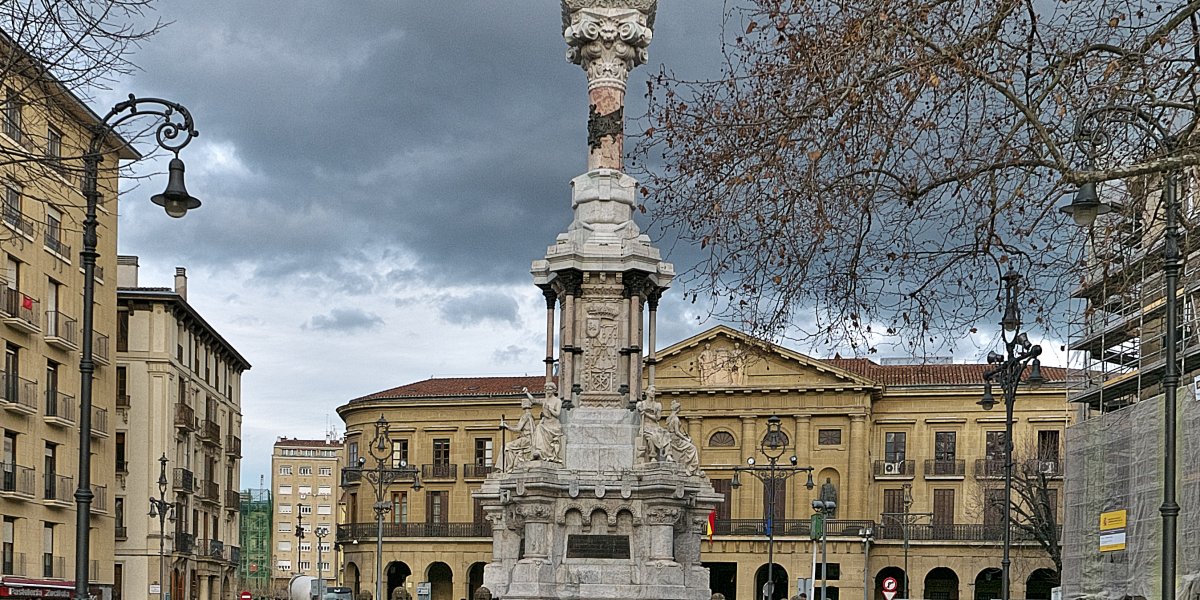
City Guide
Pamplona
Espagne · Best time to visit: May-Sep.
Day-by-day plan
Choose your pace
Durée du voyage
09:00
Landmark
Begin at the star-shaped Renaissance citadel, considered the finest 16th-century military fortification in Europe — five bastions, dry moats, drawbridges, all still intact. At this hour it belongs to joggers, dog-walkers and old men reading newspapers; the tourist coaches don't arrive until after eleven. Walk the full pentagonal perimeter (about 2.5 km), then cut through the adjoining Vuelta del Castillo lawns toward the old town.
Tip: Enter through the south gate on Avenida del Ejército and circle counterclockwise — the Baluarte de San Antón bastion (northwest corner) frames the cathedral spires across the moat for the best photo, and the morning light hits it from the right angle only between 09:00 and 10:30.
Open in Google Maps →10:45
Landmark
Walk northeast along Paseo de Sarasate for 12 minutes — this tree-lined promenade is where Pamplona's grandmothers take their morning stroll, and the bronze busts of Basque historical figures line both sides. You arrive at the bullring from the south, the same direction the bulls enter every July. Outside the ring on Avenida de Roncesvalles stands the bronze bust of Hemingway, who watched corridas here from 1923 onward, and just up the street the dramatic Monumento al Encierro captures six bulls and a tangle of runners mid-charge.
Tip: Most visitors photograph the Hemingway bust head-on and miss the inscription on the back — "hizo Pamplona famosa en el mundo entero" (he made Pamplona famous around the world). Shoot the encierro monument from the low-angle corner near Calle Tejería for the cinematic shot where the bulls appear to charge straight at the camera.
Open in Google Maps →12:00
Neighborhood
From the bullring, walk the encierro route in reverse — straight up Calle Estafeta, the narrow 400-metre canyon where the bulls thunder for 875 sweat-soaked seconds each July morning. Notice the wooden barricade slots cut into every doorway, the brass plaques marking goring sites, the closed shutters that came down in the 1970s and never reopened. The street empties into Plaza del Castillo, the city's living room — arcaded, café-lined, paved with limestone — and on the western arcade sits Café Iruña, where Hemingway wrote portions of The Sun Also Rises at the third table from the door.
Tip: Order a café solo (€2) at Iruña's marble bar and walk to the back room — the "Rincón de Hemingway" has a life-sized bronze of the writer leaning on the counter, and almost no one finds it. The waiters in long white aprons have worked there for thirty years; ask one to point to the table he used.
Open in Google Maps →13:30
Food
Two minutes from Plaza del Castillo on Travesía Espoz y Mina, this is the pintxo bar that wins the Navarra regional championship more often than any other — and locals still queue at the bar, not the tables. The counter is a glittering trench of miniature architecture: txangurro gratinado (spider-crab gratin, €3.50), the famous huevo de codorniz con foie sobre crujiente de pera (quail egg with foie on crispy pear, €3.80), and morcilla de Beintza on caramelised onion. Budget €20-28 with a glass of Navarra rosé.
Tip: Arrive at 13:30 sharp — between 14:00 and 15:30 it becomes shoulder-to-shoulder with workers from the regional government. Never sit at a table (price doubles, and you miss the show); stand at the bar, point to what you want, and pay only at the end. The huevo de codorniz is non-negotiable — it's the dish that won them the national title.
Open in Google Maps →15:30
Religious
Walk five minutes north up Calle Curia, the medieval pilgrim street still trodden by Camino de Santiago walkers — you'll pass shell-marked doorways and the scrape of trekking poles on stone. The cathedral's Neoclassical façade hides a 14th-century Gothic interior, but skip going in and instead loop around to the cloister side, where the alabaster tomb of King Carlos III sits visible through the grate. Continue along the medieval walls eastward to the Rincón del Caballo Blanco viewpoint, a flat grass terrace on the ramparts where you can see the Pyrenees on a clear afternoon and the Río Arga curling 60 metres below. Take the steep zigzag stairs down to the river path and walk the foot of the walls back up to the Portal de Francia — the gate every pilgrim has used since 1100.
Tip: The Rincón del Caballo Blanco terrace is best at 17:00-17:30 in summer — the sun is dropping behind the citadel, and the walls turn honey-gold for about twenty minutes. Don't bother with the cathedral interior unless you have a full second day; the real magic of the building is its mass seen from below, on the river path.
Open in Google Maps →20:00
Food
Walk seven minutes south through the old town's narrow lanes to Calle San Nicolás 5 — this is the parallel pintxo street to Estafeta, less photographed but where actual Pamploneses eat. Casa Otano is a 1910 inn with a wooden staircase up to a beamed dining room that smells of grilled meat and good wood smoke. Order the chuletón de vaca vieja (aged beef chop for two, €58 total) seared on the parrilla, the pochas de Sangüesa (Navarra white beans with chorizo, €14), and a half bottle of Otazu red. Budget €40-50 per person.
Tip: Book the upstairs dining room (not the ground-floor bar) by phone the morning of — the upstairs has the original 1910 wooden floor and is where the locals dine. Pitfall warning: avoid every restaurant on Plaza del Castillo itself with chalkboard menus in English and photos of paella — Pamplona is not paella country (that's Valencia, 500 km south), and those terraces charge double for half-frozen food aimed at coach tourists. The real eating streets are San Nicolás and Estafeta, one block back.
Open in Google Maps →Aller au jour
09:30
Museum
Begin at the city's northern edge inside a converted 16th-century pilgrims' hospital — a ten-minute walk downhill from any old-town hotel through the narrow lanes that smell of bread at this hour. At 9:30 opening you'll have the Roman mosaics and the Romanesque capitals of San Pedro de la Rúa entirely to yourself before the first tour buses arrive. The quiet highlight is the Goya portrait of the Marqués de San Adrián on the second floor, which most rushed visitors walk straight past.
Tip: Free Saturday afternoons and all day Sunday — but Saturday morning is the quietest hour of the week. Skip the rotating exhibits on the ground floor and head directly to Floor 2 for the Romanesque collection; that is the only reason a non-Spanish visitor comes to this museum.
Open in Google Maps →11:00
Religious
From the museum exit walk five minutes south down Calle del Redín — the narrow stone lane opens suddenly onto the cathedral's plain neoclassical façade, which gives no hint of what waits behind it. The Gothic cloister is regarded as one of the finest in Spain, and at this late-morning hour the sun cuts diagonally through the tracery onto the worn floor in a way no afternoon visit can match. Don't leave without circling the alabaster double tomb of King Carlos III and Queen Leonor in the center of the nave — the most refined royal sculpture in northern Spain.
Tip: Buy the combined Cathedral + Diocesan Museum + Tower ticket — the bell tower climb is the only elevated view of the old town and 80% of visitors skip it. Ask at the desk when the next 30-minute tower window opens; they only let small groups up on a fixed schedule.
Open in Google Maps →13:00
Food
A four-minute walk south through Plaza Consistorial brings you to Bar Gaucho on Travesía de Espoz y Mina — the small wood-paneled counter that has won the national pintxos championship more times than any other bar in the country. At lunch the bar is three deep with local office workers, which is the only proof you need. Order the Huevo de Codorniz con Boletus (3.50€) and the Solomillo con Foie (4€), wash it down with a glass of Navarran crianza (3€), and stay standing — the bar stools are reserved.
Tip: Arrive at 13:00 sharp — by 13:30 the workers' rush hits and the best pintxos run out within twenty minutes. Pay at the till near the door at the end, not at the counter, and keep every toothpick on your plate; that's how they tally your bill.
Open in Google Maps →15:00
Landmark
Step out of Bar Gaucho and cross straight into Plaza Consistorial — this is exactly where the runners gather each July 7th before the rocket fires at 8:00 sharp. Walk the full 875-meter route the bulls take: down Calle Mercaderes, sharp right onto Calle Estafeta (the longest stretch, where most photos are taken), and finally through the wooden callejón into the bullring itself. Doing it slowly in the afternoon light, with the bronze plaques marking each fatal goring underfoot, gives you the full weight of what happens on these stones every San Fermín.
Tip: Pay the 7€ at the bullring for the audio-guided self-tour — it lets you into the corrals where the bulls wait the night before the run, which is the only way to see them. The Hemingway bust at the main entrance is the standard photo, but the better shot is from the empty arena floor looking up through the dust toward the wooden bleachers.
Open in Google Maps →17:30
Neighborhood
From the bullring walk three minutes north up Paseo de Hemingway — the writer's bronze statue sits in the corner you'll pass, finger on his chin. Plaza del Castillo is Pamplona's living room, ringed by arcades; settle into a wicker chair inside Café Iruña under the gilded 1888 ceiling where Hemingway wrote and drank through the 1920s. Order a vermut de grifo (draft vermouth, 3€) and ask the waiter to walk you to El Rincón de Hemingway, the small inner room where the original marble bar still stands with the writer's bronze likeness leaning against it.
Tip: Drink only — do not eat at Iruña. The café trades on its history and the kitchen reflects exactly that; the food is overpriced banquet fare. Sit inside under the painted ceiling at the bar tables, not on the plaza terrace, where the same drink costs 2€ more for the view of buses.
Open in Google Maps →20:30
Food
A five-minute walk from Plaza del Castillo down Calle Espoz y Mina brings you to Restaurante Europa, the Idoate brothers' Michelin-starred dining room that locals still consider Pamplona's most reliable destination kitchen. The menú degustación (95€) is the smartest order — eight courses moving through Navarran lamb, the white asparagus of Tudela in season, and the celebrated huevo trufado. The room is small, formal but warm, and the service has the easy rhythm of dinner at a knowing friend's house.
Tip: Reserve at least five days ahead — Europa has only thirty seats and weekend tables are gone first. Pamplona dining warning: any restaurant in Plaza del Castillo or with a chalkboard 'menú turístico' in four languages with photos is a tourist trap charging double for half-quality food; the real kitchens hide on the side streets off Estafeta and around Mercaderes.
Open in Google Maps →09:00
Landmark
Start at the Portal de Francia, the only one of Pamplona's six original gates still in its medieval form — a ten-minute walk northeast from the cathedral down Calle del Carmen, descending the cobbled slope past the seminary garden. From the gate climb the ramparts and walk west along the Ronda Norte; this is one of the best-preserved 16th-century star fortifications in Europe, and at this hour the morning sun lights the stone bastions while the city below is still waking. The view east across the Arga river valley toward the Pyrenees is what every pilgrim sees on the morning they leave Pamplona for Santiago.
Tip: Enter the city through the Portal itself on foot, not from the top of the wall — the small bend where the gate meets the inner rampart is the exact spot where pilgrims have walked into Pamplona for a thousand years. Wear shoes with grip; the stone of the wall walk has been polished smooth and is dangerous if there was any rain overnight.
Open in Google Maps →11:00
Religious
From the walls descend at Cuesta del Palacio and walk five minutes south through the quiet Plaza San José to San Saturnino, the squat fortress-church marking the spot where the saint baptized the first citizens of Pompaelo in 64 AD. The interior is small but the late-morning sun strikes the gilded retablo at exactly this angle, and a Camino credencial stamp office sits to the right of the altar — even non-pilgrims can collect the stamp as a free souvenir of having walked the route. The bronze well in front of the church covers the original Roman baptism cistern; look down through the iron grate.
Tip: If you can be inside at 12:00 sharp, stay — San Saturnino's bell tower carries the official mariblanca chime that sets the city's hour, and the sound inside the stone nave is something you feel in your chest. The credencial stamp at the right-of-altar office is free; bring any small piece of paper if you don't have a pilgrim passport.
Open in Google Maps →13:00
Food
A two-minute walk south from San Saturnino down Calle Comedias brings you to Café Bar Roch, the city's oldest pintxos counter (1898), still run by the same family across four generations. The bar is cramped, loud, entirely Pamplonan — there are no English menus and no photos, which is why almost no foreign tourists find it. Order the croqueta de jamón (1.80€), the gilda (1.50€ — olive, anchovy and guindilla pepper on a single stick), and the iconic huevos rellenos (stuffed eggs, 1.80€), the dish Roch is famous for citywide.
Tip: The gilda is the original Basque pintxo — the correct order is olive first, then anchovy, then the pepper on its own. The husband-and-wife team behind the counter count your toothpicks at the end, so do not lose them. If the front room is shoulder-to-shoulder, the small back room often has space the front crowd doesn't notice.
Open in Google Maps →15:30
Park
Walk fifteen minutes southwest from Roch through Plaza del Castillo and down Avenida del Ejército — the plane trees of the Vuelta del Castillo open up and beyond them rise the star-shaped earth ramparts of the Citadel. Commissioned by Philip II in 1571 as one of the finest Renaissance fortifications in Europe, the pentagonal fortress is now an open public park ringed by intact stone bastions and crossed by joggers and outdoor sculpture. The afternoon light at this hour pulls long angled shadows from the bastion walls; walk the inner perimeter clockwise to pass the old armory and chapel buildings, now repurposed as free contemporary art galleries.
Tip: Enter through the original southern gate (Puerta del Socorro) rather than the modern park opening — you'll cross the dry moat exactly as the 16th-century soldiers did. The Sala de Armas usually hosts a free contemporary exhibition; check the small board outside the gate. Avoid the grass slope on the eastern bastion after rain — it drains slowly and looks dry but isn't.
Open in Google Maps →17:30
Park
From the Citadel's northern gate it's a six-minute walk up Avenida del Ejército into the Parque de la Taconera, Pamplona's oldest landscaped garden (1830), wrapped inside the medieval bastions of the old wall. The genius of Taconera is the moat: what was once the defensive ditch is now a sunken zoo where deer, peacocks and ducks roam freely; lean over the stone parapet and they look up expecting bread. At this hour Pamplonan families fill the gravel paths and the long light through the old plane trees is exactly what Hemingway described in the final pages of The Sun Also Rises.
Tip: The Café Vienés bandstand at the park's center serves a 4€ draft vermouth — the cheapest sunset drink in Pamplona with a view of the bastions. Walk the western edge along the Bulevar to find the bronze statue of the 19th-century tenor Julián Gayarre; locals touch his nose for luck as they walk past, which is why it shines.
Open in Google Maps →20:30
Food
A twelve-minute walk back into the old town brings you to Baserriberri on Calle San Nicolás, the modern-Basque kitchen by chef Mikel Aguilar that has become the most-talked-about table among Pamplona's younger chefs. The room is small, concrete-and-oak, and the kitchen sends out a tightly creative menu rooted in Navarran ingredients — order the chuletón with smoked egg yolk (28€) and the pochas verdes (white beans of Sangüesa, 14€), the dish that put the place on the map. The wine list focuses on tiny Navarran producers no app or international list will surface.
Tip: Reserve at least three days ahead — Baserriberri has 24 seats and locals fill them. Pamplona evening warning: during San Fermín week (July 6-14) every old-town restaurant triples its prices and serves a frozen 'menú de fiesta'; if you visit in that week, eat in the Ensanche district south of Plaza del Castillo where local prices still apply. Also ignore anyone selling 'private pintxos tours' outside the cathedral — the only official tour leaves from the tourist office on Plaza Consistorial.
Open in Google Maps →
Trip builder
Plan this trip around Pamplona
Turn this guide into a bookable rail itinerary with FlipEarth.
Keep exploring
Related cities
More in the same country
FAQ
Frequently asked questions
How many days do you need in Pamplona?
Most travelers enjoy Pamplona in 1 days, with enough time for headline sights and a slower meal or museum stop.
What's the best time to visit Pamplona?
The easiest season for most travelers is May-Sep, especially if you want good weather and manageable crowds.
What's the daily budget for Pamplona?
A practical starting point is about €110 per person per day before hotels, then adjust based on museums, dining, and transport.
What are the must-see attractions in Pamplona?
A good first shortlist for Pamplona includes Ciudadela de Pamplona, Plaza de Toros & Monumento al Encierro.