City Guide
Milos
Grèce · Best time to visit: May-Oct.
Day-by-day plan
Choose your pace
Durée du voyage
09:00
Landmark
From Adamas port, take the morning local bus or a 15-minute taxi north — the asphalt road ends abruptly and the world turns chalk-white. These wind-carved pumice cliffs are Milos's most famous landscape, a true lunar coastline collapsing into turquoise inlets; descend the natural rock staircase, swim in the small cove, and climb the eastern ridge for the iconic shot before the catamarans drop their day-trippers around 11:30. The early light is soft and the rock shadows are at their most dramatic — by midday everything bleaches flat.
Tip: Skip the obvious viewpoint at the parking lot — follow the unmarked footpath east for 10 minutes to find the hidden second cove with the rusted half-buried shipwreck. Bring water shoes (the rocks are sharp) and a hat; there is zero shade on the white pumice and the glare will burn through cheap sunglasses by 10:30.
Open in Google Maps →12:00
Food
Hop the local bus back to Adamas (€1.80, runs hourly) — get off at the central square and walk one block inland away from the harbor. Kivotos Geuseon is the village bakery locals queue at every morning: order a still-warm spanakopita and a slice of milk pie (galaktoboureko, €3.50), grab a cold homemade lemonade, and eat on the harbor wall watching ferries unload. Budget around €8 per person — fast, unfussy, and the best fuel for the climb up to Plaka in the afternoon.
Tip: Ask for the ladenia (Milos-style flatbread with tomato, oregano and onion, €4) — it's only baked until midday and never on tourist menus. Avoid the waterfront tavernas one row over: they charge €13 for a Greek salad you can get for €7 in the lanes behind the bakery.
Open in Google Maps →13:30
Neighborhood
From Adamas catch the Plaka-bound bus (15 min) and get off at the Tripiti–Klima junction, then walk 10 minutes down the steep cobbled path past the early Christian catacombs to sea level. Klima is the Cycladic fishing village every Greek postcard pretends to be — chest-high doors painted cobalt, scarlet, mustard and turquoise, each color marking a different family's syrma (the boat garage carved straight into the cliff below the house). The early-afternoon light here is direct and saturating; this is the photograph you will show people back home.
Tip: The widely-shared 'rainbow doors' cluster is at the southern end — walk past the first row you see and continue 80 meters along the seawall for the full color sequence. The fishermen are protective; never open a syrma door, sit on a boat, or step inside an open garage for photos — locals will (rightly) shout at you.
Open in Google Maps →15:30
Landmark
Climb back up the cobbled lane from Klima toward Tripiti — 15 minutes of switchbacks, but pause halfway to look back: the colored doors shrink into a tiny ribbon below. The Ancient Theater was carved into the hillside in the 3rd century BC and partially re-faced in white marble; the seven surviving tiers face directly across the bay and from the top row you can see the small island of Antimilos floating in the haze. Walk 200 m south afterward to the small marble plaque marking the exact spot where a farmer named Yorgos Kentrotas unearthed the Venus de Milo in 1820.
Tip: The site closes at 17:00 in summer — don't linger over coffee in Klima. Walk the rim path counterclockwise: it brings you out at a low stone wall directly above the marble tiers, the single best angle for the shot of seats-with-sea-behind, with afternoon sun lighting the marble from camera-right.
Open in Google Maps →17:00
Neighborhood
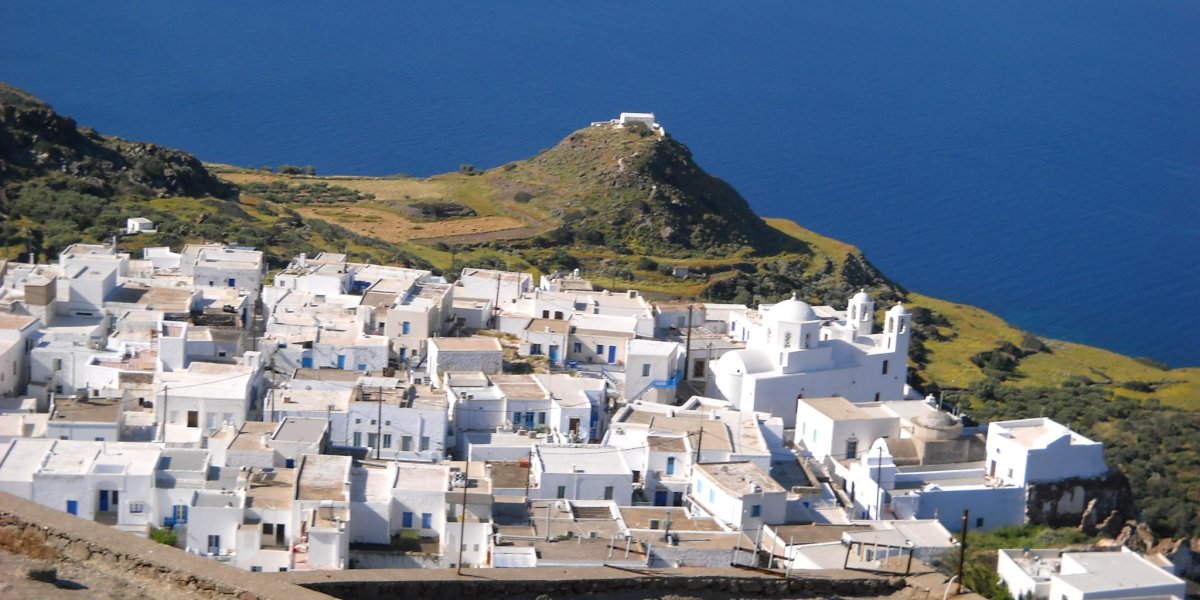
From the theater follow the ridge road west toward Plaka — 15 minutes uphill, but the panorama over the entire bay of Adamas sharpens with every step. Plaka is Milos's hilltop capital, a labyrinth of whitewashed lanes too narrow for cars; wander between the bell tower of Panagia Korfiatissa and the ruined Venetian Kastro at the very top of the village. Stake out a spot on the Kastro wall by 19:30 for what is, on a clear evening, the most spectacular Cycladic sunset that doesn't share its horizon with a cruise-ship crowd — the sun drops exactly between Sifnos and Kimolos.
Tip: Skip the Kastro summit chapel (everyone's there elbow-to-elbow) — climb instead to the tiny church of Thalassitra one terrace below for the same horizon and a third of the people. Wear shoes with grip; the marble lanes polish to a mirror and the village is unlit after sundown — bring a phone with battery for the walk down.
Open in Google Maps →20:30
Food
From the Kastro descend two minutes back into Plaka's lanes — Archontoula sits in a small whitewashed courtyard tucked just off the main square, the bougainvillea curtain you'll have already photographed at sunset. This is where Milos families bring visiting relatives: order the slow-cooked lamb kleftiko wrapped in parchment (€22), grilled octopus from the morning's catch (€18), and a half-litre of Cycladic Assyrtiko. Budget €30–38 per person — a proper, unhurried close to the day before the descent back to Adamas.
Tip: Phone to reserve same-day before 17:00 (they only hold tables for guests who call) — without a booking the wait after 21:00 stretches past an hour. Pitfall warning: avoid the Plaka restaurants with chalkboards out front promising 'sunset terrace views' — most have only one or two railing tables actually facing west and quietly add a €5/person 'view supplement' to the bill; check the menu in Greek first, and never agree to 'fish by the kilo' without asking the per-kilo price in writing.
Open in Google Maps →Aller au jour
08:30
Food
Step off the harbour road onto Aragosta's terrace, two minutes from where the Kleftiko boats moor — your fuel before a full day at sea. Order the Greek yogurt with Milos honey and walnut, and a bougatsa pastry from the warming tray; coffee here is properly Italian-pulled. Budget €10-14; arrive by 08:30 so you finish unhurried and walk straight to the pier.
Tip: Skip the freddo espresso here — it's fine but the Greek mountain tea (tsai tou vounou) is what locals nurse before a sailing day and settles a queasy stomach better than caffeine.
Open in Google Maps →09:30
Landmark
Walk 200 metres west along the Adamantas quay — you'll see the wooden sailboats lined up under the Captain Yiangos and Polco banners. The full-day route threads the south coast cliffs to Kleftiko, where 18th-century pirates hid their loot in chalk-white caves dropping straight into water so clear the anchor casts a shadow on the sand twelve metres below. You'll swim through the arches, snorkel at Sykia (a collapsed cave open to the sky), and lunch is served on board — usually grilled fish, Greek salad, and unlimited local wine — while the boat drifts off uninhabited Polyaigos. This is the experience the island is built around; nothing else on Milos comes close.
Tip: Book the sailing boat, not the speedboat — the speedboats slam through chop for two hours and you spend Kleftiko queueing behind four other groups. The sailboat takes longer, but you arrive when the speedboats have left and have the caves nearly to yourselves between 14:00-15:30.
Open in Google Maps →17:30
Neighborhood
From Adamantas it's a 10-minute drive up the switchbacks to Plaka — park at the lower lot by Panagia Thalassitra (the upper lots fill by 18:00 in season). Wander the chalk-white maze on foot: every laneway funnels uphill toward the castle, and the bougainvillaea-draped doorways here are the originals the Instagram crowds copy on Santorini. The light at this hour turns the walls pale gold while shadows deepen the blue shutters — the same hour painters come out with their easels.
Tip: Duck into Utopia Cafe's tiny terrace (signposted off the main lane) for a glass of assyrtiko before sunset — it's the highest publicly accessible terrace in the village besides the castle and locals treat it as their living room.
Open in Google Maps →18:30
Religious
Walk three minutes south from Utopia, following the cliff-edge path — Korfiatissa appears suddenly with its wide marble terrace cantilevered over the void. This is where Plaka grandmothers come to gossip at dusk; the church itself is 18th-century and stays open until evening Mass. The terrace faces due west toward the open Aegean, and the panorama sweeps from Klima's painted boathouses below to the Antimilos islet on the horizon. Save your camera battery — the real shot is fifteen minutes later from the castle.
Tip: The brass bell on the southwest corner of the terrace frames the sunset perfectly — stand two steps back so the bell silhouettes against the sun. Most visitors photograph the church facade and miss this composition entirely.
Open in Google Maps →19:30
Landmark
From Korfiatissa, the cobbled path winds up another five minutes through whitewashed lanes to the Kastro — the Venetian fort built on the ancient acropolis, with the tiny chapel of Panagia Thalassitra crowning the summit at 280 metres. This is the highest accessible point on the island and the single most iconic sunset in the Cyclades after Oia, but without the cruise-ship pandemonium. The sun drops directly into the Aegean from May through September; on clear evenings you can see Sifnos, Kimolos, and Antimilos in silhouette.
Tip: Arrive 30 minutes before sundown and walk past the main viewing rock — there's a smaller flat ledge on the north side of the chapel that almost no one finds, with the same view and zero people. Bring a thin layer; the wind picks up the moment the sun touches the water.
Open in Google Maps →20:45
Food
Descend the Kastro path back into Plaka — three minutes downhill — and Archontoula is tucked on the small square just past the lower car park. It's been run by the same family since 1970 and is where Plaka residents themselves eat. Order the slow-cooked goat in lemon and oregano (€18), the watermelon-and-xinomyzithra-cheese salad (€11, a Milos specialty you won't find off-island), and a half-litre of the house white from Kimolos. Budget €35-45 per person with wine.
Tip: Reserve before 18:00 via phone — they refuse same-evening walk-ins in July and August. Ask specifically for a table on the upper terrace, not inside; and avoid the touristy 'Plaka taverna' two doors down with the laminated English menu — same look, half the kitchen, double the price.
Open in Google Maps →07:00
Landmark
Drive ten minutes northeast from Adamantas — the road ends in a small dirt lot above what looks like a frozen white sea. Sarakiniko is wind-eroded volcanic pumice the colour of bone, scooped into smooth ridges, hidden coves, and a single deep gorge that meets the Aegean in turquoise. The trick is the hour: by 10:00 it becomes a TikTok set with 400 people. At 07:00 you have the entire moonscape to yourself, the rising sun warming the white rock to peach, and the water is glass for swimming through the natural arch on the eastern side.
Tip: Walk past the obvious cove that everyone photographs and follow the goat track east for 400 metres — there's a second, deeper gorge with a shipwreck visible underwater at three metres. Bring water shoes; the pumice is porous and shreds bare feet on exit.
Open in Google Maps →10:00
Religious
Drive fifteen minutes south to Tripiti — park by the windmills and follow the signed footpath 200 metres downhill. These are among the oldest and largest early-Christian catacombs in the world (1st-5th century AD), older than Rome's, carved into the soft volcanic tuff in three intersecting galleries. You enter the central gallery alone with a guard's torch; the silence and the carved Greek inscriptions on the loculi are extraordinary. The site opens at 09:00 and is busiest after 11:00 with cruise-day buses — arrive at the 10:00 mark and you're often the only ones inside.
Tip: Only the central gallery is open to visitors — don't waste time looking for the other two. Photography is forbidden inside but allowed in the entrance vestibule, where the best inscription (the oldest dated Christian text on the island) is on the right-hand wall.
Open in Google Maps →11:15
Landmark
From the Catacombs, follow the signed footpath west for eight minutes along the cliff — you pass a small marble stele marking the exact spot where a farmer named Yorgos Kentrotas dug up the Venus de Milo in April 1820. Just below sits the Hellenistic theatre, restored in white Parian marble, with its seating curved against the sea so the stage backs onto an infinite Aegean horizon. There's no ticket and rarely more than five people; sit on the upper tier and you understand instantly why the ancient Milians chose this hillside.
Tip: The Venus stele is genuinely easy to miss — it's a waist-high stone on the left of the path, fifty metres before the theatre. The original statue is in the Louvre (the islanders are still bitter about it); don't bother with the small replica in Plaka's archaeological museum unless you have a spare hour.
Open in Google Maps →12:45
Food
From the theatre, the path drops steeply for fifteen minutes down to Klima — the fishing hamlet of painted-door syrmata (ground-floor boathouses where families used to winter their boats and now sun themselves on the sea-level terraces). Astakas sits literally at the water's edge, three tables on a stone jetty, no menu in English. Order the linguine with grouper in white wine (€22), the grilled octopus carpaccio (€16), and the cold Sifnos rosé. Budget €35-50; the lobster spaghetti the place is named for is €70+ and worth it once in your life.
Tip: Walk down — don't drive. The Klima road is single-lane gravel with no turnaround, and at lunchtime you'll meet a delivery truck and have to reverse half a kilometre uphill. Phone Astakas the morning of for a jetty table (not the inside room); they hold three for walk-ups and they go by 13:15.
Open in Google Maps →15:30
Landmark
Drive twenty minutes northeast across the island — Papafragas is signed off the main road past Phylakopi. From the cliff-top path you look straight down into a slot canyon of black and red volcanic rock where the sea has bored three connected caves; a thin staircase carved into the wall drops to a strip of sand that pirates used as a hidden anchorage. Swim out through the natural tunnel and the cliff suddenly opens to the open Aegean. Afternoon light hits the cave walls at this hour and the water glows electric blue-green.
Tip: The descent stairs look terrifying from above but are easier than they appear — go barefoot for grip. Don't bother with the abandoned ruins of Phylakopi 300 metres west unless you're an archaeologist; they're fenced and unimpressive without a guide. The cliff-top view of the caves is the photograph, not the swim.
Open in Google Maps →19:30
Food
Five minutes' drive east brings you to Pollonia, a tiny fishing village on the Kimolos channel — Enalion's terrace is on the sea-facing promenade, three tables back from the waves. The chef is a Milian who trained in Athens and brings home elevated Greek: grilled scorpion fish with smoked aubergine purée (€32), the carpaccio of locally-caught amberjack with kritamo (sea fennel) and pink peppercorns (€18), and a wine list heavy with Aegean small producers. Budget €55-75. Watch the lights of Kimolos blink on across the strait and you'll understand why people quietly never leave Milos.
Tip: Reserve at least two days ahead in season — Enalion has 11 tables and Pollonia's restaurant scene draws every food-conscious traveller on the island. Pitfall warning for the Pollonia waterfront: the three tavernas with menu boards out front and waiters waving you in are tourist traps charging €28 for frozen calamari; the real local kitchens (Enalion, Yialos, Armenaki) don't tout and require reservations.
Open in Google Maps →
Trip builder
Plan this trip around Milos
Turn this guide into a bookable rail itinerary with FlipEarth.
Keep exploring
Related cities
More in the same country
FAQ
Frequently asked questions
How many days do you need in Milos?
Most travelers enjoy Milos in 1 days, with enough time for headline sights and a slower meal or museum stop.
What's the best time to visit Milos?
The easiest season for most travelers is May-Oct, especially if you want good weather and manageable crowds.
What's the daily budget for Milos?
A practical starting point is about €120 per person per day before hotels, then adjust based on museums, dining, and transport.
What are the must-see attractions in Milos?
A good first shortlist for Milos includes Sarakiniko Beach, Ancient Theater of Milos.