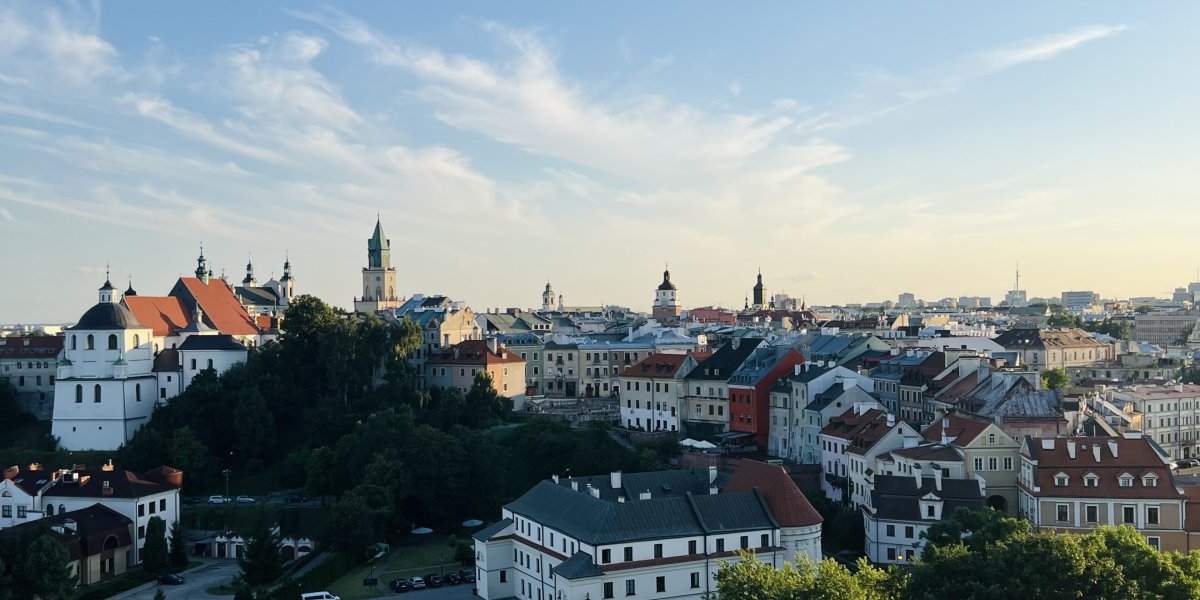
City Guide
Lublin
Pologne · Best time to visit: May-Sep.
Day-by-day plan
Choose your pace
Durée du voyage
09:00
Landmark
Start at the 14th-century brick gate that has greeted every traveller approaching the Old Town from the west — and at 09:00 you will essentially have it to yourself. Morning sun rakes the eastern (Old Town side) facade, hitting the vertical brickwork head-on while the whitewashed upper tier and Baroque copper dome glow above. This is the silhouette every postcard wants; shoot it from inside Plac Łokietka looking back through the arch before the first tour groups roll in at 10:30.
Tip: Stand 15 m east of the gate inside Plac Łokietka and frame the arch with the Trinity Tower behind — the only spot where both Lublin landmarks line up in one shot. Skip the tiny museum inside the gate; the magic is purely the silhouette, and you will see better views from the castle later.
Open in Google Maps →10:00
Neighborhood
Walk through Krakowska Gate and continue 100 m up Bramowa Street — the leaning Renaissance houses press in until the square explodes open around you. The Crown Tribunal, once the supreme court of the Polish-Lithuanian Commonwealth, anchors the centre; circle it clockwise to read each facade's sgraffito story. Then slip into the side streets — Złota, Olejna, Archidiakońska — where the painted houses are even better and tourists never wander. Climb the 207-step Trinity Tower for the only paid stop worth your time: a 360° view of every other thing on your day's itinerary in a single panorama.
Tip: For the iconic Tribunal shot, stand at the southwest corner in front of Konopnica House (Rynek 12) — you get the sgraffito facade plus the tribunal tower in one frame, and the morning light at 10:30 is perfect. The Lublin Underground Trail starts at the Tribunał but eats 1.5 hours indoors — skip it on a power-walk day; the surface Old Town has more soul.
Open in Google Maps →12:30
Food
Exit the Rynek down Złota Street, turn right onto Rybna for a 3-minute walk past wooden balconies leaning over the cobbles. Mandu makes Lublin's most-loved pierogi in small portions designed for mixing — order half-portions of three fillings rather than one big bowl. The Russian-style (potato and twaróg cheese, 22 PLN) is the benchmark every Pole judges a kitchen by; the lamb-and-mint pierogi (28 PLN) is the unicorn locals queue for. Fast, hot, and honest — exactly what a power-walk lunch should be.
Tip: Arrive at 12:15 sharp — the queue spills onto Rybna by 12:45 and the lamb-mint pierogi sells out by 14:00 on weekends. They do not take reservations; just walk in, grab the first counter seat near the kitchen, and you will be eating within 8 minutes.
Open in Google Maps →14:00
Landmark
Head east out of the Old Town through Grodzka Gate, then cross the long elevated brick walkway over Plac Zamkowy — the white castle rises like a chess piece on its hill. The textbook photo is from the foot of the symmetrical staircase looking up: at 14:30 the afternoon sun lands directly on the whitewashed facade, and the Chapel of the Holy Trinity's stone bulk pokes above the curtain wall. Skip the interior — circle the castle base anticlockwise on the grass instead, following the path up Czwartek Hill for a panorama looking back over the entire Old Town roofline you just walked through.
Tip: Walk the grass perimeter on the castle's northern flank toward Czwartek Hill — almost no tourist makes this loop, and the view back over Old Town from the small Sienkiewicz park bench is the panorama every Lublin local secretly considers theirs. Bring water; there is no cafe on the hill itself.
Open in Google Maps →16:30
Landmark
Recross the elevated walkway back toward the Old Town and stop at Plac Po Farze — the ghost outline of the demolished St Michael's church traced in low brick on the cobblestones, with a single chunk of original wall standing like a tombstone. Come at 17:00 and the slanting light fills the empty nave; you will have the entire footprint to yourself. Then continue 50 m west to Grodzka Gate — known as the Jewish Gate because it once divided the Christian Old Town from the vanished Jewish district below. Stand on its eastern side at golden hour for the framed view back across to the white castle, lit warm against the sky.
Tip: PITFALL WARNING — three Lublin tourist traps to refuse tonight: (1) the horse-drawn carriages waiting in the Rynek charge 200 PLN for a 15-minute loop you have already walked twice; (2) any Rynek cafe advertising a 'tourist menu' in four languages adds a silent 15-20% service charge — always check the bill before paying; (3) ignore the 'Ghetto Memorial Tour' touts near Grodzka Gate. The free Po Farze outline tells the same story with more dignity at no cost.
Open in Google Maps →19:00
Food
Magia is 30 seconds west of where you just stood, hidden inside the courtyard at Grodzka 2 — push through the unassuming passage and a lantern-lit garden opens up. Locals call it Lublin's most romantic table, and it earns the title without trying. Order the duck pierogi (38 PLN), the żurek rye sour soup served in a sourdough bread bowl (28 PLN), and a glass of Polish śliwowica plum brandy from the bar — not on the wine list, just ask. Main courses run 50-70 PLN; budget 100-130 PLN per person with drinks. A proper sit-down ending to a power-walk day.
Tip: Reserve a courtyard table (not the indoor seating) — book online 24 hours ahead in summer because the 12 outdoor tables fill by 19:00 every night from June through September. Specifically request 'stolik w ogrodzie' if calling. Ask for the śliwowica plum brandy by name; it is poured from an unlabelled house bottle and you will not find it in any shop back home.
Open in Google Maps →Aller au jour
09:00
Museum
Lublin Castle dominates the city from a green hilltop, and inside its 14th-century walls hides one of Poland's most surprising treasures: the Holy Trinity Chapel, where Byzantine-Ruthenian frescoes from 1418 cover every inch of a Gothic Catholic interior. East and West literally painted onto the same vault. After the chapel, climb the keep for a first orientation — the painted Old Town below, and on the southern horizon, faintly, the Majdanek mausoleum waiting for tomorrow.
Tip: Arrive at 8:55 — the ticket office opens at 9 and the chapel is empty for the first 20 minutes; after 11:00 tour groups crowd the narrow nave and you cannot back up to see the dome. Photography is allowed without flash; the apse frescoes glow best around 9:30 when east light hits them. The castle is closed Mondays — plan around it.
Open in Google Maps →11:30
Museum
Walk down the castle ramp through the chestnut alley and cross the wooden footbridge to Brama Grodzka — 8 minutes, with the Old Town's painted facades opening below you like a stage set. This gate was once the literal threshold between Christian Lublin and the city's Jewish quarter, the largest in Poland before the war. Now it houses Teatr NN's archive of the lost community: 43,000 names on a wall, recordings of the last survivors, and a wooden scale model of pre-war Lublin you can walk around. Quiet, painful, essential preparation for tomorrow's Majdanek.
Tip: Ask at the desk for the 'Lights in the Darkness' multimedia presentation — most visitors miss it; it's free with the ticket and runs every 45 minutes. The model room upstairs photographs best without flash from the southwest corner, where morning side-light catches the miniature rooftops in relief.
Open in Google Maps →13:00
Food
Three minutes from Grodzka Gate: head into the Old Town through Bramowa street, turn right onto Rybna — Czarcia Łapa ('The Devil's Paw') sits in the cellar of a 16th-century townhouse. This is the Lublin lunch a local would lead you to. Żurek (sour rye soup) served in a hollowed bread loaf, pierogi ruskie with crackling, kompot from rehydrated plums. Vaulted brick rooms, scarred wooden tables, the soundtrack of clinking soup spoons.
Tip: Order the żurek w chlebie (28 PLN) — locals consider it the best in town — plus pierogi ruskie (24 PLN) and a Perła Chmielowa beer (8 PLN). Skip the wine list (overpriced) and skip dessert here (a milk-bar pączek does it better). No reservation needed if you arrive before 13:15; after that there's a 20-minute queue. Lunch budget: 55 PLN per person.
Open in Google Maps →15:00
Landmark
Two minutes west — Rybna street spills directly into Rynek, Lublin's painted Renaissance market square. Rynek is small but every facade is a story: trompe-l'œil columns where no columns stand, sgraffito coats-of-arms, the 1574 horse mural on the Old Pharmacy house. In the centre, the Crown Tribunal — for two centuries the highest court of Polish nobility — hides downstairs a 'Devil's Trial Room' where local legend says the Devil himself once held court for a wronged widow, leaving a scorched handprint in a table.
Tip: Walk the square clockwise starting at Rynek 2 (the Klonowic House) so the afternoon sun falls on the painted facades from behind your right shoulder — colours saturate beautifully for photos. The Devil's Hand exhibit (the scorched table, per legend) is in the Tribunal cellar — most visitors miss it; ask the guard for 'Czarcia Łapa Trybunał' and they'll unlock the side door.
Open in Google Maps →17:00
Landmark
Three minutes south through Złota street — the Trinitarian Tower's 60-metre brick spike rises straight ahead. 207 stone steps in a tight spiral lead to Lublin's best view: the painted Old Town immediately below, the Castle to the east, and the wider city stretching west toward Plac Litewski. The tower belongs to the cathedral complex, but you save the cathedral interior for tomorrow — today is for the rooftops at golden hour.
Tip: 17:00 is the chosen hour — the western sun rakes across the Castle and its sandstone turns honey-gold, perfect through the tower's open arches. The view east toward the Castle frames best from the third platform, not the top. Carry water; the climb is hot in summer with no fan. Last entry 18:30 in summer, 16:30 in winter.
Open in Google Maps →19:30
Food
Four-minute walk back through Złota and Bramowa to Rynek 9 — candlelight in the windows of Mandragora is your destination. Mandragora keeps the kitchen of Lublin's vanished Jewish community alive: gefilte fish, cymes (carrot-honey stew), czulent slow-cooked since morning, challah baked the same day. The interior is half-restaurant, half-museum — sepia photographs of the pre-war community, klezmer live on Thursdays, a small bar pouring Lubelska vodka flights.
Tip: Reserve by phone (the online form occasionally drops bookings) — Friday and Saturday evenings are fully booked a week ahead in season. Order the chicken with prunes and almonds (65 PLN, a regional Sephardic recipe) and a Lubelska Wytrawna vodka flight. Pitfall: the half-dozen 'Polish folk' restaurants on Grodzka and Olejna with photo menus and 'Cracovian' pierogi flown in charge €25 mains and feed coach tours — Mandragora and the milk bars are where Lublin actually eats. Budget 130 PLN per person with drinks.
Open in Google Maps →08:30
Museum
From Plac Litewski catch bus 23 — a 25-minute ride south, drop off at the 'Majdanek' stop, and sit on the right side: the watchtowers come into view above the trees long before you arrive. Majdanek is unlike Auschwitz: it sits openly on the edge of Lublin, never destroyed, never disguised. From the entrance you see everything at once — the barracks, the gas chambers, the crematorium, and on the far horizon the Mausoleum holding the ashes of the murdered. You walk the same gravel road the prisoners walked. The visit is silent and slow.
Tip: Arrive at the 9:00 opening — the first hour is when the camp is emptiest, the air still cold, the experience most direct. Pick up the free English map at the visitor centre; the self-guided route runs 2.5 hours. The crematorium and gas chambers are the hardest stops — pace yourself; sit in the visitor centre between buildings if needed. Admission is free. Children under 14 are not permitted (museum rule). Dress dark and warm; even summer mornings are sharp on the open field.
Open in Google Maps →12:30
Food
Take bus 23 back toward the centre (25 min) — get off at the 'Brama Krakowska' stop and walk three minutes west along Krakowskie Przedmieście. Familijny is on the right: a faded blue sign and a queue out the door at lunch. Bar mleczny is the Polish milk bar — communist-era cafeteria, state-subsidised lunches, the soul of post-war recovery. Order at the counter, slide your tray to a shared table, eat among nurses, students, retired teachers, sausage-truck drivers. Żurek 9 PLN, pierogi 14, schabowy with potatoes and cabbage 21.
Tip: Order the kotlet schabowy z ziemniakami i kapustą (21 PLN) and a kompot truskawkowy (4 PLN) — the canonical post-war Polish lunch, and the deliberate counterweight to the morning. Pay in cash (the card machine works half the time). Skip the placki ziemniaczane (they come out flabby); pierogi ruskie are the better starch. Hot food strongest 12:00-14:00. Whole meal under 30 PLN.
Open in Google Maps →14:30
Religious
Four minutes east — walk back along Krakowskie Przedmieście, through Brama Krakowska, and the cathedral square opens on your right. The Archcathedral is Lublin's secret baroque: a plain Jesuit exterior hiding an interior of trompe-l'œil ceilings, marbled side-altars, and the famous Acoustic Vestry — whisper at one wall and the sound carries diagonally across the room to the opposite corner as if the voice were sitting next to you. The Treasury holds a 17th-century crucifix said to have wept during the Swedish siege.
Tip: Buy the combined ticket (Acoustic Vestry + Crypts + Treasury, 18 PLN) — the counter staff often don't volunteer it. Stand at the diagonal-marked corner of the vestry and whisper a name; your partner at the opposite wall hears it perfectly while a stranger between you hears nothing — a 17th-century acoustic trick still working. The cathedral closes during noon Mass (12:00-13:00 weekdays) — afternoon is the only weekday window.
Open in Google Maps →16:30
Landmark
Four minutes west along Krakowskie Przedmieście, Lublin's pedestrian boulevard. You'll pass the Trinitarian Column, then the Hotel Europa, and Plac Litewski opens at the end. The square is grand 19th-century in form, but its meaning is older: here in 1569 Poland and Lithuania signed the Union of Lublin, the document that created Europe's largest country for the next two centuries. The Union Monument stands at the centre of the modern dancing fountains.
Tip: The fountains start at the top of every hour in summer; the full music-and-light show plays at 20:00, 21:00, 22:00. Sit on the granite steps facing east so Brama Krakowska is silhouetted behind the water. Take-away ice-cream from Lodziarnia Staropolska (across the street) is the local move. Daytime, the square is quietest 16:00-17:00, before school lets out.
Open in Google Maps →17:30
Park
Three minutes west across Plac Litewski and through the wrought-iron gate of Ogród Saski. The Saxon Garden is Lublin's oldest park — an English-style landscape from 1837, with romantic alleys, a duck pond, and the white-painted gazebo where 19th-century brass-band concerts were once held. Locals walk here after work; couples meet at the pond bench; old men play chess on the southern lawn. After Majdanek, after the cathedral, this is where Lublin breathes.
Tip: Walk the loop counter-clockwise starting at the southeast gate — the path passes the pond exactly at golden-hour (18:00 in summer) when willows reflect on the water. The gazebo is a good pause; bring a coffee from the kiosk near the entrance. Open until 22:00 in summer, lit by gas-style lamps.
Open in Google Maps →19:30
Food
Eight minutes south — exit the garden via the southeast gate, walk down Spokojna and turn left onto Peowiaków. Hades occupies a 19th-century townhouse with a vaulted brick cellar. Restauracja Hades has been Lublin's grown-up restaurant since 1962 — Polish classics with French refinement, a real sommelier, candlelit cellar tables, live classical music Thursday through Saturday. The duck with cherries is the dish to order; the żurek arrives in a copper tureen poured at the table.
Tip: Reserve a cellar table specifically (not the upstairs hall — too bright, less atmosphere). Order kaczka z wiśniami (duck with cherries, 85 PLN) and a glass of Polish Solaris white (24 PLN). Pitfall warning: the cluster of restaurants directly on Plac Litewski with English-only laminated menus charges double for half the food, and the 'Polish goose' joints on Krakowskie Przedmieście aimed at coach groups rarely serve actual Polish goose — Hades is two blocks south, where Lubliners go. Budget 140 PLN per person with wine.
Open in Google Maps →
Trip builder
Plan this trip around Lublin
Turn this guide into a bookable rail itinerary with FlipEarth.
Keep exploring
Related cities
More in the same country
FAQ
Frequently asked questions
How many days do you need in Lublin?
Most travelers enjoy Lublin in 1 days, with enough time for headline sights and a slower meal or museum stop.
What's the best time to visit Lublin?
The easiest season for most travelers is May-Sep, especially if you want good weather and manageable crowds.
What's the daily budget for Lublin?
A practical starting point is about €60 per person per day before hotels, then adjust based on museums, dining, and transport.
What are the must-see attractions in Lublin?
A good first shortlist for Lublin includes Krakowska Gate (Brama Krakowska), Lublin Castle (Zamek Lubelski), Plac Po Farze & Grodzka Gate (Brama Grodzka).