City Guide
Krakow
Pologne · Best time to visit: May-Sep.
Day-by-day plan
Choose your pace
Durée du voyage
09:00
Landmark
Start your day at the northern edge of the Planty park ring, where the massive drum-shaped Barbican rises from the green like a brick fortress dropped from another century. Built in 1498, this is one of only three surviving barbicans in Europe — circle the full perimeter to take in its seven turrets and 3-meter-thick walls, each firing slit angled for a different line of defense. The adjoining Floriańska Gate, its original Gothic tower still intact, marks the start of the Royal Road — the ceremonial route Polish kings once walked to their coronation at Wawel Castle. Today, you follow in their footsteps.
Tip: Stand on the east side at 09:00 for the best photographs — the low morning sun lights the red brick into a deep amber glow, with the Planty's tree line providing a clean foreground. The turret on the northeast corner gives the most dramatic angle. Skip the paid interior (a small exhibition); the exterior is the real show.
Open in Google Maps →10:00
Landmark
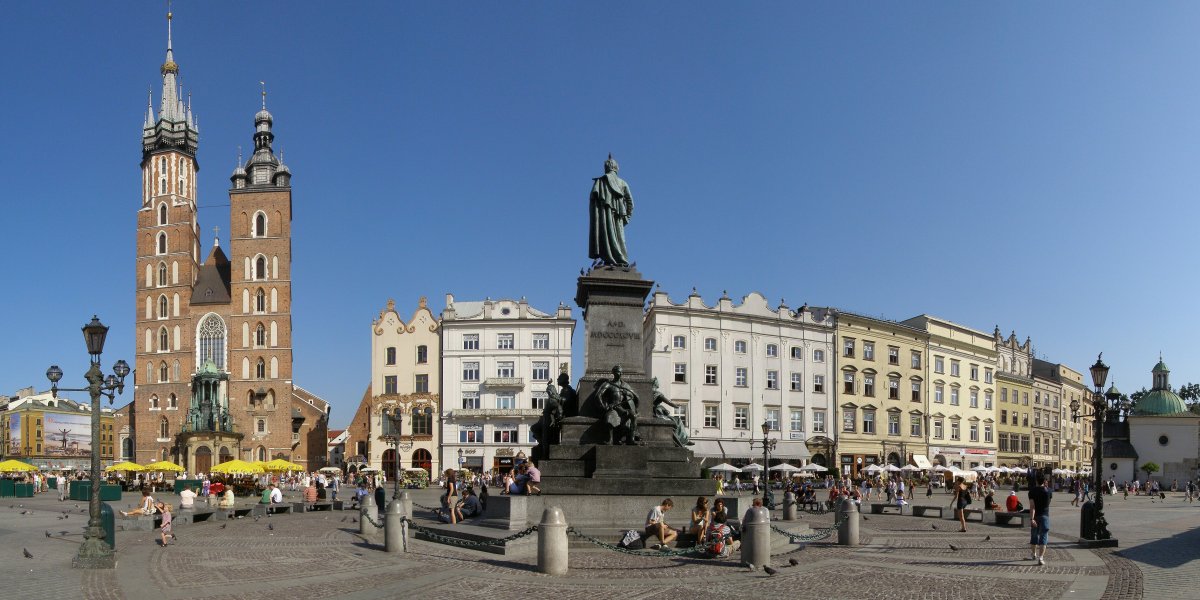
Walk south through Floriańska Gate and down ul. Floriańska, Krakow's most storied street — Renaissance and Baroque facades line both sides, the painted ceiling of Jama Michalika café flashes through a doorway on your left, and ahead, the Gothic towers of St. Mary's grow taller with every step. After 8 minutes, the street opens into Rynek Główny, the largest medieval square in Europe. The twin asymmetric towers of St. Mary's Basilica dominate the east side, the 100-meter-long Cloth Hall stretches across the center with its arcaded ground-floor market, and the tiny Romanesque Church of St. Adalbert sits humbly in the southeast corner, a thousand years old. Every hour on the hour, a lone trumpeter plays the Hejnał from St. Mary's higher tower — the melody cuts off mid-note, commemorating a 13th-century watchman killed by a Tatar arrow while sounding the alarm.
Tip: The best photograph of the square: stand at the Adam Mickiewicz Monument and shoot southeast to frame the Cloth Hall arches with St. Mary's towers rising behind. If you hear the Hejnał, watch the trumpeter in the higher tower — he plays to all four compass points, and the south-facing window is easiest to spot from the square. Skip the ground-floor souvenir stalls inside the Cloth Hall; they sell the same mass-produced amber and wooden boxes you'll find for half the price in Kazimierz later today.
Open in Google Maps →11:45
Landmark
Leave the square from its southwest corner and walk south down ul. Grodzka, the continuation of the Royal Road — you'll pass the twin Baroque apostle statues flanking the Church of Saints Peter and Paul, then the squat Romanesque tower of the Church of St. Andrew, two buildings eight centuries apart standing shoulder to shoulder. After 12 minutes, the street opens and the limestone hill of Wawel rises ahead. Climb through the fortified gate to the hilltop where the Renaissance castle and Gothic cathedral share one of Europe's most concentrated royal complexes. The arcaded inner courtyard is pure Italian Renaissance — King Sigismund I hired Florentine architects in the 1500s and the result feels transplanted from Tuscany. Circle to the river side for a panoramic view over the Vistula, then descend to the Wawel Dragon statue at the base of the hill, which breathes real fire every few minutes — you'll hear the cheers before you see it.
Tip: Most visitors photograph Wawel from the front gate — but the view from the river embankment below is far more dramatic, with the full castle and cathedral silhouette mirrored in the Vistula on a calm day. Walk down to the dragon statue and look back up. The golden dome of the Sigismund Chapel on the cathedral's south side is the single most important piece of Renaissance architecture in Poland — don't miss it in the cluster of towers.
Open in Google Maps →13:15
Food
From the dragon statue, walk east along the river embankment for 2 minutes, then cut left up ul. Stradomska into Kazimierz. The mood shifts immediately — royal grandeur gives way to street art, vintage shops, and café tables spilling onto cracked cobblestones. After 12 minutes you reach Plac Nowy, a lively neighborhood square with a round kiosk building called Okrąglak at its center. This is Krakow's most iconic street food: zapiekanka, a toasted half-baguette loaded with sautéed mushrooms, melted cheese, and your choice of toppings — invented here during the communist era and still the city's go-to late-night and anytime snack. Order the classic mushroom-and-cheese (10 PLN / ~€2.30) or upgrade to the version with smoked meat and caramelized onion (16 PLN / ~€3.70). Grab a cold Żywiec from the adjacent window (8 PLN / ~€1.80) and eat standing at the counter like every local has done since the 1970s.
Tip: The stall at position #3 on the south side of the Okrąglak consistently has the crispiest bread and most generous toppings — follow the longest local queue. Avoid any stall displaying pre-assembled zapiekanki under a heat lamp; you want yours built and toasted fresh to order. A zapiekanka and a beer here will cost you less than a single espresso on the Main Market Square.
Open in Google Maps →14:15
Neighborhood
Cross Plac Nowy heading east along ul. Estery — a 3-minute stroll past street murals and hole-in-the-wall bookshops brings you to Szeroka Street, the heart of Jewish Kazimierz. The wide, tree-lined plaza feels more like a village square than a city block. The Old Synagogue, Poland's oldest surviving synagogue built in the 15th century, anchors the south end; the Remuh Synagogue and its hauntingly beautiful Renaissance cemetery sit halfway along. Walk slowly here. This neighborhood was the center of Jewish life in Krakow for five centuries before the Holocaust devastated it. Today it is alive again — look for Hebrew lettering carved into stone doorframes, Stars of David worked into the wrought iron, and murals honoring the community that once filled these streets. Continue south along ul. Józefa, now Krakow's most creative street, where former prayer houses sit between craft cocktail bars, independent galleries, and vintage furniture shops.
Tip: At the back of the Remuh Cemetery, fragments of hundreds of destroyed Jewish headstones were pieced together into a reconstructed Wailing Wall — one of the most quietly powerful sights in Krakow, and one most visitors walk right past. The cemetery exterior is visible from the street gate even without entering. Take ul. Józefa slowly on the way back — every second doorway hides a courtyard worth peering into.
Open in Google Maps →19:00
Food
After exploring Kazimierz at your own pace, walk to ul. Józefa 14 — a 5-minute stroll from Szeroka Street past galleries and vintage clothing shops, the kind of street where you stop at every window. Starka is a candlelit cellar restaurant built into a vaulted brick basement that dates back centuries, doubling as Krakow's most serious vodka bar. Start with the hand-chopped beef tartare with pickled wild mushrooms (28 PLN / ~€6.50) — it arrives on a wooden board with a raw egg yolk glistening in the center. The signature roasted duck leg with braised red cabbage and crispy potato pancakes (52 PLN / ~€12) is the main event, tender enough to pull apart with a fork. Finish with a flight of house-infused vodkas — the quince and wild cherry are exceptional. Budget €15–20 per person including drinks — a fraction of what this quality would cost anywhere in Western Europe.
Tip: Reserve a table or arrive by 18:45 — by 19:30 every seat is taken. Ask for the back room under the brick vault ceiling for the best atmosphere; the front bar area is noisier. Tourist trap warning: the restaurants lining Szeroka Street's main strip (Ariel, Klezmer-Hois) are scenic but charge double for half the quality and serve reheated tourist-menu standards. Starka, one quiet block over on Józefa, is where Krakow locals actually celebrate.
Open in Google Maps →Aller au jour
09:00
Landmark
Start your morning at the foot of Wawel Hill — approach from ul. Grodzka and climb the cobblestone ramp through the Coat of Arms Gate into the Renaissance arcaded courtyard, one of the finest in Europe. The State Rooms house a staggering collection of 16th-century Flemish tapestries commissioned by King Sigismund Augustus; the Senators' Hall ceiling with its carved wooden heads staring down at you is the image you'll remember longest. Arrive at 9:00 to photograph the empty courtyard in soft morning light and be first through the door when the exhibition opens at 9:30.
Tip: Buy tickets online the day before — the State Rooms have a daily visitor cap and sell out by 11:00 in summer. If sold out, the Crown Treasury and Armoury share the same wing and need no advance booking.
Open in Google Maps →11:15
Religious
Step out of the castle and turn right across the hilltop courtyard — the cathedral's gold-topped dome is two minutes away on foot. This is where every Polish king was crowned and buried for five centuries. Climb the Sigismund Tower to touch the legendary Sigismund Bell — tradition says it grants a wish — then descend into the Royal Crypts to stand before the sarcophagi of Józef Piłsudski and King Casimir the Great. The cathedral nave is free; the tower and crypts are the draw.
Tip: Go to the tower first — only 10 people are allowed up at a time, and the queue grows fast after 11:00. The combined ticket (tower + crypts + museum) is 18 PLN. The nave itself is free to enter.
Open in Google Maps →12:30
Food
Walk down from Wawel Hill and head north along ul. Grodzka — Krakow's ancient Royal Road lined with Baroque facades and street musicians. Five minutes of gentle downhill strolling brings you to this legendary milk bar at Grodzka 43. Order at the counter: ruskie pierogi — potato-and-cheese dumplings, 12 PLN / €3 — and a bowl of żurek, a sour rye soup with egg and white sausage, 10 PLN / €2.50. Milk bars are a communist-era institution: subsidized canteens where professors eat beside construction workers. This one hasn't changed its recipe in decades. Budget 20–28 PLN (€5–7) per person.
Tip: Don't wait for a table — locals share seats without asking. Grab your tray, find a spot, and eat. There is no tipping. Arrive before 12:30 to beat the office workers' rush; by 12:45 every seat is taken.
Open in Google Maps →14:00
Museum
Continue north on Grodzka for five minutes until the street opens into the Main Market Square — the largest medieval town square in Europe, so vast it takes your breath away the first time. The museum entrance is on the northeast side of the Cloth Hall, marked by a glass pavilion at ground level. Descend four metres below the square into an archaeological time capsule: excavated market stalls from the 11th century, medieval cobblestones still bearing cart-wheel grooves, and holograms that bring the old traders back to life. The displays are beautifully interactive — it feels more like walking through a film set than visiting a museum.
Tip: Free entry on Tuesdays (timed tickets still required — grab them online at 8:00 AM, they vanish within the hour). On paid days the 14:00 slot is the sweet spot: morning tour groups have left and afternoon visitors haven't arrived. Closed on the first Tuesday of each month for maintenance.
Open in Google Maps →16:00
Religious
Exit the museum and look northeast across the square — St. Mary's twin asymmetric towers are impossible to miss. Enter through the tourist entrance on the south side (Plac Mariacki) into a space that stops you mid-step: the Veit Stoss Altarpiece, carved from limewood over twelve years, stands 13 metres tall, its gold-and-polychrome panels depicting the life of the Virgin Mary. It is the largest Gothic altarpiece in the world. At 16:00 the afternoon light through the western windows strikes the gold leaf at just the right angle — the entire altar seems to ignite.
Tip: The tourist entrance is on the SOUTH side (Plac Mariacki), not the main west doors. Listen for the hejnał — a trumpet melody played every hour from the taller tower, famously cut short mid-note to honour a 13th-century watchman killed by a Mongol arrow. Time your 16:00 entry to hear it as you walk in.
Open in Google Maps →19:00
Food
Walk south from the square along Grodzka for five minutes to number 35, past lantern-lit doorways as Old Town shifts into its evening glow. Descend a stone staircase into a 13th-century cellar where whole cuts of Polish beef and lamb are grilled over an open beechwood fire — you smell the smoke before you see the flames. Order the grilled beef tenderloin (polędwica wołowa, 69 PLN / €16) with roasted beetroot, and start with smoked oscypek cheese drizzled in cranberry sauce (28 PLN / €7). Budget 90–120 PLN (€21–28) per person with a glass of Polish wine.
Tip: Reserve a table in the lower cellar (dolna piwnica) — the older, more atmospheric vault with exposed stone arches. Walk-ins work before 19:00 on weekdays, but Friday and Saturday need a booking. Avoid the tourist-trap restaurants with aggressive touts lining the Main Square — most serve frozen reheated food at triple the price.
Open in Google Maps →09:00
Neighborhood
From the Old Town, walk south through the Planty gardens — the green belt ringing the old city walls — and cross ul. Starowiślna into Kazimierz, a 10-minute stroll. Once a separate walled city, then the beating heart of Jewish Krakow, now the city's most soulful neighbourhood. Start on ul. Józefa, where prewar prayer houses hide behind pastel facades and every second courtyard shelters a café or gallery. Turn right onto Szeroka Street — the wide, cobblestoned square that was once the Jewish market. Enter the Remuh Cemetery (10 PLN): 16th-century tombstones leaning at gentle angles behind a fragment of wall reconstructed from headstones smashed during the war.
Tip: Visit the Remuh Cemetery before 10:00, when tour groups flood in. Walk to the back wall — the Wailing Wall, built from fragments of desecrated headstones found scattered after the war — is the most moving sight in all of Krakow, and almost no guidebook mentions it.
Open in Google Maps →10:30
Museum
Walk two minutes south to the bottom of Szeroka Street — the Old Synagogue stands at number 24, its fortified facade giving it the look of a small Gothic castle. Built in the 15th century, it is the oldest surviving synagogue in Poland and now houses a museum of Jewish history and ritual. The vaulted interior holds a reconstructed bimah surrounded by wrought-iron grilles, Torah scrolls under glass, and ceremonial objects spanning six centuries. Upstairs, the exhibition traces the arc of Jewish Krakow from its founding charter to the devastation of the Holocaust and the fragile revival that followed.
Tip: Free admission on Mondays. Stand in the centre of the ground-floor prayer hall, close your eyes, and listen — the acoustics in this vaulted room are extraordinary. You'll understand why cantors once came from across Europe to sing here.
Open in Google Maps →12:00
Food
Step out of the synagogue and walk north to the middle of Szeroka Street — Ariel's terrace tables face the square, and on a sunny morning the scene could be a painting by Chagall. This is Kazimierz's oldest Jewish restaurant, serving recipes passed through generations. Order the stuffed goose neck with liver (szyja gęsia, 38 PLN / €9) and the Jewish-style carp in sweet onion jelly (karp po żydowsku, 32 PLN / €7). On weekends a klezmer trio plays inside from noon — the music drifts across the terrace. Budget 50–70 PLN (€12–16) per person.
Tip: Sit outside if the weather allows — the terrace has the best people-watching in Kazimierz. If klezmer music isn't playing when you arrive, ask the waiter when the next session starts; they're informal and never listed online.
Open in Google Maps →13:30
Museum
Walk south from Szeroka to the Vistula riverbank, then cross the Father Bernatek Footbridge — an 11-minute walk that is itself worth the trip, with acrobatic bronze sculptures suspended above the water by steel cables. On the far bank turn left along the river, then right on ul. Lipowa to number 4. The factory is now a world-class museum that tells the story of Krakow under Nazi occupation through the eyes of its citizens — not just Schindler's famous list, but the daily texture of a city torn apart. The final room, an installation of thousands of enamel pots stacked floor to ceiling, is devastating and unforgettable.
Tip: Book online at least 3 days ahead — this is the most visited museum in Krakow and walk-in tickets sell out by 10:00 AM daily. Free on Mondays, but the queue forms before 7:00 AM. Weekday slots between 13:00 and 14:00 are reliably the least crowded.
Open in Google Maps →16:00
Museum
Exit the factory, turn right on Lipowa, and walk west for 8 minutes to Plac Bohaterów Getta — the former Ghetto Heroes' Square. Before entering the museum, stop in the square: 70 oversized empty bronze chairs stand on the cobblestones, each representing a thousand victims deported from this exact spot. The small pharmacy on the north side was the only non-Jewish business allowed inside the ghetto. Its owner, Tadeusz Pankiewicz, risked his life daily to smuggle medicine, forged documents, and messages to imprisoned residents. Inside: original pharmacy drawers, eyewitness testimonies, and Pankiewicz's own photographs. Tiny, but shattering.
Tip: Spend a few quiet minutes with the bronze chairs before going inside. In the late afternoon the low sun casts long shadows from each chair across the cobblestones — it is the most powerful photograph you will take in Krakow. The pharmacy closes at 17:00 on some days; check hours online that morning.
Open in Google Maps →19:00
Food
Cross back over the Vistula on the Father Bernatek Bridge — the acrobat sculptures are now silhouetted against the sunset — and walk north through Kazimierz to ul. Józefa 14, a 15-minute stroll through streets that feel completely different at dusk. Starka is named after the aged Polish rye spirit, and its candlelit brick interior feels like a 19th-century apothecary. Order the slow-roasted duck leg with plum sauce (udko kacze, 52 PLN / €12) and the beef tartare prepared tableside (tatar wołowy, 42 PLN / €10). The vodka list runs to 70 varieties — ask for a flight of three starkas aged 10, 20, and 50 years (35 PLN / €8). Budget 80–110 PLN (€19–26) per person.
Tip: Ask for the back room — exposed brick, fewer tables, candlelight only. Do not buy vodka from the 'vodka museums' or street vendors scattered around Kazimierz — they sell flavoured industrial spirit at five times the price. Starka's house-aged infusions are the real thing.
Open in Google Maps →Aller au jour
09:00
Museum
Start your Krakow journey at its spiritual heart. From your Old Town hotel, walk south along Grodzka Street — the ancient Royal Road — for about 12 minutes; the Renaissance façades and buskers warming up set the mood before you arrive. The State Rooms open at 9:00 and the first thirty minutes are blissfully uncrowded: walk through the arcaded Italian-designed courtyard, then step into vaulted chambers hung with Flemish tapestries commissioned by the Jagiellonian kings. The morning light pouring through east-facing windows illuminates the Senators' Hall ceiling — carved wooden heads that literally stare down at you — in a way that flat afternoon light cannot replicate.
Tip: Buy tickets online the day before — the State Rooms cap visitors per time slot and sell out by 10:30 in summer. Enter via the main courtyard gate, not the side entrance near the Dragon's Den, which only leads to a kitschy souvenir zone. Closed Mondays.
Open in Google Maps →11:15
Religious
Exit the State Rooms and cross the courtyard — the Cathedral is two minutes on your left, impossible to miss. This is Poland's Westminster Abbey: every king was crowned here for five hundred years, and Pope John Paul II celebrated his first mass in the crypt below. Climb the narrow wooden staircase of Sigismund Tower to touch the 11-tonne Sigismund Bell and catch an elevated view of the Vistula curving south. The late-morning sun backlights the cathedral's mix of Gothic and Baroque chapels, making the gold dome of the Sigismund Chapel almost glow.
Tip: The cathedral nave is free; the ticket covers the royal crypts, Sigismund Bell, and museum. Climb the tower first — the spiral staircase is tight and gets painfully congested after 11:30 when tour buses arrive.
Open in Google Maps →12:30
Food
Walk down Wawel Hill and turn right onto Grodzka Street — a 5-minute stroll past flower stalls and street musicians. Pod Aniołami ('Under the Angels') at Grodzka 35 occupies a 13th-century stone cellar with vaulted ceilings and candlelit tables that feel like dining inside a medieval crypt. This is where Krakovians bring visitors they want to impress. Order the żurek served in a bread bowl (22 PLN / €5) — Poland's most iconic fermented rye soup — followed by the house specialty: a sizzling hot-stone grill plate of Polish meats with horseradish and pickles (58 PLN / €13).
Tip: No reservation needed for lunch if you arrive before 12:45. Skip the tourist-menu pierogi — the grilled meats are what this kitchen does best. Budget 60–80 PLN (€14–18) per person with a drink.
Open in Google Maps →14:00
Landmark
Continue north on Grodzka for 7 minutes — the street opens dramatically into the Rynek Główny, the largest medieval town square in Europe. At 14:00 the afternoon light hits the eastern façade of the Cloth Hall and turns the ochre stone golden — shoot your photo from the southeast corner near the Adam Mickiewicz statue. Enter St. Mary's Basilica through the side tourist entrance to see the Veit Stoss altarpiece, a 13-metre limewood masterpiece whose winged panels open at noon, so by afternoon you see the full tableau. Listen for the hejnał trumpet call from the taller tower on the hour — it cuts off mid-melody, commemorating a 13th-century watchman shot by a Mongol arrow. Leave thirty minutes to wander the Cloth Hall's ground-floor stalls and the quiet side streets radiating from the square.
Tip: St. Mary's tourist entrance is on the side (Plac Mariacki), not the main front door — that's for worshippers only. Entry 10 PLN. Skip the Cloth Hall upper gallery unless you love 19th-century Polish painting; the ground floor is better value for time.
Open in Google Maps →19:00
Food
You are already on the square — Szara Gęś ('The Grey Goose') sits at Rynek Główny 17, on the northwest edge with a view across the lamplit expanse. This is the best restaurant directly on the square, run by one of Krakow's most respected kitchen teams. Start with the beef tartare hand-cut tableside with capers and quail egg (48 PLN / €11), then the signature roast duck with caramelized plums and silesian dumplings (78 PLN / €18) — the duck skin is shatteringly crisp. Pair it with a glass of Georgian Saperavi from their curated wine list.
Tip: Reserve a window table for 19:00 at least two days ahead — the square at golden hour is unforgettable from inside. Avoid the restaurant touts along Floriańska Street between the square and the train station: they steer tourists to overpriced traps serving microwaved food. If anyone hands you a menu on the street, walk away.
Open in Google Maps →09:00
Museum
Take an early Lajkonik bus from MDA bus station (Bosacka 18, a 10-minute walk east of the main train station) — the 90-minute ride through the flat Silesian countryside gives you time to prepare mentally. Arriving for the 09:00 guided-tour slot means you walk through the 'Arbeit Macht Frei' gate, the prisoner barracks, and the gas chamber of Crematorium I before the midday crowds. This is not a museum you rush; it is a place where you stand still and let the enormity settle. The displays of confiscated suitcases, shoes, and human hair are among the most powerful things you will ever witness.
Tip: Book your timed-entry pass at visit.auschwitz.org at least 3 weeks ahead — summer slots fill months in advance. The English guided tour (75 PLN / €17, ~3.5 hours covering both camps) is essential for first-time visitors. Bring your passport — security checks bags and IDs strictly.
Open in Google Maps →12:00
Landmark
A free shuttle bus runs every 10 minutes from the Auschwitz I car park — the ride to Birkenau takes 5 minutes. Nothing prepares you for the scale: railway tracks stretching to the horizon, the ruins of four gas chambers the Nazis dynamited to destroy evidence, and a vast field of brick chimneys marking where 300 barracks once stood. Walk the full length of the railway spur to the International Monument at the far end — each step makes the industrial nature of the genocide physically comprehensible. The open sky and silence here feel fundamentally different from the enclosed corridors of Auschwitz I.
Tip: Birkenau is entirely outdoors on exposed terrain — wear comfortable shoes and bring water. There are no vendors or cafés inside. The walk to the monument and back is nearly 2 km; allow at least 90 minutes to do it justice.
Open in Google Maps →14:00
Food
Take the shuttle back to Auschwitz I and walk to the visitor centre near the main car park — 3 minutes from the shuttle stop. After a morning of bearing witness, a quiet bowl of soup and coffee is all most people want. The cafeteria serves honest Polish basics: mushroom soup (12 PLN / €3), a warm open-face sandwich with cheese and ham (15 PLN / €3.50), and surprisingly good szarlotka — Polish apple cake with a crumble top (10 PLN / €2). It is simple, clean, and exactly what you need before the bus ride home.
Tip: This is the only food within walking distance — do not count on finding restaurants nearby. Check return bus times on the Lajkonik app before you sit down; buses depart every 30–60 minutes from the stop across the road and take 90 minutes back to Krakow.
Open in Google Maps →17:00
Park
Back in Krakow, step off the bus at MDA station and walk 5 minutes west to the green belt of Planty Park — a 4-km ring of gardens, fountains, and century-old chestnut trees that replaced the medieval city walls in the 1820s. After the emotional weight of the morning, this is the decompression you need: no agenda, no tickets, just a slow walk along the northern arc past the Barbican and Floriańska Gate. The late-afternoon light filters through the canopy, students read on benches, and the city gently brings you back to the present.
Tip: Start at the Barbican (northeast corner) and walk clockwise — you pass a beautiful stretch of weeping willows near the Collegium Maius. The full loop is 4 km, but the northern half alone (30 minutes) is the prettiest section.
Open in Google Maps →19:30
Food
From Planty's western edge, walk 3 minutes south to Plac Szczepański — Morskie Oko is at number 8, behind a carved wooden highland-style entrance you cannot miss. Named after the famous Tatra mountain lake, this restaurant serves Polish highland cuisine and remains a local favourite for comfort food — exactly what this day demands. Start with oscypek cheese grilled with cranberry jam (28 PLN / €6), then the lamb shank braised in dark beer with root vegetables and kluski noodles (68 PLN / €15). The wooden interior, gentle folk music, and warmth of the room work like a balm.
Tip: No reservation needed on weeknights; book for Friday or Saturday. Budget 70–100 PLN (€16–23) per person. The house-infused vodka flight (5 flavours, 25 PLN / €6) is excellent — after today, earned. Avoid the exchange offices (kantors) near the train station that advertise '0% commission' — their rates are 15–20% worse than the ones on Grodzka or Szewska Street.
Open in Google Maps →09:00
Museum
From your Old Town hotel, walk south across the Powstańców Śląskich bridge over the Vistula — 15 minutes through the quiet Podgórze neighbourhood along Lipowa Street. The factory at Lipowa 4 is one of Europe's most immersive history museums, telling the story of Krakow under Nazi occupation through reconstructed streets, original artifacts, and multimedia installations that place you inside the timeline. At 09:00 you will have the rooms nearly to yourself; by 11:00 school groups pour in and the narrow corridors become claustrophobic. The final room — a corridor of blinding white light and silence — is one of those museum endings that stops you in your tracks.
Tip: Tickets MUST be booked online at bilety.mhk.pl — the museum sells out 3–5 days ahead in peak season. Monday admission is free but the museum is packed wall-to-wall; a paid weekday morning is the far better experience. Allow the full 2 hours — rushing through cheapens the impact.
Open in Google Maps →11:30
Religious
Cross back over the Vistula via the Father Bernatek Footbridge — a playful pedestrian bridge with acrobatic sculptures suspended on cables overhead — and walk 8 minutes north into Kazimierz along Józefa Street, past street-art murals and vintage clothing shops. The Old Synagogue at Szeroka 24 is the oldest surviving synagogue in Poland, built in the 15th century and now housing a museum of Jewish ritual objects and community life. Then step next door to the Remuh Cemetery, where moss-covered Renaissance tombstones lean against a wall assembled from fragments rescued after the war — each broken stone a life erased. The quiet here, enclosed by apartment buildings, is profound.
Tip: The Old Synagogue is closed Tuesdays. Remuh Cemetery is small — you can see it in 15 minutes, but give yourself time to read the inscriptions on the fragment wall. Men must cover their heads; paper kippot are provided at the entrance.
Open in Google Maps →12:45
Food
Walk 30 seconds across Szeroka Street — Ariel is at number 18, on the sunlit western side of Kazimierz's main square. Opened in 1992 to revive Jewish culinary traditions that nearly vanished, this is the neighbourhood's most storied restaurant. Sit by the window overlooking the square where Spielberg filmed parts of Schindler's List. Start with the Jewish-style herring in oil with onion and apple (24 PLN / €5), then the slow-cooked cholent — a Sabbath stew of beans, barley, potato, and beef simmered overnight (38 PLN / €9). Lunchtime is quieter than evening, when live klezmer music fills the room.
Tip: Sit upstairs for the best light and fewer tour groups. Budget 45–70 PLN (€10–16) per person. The gefilte fish is the most popular starter but the herring is the better dish. Skip the 'Jewish-style cocktails' — they are standard drinks with a markup.
Open in Google Maps →14:15
Neighborhood
Walk south from Szeroka along Bożego Ciała Street for 5 minutes to Plac Nowy — the neighbourhood's beating heart. This scruffy round market hall is where locals queue for zapiekanka, a half-baguette loaded with mushrooms, cheese, and ketchup (8–15 PLN / €2–3) that is Krakow's definitive street snack. From here, wander without a plan: duck into the courtyard galleries on Józefa Street, find the street-art alley behind the Galicia Jewish Museum, browse the vinyl record shops on Meiselsa. Kazimierz rewards aimlessness — every crooked doorway hides a café or a bookshop. Save the last thirty minutes to sit at any Plac Nowy terrace with a cold Żywiec and watch the neighbourhood do its thing.
Tip: The best zapiekanka stall at Plac Nowy is Endzior — look for the longest local queue. The flashier stalls with 20 topping options are actually worse than the classic mushroom-and-cheese original.
Open in Google Maps →19:00
Food
Walk 4 minutes east along Józefa Street — Starka is at number 14, behind a modest wooden sign that hides one of Kazimierz's finest kitchens. The vaulted brick interior feels like a grown-up version of the neighbourhood: candlelit, unhurried, full of well-dressed locals on a night out. Begin with the house-infused starka vodka — the aged rye spirit the restaurant is named after — served ice-cold in a frozen glass. Then order the duck leg confit with red cabbage and potato pancake (55 PLN / €13), skin crackling, meat falling off the bone, followed by a slice of their legendary poppy seed cake (18 PLN / €4). This is not a tourist restaurant; it is where Krakow says goodbye properly.
Tip: Reserve for 19:00 — by 20:00 the bar crowd arrives and tables vanish. Budget 80–120 PLN (€18–27) per person with drinks. Do not leave Krakow without trying the house starka vodka. Avoid the 'Kazimierz pub crawl' tours that swarm after 21:00 — they herd tourists into bars charging triple for watered-down drinks and drown out every restaurant on the street.
Open in Google Maps →
Trip builder
Plan this trip around Krakow
Turn this guide into a bookable rail itinerary with FlipEarth.
Keep exploring
Related cities
Nearby cities
More in the same country
FAQ
Frequently asked questions
How many days do you need in Krakow?
Most travelers enjoy Krakow in 1 days, with enough time for headline sights and a slower meal or museum stop.
What's the best time to visit Krakow?
The easiest season for most travelers is May-Sep, especially if you want good weather and manageable crowds.
What's the daily budget for Krakow?
A practical starting point is about €40 per person per day before hotels, then adjust based on museums, dining, and transport.
What are the must-see attractions in Krakow?
A good first shortlist for Krakow includes Krakow Barbican & Floriańska Gate, Main Market Square & St. Mary's Basilica, Wawel Royal Castle.