City Guide
Wroclaw
Pologne · Best time to visit: May-Sep.
Day-by-day plan
Choose your pace
Durée du voyage
09:00
Landmark
Begin on one of Europe's largest medieval market squares, where pastel merchant houses form a rainbow around the Gothic Old Town Hall. At this hour the light catches the eastern facades — Dom pod Gryfami, House Under the Golden Sun — and the first bronze dwarfs appear on doorsteps and lamp bases. Start the dwarf hunt at Papa Krasnal, the original, on the corner of Świdnicka Street.
Tip: Shoot the square from the southwest corner (by Dom pod Gryfami) between 09:00 and 10:00 — the sun is behind you, the colored facades glow, and you'll beat every tour group by 90 minutes. The biggest cluster of dwarfs is along the south side near the Witches' Tower; pick up a free dwarf map from any kiosk to track the ones hiding on window ledges and chained to doorways.
Open in Google Maps →11:00
Landmark
Leave the Rynek at the northeast corner and follow ul. Kuźnicza — a 7-minute walk through the student quarter, passing the 'Więzień' (Prisoner) dwarf chained to a doorway on your left. You arrive at the cream-yellow Baroque facade of Collegium Maximum, Wrocław's 18th-century university, built by the Habsburgs to out-Vienna Vienna. Walk around to the Oder-facing terrace for the wide shot; the riverbank promenade here is where students cram for exams with coffee and a cigarette.
Tip: Skip the ticketed Aula Leopoldina today — instead, take the steps down to the river terrace directly behind the building. From there you'll already see Cathedral Island's twin towers framed downriver, a preview of your evening. The 'Szermierz' (Fencer) fountain statue in front of the university is a local photo cliché worth one frame.
Open in Google Maps →12:30
Food
From the university's riverside terrace, cross back to ul. Grodzka and walk east — a 5-minute walk to the red-brick giant on your right, Hala Targowa, Wrocław's 1908 market hall under soaring parabolic concrete arches. Ground-floor stalls serve pierogi ruskie (potato-cheese, ~14 zł / €3 a plate), pierogi z mięsem (meat, ~16 zł) and seasonal paczki; this is where office workers, babcias, and traders all eat shoulder to shoulder at standing counters. Budget €6–10 and wash it down with a Tymbark apple juice from the refrigerated case.
Tip: Head to the family-run stalls along the east wall on the ground floor, not the upstairs sit-down counters — prices are lower and the pierogi are hand-folded that morning. Bring small zloty cash; many stalls still wave off cards for orders under 30 zł. Avoid the mid-hall souvenir T-shirts — the same ones are half price in any Rynek kiosk.
Open in Google Maps →13:30
Landmark
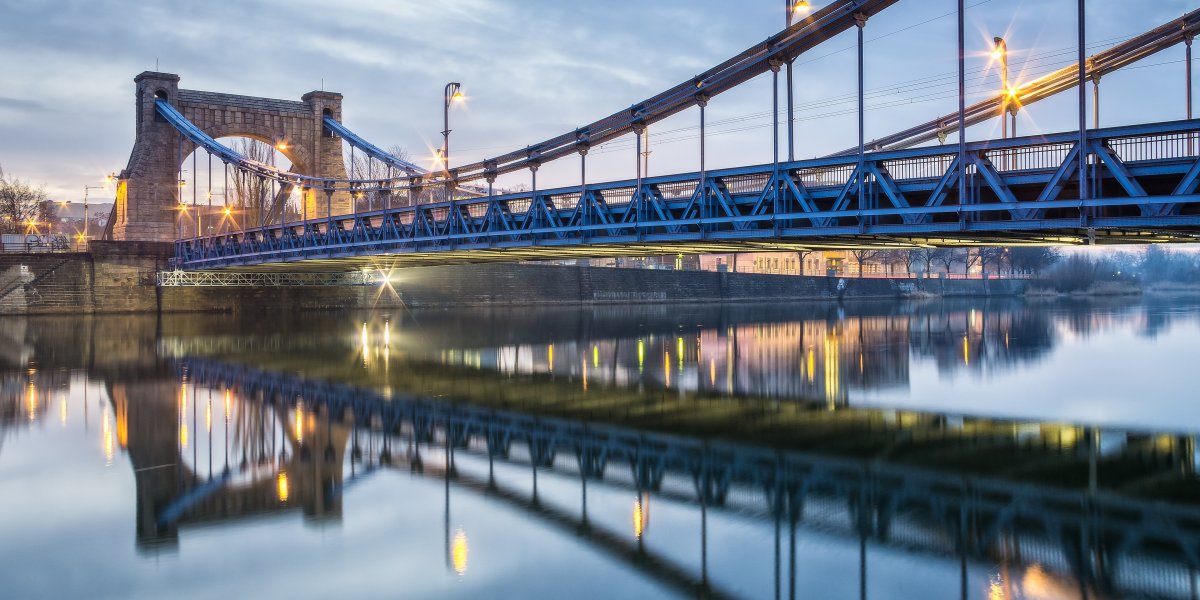
Leave Hala Targowa's north side and cross Most Piaskowy onto Wyspa Piasek (Sand Island) — 3 minutes, willows leaning over the Oder on your right. Wander Sand Island for 20 minutes past the Church of St. Mary on the Sand, then step onto Most Tumski itself, the 19th-century iron bridge whose railings still sag under thousands of padlocks left by lovers. Pause mid-bridge for the postcard frame: the Cathedral of St. John the Baptist's twin Gothic towers rising ahead, daring you to walk into another century.
Tip: Shoot the cathedral from the Sand Island end of the bridge, composing the twin spires through the black iron ironwork — mid-afternoon light backlights the towers perfectly. Don't buy a padlock from the sellers at either end; the city officially discourages new locks and occasionally cuts them off, and the practice lost its romance two decades ago.
Open in Google Maps →15:00
Neighborhood
Step off Tumski Bridge and the cobblestones change color — you've crossed onto Ostrów Tumski, Wrocław's oldest ground, a pedestrian-only island where the silence feels deliberate. Wander the lanes: the Cathedral of St. John the Baptist, the Collegiate Church of the Holy Cross, the Botanic Gardens' back wall, the Archbishop's Palace. Then settle in for the moment that justifies the whole day — at dusk, Wrocław's last Latarnik (lamplighter) appears in black cape and top hat, brass pole in hand, and lights all 103 gas lamps across the island by hand. Follow him in quiet awe as the island shifts from daylight to gaslight.
Tip: The lamplighter starts on ul. Katedralna roughly 15 minutes before local sunset (about 20:30 in June, 19:15 in September — check that day's sunset). Arrive 30 minutes early to claim a spot on the cathedral steps for the opening ceremony; once he starts, walk behind him, never in front, and switch your flash off — he'll pose briefly if asked politely in Polish ('czy mogę zrobić zdjęcie?'). Skip the horse-carriage rides at the bridge entrance — they run 200 zł for ten minutes and are the single biggest tourist rip-off in the city.
Open in Google Maps →20:00
Food
Walk back across Tumski Bridge under the newly lit gas lamps, through Sand Island, and right onto ul. Więzienna — 10 minutes, with the gaslight glow fading behind you. Starka is a vaulted cellar restaurant near the university, named for the aged rye vodka the city is proud of; the kitchen cooks heritage Polish without irony. Order żurek (sour rye soup, 24 zł), pierogi with wild boar (48 zł), or oven-roasted duck with apples and buckwheat (82 zł); the 200+ flavored vodkas poured from oak barrels behind the bar are the real reason locals come back.
Tip: Reserve the same morning by phone or walk-in on your way to Rynek — Starka fills by 19:30 and doesn't take last-minute online bookings. Ask for the 'Starka 10-year' as your aperitif; it's the house namesake and the bartender will light up. Avoid the restaurants lining the Rynek with menus in five languages and photos of every dish — those are the city's classic tourist traps, serving frozen pierogi at triple the price; Starka is where locals bring out-of-town friends they actually want to impress.
Open in Google Maps →Aller au jour
09:00
Landmark
Step into one of Europe's largest medieval squares before the tour buses arrive at 10:30, while cafés are still setting out chairs and the pastel facades glow in clean morning light. Circle the Old Town Hall from the east first — sunlight washes the Gothic astronomical clock in warm gold, and every burgher house carries a carved name above its door. This is the heart from which the whole city radiates.
Tip: Photograph the Old Town Hall's eastern facade at 09:15 when light hits the clock directly. Look up at Rynek 2 ('Pod Gryfami', House Under the Griffins) — the finest carved stonework in the square is above eye level, missed by most visitors staring at ground-floor windows.
Open in Google Maps →10:30
Religious
Exit the Rynek through the northwest corner, past the candy-pink 'Jaś i Małgosia' (Hansel & Gretel) houses that lean toward each other — the church rises immediately behind them, a 90-second walk. Climb 300 stone steps up the Gothic brick tower for Wrocław's only unobstructed 360° view: the Rynek dead ahead, the Oder curling north, Cathedral Island's twin spires on the horizon. Do this now while your legs are fresh — tomorrow's cathedral climb deserves full strength.
Tip: Opens 10:00; arrive by 10:30 to beat the 11:30 bus-tour wave. The stairwell is a single narrow spiral — descending traffic yields to ascending, so don't rush anyone coming up. Cash preferred at the ticket booth.
Open in Google Maps →12:30
Food
Back down to the Rynek, cut diagonally across the square to Rynek 36 — a 3-minute stroll. The city's most honest pierogi kitchen hides in a vaulted medieval cellar: order pierogi ruskie (potato and sheep cheese, 32 PLN / ~8€) and pierogi with duck and cranberry (38 PLN / ~9€), washed down with house kompot. Average meal 10-15€.
Tip: Arrive by 12:30 or after 14:00 — the 13:00 rush fills the cellar and waits stretch past 30 minutes. Half-portions (pół porcji) exist off-menu — just ask. Skip the 'traditional pierogi' touts standing on Rynek with laminated photo boards; this cellar has no sidewalk hustler because it doesn't need one.
Open in Google Maps →14:00
Museum
Leave the Rynek east via ul. Kuźnicza, then cut along Purkyniego through the green boulevard that traces the old city moat — a 12-minute walk past the University quarter. Step inside the rotunda and a 15-meter-tall, 114-meter-long 360° oil painting of the 1794 battle wraps around you, its foreground blended into real earthworks and wagon wheels at your feet. The English audio guide walks you through every gun-smoke plume; nothing quite like it exists elsewhere in Europe.
Tip: Entry is by timed 30-minute slot — book online the night before or you queue 45 minutes. Closed Mondays year-round. Your ticket also covers the National Museum next door, but skip it unless you have a spare two hours; the Panorama is the experience.
Open in Google Maps →16:00
Neighborhood
Retrace your steps west along Purkyniego and ul. Kuźnicza toward the Rynek — but this time walk slowly, eyes at knee level. Over 800 tiny bronze dwarfs live in Wrocław's Old Town: sleeping on benches, pushing motorcycles, playing cellos, yanking cash from ATM slots. They began as an anti-communist protest symbol in the 1980s and stayed — the city's great inside joke on its visitors.
Tip: Must-find five: Papa Dwarf (Świdnicka, north end), the Sisyphus duo pushing a stone ball (Świdnicka mid-street), the ATM dwarf (near Świdnicki Bridge), the sleepyhead on Ratuszowa, and the lawyer-dwarf on ul. Kiełbaśnicza. Free map at any tourist info point, or install the 'Wrocławskie Krasnale' app. Golden light between 17:00-18:30 makes the bronze photograph beautifully.
Open in Google Maps →19:30
Food
A 2-minute stroll back to the Rynek's southern stretch — the restaurant fills a medieval townhouse with wooden beams, fur throws on chair backs, and live accordion after 20:00. Order żurek w chlebie (sour rye soup served in a hollowed bread bowl, 28 PLN / ~7€) and placki po węgiersku (potato pancakes buried under goulash, 48 PLN / ~12€). Average dinner 18-25€.
Tip: Reserve 24 hours ahead for a Rynek-facing window table; ask specifically for 'pierwsze piętro przy oknie' (first floor by the window). Wrocław's great dinner trap: avoid any Rynek restaurant with a costumed medieval-banquet tout outside or a chalked English-only menu — those are the frozen-pierogi inflation zones. Karczma Lwowska has no sidewalk hustler because locals fill it.
Open in Google Maps →10:00
Museum
Arrive as the doors open at 10:00, when the low morning sun pours through the tall east windows and lights the frescoed ceiling like stage design. The 18th-century Baroque assembly hall is among Europe's most ornate university rooms — swirling allegories of Wisdom and Philosophy overhead, gilded pilasters, an emperor's private box. Your ticket also grants the Mathematical Tower above, where the Oder makes its great bend around Piasek Island.
Tip: Be at the cashier window by 09:55 — the 10:00 opening admits a small wave before the 10:30 coach parties arrive. Visit the Aula first (upstairs left), then climb the Mathematical Tower; the tower stairs close to visitors between 13:00-14:00 for maintenance. Photography allowed without flash.
Open in Google Maps →12:00
Food
Exit the University main building onto ul. Kuźnicza and walk south 200 meters — 3 minutes. The last genuine milk bar (bar mleczny) in central Wrocław: self-service, cafeteria trays, still state-subsidized from the communist era and beloved for it. Order pierogi leniwe (lazy cheese dumplings, 14 PLN / ~3.50€) and kotlet schabowy z ziemniakami (breaded pork cutlet with potatoes and buraczki, 22 PLN / ~5.50€). Full meal under 8€.
Tip: Cash preferred; card accepted but slower. Queue moves fast — but tables are scarce, so eat at the standing counter if needed. No reservations, no English menu — point at the photos taped to the wall behind the counter, or follow the old gentleman ahead of you.
Open in Google Maps →13:30
Religious
North from the milk bar, cross the Piasek Bridge onto tiny Piasek Island, then the Tumski Bridge onto Ostrów Tumski — 10 minutes across two bridges and two channels of the Oder. Twin Gothic spires mark Wrocław's spiritual origin, the oldest inhabited island of the city. Inside, brick ribs vault 30 meters overhead; the south-tower elevator lifts you level with the red rooftops of the Old Town and every bend of the river.
Tip: Tower elevator runs until 17:00 — arrive by 14:00 to catch the 14:30 slot without queuing. The cobblestones on ul. Katedralna are severely uneven; heels will suffer. Photography inside the nave is allowed only without flash, and skip the side-chapel 'relic donation' collection boxes — they are not run by the cathedral.
Open in Google Maps →15:30
Park
Walk three minutes north behind the cathedral's apse; the entrance hides on ul. Sienkiewicza between the Archbishop's Palace and the riverbank. The university's 200-year-old garden unfolds in layers — a rose maze, a Victorian palm house, a sunken Alpine rockery, and a koi pond beside a small Japanese bridge. Afternoon light filters green through the linden avenue and the whole place smells like warm earth.
Tip: Pay cash at the gate booth — card machine is often down. The palm house is the coolest (and most humid) shelter in summer heat, the Alpine rockery the most photogenic at 16:30 when shadows deepen. Last entry 17:00 from April to October, 15:30 in winter — don't cut it close or the gate closes with you inside.
Open in Google Maps →17:30
Neighborhood
A 2-minute walk back across Plac Katedralny to the cobblestone heart of Cathedral Island. Every evening at dusk, a single man in 19th-century dress and long cloak walks these streets lighting the 103 gas lamps one by one with a brass pole — the last working lamplighter in this corner of Europe. The lamps flicker on in sequence as he disappears down ul. Katedralna, and the island slips from grey stone into amber glow.
Tip: The lighting time shifts with sunset — around 17:00 in November, 21:30 in June. Check the daily 'zapalacz latarń' schedule posted at the Archbishop's Palace notice board, or ask at the cathedral sacristy. Stand at the Tumski Bridge end looking east toward the cathedral — the lamps glow brighter as night deepens and you catch the lamplighter in perfect backlit silhouette.
Open in Google Maps →19:45
Food
South across Piasek Island, back over the Oder into the Old Town, then down ul. Rzeźnicza — a pleasant 12-minute walk along the illuminated river after the lamplighter has done his work. Wrocław's finest modernized Polish kitchen occupies a 14th-century vaulted cellar here. The 5-course tasting menu at 220 PLN (~55€) is the move, but à la carte highlights include venison tartare (65 PLN / ~16€) and duck breast with beetroot and kasha (95 PLN / ~23€). Wine pairing adds 120 PLN.
Tip: Reservation essential — book 3-4 days ahead via the JaDka website, request the back cellar (bardziej cichy). Arrive 15 minutes early for a glass of Polish sparkling in the ground-floor lounge before seating. Wrocław's other great dinner trap: the 'Polish cuisine' restaurants ringing the Rynek with English chalkboards and costumed doormen serve pre-portioned frozen food at double the price of real kitchens like this one — JaDka has no sidewalk sign and no hostess on the street.
Open in Google Maps →
Trip builder
Plan this trip around Wroclaw
Turn this guide into a bookable rail itinerary with FlipEarth.
Keep exploring
Related cities
More in the same country
FAQ
Frequently asked questions
How many days do you need in Wroclaw?
Most travelers enjoy Wroclaw in 1 days, with enough time for headline sights and a slower meal or museum stop.
What's the best time to visit Wroclaw?
The easiest season for most travelers is May-Sep, especially if you want good weather and manageable crowds.
What's the daily budget for Wroclaw?
A practical starting point is about €90 per person per day before hotels, then adjust based on museums, dining, and transport.
What are the must-see attractions in Wroclaw?
A good first shortlist for Wroclaw includes Rynek (Main Market Square), Collegium Maximum (University of Wrocław), Most Tumski (Tumski Bridge).