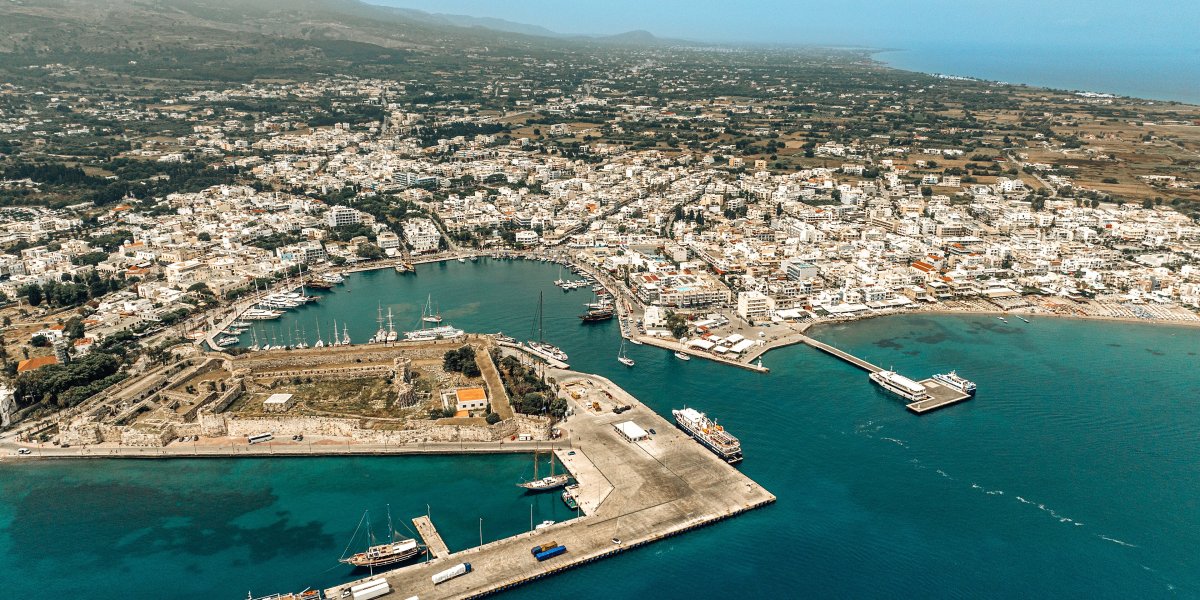
City Guide
Kos
Grèce · Best time to visit: May-Oct.
Day-by-day plan
Choose your pace
Durée du voyage
08:00
Landmark
Set off from Eleftherias Square at 08:00 and walk 4 km southwest along eucalyptus-lined Grigoriou tou Pemptou Avenue — a flat 50-minute warm-up past goat pastures and hibiscus hedges, the Turkish coast glinting on your right. Built on a cypress-covered hillside, this is where the world's first medical school stood 2,400 years ago: three tiered marble terraces, ionic column stumps, and a sacrificial altar facing Bodrum across the strait. Arriving at 08:50 — ten minutes before the first cruise buses — you'll have the upper platform almost alone, the cypress shadows still cool over the stones.
Tip: Skip the entry-gate audio guide and climb straight to the third terrace first — at 09:15 the rising sun cuts horizontally through what remains of the colonnade, the only hour the altar stones cast meaningful shadows. Cruise tour buses pour in continuously from 10:00, so doing this morning-first is non-negotiable; don't drift back into town later in the day expecting to fit it in.
Open in Google Maps →11:30
Food
Retrace the 4 km back northeast — by 11:20 you're crossing into the old town's grid of low whitewashed houses, and the smell of charcoal-grilled meat tells you you've arrived. Two minutes off Eleftherias Square on Bouboulinas Street, this family-run kitchen plates Greek home cooking on paper-covered tables shaded by a grapevine. Order the lamb kleftiko (slow-roasted in parchment with lemon and oregano, €9.50) and a Greek salad with Kos-grown tomatoes (€6.50); €15 for one, €25 for two with a quarter of house white.
Tip: Sit in the back courtyard, not the street tables — it runs 4°C cooler at noon and the resident cats keep you company. Carry cash: card payments crawl through the family's ancient terminal and have been known to take ten minutes per transaction.
Open in Google Maps →12:45
Landmark
Walk two minutes east on Eleftheriou Venizelou — the enormous green canopy appears between the houses and you'll hear cicadas a block before you arrive. Stand under the gnarled trunk where Hippocrates is said to have taught his students; the present tree is a 500-year-old descendant (the 2,400-year legend is poetic, not botanical), propped on iron crutches above a marble Ottoman fountain. Fifty metres north drops you into the Ancient Agora — Hellenistic stoa foundations, a Roman bath floor, an early Christian basilica with broken mosaics — all open to the sky, walked freely without a ticket.
Tip: The signature photo of Kos is the plane tree's branches framing the minaret of the 1786 Defterdar Mosque behind it — shoot from the southwest corner of Plateia Platanou at 13:30, when the sun lights tree and minaret equally. Two cruise ships dock by 14:00 and the square fills with selfie sticks, so finish your photos before then.
Open in Google Maps →14:30
Landmark
Exit the Agora at its north gate and cross the palm-lined Phoinikon Avenue — the honey-stone walls rise straight ahead, four minutes past Italian-era arcades. Built by the Knights of St. John in the 14th century from blocks quarried out of the Asklepieion you visited this morning (look for inscribed Greek fragments embedded in the curtain walls), this fortress still guards the harbor mouth. You aren't going inside — the exterior tells the whole story. Walk the moat clockwise: the southern bastion carries the carved coats of arms of the Grand Masters, the north wall plunges directly into the sea.
Tip: The frontal shot from the wooden bridge is fine, but the iconic angle — castle reflected on calm water with the Turkish coast behind — is from the north quay (Akti Koundourioti) at 15:00, when the eastern bastion is fully sunlit. Allow 45 minutes for the full 700 m circumnavigation; the seaward side is the half most visitors skip and it's the better half.
Open in Google Maps →16:00
Neighborhood
Step off the north quay onto Akti Koundourioti and follow the palm promenade due east — fishing caïques on your left, low-rise Italian colonial façades on your right, the Turkish islet of Pserimos floating on the horizon ahead. Two flat kilometres of seafront lead from the working inner harbor (octopus drying on lines, nets folded in piles) past the tile-roofed Casa Romana to the modern marina with its 200 yachts. This is Kos's evening living room — locals jog, kids fish, retirees play tavli. Reach the marina's east mole by 18:30 and double back; the sun will be dropping behind the castle by 20:15.
Tip: The postcard sunset shot isn't from the marina but from the wooden fishing pier 100 m east of the harbor mouth — line the castle's southwest tower up with the setting sun for the composition every postcard uses. Take a €4 Mythos at any inner-quay café; skip the marina-end cocktail bars where mediocre mojitos run €12.
Open in Google Maps →19:30
Food
Leave the harbor at 19:15 and cut three minutes inland to Plateia Theologou — Petrino's bougainvillea-draped volcanic-stone walls (the name means 'of stone') are unmistakable beside the Ancient Agora you walked through earlier. A 19th-century stone house turned into Kos's most loved sit-down dinner: mezedes-style, tables outside under the plane trees, the floodlit Roman ruins glowing beside you. Order the grilled octopus with fava purée (€16), the kritharoto with prawns (orzo risotto, €18), and a half-litre of local Limnio red (€8); €35-42 a head with bread, salad and a tsipouro nightcap.
Tip: Reservations are essential for the courtyard tables after 20:00 — call ahead the morning of, or arrive at 19:30 sharp to walk straight in. Tourist-trap warning for Kos Town: never eat at the harborfront strip with the laminated multilingual menus and touts who grab you by the arm — that line of tavernas pours €19 moussaka and frozen fish onto tourists. Simple rule for the night: if you can see the castle from your table, you're being overcharged.
Open in Google Maps →Aller au jour
09:00
Landmark
Take a 10-minute taxi from Kos Town through olive groves to the southwest hill — the driver drops you at the foot of three terraces rising into pines. The Asklepieion was the ancient world's most celebrated medical sanctuary, where Hippocrates trained physicians twenty-four centuries ago. Climb the wide marble stairways between cypresses to the upper terrace, where the Temple of Asklepios opens to a sweeping view across the strait to the Turkish coast.
Tip: Arrive at 08:30 when gates open — by 10:00 the cruise-ship coaches arrive and the grand staircase becomes a slow queue. Climb to the top terrace first and shoot looking back down: the morning sun lights the Doric columns from the east and the sea behind glows turquoise. The lower terrace can wait until you descend.
Open in Google Maps →12:00
Food
Walk 15 minutes north from the Asklepieion through olive groves into Platani — a Turkish-Muslim village that has cooked the same way for a century, hidden in plain sight 2 km from the tourist beaches. Sit under the plane trees in the main square at Arap, where four generations have served charcoal-grilled lamb skewers and homemade tzatziki thicker than yogurt. Order the keftedes (handmade meatballs with mint, €8) and the lamb kebab plate with warm flatbread (€14) — both arrive sizzling on wooden boards with a slice of grilled tomato.
Tip: Walk in by 11:55 — the four shaded tables nearest the fountain in the back garden fill the moment Asklepieion tour groups arrive at 12:15. The flatbread isn't listed on the menu but the waiter will bring it warm from the oven if you order any kebab; ask for ekmek.
Open in Google Maps →14:00
Museum
A 5-minute taxi from Platani drops you at Kos Town's western edge — Casa Romana hides behind a wall of bougainvillea on a quiet lane. Step inside this restored 3rd-century Roman villa and the temperature drops ten degrees; the rooms unfold around three columned atria with original mosaic floors of leaping dolphins, panthers, and a coiling Medusa. Almost no one visits in the afternoon — you'll likely have the whole villa to yourself.
Tip: The dolphin and panther mosaics sit behind protective glass that catches reflections — angle your phone's flashlight beam at 45 degrees across the floor (the guards don't mind) and the tesserae light up like wet stones. The triclinium on the right has the best-preserved floor; save it for last.
Open in Google Maps →15:45
Landmark
Cross the road from Casa Romana — you're now standing on the Decumanus Maximus, the 2,000-year-old paved Roman road running east to west across the western archaeological zone. Walk its length past the columns of the gymnasium and the Nymphaeum baths to the Roman Odeon, a small marble theater cut into the slope. The site is fenced but free, and the afternoon sun turns the limestone honey-gold.
Tip: Climb to the top tier of the Odeon and sit on the upper marble row — locals come here to read in late afternoon and the acoustics still work: drop a coin on the orchestra floor and you'll hear it. The wildflowers between the stones bloom March through May; in summer the heat reflects strongly, bring water.
Open in Google Maps →17:00
Neighborhood
Walk 15 minutes northeast through Eleftherias Square to Akti Koundourioti — the palm-lined harbor promenade locals call Finikon Avenue. Mandraki is where fishing caïques and white yachts moor side by side beneath the stone walls of Nerantzia Castle. As the light softens after 18:00 the masts cast long bands across the water and the castle silhouettes against a pink-gold sky over Bodrum on the Turkish coast.
Tip: Walk past the moored yachts to the very end of the stone breakwater — there's an unmarked stone bench locals call the 'sunset seat.' From here the angle catches both the castle ramparts and the sun dropping behind the hills of Pyli in one frame. Bring nothing to drink from the marina kiosks — they overcharge by 40%.
Open in Google Maps →19:30
Food
Walk 10 minutes south from the harbor to Plateia Theologou — Petrino occupies a restored 19th-century stone mansion, the only restaurant in Kos with a candlelit garden under old fig trees. The kitchen serves traditional dishes you won't find on tourist menus: pitaridia, Kos's own handmade pasta tossed with aged goat cheese and brown butter (€14), and slow-cooked kid goat in lemon-oregano sauce that falls off the bone (€22). The wine list runs deep into small Dodecanese producers most visitors have never heard of.
Tip: Reserve at least 24 hours ahead and ask specifically for the upper courtyard — the lower one sits beside a lane where scooters pass. The pitaridia is the dish of the island and is only made fresh on weekends; order it first because the kitchen runs out by 21:00. PITFALL: do not eat dinner anywhere along Akti Koundourioti or Akti Miaouli — those harbor restaurants run identical 'tourist menus' with frozen calamari and reheated moussaka at 60% markup; locals never set foot in them.
Open in Google Maps →09:00
Museum
Begin at Eleftherias Square, the heart of Kos Town, where the Archaeological Museum occupies an elegant Italian-built palazzo from 1935. Two floors hold finds spanning two millennia: a 4th-century BC seated statue of Hippocrates himself, dazzling Roman mosaics lifted from local villas, and Hellenistic figurines pulled from the seabed off Antimachia. At 09:00 you share the galleries with a handful of others; by noon school groups arrive.
Tip: Head straight upstairs to Room 3 — the seated Hippocrates is the museum's masterpiece, but most visitors miss the side cabinet where bronze surgical instruments from the Asklepieion are displayed: scalpels, forceps, and probes barely changed in design from a modern operating room. Closed Tuesdays — verify the hours notice on the door, as Greek state museum schedules shift seasonally.
Open in Google Maps →10:45
Landmark
Walk 5 minutes north from Eleftherias Square along Vasileos Pavlou, then cross the small palm-shaded stone bridge over Finikon Avenue — you enter the Castle of the Knights through its land gate. Built by the Knights Hospitaller across the 14th and 15th centuries to guard the harbor against Ottoman fleets, the double walls enclose an open ramparts walk where ancient marble columns are reused as cannon supports and Hospitaller coats of arms carve the inner gates. Climb the northwest tower for the widest view of the harbor and the Asian coast.
Tip: Walk the outer walls clockwise — the southeast bastion has a low parapet that perfectly frames Kos Mandraki in the foreground with Bodrum Castle visible across the strait 5 km away. The 11:00 morning angle lights both castles from the front; by 14:00 the Turkish coast turns into a flat silhouette.
Open in Google Maps →12:30
Food
Walk 10 minutes south back into the old quarter — Mummy's Cooking sits on a quiet pedestrian lane two blocks behind Eleftherias Square. There is no printed menu; the owner walks to your table and lists what her mother cooked that morning in the open kitchen: gemista (stuffed tomatoes and peppers, €11), lamb stifado in cinnamon-clove sauce (€13), eggplant moussaka layered with béchamel (€12). Plates are generous, portions are home-sized, and prices haven't moved in three summers.
Tip: Arrive at 12:30 sharp to claim one of the seven outdoor tables under the grapevine canopy — they fill completely by 13:15 and there is no waitlist. Order the gemista and ask for a slice of galaktoboureko (warm custard pastry) — both are made before noon and sell out by 14:00. Cash only.
Open in Google Maps →14:30
Landmark
Walk 3 minutes north through the old lanes to Plateia Platanou — a small square dominated by the Plane Tree of Hippocrates, its 12-meter hollow trunk propped up by re-used Roman columns and iron braces. Legend says Hippocrates taught his students beneath it 2,400 years ago; botanists place the actual tree at 500 years old, still the oldest plane tree in Europe. The 1786 Loggia Mosque sits beside it, its slender minaret a remnant of Ottoman Kos, framed against the medieval castle bridge.
Tip: Stand at the southwest corner of the square, beside the small marble fountain — from there a single frame catches the tree's spreading canopy, the white mosque minaret, and the castle bridge stones all at once. The 15:00 light hits the mosque wall and the dappled leaves at the same intensity; before or after, one or the other is in shadow.
Open in Google Maps →15:30
Landmark
Walk 2 minutes north from the Plane Tree and the ancient city opens at your feet — the Agora of Kos is one of the largest open archaeological fields in Greece, completely free and unfenced, walked freely by locals on their evening stroll. Wander through the foundations of the Hellenistic stoa, the Roman temple of Aphrodite, and the early Christian basilica's mosaic floor. In late afternoon the low sun rakes across the broken column drums and the entire field turns into long golden geometry.
Tip: Walk the perimeter counterclockwise to find the standing column of the Aphrodite Pandemos sanctuary on the eastern edge near the harbor wall — it's the tallest surviving shaft on the site and almost no day-tripper makes it that far. The 18:30 light is the best photograph moment of the entire trip; bring water as there is zero shade once you step off the path.
Open in Google Maps →19:30
Food
Walk 5 minutes south through the old lanes — Pote Tin Kyriaki ('Never on Sunday') is a hidden taverna with eight tables on a flowering courtyard and no sign on the outer wall, just a wooden door framed in jasmine. The owner Spyros opens the kitchen door to show you the day's catch from his own boat: red mullet, sea bream, octopus drying on a line. Order the charcoal-grilled octopus tender from a slow simmer in red wine (€18) and the sea bass baked in salt crust, cracked open at the table (€26 per kg).
Tip: Closed Sundays (true to the name) and the eight tables book out two days ahead in summer — call before 11:00 the same morning to catch the cancellation slot. Ask for Table 3 by the lemon tree and begin with a half-bottle of house Assyrtiko (€12). PITFALL: ignore the 'fresh fish' restaurants lining Akti Miaouli with photo menus and English-speaking touts at the door — most serve frozen Atlantic fish at fresh Aegean prices; here you watch the fish come off Spyros's caïque each morning.
Open in Google Maps →
Trip builder
Plan this trip around Kos
Turn this guide into a bookable rail itinerary with FlipEarth.
Keep exploring
Related cities
More in the same country
FAQ
Frequently asked questions
How many days do you need in Kos?
Most travelers enjoy Kos in 1 days, with enough time for headline sights and a slower meal or museum stop.
What's the best time to visit Kos?
The easiest season for most travelers is May-Oct, especially if you want good weather and manageable crowds.
What's the daily budget for Kos?
A practical starting point is about €75 per person per day before hotels, then adjust based on museums, dining, and transport.
What are the must-see attractions in Kos?
A good first shortlist for Kos includes Asklepieion of Kos, Plane Tree of Hippocrates & Ancient Agora, Neratzia Castle (Castle of the Knights).