City Guide
Jerez de la Frontera
Espagne · Best time to visit: Mar-May, Sep-Nov.
Day-by-day plan
Choose your pace
Durée du voyage
09:00
Landmark
Begin north of the centre at the wrought-iron gates of the Royal Andalusian School of Equestrian Art, set inside a 19th-century palace designed by Charles Garnier — the same architect behind the Paris Opéra. From the outside you can photograph the cream-coloured façade through the avenue of palm trees, and on training mornings the rhythmic clop of Cartujano horses drifts over the wall. The grounds and carriage entrance set the visual tone for the whole day: this is a city where animals, aristocracy and theatre have always shared the same address.
Tip: If your visit falls on a Tuesday, Thursday or Friday, the 12:00 'Cómo Bailan los Caballos Andaluces' show is the single most magical thing in Jerez — but for a power-walk day, arrive at 09:00 when the riders are training in the outdoor paddock visible from the east-side fence: same horses, no ticket, no crowd.
Open in Google Maps →10:45
Religious
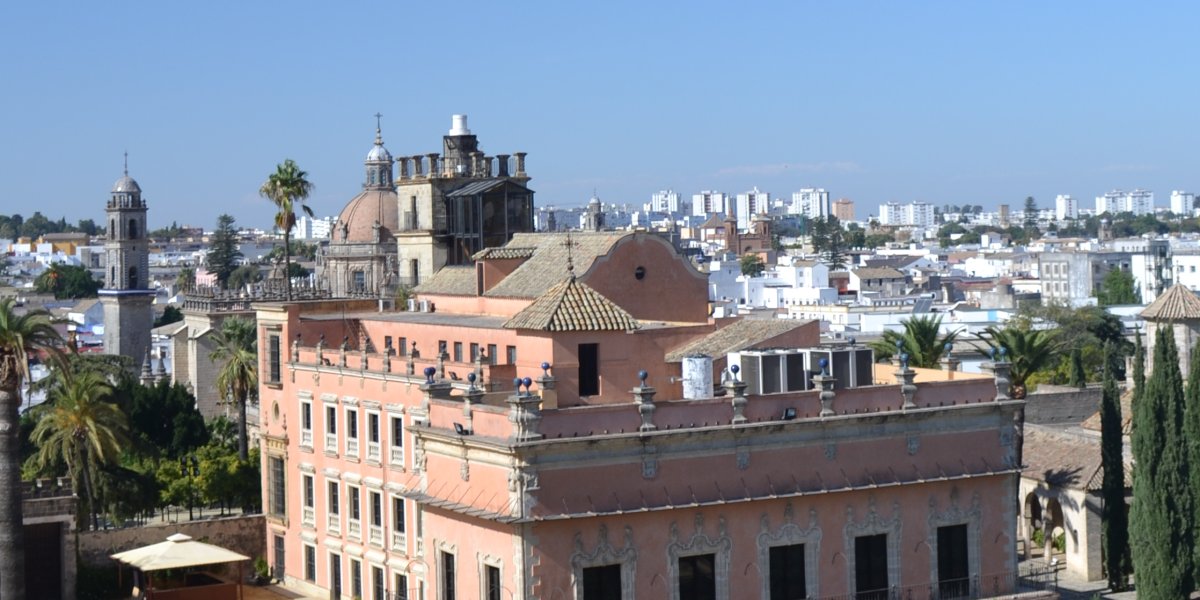
Walk south down Avenida Álvaro Domecq into the old town — about 15 minutes, lined with orange trees and the white-tiled façades of working sherry houses — until the detached bell tower of the cathedral rises behind the rooftops. The Almohad-era campanario stands apart from the church itself, a leftover minaret in stone, while the cathedral fuses Gothic ribs with a Baroque dome and Neoclassical staircase. From the steps you frame the most jerezano view there is: a cathedral on one side, the black 'Tio Pepe' barrels of González Byass spilling out of the bodega gates on the other.
Tip: Stand at the bottom-left corner of the south staircase (facing the façade): from there the bell tower, the cathedral dome and the bodega rooftop all line up in a single frame — late-morning light hits them all at the same angle and there is almost no one shooting from this exact spot.
Open in Google Maps →11:50
Landmark
Cross the cathedral plaza and follow Calle Manuel María González downhill for 4 minutes — you will pass the famous arched entrance of the González Byass bodega on your left, lined with hand-painted Tio Pepe barrels signed by Hemingway, Picasso and Spielberg. The Alcázar appears at the end of the street: an 11th-century Almohad fortress with an octagonal tower, a mosque-turned-chapel and a hammam still under its original brick vaulting. Even from the exterior you can circle the ochre walls, peer into the orange-tree courtyard and climb to the Plaza del Arenal viewpoint that looks straight down onto the bodega's tiled rooftops.
Tip: Skip the interior ticket on a one-day trip — the real prize is the outer rampart walk along Alameda Vieja, where at midday the light hits the octagonal tower head-on and frames it against the cathedral behind. The kiosk in the alameda sells fresh orange juice from Jerez groves for €2; locals stop here on their way to lunch.
Open in Google Maps →13:15
Food
Walk five minutes north through Plaza del Arenal — the broad palm-lined square where Jerez gathers — and turn into the narrow Calle Santa María. The doorway of El Pasaje is easy to miss: it is the oldest tabanco in the city, opened in 1925, and you order standing at a marble counter scrawled with the chalk-written wine list. A copita of fino straight from the barrel is €1.80, the chicharrones especiales (pressed pork belly with lemon and oregano) are €5, and the montadito de pringá — a slow-cooked stew folded into a hot bun — is €3.50. Around 14:00 a flamenco singer often steps out from behind the bar with a guitarist and the whole room falls silent.
Tip: Arrive at 13:15 sharp — by 13:45 the tour groups from the cruise ships in Cádiz arrive and you lose your standing spot. Order in this exact sequence: fino en rama, chicharrones, then montadito de pringá; ask the barman for 'una caña de oloroso' to finish — it is what jerezanos drink before the afternoon siesta.
Open in Google Maps →16:30
Neighborhood
Walk 12 minutes north-west from the tabanco through Calle Francos and Calle Cantarería, watching the streets narrow and the geraniums multiply on the whitewashed walls. You are entering Barrio de Santiago, the gitano quarter where flamenco was born — the home of Lola Flores, Manuel Soto 'Sordera' and the entire bulería rhythm. Loop past the Gothic Iglesia de Santiago, the Palacio de Pemartín that houses the Centro Andaluz de Flamenco (the courtyard is free to enter), and the Plaza del Mercado where children still clap palmas in the late afternoon. Around 17:30 the side-light raking down Calle Nueva turns the whitewash a soft cream — this is the photograph people remember of Jerez.
Tip: Calle Francos is the postcard street — walk it east to west around 17:00 when the sun is behind you and the shadow of the iron grilles falls across the white walls in stripes. Step into the courtyard of the Palacio de Pemartín even if the flamenco centre exhibition is closed; the patio with the marble fountain is open until 19:00 and almost always empty.
Open in Google Maps →19:45
Food
Walk south from Barrio de Santiago for 8 minutes down Calle San Francisco de Paula until you find a tall arched doorway with no obvious sign — this is La Carboná, set inside a 19th-century working bodega with original brick vaulting, sand floors and rows of sherry barrels lining the walls. Chef Javier Muñoz cooks the most refined sherry-pairing menu in Andalusia: ask for the tasting menu (€55) and each course arrives with a different copita poured directly from the cask beside the table. Don't miss the atún rojo de almadraba a la brasa con manzanilla (€32) and the risotto de boletus y jamón ibérico (€22) — both dishes locals order over and over.
Tip: Reserve at least three days ahead — there are only fourteen tables and Saturday nights book out two weeks in advance. Pitfall warning: ignore every restaurant directly on Plaza del Arenal and the streets leading to the bus station — they run mass-tourism 'paella + sangria' menus that have nothing to do with jerezano cooking. Real Jerez eats inside old bodegas like this one or standing up at a tabanco; if a menu is translated into five languages and posted on the street, walk past it.
Open in Google Maps →
Trip builder
Plan this trip around Jerez de la Frontera
Turn this guide into a bookable rail itinerary with FlipEarth.
Keep exploring
Related cities
More in the same country
FAQ
Frequently asked questions
How many days do you need in Jerez de la Frontera?
Most travelers enjoy Jerez de la Frontera in 1 days, with enough time for headline sights and a slower meal or museum stop.
What's the best time to visit Jerez de la Frontera?
The easiest season for most travelers is Mar-May, Sep-Nov, especially if you want good weather and manageable crowds.
What's the daily budget for Jerez de la Frontera?
A practical starting point is about €100 per person per day before hotels, then adjust based on museums, dining, and transport.
What are the must-see attractions in Jerez de la Frontera?
A good first shortlist for Jerez de la Frontera includes Real Escuela Andaluza del Arte Ecuestre (Palacio del Recreo de las Cadenas), Alcázar de Jerez.