City Guide
Caceres
Espagne · Best time to visit: Apr-Jun, Sep-Oct.
Day-by-day plan
Choose your pace
Durée du voyage
09:00
Landmark
Start where Cáceres begins — a long sloping square with a wall of medieval towers rising on one side, looking less like Spain than a film set. Stand at the lower western end facing east: the 12th-century Torre de Bujaco glows gold in raking morning light, with stork nests bristling on every battlement. The cafes are still setting out chairs and the buses arriving from Madrid won't reach the plaza until 11:00 — for ninety minutes the view is yours.
Tip: The best photo of the wall of towers is from the southwest corner of the plaza between 09:00-09:30, when the sun rakes across the stones from the left. Skip the cafes on the plaza itself — they charge €4 for an espresso — and grab coffee at Cafetería La Montera one street back on Calle Pintores, where the locals go.
Open in Google Maps →10:00
Religious
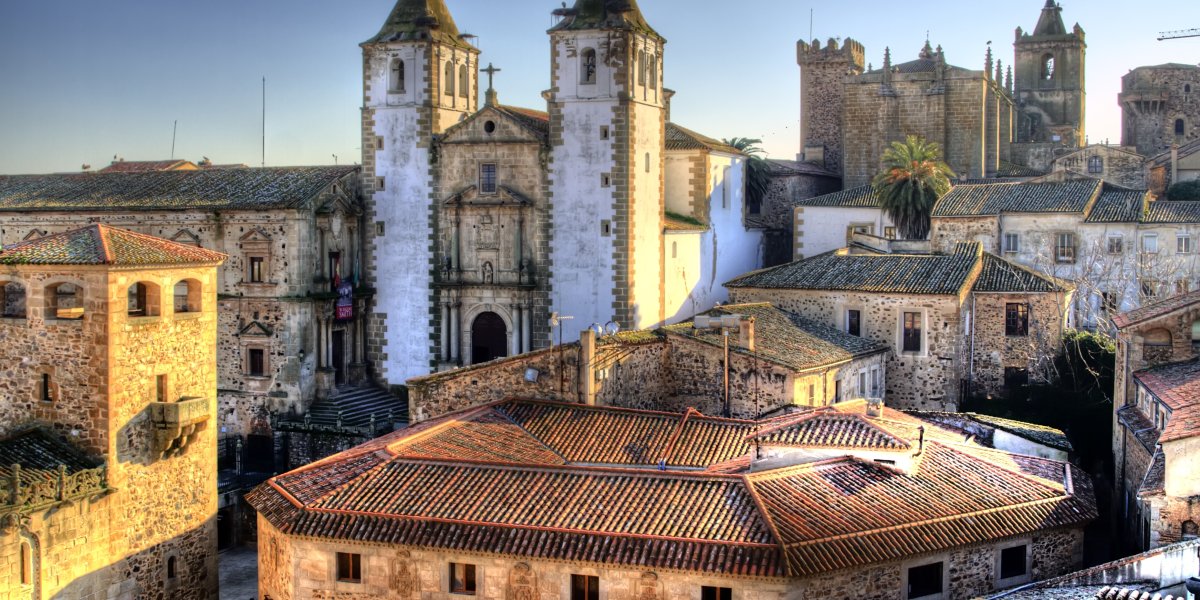
Walk up the ramp at the east end of Plaza Mayor and pass through Arco de la Estrella — Cáceres' star-shaped 18th-century gate — and in ten paces you step from modern Spain into 1500. The Concatedral rises in honey-colored sandstone on a small stepped square hemmed in by Renaissance palaces, each doorway carved with a different family's coat of arms. Plaza de Santa María at 10:00 is one of the most photographable corners in all of Spain — the light is soft on the west-facing facade and the square is still half-empty.
Tip: Touch the bronze foot of San Pedro de Alcántara at the cathedral's south door — locals say it guarantees a safe trip and a return to Cáceres, and the foot is worn smooth from four centuries of believers. The narrow lane Cuesta de la Compañía behind the cathedral is empty before 11:00 and leads straight up to the upper city.
Open in Google Maps →11:30
Neighborhood
Climb the steep stone steps behind the cathedral — three minutes uphill past stork-topped palaces — and you arrive at Plaza de San Jorge, the square HBO used as King's Landing for Game of Thrones Season 7. The white twin towers of Iglesia de San Francisco Javier dominate the view; continue another 200 metres up Calle Ancha to Plaza de San Mateo, the city's highest point, where the air thins and you can see across all of Extremadura. The alleys between the two squares — Cuesta de Aldana, Calle Olmos — look identical to how Cervantes would have seen them.
Tip: For the iconic Game of Thrones shot of San Francisco Javier, stand at the top of the staircase on the south side of Plaza de San Jorge and shoot upward — the two white towers frame perfectly against the sky. Climb the church's belltower (€1.50, open daytime) by the unmarked side door on the left for the city's only true panoramic view; almost no tourist finds it.
Open in Google Maps →13:30
Food
Walk back down through Arco de la Estrella and across Plaza Mayor — eight minutes downhill — to this restored 19th-century market hall just outside the walls on Plaza San Juan. A dozen stalls share long communal tables: order the tosta de Torta del Casar (€4 — runny sheep's-milk cheese spooned warm onto toasted bread) at the Quesos del Casar counter, then a plate of jamón ibérico de bellota (€12) at La Bellota two stalls down. Cool, lively, fast — counter-order, eat in forty minutes, keep the day moving.
Tip: No reservations and tables are first-come — arrive by 13:15 to grab a corner table before the Spanish lunch wave at 14:00 swallows the room. The Quesos del Casar stall sells whole take-away wheels (€8-15) vacuum-packed — vastly cheaper than the airport and survives a 24-hour carry-on home.
Open in Google Maps →15:30
Landmark
Re-enter the walls via the smaller Arco del Cristo gate on the southeast side — a quieter ten-minute climb than the main arch. Walk past Torre de las Cigüeñas, the only crenellated tower in Cáceres allowed to keep its battlements after Queen Isabella's 1477 decree stripped the rest of the nobility of theirs, then exit through the eastern wall onto the Adarve del Padre Rosalío. The path traces the outside of the fortifications — afternoon sun lights the full sweep of towers from the east, and at 17:00 the storks return to their nests in a noisy aerial homecoming most tourists have already missed.
Tip: Time your outer-wall walk for 17:00-17:30 — the stork return is loud, dramatic, and photographed by almost no one because the day-trippers leave at 16:00 for their buses. The bench beside the Olivo de la Judería at the southeast corner of the walls is the magic spot for the classic 'wall of towers' shot, with golden hour starting there at 18:30 in spring.
Open in Google Maps →20:00
Food
Walk west from the walls back to Plaza San Juan — six minutes downhill, past the floodlit cathedral — to this 1947 family restaurant whose menu has not changed in three generations. Order the migas extremeñas (€11 — fried breadcrumbs with chorizo, grapes and peppers, the dish shepherds invented in the dehesa hills outside town) and the solomillo de retinto al Pedro Ximénez (€22 — local heritage beef in a sweet sherry reduction). The dining rooms are small, tile-walled, and packed with locals celebrating birthdays; two people with a half-bottle of Ribera will land around €70.
Tip: Reserve 48 hours ahead by phone (+34 927 244 362) for a 20:30 seating — walk-ins after 21:00 routinely wait an hour. Cáceres pitfall warning: avoid every restaurant fronting Plaza Mayor and the 'jamón experience' shops on Calle Pintores — both charge double price for industrial supermarket-grade product, while the real Extremaduran kitchens (Eustaquio, Madruelo, Atrio) hide one street back from the tourist routes.
Open in Google Maps →Aller au jour
09:30
Landmark
Begin on Cáceres' sloping golden plaza before the day heats up — its 16th-century porticoes face the city walls and the squat, stork-nested Torre de Bujaco. Have breakfast under the arcades while the square is still empty, then climb the Bujaco at 10:00 opening: the Almohad battlements appear at eye level and you suddenly see how every rooftop inside the walls is crowned with a stork nest. The morning sun hits the granite from the east, throwing the silhouette into postcard relief.
Tip: Order café con tostada con tomate at Café El Pato on the southwestern corner of the porticoes (5€) — locals' breakfast spot, and the only Plaza Mayor angle where the Bujaco tower sits dead-center in your frame. Climb the tower at 10:00 sharp — school groups arrive after 11:00 and the spiral stair only fits one person.
Open in Google Maps →11:00
Religious
From the foot of Bujaco, step through Manuel Churriguera's dramatic 18th-century arch — the threshold every visitor remembers, carved wide enough for carriages and framing the walled city like a stage set. Two minutes inside lies Plaza de Santa María, where the rough-granite Concatedral rises out of the bedrock; climb the bell tower (5 minutes of spiral stairs) and step out onto a stone catwalk eye-to-eye with three resident storks. From up here the entire UNESCO old town spreads beneath you with not a single building newer than 1600.
Tip: Buy the combined Concatedral+tower ticket at the entrance (5€) — the tower door is a small wooden one to the left of the altar, easy to miss. Skip the audioguide; the views are the point. Closed Sunday mornings until 13:00 for mass.
Open in Google Maps →13:30
Food
Walk back out under Arco de la Estrella and turn right onto Calle Orellana — three minutes to Cáceres' most loved tapas counter, hidden in a cave-like stone room with a dozen tables and a permanent line of locals. Order the torta del casar montadito (warm runny Casar cheese on toast, 4.50€) and the presa ibérica with smoked sweet paprika (12€) — both from Extremadura producers within 40 km. Budget 25-30€ per person with a glass of Ribera del Guadiana.
Tip: Arrive at 13:15 — they open at 13:30 but the line forms 15 minutes early and they don't take reservations for groups under four. Order at the bar to avoid the back room's wait; the torta del casar is non-negotiable, the salmorejo is the dark horse. If full, walk 80 m to Tapería La Madrila for the same regional dishes.
Open in Google Maps →16:30
Museum
Cross back into the walled city through Arco de la Estrella and follow Cuesta de la Compañía south — six minutes past sandstone palaces to the Casa de las Veletas, the quietly extraordinary museum of Extremadura. Beneath the 16th-century mansion lies an 11th-century Almohad cistern (aljibe) — five granite columns and horseshoe arches still holding the same still green water 900 years later. The afternoon session opens at 16:00 and stays nearly empty for the first hour.
Tip: Skip the upstairs ethnographic rooms on first visit and descend straight to the aljibe — the lights are dim and slow to adjust to; pause on the lower steps for thirty seconds and the water suddenly mirrors the full underwater-mosque effect. Free for EU citizens, 1.20€ otherwise. Closed Mondays — if your Day 1 falls on a Monday, swap with Day 2.
Open in Google Maps →18:30
Religious
Walk north from the museum down narrow Cuesta del Marqués — three minutes to the steep, cinematic Plaza de San Jorge, where Game of Thrones filmed Cersei's Walk of Shame and the King's Landing slope. Climb the bell tower of the white-stuccoed Iglesia de San Francisco Javier (the only baroque facade in the old city) for the city's best sunset platform — the granite town turns honey-gold and every stork below tilts west into the light.
Tip: Pay 1€ at the door to climb the tower and aim to be up there 30 minutes before sunset (Apr 19:30 / Jun 21:00 / Sep 19:45 / Oct 18:30). Don't waste daylight on the dim church interior — it's the rooftop that matters. Stand at the north corner of the platform: the Concatedral lines up perfectly with the descending sun.
Open in Google Maps →20:30
Food
Exit the walls through Arco del Cristo and cross Plaza Mayor diagonally — seven minutes to Plaza San Juan, where Cáceres' oldest restaurant (since 1947) has been serving the same migas extremeñas (fried breadcrumbs with chorizo and grapes, 14€) to four generations of locals. Order the solomillo of retinto beef (28€) — pasture-raised in the dehesa where the Iberian pigs roam — and the perdiz estofada (stewed partridge, 22€) in autumn. The wood-paneled dining room feels frozen in 1970 and that's exactly the point. Budget 50-60€.
Tip: Reserve 2 days ahead and ask for the front salon by the window — the back room is cramped and acoustically punishing. Pitfall warning: avoid the restaurants right on Plaza Mayor entirely. They charge 18€ for a frozen tortilla and 14€ for tinned anchovies, and the menus in five languages on the porticoes are the tell. Plaza San Juan is just 60 m further and is where locals actually eat.
Open in Google Maps →09:30
Neighborhood
Enter the walled city from the south through Arco del Cristo — the only original Roman gate left standing — and climb cobbled Cuesta de Aldana into the medieval Jewish Quarter. Whitewashed houses (the only white in an otherwise stone-colored city) cling to the slope like an Andalusian village dropped inside a Castilian fortress, geraniums spilling from every wrought-iron grate. At the top, the tiny Ermita de San Antonio sits on what was once the main synagogue — push the door, it's almost always empty.
Tip: Take Cuesta de Aldana, not the parallel Calle de la Cruz — Aldana is narrower, steeper, and the white-walls-and-geraniums composition is the photo every guidebook uses (best between 09:30-10:30 when the eastern sun lights the lane head-on). The Ermita opens 10:00-13:30; if locked, the keyhole-shaped window at the back lets you see the white-and-gold altar.
Open in Google Maps →11:00
Landmark
Walk north out of the Jewish Quarter and curve around Plaza de Santa María — five minutes to the most spectacular private palace still standing in the walled city, occupied by the Golfín family for 600 years. The 11:00 guided tour walks you through Mudéjar coffered ceilings, the actual bedroom where Isabella and Ferdinand slept in 1486 on the road to Granada, and a tower whose narrow windows were carved for the family's crossbowmen.
Tip: Book online one day ahead at fundacioncbg.es — tours cap at 25 people, are in Spanish with English laminated cards, and the 11:00 slot is the only one with no school groups. Ask the guide to point out the carved family motto 'Esta es Cáceres' on the facade — easily missed but the single most photographed inscription in the city.
Open in Google Maps →13:00
Food
Walk west out through Arco de la Estrella — four minutes to a low-ceilinged tapas room on Calle Sancti Spíritus where hams hang from the rafters and old men line the bar by noon. Order the croqueta de jamón ibérico (2€ each — the city's best, crisp shell collapsing onto a molten ham bechamel) and the tabla de quesos extremeños (15€, three regional cheeses including the runny D.O.P. Torta del Casar you eat with a spoon). Budget 22-28€ with a glass of Ribera del Guadiana.
Tip: Sit at the bar, not the back room — that's where the conversation and the better pours happen. Arrive at 13:00 sharp; by 14:00 every stool is taken and they stop seating until 15:30. Ask for 'el ibérico de bellota' — they keep a different ham (older, acorn-fed, 5€ a plate more) for guests who specifically request it.
Open in Google Maps →16:00
Landmark
Walk back through Arco de la Estrella into Plaza de Santa María — three minutes to the free-entry Palacio de Carvajal, where a 500-year-old fig tree fills the cool central patio. The chapel-tower is one of the few round Roman-era towers still standing in Spain, and the upstairs noble rooms show how the granite walls hide cool, frescoed interiors — the survival trick of Extremaduran summer.
Tip: Free entry — most tourists walk straight past assuming it's closed. Look up at the wooden Mudéjar ceiling in the entrance hall (often missed); the fig tree blooms in June and drops fruit in late August. Closed Sundays after 14:00.
Open in Google Maps →17:30
Neighborhood
From Carvajal, walk south along Calle Ancha to Plaza de San Mateo — five minutes climbing gently to the highest point of the walled city, where the bare granite Iglesia de San Mateo sits on what was the old mosque. Slip out through the southern corner onto Adarves del Padre Rosalío, the elevated walkway around the outer wall — the next 1 km circles the city counterclockwise, passing the Torre de los Pozos and the Foro de los Balbos, with storks below and the dehesa plain stretching west into sunset.
Tip: Time the walls walk for 30 minutes before sunset — the western stretch by Torre de los Pozos catches the lowest light, when the stone goes pink and the storks return to nest in chattering pairs. Stay on the southern and western arcs (Adarves Sur and Adarves Oeste); skip the eastern stretch along Avenida de la Universidad — that side faces the modern city and breaks the spell entirely.
Open in Google Maps →20:00
Food
Walk back into the walled city via Arco de la Estrella and turn left onto Calle Camberos — five minutes to two narrow stone-vaulted rooms serving the most refined Extremaduran cooking outside Atrio. Order the carrillada de retinto (slow-braised beef cheek in Pedro Ximénez, 22€) and the cardillos con jamón (wild thistle stems with Iberian ham, 28€) — a dish you'll only find in Extremadura and only when the thistles are in season (Mar-May). Budget 45-55€ for three courses.
Tip: Reserve at least 2 days ahead — only six tables on the ground floor; request the front room (the back is windowless). Ask the chef's daughter who runs the floor for the wild-herb dishes not on the English menu. Pitfall warning: don't be tempted by the 'jamón ibérico' vacuum-packs in the souvenir shops near Plaza Mayor — those are 'cebo' grade (grain-fed), not the 'bellota' (acorn-fed) Extremadura is famous for. Real bellota costs 8-12€ per 100g at the proper charcuterías like Sabores de Extremadura on Calle Pintores; if it's cheaper, it isn't bellota.
Open in Google Maps →
Trip builder
Plan this trip around Caceres
Turn this guide into a bookable rail itinerary with FlipEarth.
Keep exploring
Related cities
More in the same country




FAQ
Frequently asked questions
How many days do you need in Caceres?
Most travelers enjoy Caceres in 1 days, with enough time for headline sights and a slower meal or museum stop.
What's the best time to visit Caceres?
The easiest season for most travelers is Apr-Jun, Sep-Oct, especially if you want good weather and manageable crowds.
What's the daily budget for Caceres?
A practical starting point is about €80 per person per day before hotels, then adjust based on museums, dining, and transport.
What are the must-see attractions in Caceres?
A good first shortlist for Caceres includes Plaza Mayor & Torre de Bujaco, Torre de las Cigüeñas & Adarve Wall Walk.