City Guide
Sopron
Hungría · Best time to visit: May-Oct.
Day-by-day plan
Choose your pace
Duración del viaje
09:00
Landmark
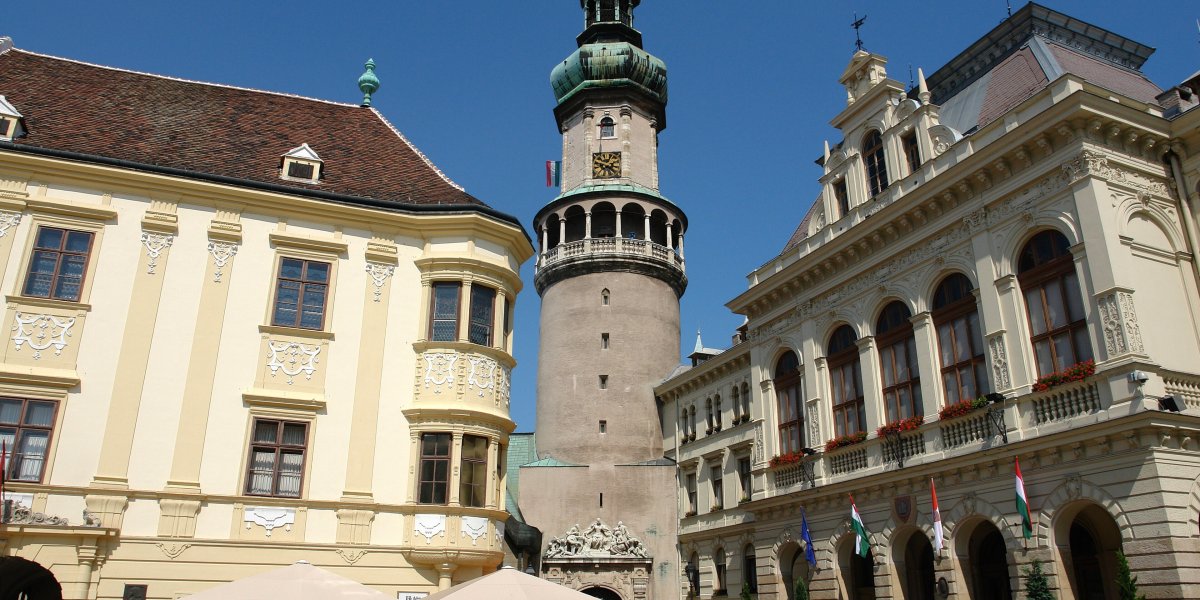
Step into Fő tér from any direction — Sopron's medieval heart is so compact you'll feel you've walked into a stage set. At 9:00 the eastern sun rakes across the gilded saints of Hungary's oldest Holy Trinity Column (1701) and warms the candy-pink baroque facade of the Storno House. Locals walk dogs and pick up morning coffee from the corner bakery; the tour buses won't arrive for another hour, so this is your only window to have the square almost to yourself. Take it slowly — Sopron is too small to rush and too pretty to skip past.
Tip: Stand at the southwest corner of the square (in front of the Goat Church doorway) for the iconic frame: Trinity Column in the foreground, Firewatch Tower rising behind it — this is the single photo that says 'Sopron.' Before 09:30 you'll have an empty square; after 10:00 a stream of Austrian day-trippers arrives by bus from Vienna.
Open in Google Maps →10:00
Landmark
Exit Fő tér's north side and the tower is literally above you — 30 seconds of walking through the cobbled passage to the entrance. Time your arrival for 09:55, five minutes before the doors open at 10:00 sharp, because the first 30 minutes are the only window with empty balconies. The 58-metre tower is the city's symbol and its biography in stone: a 13th-century Roman base, a Renaissance loggia where the night watchman blew his horn, and a baroque copper helmet added after the 1676 fire. From the top viewing gallery you sweep across red-tiled rooftops to Hungary in the east, Austria's Alpine foothills in the west, and the Lővér pine forests rising green to the south.
Tip: Buy your ticket from the small kiosk at the tower's base, not the tourism office on Fő tér — same 2000 HUF price, zero queue. Once at the top, walk to the southwest corner of the balcony: that's where you'll see the Goat Church spire, Trinity Column, and the Austrian border all in one shot.
Open in Google Maps →11:30
Neighborhood
Descend the tower's spiral staircase, exit back onto Fő tér, and turn immediately right past the Trinity Column — the Goat Church (Kecske-templom) squats at the square's south end with its severe 13th-century Gothic facade. Local legend says a goat unearthed the treasure that built it; look for the small carved goat on the southern buttress. Then slip south down Új utca, Sopron's most photogenic medieval lane, where ochre, saffron and dusty-rose houses lean toward each other across worn cobbles. At numbers 22 and 11 you'll find two of Europe's oldest surviving synagogues — both 14th-century, both hidden behind unassuming wooden gates that almost no tour group bothers to push open.
Tip: At Új utca 22, push open the wooden gate even if it looks private — the Old Synagogue's medieval courtyard is open to the public, free until noon, and you'll almost always have it to yourself. For the Goat Church, photograph the famous gilded goat carving on the pulpit through the side-door railings; the main entrance has tour groups blocking the angle by midday.
Open in Google Maps →13:00
Food
Step out of the Old Synagogue's courtyard, walk 200 metres west past the Storno House, and duck down the narrow alley of Hátsókapu — Cézár Pince's vaulted cellar door is on your left, half-hidden under a wrought-iron sign. This is a 17th-century barrel-vaulted cellar where Sopron's office workers and old wine merchants have been drinking Kékfrankos straight from the cask for generations. It's casual, fast, and properly Hungarian: paper tablecloths, candles in the day, a soup-and-glass-of-wine kind of place that resets you for the afternoon walk without burning two hours.
Tip: Order the gulyásleves (real Hungarian goulash served as a soup, 2200 HUF / ~5.50 EUR) and a deci of house Kékfrankos (800 HUF / ~2 EUR) straight from the barrel — that's the local lunch order, no menu reading required. Arrive by 12:55; the cellar fills with city-hall staff at 13:00 sharp and you'll wait 20 minutes for a table after that.
Open in Google Maps →14:30
Landmark
Leave Cézár onto Hátsókapu, follow Várkerület southwest until it becomes Csengery utca, and within ten minutes the cobbles give way to pine-shaded gravel — you're climbing into the Lővér hills, Sopron's leafy backyard. The marked red-triangle trail to Várhely is a steady 4-kilometre ascent through one of Hungary's most beautiful chestnut and Austrian-pine forests, threaded with the scent of resin in the warm afternoon. At the summit, the 23-metre stone Károly-kilátó (built 1936) gives you the day's best view: the silvery Lake Fertő plain stretching west into Austria, the Sopron old town a red-tile cluster behind you, and on a clear day the Alps glinting on the horizon. This is the moment the day's geography clicks into place.
Tip: Take the marked piros háromszög (red triangle) trail from the end of Lővér körút — do not follow road signs for cars, the foot trail is faster and gentler. Climb between 14:30 and 16:00 so the sun is behind you on the ascent and full backlit over the Austrian plain when you reach the top. Carry a litre of water — there is no shop on the trail, only a single closed forester's hut near the summit.
Open in Google Maps →19:00
Food
Descend the Várhely trail back into town along Lővér körút, follow Várkerület around the old town's eastern flank, and you'll find Erhardt on a quiet corner of Balfi utca — a 16th-century burgher's house turned wine restaurant with a candlelit cobbled courtyard. This is where Sopron's serious Kékfrankos producers — Weninger, Luka, Pfneiszl — are actually poured by the glass, not just printed on the list. A bowl of szarvas ragu (venison stew slow-cooked with juniper) under the courtyard lanterns, paired with a half-litre carafe of Weninger Kékfrankos, is the right way to close a Hungarian-Austrian border day. Sit outside if the night is warm — the kitchen stays open until 22:00.
Tip: Reserve a courtyard table 2 days ahead through the restaurant's website — the indoor cellar room is fine but the courtyard is where you want to drink Kékfrankos on a summer evening. Order the szarvas ragu (venison stew, ~7800 HUF / 19 EUR) with a glass of Weninger Kékfrankos (~1800 HUF / 4.50 EUR) — that's the pairing the sommelier will steer you to anyway. Pitfall warning: avoid the restaurants directly on Fő tér with picture menus and waiters waving you in from the doorway — they double prices for tourists and pour anonymous bulk wine as 'local Kékfrankos.' The good cellars are always one street back from the square.
Open in Google Maps →
Trip builder
Plan this trip around Sopron
Turn this guide into a bookable rail itinerary with FlipEarth.
Keep exploring
Related cities
More in the same country

FAQ
Frequently asked questions
How many days do you need in Sopron?
Most travelers enjoy Sopron in 1 days, with enough time for headline sights and a slower meal or museum stop.
What's the best time to visit Sopron?
The easiest season for most travelers is May-Oct, especially if you want good weather and manageable crowds.
What's the daily budget for Sopron?
A practical starting point is about €90 per person per day before hotels, then adjust based on museums, dining, and transport.
What are the must-see attractions in Sopron?
A good first shortlist for Sopron includes Fő tér & Holy Trinity Column, Firewatch Tower (Tűztorony), Károly-kilátó (Karl Lookout) via the Lővér Hills.