City Guide
Debrecen
Hungría · Best time to visit: May-Sep.
Day-by-day plan
Choose your pace
Duración del viaje
08:30
Religious
Begin at Debrecen's most charming oddity — a 17th-century church missing its proper steeple. A storm tore the spire off in 1907 and the city never replaced it, leaving a stubby green onion dome sitting like a misplaced hat on a brick body. Locals affectionately call it 'Csonka templom' (the truncated church). Walk one slow loop around the exterior on Révész tér; the bulbous silhouette against the brick is the most-photographed eccentricity in town.
Tip: Morning light from the east washes the green dome with color between 8:30 and 9:30 — after that the sun rotates behind it and the dome reads as a flat grey blob in photos. Shoot now or settle for a worse picture.
Open in Google Maps →09:15
Landmark
Walk straight north up Piac utca for 7 minutes — Debrecen's pastel pedestrian spine, with townhouses warming awake and the twin yellow towers of the Great Church rising at the far end. This is the symbol of the city and the largest Reformed church in Hungary: here, on 14 April 1849, Lajos Kossuth stood on these steps and declared Hungary's independence from the Habsburgs. Walk the full length of Kossuth Square in front of it, then circle to the back side — the apse end is rarely photographed and gives you the towers without the crowd. Climbing the western tower (4 EUR) is the one ticketed thing worth doing today: 210 steps to a 360° panorama of the Great Plain stretching flat and yellow to the horizon.
Tip: Climb the tower before 10:30 — by 11:00 tour groups fill the single spiral staircase and you'll wait 20 minutes for the descent. The symmetrical façade only lines up perfectly from the southern edge of Kossuth tér by the Kossuth statue; everywhere else, the two towers refuse to align.
Open in Google Maps →11:30
Landmark
Slip behind the Great Church onto Kálvin tér — the colossal ochre block of the Reformed College stands 60 seconds north. Hungary's Protestant elite have been educated here since 1538: Kossuth, Csokonai, Móricz all walked these courtyards. We're staying outside today, so trace the perimeter to take in the neoclassical façade, then cut two short blocks west to Déri Square. The plaza is framed by the Déri Museum's columned portico and Mihály Munkácsy's bronze 'Four Seasons' figures — widely considered the finest public sculpture in Hungary, by a sculptor whose 'Christ before Pilate' is in the museum behind them.
Tip: The four bronze figures face inward toward the central fountain. For the best frame, kneel low at the southwest corner and shoot 'Tudomány' (Science, the reading woman) with the museum's columned façade rising behind her — the only angle where statue and architecture stack cleanly.
Open in Google Maps →12:45
Food
Walk east on Hatvan utca for 8 minutes, past the red-brick gables of the County Hall, then south onto Csapó utca — the market hall's wide arched entrance opens on your right. The 1929 hall is where Debrecen actually eats. Glance at the paprika strings hanging wall-to-wall on the ground floor, then head straight upstairs to the food counters: the lángos stand is the one with the queue, because it's the right one. Order the 'sajtos-tejfölös' (cheese and sour cream lángos, 1,800 Ft / ~5 EUR) and a Soproni beer (650 Ft). Eat standing at the metal counter; this is fuel, not a sit-down — total 8 EUR.
Tip: Get to the lángos counter before 13:15 — the fryers run one batch at lunch and shut off around 13:30, no refire until tomorrow. Skip the döner stand two counters over; it looks tempting but uses pre-cooked meat that's been on the warmer since 11.
Open in Google Maps →14:30
Landmark
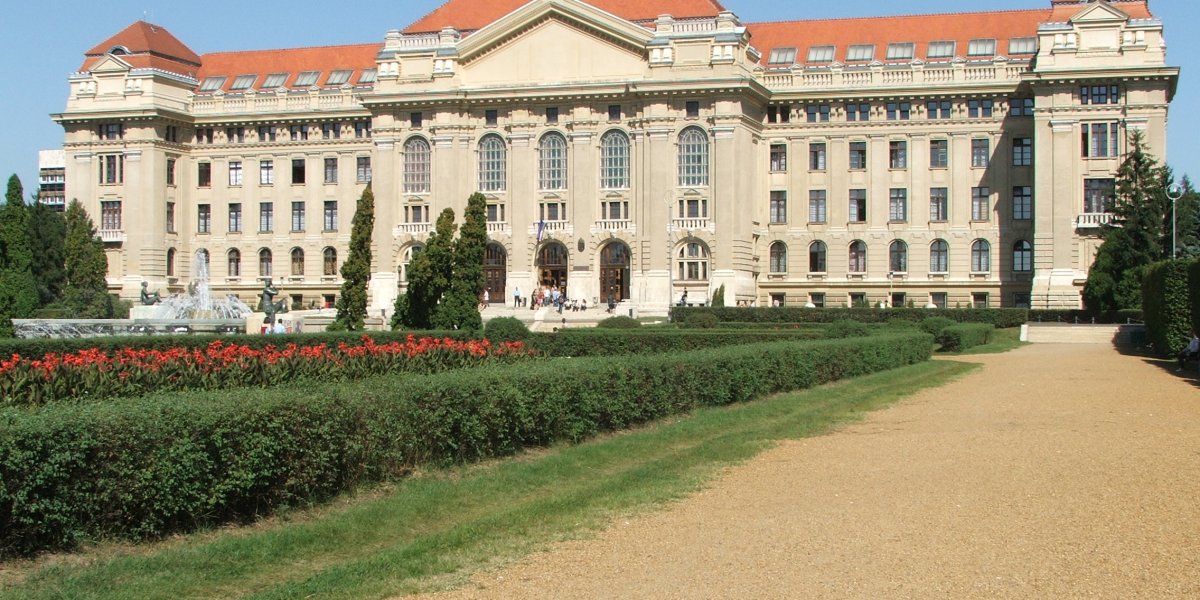
Head north up Csapó utca onto Egyetem sugárút — a 25-minute walk through a quiet quarter of pastel villas and chestnut-shaded sidewalks (Tram 1 cuts it to 10 minutes, but you lose the slow reveal of the building). The university's 1932 main building suddenly rises at the head of a 200-meter reflecting pool: a vast yellow neoclassical-meets-Bauhaus mass that doubles its silhouette on still afternoons. This is one of Hungary's great works of interwar architecture and almost nobody outside the country has heard of it. Walk the full central axis from the south end of the pool to the colonnade; the symmetry is the entire point. The lobby is open during weekday office hours if you want a peek at the marble.
Tip: Stand at the very south end of the reflecting pool around 15:00 — the building, its mirror image in the water, and the flanking poplars line up into one of the most underrated architectural shots in Hungary. Bring or zoom a wide angle; a phone's main lens will clip the towers.
Open in Google Maps →17:30
Food
Cross Egyetem tér behind the university and the Great Forest (Nagyerdő) begins immediately — Europe's first protected woodland (1939) and the lungs of the city. Wander north on the soft dirt paths for 15 minutes past the boating lake and the wooden Aquaticum pavilions; in late-afternoon summer light the oak canopy turns amber. End at Lovarda — a half-timbered former cavalry riding hall converted into Debrecen's most loved Hungarian restaurant. Order the slow-roasted goose leg with braised red cabbage and steamed potatoes (4,900 Ft / 13 EUR) and the 'somlói galuska' rum-soaked sponge for dessert (1,900 Ft / 5 EUR); a glass of dry Tokaji Furmint is the right pairing. Total around 10,000-11,000 Ft (25-28 EUR) with a drink.
Tip: Reserve a table for 19:00 the previous day via their website — Lovarda fills with locals on weekend evenings and walk-ins are routinely turned away. Pitfall warning for Nagyerdő: ignore the cluster of cafés around the Aquaticum entrance — they all charge tourist prices (5-6 EUR for a coffee) for mediocre product, and the 'goulash' on their English menus is microwaved. The kiosk by the boating lake is half the price for the same drink.
Open in Google Maps →Saltar al día
09:00
Religious
Arrive at the 09:00 opening to climb the 210-step western tower before the tour groups — the dazzling yellow neoclassical façade catches the eastern light just after nine, and from the parapet you can see the entire Belváros laid out in a single grid. This is the spiritual heart of Calvinist Hungary, the only place in the country where the Habsburg dethronement was voted in 1849, and the interior's spartan white walls — no statues, no gilding — say more about Hungarian Protestantism than any guidebook.
Tip: Buy the combined church + tower ticket at the western door, not the eastern one — the eastern ticket office often runs out of English audio guides by 09:30. Climb the west tower (the larger panorama) rather than the eastern Rákóczi-bell tower; the bell itself, Hungary's largest, is impressive but the view is half the angle.
Open in Google Maps →10:45
Museum
Exit the church's south portal and walk 150 m east along Kálvin tér past the bronze Bocskai statue — the college's ochre facade is directly opposite. Founded in 1538 and still a working seminary, the college houses the Oratorium where Lajos Kossuth read the Declaration of Independence on 14 April 1849, plus a library of 600,000 volumes including a 1590 Vizsoly Bible — the first Hungarian Bible — kept under low light at the end of the upstairs gallery.
Tip: Ask the front-desk staff specifically for access to the Oratorium — it's roped off and most tourists miss it. The painted ceiling above the main library staircase is best photographed from the second landing looking up, with the brass chandelier centered in frame.
Open in Google Maps →12:30
Food
Walk 6 minutes south down Piac utca, cross the brass-rail tramline, and turn east onto Miklós utca — Flaska's wooden sign hangs above a half-cellar entrance favored by Debrecen lawyers and university professors on lunch break. The kitchen runs a tight daily menu of Hungarian classics: order the bográcsgulyás (kettle goulash, ~€6) with a half-portion of lángos with garlic and sour cream (~€4), and finish with somlói galuska — three sponge layers, walnut, rum, chocolate (~€4).
Tip: Skip the printed English menu — point at the chalkboard daily specials instead; the napi menü (€7 for soup + main) is twice the food at half the price. Lángos is made to order here, so plan on a 12-minute wait — refuse anything that arrives in under 8 minutes, it means it was pre-cooked.
Open in Google Maps →14:00
Museum
Walk 5 minutes northwest along Csapó utca — the museum's neoclassical pediment appears suddenly behind a row of plane trees, with Ferenc Medgyessy's four colossal bronze allegories flanking the steps. The second-floor Munkácsy Hall holds Mihály Munkácsy's monumental Christ Trilogy — Christ Before Pilate, Golgotha, and Ecce Homo — three of the most important canvases in Hungarian painting, displayed in a single dimmed chamber with a 30-minute timed lighting cycle that physically changes how the paintings read.
Tip: Enter the Munkácsy Hall at the top of the hour to catch the lighting cycle from its beginning — the third minute, when the side lamps come up on Golgotha, is the moment locals come back for. The ground-floor ethnographic wing (Hortobágy puszta shepherds' coats and bone-carved csikós whips) is what you'd see at Hortobágy National Park anyway, in better light — skip the day-trip if your time is short.
Open in Google Maps →16:30
Neighborhood
Walk 4 minutes south from the museum back toward Kossuth tér — late-afternoon light hits the yellow church facade head-on, which is the angle every Debrecen postcard uses but most tourists miss because they photographed it in the morning shadow. Wander south down Piac utca, the city's spine since the medieval cattle market gave Debrecen its name 'civis' (free citizen), and notice the cannonball still embedded in the iron-cross fence on the church's east side — left there since 1849 as a deliberate scar.
Tip: The Csokonai Theatre's eclectic 1865 facade (Kossuth utca 10, 3 min west of Piac) is best photographed at 17:15 when the side lanterns turn on but the sky is still blue — a 5-minute window. The water-clock fountain in front of the Aranybika Hotel chimes at 18:00 with a folk-music sequence; locals time their coffee at Pálma Cukrászda across the street to catch it.
Open in Google Maps →19:30
Food
Walk 3 minutes north along Piac utca — IKON sits behind a wrought-iron gate at no. 23, the courtyard lit by a single brass lamp that you'll miss if you're not looking. Debrecen's most ambitious kitchen, run by chef Vencel Lévai with two Gault & Millau toques, treats local ingredients with restraint: the slow-cooked mangalica pork cheek with Tokaji jus (~€19), the gray cattle tartare with smoked egg yolk (~€16), and the 6-course tasting menu (~€55) that costs a third of Budapest equivalents.
Tip: Book the 19:30 seating at least two weeks ahead and request the wine-cellar nook — the sommelier opens single-glass pours of late-harvest Tokaji Aszú here that aren't on the printed list. Pitfall: never eat on a Kossuth tér terrace facing the church — those restaurants mark up 40% for the view and serve frozen lángos; the same dishes cost half on Hatvan utca two blocks east. Service charge is rarely on the bill in Debrecen — leave 10% in cash, the card terminal won't add it.
Open in Google Maps →09:00
Entertainment
Take tram 1 from Kossuth tér north for 20 minutes to the Nagyerdő terminus — the spa's glass-domed jungle of palms, waterfalls, and turquoise pools rises directly across the tram stop. Arrive at the 09:00 opening before the 11:00 family wave: the wave pool, the surge channel, and the salt-water grotto are all empty for the first hour, and the morning sun through the cupola turns the steam gold. This is where Debrecen actually relaxes — the puszta is flat and arid, so the city built itself a Mediterranean.
Tip: Buy the 3-hour ticket (~€18), not the all-day (~€28) — the Mediterranean wing is compact and 2.5 hours covers every pool twice. The outdoor wave pool runs only on the hour for 10 minutes; check the schedule at the entrance and time your laps to skip the surge. Lockers take a refundable €2 coin, not the wristband — bring cash.
Open in Google Maps →12:15
Food
Walk 3 minutes south from the spa entrance through the spruce alley — the Vigadó's Art Nouveau pavilion appears at the edge of the boating lake, its veranda set with white tablecloths under the trees. The kitchen is Debrecen's most reliable for traditional Hungarian at park prices: the namesake Debreceni sausage plate with mustard and pickle (~€10), and the slow-roasted goose leg with red cabbage and steamed potato (~€14), with a glass of Egri Bikavér (~€4) that comes properly chilled to 16°C.
Tip: Sit on the veranda, not inside — the lakefront tables get a constant breeze even in August, and the willows screen out the spa's amusement-park music. Order the goose leg over the schnitzel; the restaurant raises its own geese on a farm 30 km south, and the leg confit is the dish Debreceniek themselves come here for.
Open in Google Maps →13:45
Landmark
Walk 8 minutes west through Nagyerdei Park along the rose alley — the university's neo-Baroque main building emerges through the trees like a small Versailles dropped in a Hungarian forest. Completed in 1932 from butter-yellow brick with a green copper dome, its central aula (great hall) is covered by a coffered ceiling of carved oak and gilded rosettes that ranks among the most photographed interiors in eastern Hungary — and almost no foreign tourist knows it's open to walk-ins.
Tip: The aula is only accessible weekdays 09:00-16:00 and closed during exam weeks (mid-Jan, mid-June) — speak to the porter at the central main entrance, who will wave you through if no ceremony is running. Photograph the ceiling from the south balcony of the second floor, not the ground level — at ground level the chandelier blocks the dome's center medallion.
Open in Google Maps →14:45
Park
Walk 5 minutes north from the university aula — follow the chestnut-lined path past the chemistry tower and the small lake materializes in a clearing of oaks. Debrecen's locals come here on weekend afternoons to row wooden skiffs, feed the carp, and walk the eastern shore counter-clockwise, which is also the photographer's path: at 15:30 in summer the western sun reflects the university's green dome cleanly across the water, and the boathouse's red roof anchors the foreground.
Tip: Rent a wooden rowboat from the southeast jetty (~€4 for 30 min, cash only) — the lake is small enough to circle once in 20 minutes and the middle is the only place to photograph both the university dome and the spa's glass jungle in one frame. Skip the pedalos; they're loud and the seats are wet by 14:00.
Open in Google Maps →16:30
Museum
Walk 15 minutes south along the park's eastern edge — past the Nagyerdei football stadium, the brick cube of MODEM appears on Baltazár Dezső tér, almost out of place in its restraint. Opened 2006, this is the most important contemporary art venue outside Budapest, rotating Eastern European artists rarely shown in Western European museums alongside a permanent collection drawn from Antal-Lusztig — strong on Hungarian neo-Avantgarde, Béla Kondor's monoprints, and the unsettling sculptures of Imre Bukta.
Tip: Take the northeast staircase to the rooftop terrace rather than the elevator (which queues at this hour) — the terrace is free, overlooks the entire Nagyerdő canopy, and the steel sculpture by the parapet frames the spa dome in golden hour. Closed Mondays; on Sundays the last entry is 17:00 sharp — the staff start sweeping at 17:30 regardless of the posted 18:00 close.
Open in Google Maps →19:00
Food
Walk 8 minutes northwest from MODEM along Pallagi út, past the wrought-iron gate of the botanical garden — Kandalló's wood-smoke chimney announces it before the sign does. A Debrecen institution since 1996, the wood-fired grill turns out the city's best mangalica pork ribs (~€16) and a 'Hortobágyi húsos palacsinta' — savory crêpe stuffed with veal paprikás under sour-cream sauce (~€11) — paired with unfiltered Monyó IPA from the brewery two streets away (~€3 for 0.4 L).
Tip: Arrive by 19:00 — the wood-grilled mangalica steaks come off the fire in two batches at 19:30 and 21:00 and the first batch sells out by 19:45; sit at the bar's high counter if the dining room is full, the grill is in view and you'll be served first. Pitfall: the taxis idling outside Nagyerdő spa and the tram terminus quote €15+ flat rates to the city center — call Főnix Taxi (+36 52 444 444) for the metered €5 fare, or ride tram 1 (€1.20) which runs until 23:00. The 'authentic Hungarian paprika' in plastic bags at Piac utca souvenir shops is bulk-grade dyed powder; buy real csípős paprika at Csapó utca market hall on the way home, stalls 12–18, open until 14:00 weekdays.
Open in Google Maps →
Trip builder
Plan this trip around Debrecen
Turn this guide into a bookable rail itinerary with FlipEarth.
Keep exploring
Related cities
More in the same country
FAQ
Frequently asked questions
How many days do you need in Debrecen?
Most travelers enjoy Debrecen in 1 days, with enough time for headline sights and a slower meal or museum stop.
What's the best time to visit Debrecen?
The easiest season for most travelers is May-Sep, especially if you want good weather and manageable crowds.
What's the daily budget for Debrecen?
A practical starting point is about €75 per person per day before hotels, then adjust based on museums, dining, and transport.
What are the must-see attractions in Debrecen?
A good first shortlist for Debrecen includes Great Reformed Church & Kossuth Square, Reformed College & Déri Square, University of Debrecen Main Building.