City Guide
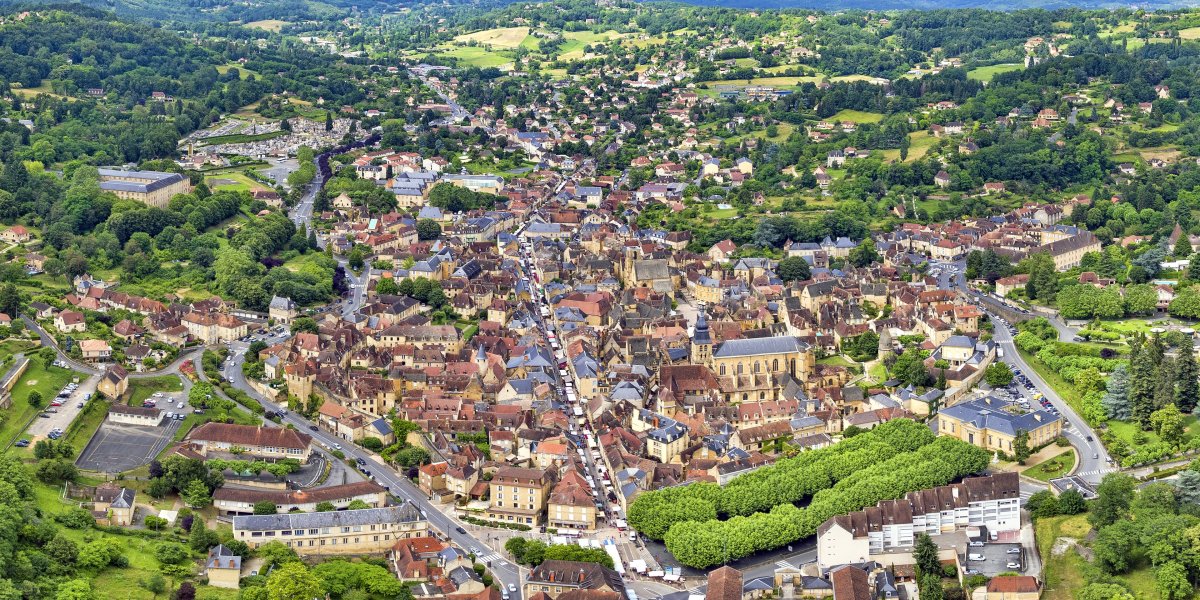
Sarlat-la-Caneda
Francia · Best time to visit: May-Oct.
Day-by-day plan
Choose your pace
Duración del viaje
09:00
Landmark
Begin where Sarlat began — Place du Peyrou, where the 12th-century Cathedrale Saint-Sacerdos faces the carved Renaissance facade of Maison de La Boetie (1525), birthplace of Etienne de La Boetie, Montaigne's beloved friend. Slip behind the cathedral into the Jardin des Enfeus to find the Lanterne des Morts, a mysterious 12th-century beehive tower whose original purpose still baffles historians. At 09:00 the morning light strikes the honey-colored limestone head-on — this is the photograph you came for, and the square is still empty.
Tip: Stand on the cathedral steps and shoot west across the square — La Boetie's two-story Italianate windows are framed by the cathedral shadow only between 09:00 and 09:45. The Lanterne des Morts is hidden behind the apse in the small walled cemetery garden; 90% of day-trippers miss it entirely, so you'll likely have the 800-year-old tower to yourself.
Open in Google Maps →10:30
Landmark
Three-minute walk south down Rue de la Republique, then turn left at the second cross-street into the broad slanted square — the deconsecrated 14th-century church looms on the eastern flank. Jean Nouvel (the Pritzker-winning architect who grew up in Sarlat) installed a steel-and-glass panoramic elevator inside the old nave that rises silently 35 meters above the medieval rooftops. The 360-degree view is the only one in town: cathedral spire to the north, an ocean of terracotta tiles, and the Perigord hills rolling out to the horizon.
Tip: Go before 11:15 — by midday the covered market under the elevator empties out tour groups straight onto the lift queue. Buy your ticket from the elevator operator (not the tourist office) and ask to go up just before they close the basket — you'll get an extra minute alone at the top. Face north-east for the cathedral spire framed against rooftops; that's the shot.
Open in Google Maps →11:30
Neighborhood
Step straight out of the church onto Place de la Liberte — the broad, slanting market square that has been Sarlat's social heart for eight centuries; cafe awnings, stone arcades, and the Hotel de Maleville's Renaissance facade on the western flank. Walk one block east through a stone passage into the small Place du Marche aux Oies, where three life-size bronze geese by sculptor Francois-Xavier Lalanne stand in tribute to the city's foie gras trade, with the spired Manoir de Gisson (1525) rising behind them. This pocket-square is the icon shot of Sarlat — and far quieter than the main place a few meters away.
Tip: Crouch low next to the largest bronze goose and shoot upward — Manoir de Gisson's pepper-pot tower aligns perfectly behind the goose's beak between 11:30 and 12:30 when the sun is high. If it's Saturday, the market overruns the entire square with foie gras, walnut, and truffle stalls; arrive by 11:30 sharp before the lunchtime crush turns it into a slow shuffle.
Open in Google Maps →13:00
Food
Forty-meter walk back west across Place de la Liberte to the corner terrace facing the church — Le Glacier holds Sarlat's prime square seats and has done so for decades. This is the locals' lunch refuge: order the salade perigourdine (16 EUR), a single plate layered with duck gizzards, sliced magret, a sliver of foie gras, walnuts, and bitter greens dressed in walnut oil — lunch and Perigord identity on one plate. Service is brisk; you'll be done in 50 minutes and refueled for the afternoon.
Tip: Skip the front-row tables with the five-language menus and bus-tour herds — ask for the side terrace facing the Lalanne geese (same menu, half the noise, and you keep watching the square). If salade perigourdine doesn't tempt you, the magret de canard plat du jour (19 EUR) lands fast and comes with proper pommes sarladaises crisped in duck fat. No reservation needed at lunch; just arrive before 13:15.
Open in Google Maps →14:30
Neighborhood
From Le Glacier, walk 60 meters north into Rue des Consuls — the medieval merchants' street, a stone canyon of Gothic windows and ornate carved doorways including the 14th-century Hotel Plamon at no. 9 and Hotel de Vassal at no. 1. Then loop south through Place de la Liberte and into Rue Fenelon — the prettiest lane in Sarlat, sloping gently into the quieter southern half: Hotel de Maleville's Renaissance courtyard, the hidden flagstones of Rue Landry, the carved tympanum of Hotel de Vienne. Four hours of slow looking in afternoon light — every doorway is a small masterpiece, every turn opens onto a courtyard.
Tip: Hotel Plamon's Gothic windows photograph best at 16:00 — the sun rakes across the carved stone and the rosette tracery casts shadows you cannot get any other hour. From there cut south via Rue Fenelon: locals start closing shutters around 17:30, and the whole southern quarter empties out — you'll have 14th-century lanes entirely to yourself. Look up at every doorway; the carved hood-mouldings of Sarlat are unmatched anywhere in southwestern France.
Open in Google Maps →19:30
Food
Three-minute walk from Rue Landry to its junction with Rue Landry no. 6 — Le Presidial occupies the 17th-century royal courtroom of Perigord, with vaulted candlelit rooms inside and a walled garden under fig and chestnut trees for warm-weather dinners. The kitchen is unapologetically traditional Perigord: foie gras poele aux pommes (22 EUR), magret de canard aux cepes (32 EUR), pommes sarladaises crisped in duck fat. End with a glass of sweet Monbazillac and a slice of tarte aux noix — this is the dinner you tell people about.
Tip: Reserve a garden table 2-3 days ahead (the 17th-century courtyard IS the experience — indoors is fine, the garden is unforgettable). Pitfall warning: avoid the restaurants directly on Place de la Liberte with photo menus in five languages and 'foie gras 9 EUR' chalkboards — they serve industrial canned foie gras and heated-up confit at tourist prices. Sarlat's real kitchens (Le Presidial, Le Bistrot at Place du Peyrou, Chez le Gaulois) are tucked one street off the main square; if you can see the bronze geese from your table, you're probably paying double for half the quality.
Open in Google Maps →
Trip builder
Plan this trip around Sarlat-la-Caneda
Turn this guide into a bookable rail itinerary with FlipEarth.
Keep exploring
Related cities
More in the same country

FAQ
Frequently asked questions
How many days do you need in Sarlat-la-Caneda?
Most travelers enjoy Sarlat-la-Caneda in 1 days, with enough time for headline sights and a slower meal or museum stop.
What's the best time to visit Sarlat-la-Caneda?
The easiest season for most travelers is May-Oct, especially if you want good weather and manageable crowds.
What's the daily budget for Sarlat-la-Caneda?
A practical starting point is about €95 per person per day before hotels, then adjust based on museums, dining, and transport.
What are the must-see attractions in Sarlat-la-Caneda?
A good first shortlist for Sarlat-la-Caneda includes Place du Peyrou & Cathedrale Saint-Sacerdos, Eglise Sainte-Marie Panoramic Elevator.