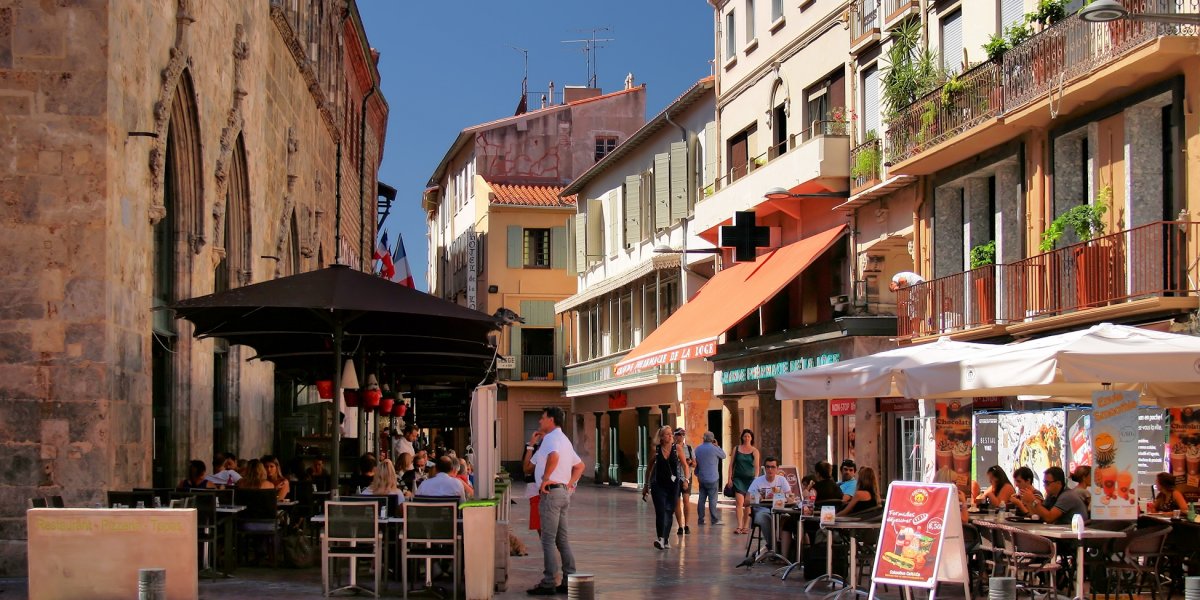
City Guide
Perpignan
Francia · Best time to visit: Apr-Oct.
Day-by-day plan
Choose your pace
Duración del viaje
09:00
Landmark
Step off the platform and you have already arrived at the spot Salvador Dalí proclaimed the 'Center of the Universe' after a cosmic vision here in 1963. The dusty-pink ironwork façade, the painted bronze plaque, and the surreal ceiling murals make this the most photographed provincial station in France. At nine in the morning the eastern sun rakes across the rose-gold tiles and the parking circle out front is empty of taxis — the only twenty-minute window all day when you can frame the building cleanly.
Tip: The bronze plaque 'Perpignan — Centre du Monde' is embedded in the pavement just outside the main entrance, not on the platforms — most travelers walk straight over it. Shoot the façade from the parking circle's far edge so the painted lettering above the doors stays sharp; closer than 20 meters and the angle distorts.
Open in Google Maps →10:00
Landmark
Walk east from the station for 15 minutes along Avenue du Général de Gaulle, cross La Basse river, and the modern boulevards give way to the colossal red-brick ramparts of a star-shaped Vauban citadel rising above the old quarter. Inside sits the 13th-century summer palace of the Majorcan kings — but the real show is the free perimeter walk on the grassy ramparts, with panoramas over terracotta rooftops, the Pyrenees to the west, and the Mediterranean glinting east. Mid-morning light catches the pink brickwork at its deepest tone before the sun climbs overhead.
Tip: Enter through the Rue des Archers gate, then circle left up the grass slope onto the ramparts — this whole loop is free and gives the better photograph than the paid courtyard inside. On a clear day, look due west: the sacred Catalan mountain Canigou is visible above the cypress line, and locals will tell you a true Catalan must see Canigou at least once a year.
Open in Google Maps →12:30
Food
Walk north 15 minutes through Rue Émile Zola, the old artisan lane, and the streets funnel you into Place de la République with its covered market hall, Les Halles Vauban. Order a 'pa amb tomàquet' rubbed with tomato and topped with Collioure anchovies (€7), a paper cone of fuet sausage (€5), and a glass of cold Muscat de Rivesaltes (€3) — Catalan farmer's lunch, eaten standing at the counter. Take the rest out under the plane trees on the square where old men are mid-pétanque match.
Tip: The Collioure anchovy counter is at the back-left of the hall, marked 'Roque'; this is the only stall in Perpignan still salting anchovies on the bone. Avoid the sandwich shops along Rue des Augustins facing the square — they charge double for the same baguette the market stalls cut fresh.
Open in Google Maps →13:45
Religious
From the market, walk three minutes east up Rue Saint-Jean and the alley opens into a small square dominated by the striped Catalan-Gothic façade of the cathedral — raw river pebbles laid in courses with red brick, unlike any other church front in France. Around its north flank, push open the low wooden door of Campo Santo: the only fully preserved medieval cloister-cemetery in France, a hushed quadrangle of white marble arcades enclosing a square of grass. The afternoon sun rakes across the carved tomb-niches and you can hear the swallows.
Tip: Campo Santo's discreet entrance is on Rue Amiral Ribeil on the cathedral's north side — most tour groups walk straight past it because there is no signage. Arrive between 14:00 and 14:30: the marble niches face south-southwest and only glow with that backlit translucence for about 30 minutes a day.
Open in Google Maps →15:15
Neighborhood
Walk five minutes northwest along Rue Louis Blanc until the crenellated pink-brick tower of Le Castillet rises ahead — the 14th-century city gate that is Perpignan's official emblem and the only surviving piece of the medieval walls. Cross the Pont Joffre footbridge for the postcard shot of Le Castillet reflected in La Basse river, then loop back through Place de la Loge past the Gothic Loge de Mer and into the courtyard of the Hôtel de Ville to see Maillol's bronze 'La Méditerranée'. As the sun drops, the brick of the whole quarter turns blood-red.
Tip: Stand on the middle of Pont Joffre at exactly 17:00 in summer (16:00 in shoulder season): the western sun is full on the Castillet façade and La Basse below runs gold — this is the iconic shot. Do not pay to climb inside the tower; the staircase is a 142-step low-ceiling squeeze and the parapet view is fenced and disappointing.
Open in Google Maps →19:30
Food
Two streets back from Place de la Loge, duck into the vaulted-stone dining room of Casa Sansa, open since 1846 and the oldest table in Perpignan. Order grilled snails 'à la catalane' to start (€14, eaten with aioli and a wooden pick), a bullinada — the Catalan fisherman's saffron stew of monkfish and potato — as the main (€22), and finish with a glass of sweet amber Banyuls Rimage (€7). The room is wood-beamed and lit by single bulbs; the staff are family.
Tip: Casa Sansa does not take phone bookings for tables under four, but if you walk in at 18:00 and ask for a 19:30 seating, you almost always get one — locals know this trick, tourists call ahead and are turned away. Pitfall warning: avoid the photogenic terraces on Place de la Loge itself, especially anything with a multilingual menu and a hawker out front; they charge €28 for a microwaved cassoulet and the Banyuls is the cheap supermarket bottle.
Open in Google Maps →
Trip builder
Plan this trip around Perpignan
Turn this guide into a bookable rail itinerary with FlipEarth.
Keep exploring
Related cities
More in the same country
FAQ
Frequently asked questions
How many days do you need in Perpignan?
Most travelers enjoy Perpignan in 1 days, with enough time for headline sights and a slower meal or museum stop.
What's the best time to visit Perpignan?
The easiest season for most travelers is Apr-Oct, especially if you want good weather and manageable crowds.
What's the daily budget for Perpignan?
A practical starting point is about €90 per person per day before hotels, then adjust based on museums, dining, and transport.
What are the must-see attractions in Perpignan?
A good first shortlist for Perpignan includes Gare de Perpignan (Salvador Dalí's Center of the Universe), Palace of the Kings of Majorca (Palais des Rois de Majorque).