City Guide
Tours
France · Best time to visit: Apr-Oct.
Day-by-day plan
Choose your pace
Durée du voyage
09:00
Landmark
Begin at the cathedral's west front, where the twin Flamboyant Gothic towers catch the first sun from the east — the limestone glows almost pink between 09:00 and 10:00. Circle the exterior first, then slip into the free Cloître de la Psalette on the north side: three storeys of Renaissance arcades that almost no day-tripper ever finds. Inside, head straight for the 13th-century stained glass behind the choir — the deep cobalt blue is considered the finest in France outside Chartres.
Tip: Stand on Place de la Cathédrale facing the facade and shoot the towers from the southwest corner of the square — this is the only angle where you get both spires plus the rose window without parked cars in frame. The Psalette cloister opens at 09:30; arrive at 09:25 and you'll have the upper gallery entirely to yourself for 20 minutes.
Open in Google Maps →11:00
Neighborhood
Exit the cathedral, walk west on Rue Colbert for 12 minutes — this is the old silk-weavers' street, every other doorway a 16th-century mansion, and you'll pass the plaque marking the house where Joan of Arc had her armor made in 1429. The street drops you into Place Plumereau, the medieval heart of Tours: a perfect square ringed with leaning half-timbered houses, the carved corner posts painted in faded reds and ochres. Loop north onto Rue Briçonnet, the prettiest street in the city, where Hôtel Gouïn (15th c.) has a Renaissance facade so detailed it looks embroidered in stone.
Tip: Place Plumereau goes from photogenic to crowded the moment the cafe umbrellas open at noon — shoot it now, with the corner of Rue du Change for the textbook postcard angle (the three-storey blue-trimmed house on the left). Skip the square's cafes entirely; they are pure tourist pricing. The locals' photo trick: stand at the entry of Rue Briçonnet and frame the half-timbered facades through the medieval archway.
Open in Google Maps →12:30
Food
Walk south from Place Plumereau down Rue des Halles for 5 minutes — a straight shot past antique dealers and natural-wine shops — to the city's 1980 covered market, the gastronomic engine room of the Loire. This is a stand-and-eat lunch, not a sit-down: graze the charcuterie counters, the goat-cheese stalls, the Loire-wine bars. Order rillons de Tours (€6, slow-confited pork belly, the regional specialty), a wedge of Sainte-Maure-de-Touraine goat cheese with its signature straw running through it (€5), and a glass of dry Vouvray (€4). Eat standing at the zinc counter of Bar à Vins Saint-Sym in the southwest corner.
Tip: Charcuterie Hardouin (stall 12, central aisle) has the best rillons in Tours — ask for them "tièdes," warmed slightly, the way the locals eat them. Avoid the seated brasserie inside the hall; the food is identical to the stalls but triple the price. Closed Mondays — if you're here on a Monday, walk five extra minutes to Rue Colbert and grab a fougasse aux rillons from Boulangerie La Promesse instead.
Open in Google Maps →14:00
Religious
Exit Les Halles north onto Rue des Halles — three minutes' walk lands you between two lonely medieval towers in the middle of a modern street: Tour Charlemagne and Tour de l'Horloge. These are the only fragments left of the colossal 11th-century basilica that once covered five city blocks — burned by the Revolution, demolished in 1802, the rest of the church now lies under the surrounding shops. The modern Neo-Byzantine basilica next door (1902) houses the tomb of Saint Martin of Tours in a crypt directly below the high altar, the most important medieval pilgrimage site in France after Mont-Saint-Michel.
Tip: Enter the basilica through the south door on Rue Descartes, not the main facade — you arrive in the nave aligned exactly with the candlelit crypt staircase, the dramatic descent the pilgrims have taken since the 5th century. Between 14:00 and 14:30 the crypt is almost always empty; after 15:00 a coach group from Paris usually fills it. The gold mosaic above the tomb only reads properly when your eyes adjust — wait 60 seconds in the dark before looking up.
Open in Google Maps →15:30
Landmark
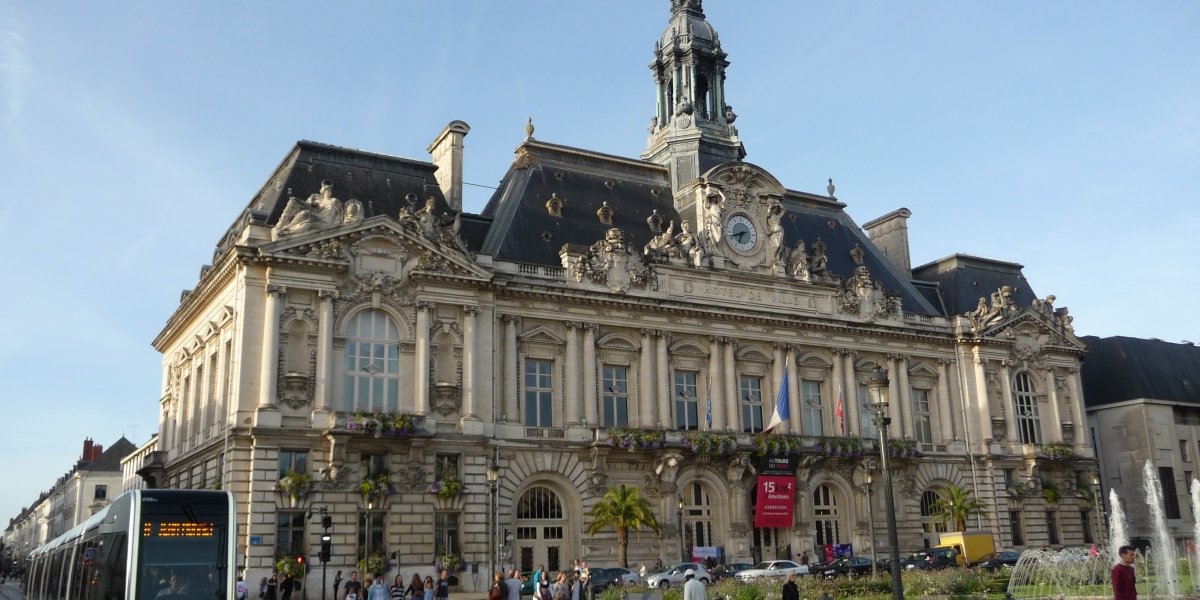
Walk north on Rue du Commerce for 10 minutes to the river — you'll pass under the Hôtel de Ville's grand 1904 facade on Place Jean-Jaurès, the city's monumental crossroads. Pont Wilson, locally just "le pont de pierre," is the 1779 stone bridge that gave Tours its identity: 15 arches stretching 434m across the wide, sandy-banked Loire — the longest classical bridge in France. Cross to the Île Aucard side, then walk west along the north quay toward Pont de Fil. This is the only place in central Tours where you see the full sweep of the Loire — sandbars, herons, fishing skiffs — exactly the landscape the chateau-builders chose this valley for.
Tip: From the middle of Pont Wilson facing south, you get the iconic shot of the cathedral's twin spires rising above the old town — the postcard that has sold Tours since 1900. Golden hour here in summer is 19:30-20:30, but at this season the light starts going amber by 17:00; linger on the north bank for the warmest exposure. Walk back across the western pedestrian footbridge (Pont de Fil) — it lands you 200m from dinner.
Open in Google Maps →19:30
Food
From Pont de Fil it's a 6-minute walk south on Rue du Grand Marché, then left onto Rue Colbert — you arrive at number 58, an unassuming dark-blue storefront with chalkboard menus in the window. This is where the chefs of Tours eat on their day off: 24 covers, one chef-owner (David Magoutier), one regional menu that changes with the market. Order the geline de Touraine en cocotte (€22) — the local heritage black-feathered chicken, slow-braised with Sainte-Maure goat cheese and Vouvray — and the poire tapée rehydrated in red wine for dessert (€8), a 19th-century Touraine specialty almost no other restaurant still serves. Pair with a glass of dry Vouvray from Domaine Huet (€7) — the benchmark producer.
Tip: Reserve at least one day ahead by phone (+33 2 47 66 05 81) — they don't take online bookings and walk-ins are turned away by 19:45. Ask for table 4 or 5 along the back wall; the front window seats catch street draft. PITFALL WARNING: every restaurant directly on Place Plumereau is a tourist trap — frozen rillettes, supermarket cheese, mass-market Loire wine at triple the price. Half-timbered backdrops do not mean good kitchens; the real Touraine cooking is always one street back from the square.
Open in Google Maps →Aller au jour
09:00
Landmark
Catch the 08:00 TER from Tours to Chenonceaux (25 minutes; the dedicated château halt sits 400 m through a tree-tunnelled lane from the gates) and you'll arrive a clear hour before the first coach tours. The five-arched gallery spans the River Cher itself — built by Diane de Poitiers, redesigned by Catherine de Medici, and best photographed first from the eastern garden where the water mirrors its full length, before the same shot becomes a queue.
Tip: Buy your ticket online before 22:00 the night before — the print-at-home QR skips the 30-minute summer queue at the gate. Walk first to Catherine's garden on the east side, take the gallery-over-water shot, then enter; if you reverse the order, by the time you exit every group will be lined up at your composition.
Open in Google Maps →12:30
Food
Take the 11:45 TER back through Tours and on to Amboise (50 minutes total, one change at St-Pierre-des-Corps), then cross the Loire bridge — eight minutes' walk with the château looming above you — to Place Michel Debré at the rampart's foot. This wine bar, run by a Master Sommelier, serves the Loire's best 'à l'ardoise' lunch: a chalkboard menu of charcuterie, fresh quiches and a single rotating hot dish, paired from a list of growers you cannot buy elsewhere.
Tip: Order the €18 plat-du-jour with a 12cl glass of Montlouis-sur-Loire sec — Bruno will pour from a producer outside the export network. Arrive 12:15 sharp to claim a terrace seat looking up at the château's rampart; by 12:45 the terrace is full and the inside room loses the view.
Open in Google Maps →14:30
Landmark
Climb the cobbled ramp from Chez Bruno's terrace — four minutes uphill — to the royal château that taught Renaissance manners to a generation of French kings. The Saint-Hubert Chapel at the eastern end holds Leonardo da Vinci's tomb (he died 500 m from here in 1519); the rampart terrace opens onto a Loire panorama unrivalled in the valley, while inside the heavy stone spiral and gothic council chamber sit in deliberate contrast to the airy royal apartments above.
Tip: Walk the rampart terrace clockwise so the Loire is on your right — this puts the camera facing the right direction for the most cinematic shot of the river bend through the gothic merlons. Da Vinci's chapel is on the exit route, not the entrance — most visitors miss it because they retrace their steps; follow the signed circuit to the end.
Open in Google Maps →16:15
Museum
Walk 500 m up the gentle Rue Victor Hugo away from the river — a tree-shaded slope lined with the troglodyte houses carved into Amboise's tuffeau cliffs. Clos Lucé was Da Vinci's final home: Francis I gave him a salary, an underground passage to the royal château, and complete freedom for the last three years of his life — the bedroom where he died, the workshop with his sketches, and the seven-hectare park of full-scale wooden reconstructions of his inventions together form the most personal Da Vinci site in the world.
Tip: Visit the park before the house: by 17:00 the indoor rooms are deserted and the late afternoon light through the leaded windows is exquisite for photographs of the workshop. The underground passage exhibit at the back of the courtyard is included with your ticket but unsigned from inside the manor — easy to miss, worth ten minutes.
Open in Google Maps →18:30
Neighborhood
Stroll back down the hill — fifteen minutes, all downhill, a relief after Clos Lucé's gardens — and onto the long stone bridge spanning the Loire. From the bridge's midpoint, golden hour catches the château's limestone walls in their warmest light and the chapel spire sharpens against the western sky; this is the photograph everyone hopes for and few manage, because most visitors leave Amboise by 17:00 and the bridge empties out.
Tip: Stand at the third lamppost from the south bank — it's the only spot on the bridge where the chapel spire aligns cleanly above the keep. May-August the sun sets behind the château at roughly 21:00; April and October check before you cross — be on the bridge 40 minutes before the published sunset.
Open in Google Maps →19:45
Food
A four-minute walk along Quai Charles Guinot — the riverside lamps coming on as you arrive — brings you to a slim modern dining room facing the Loire. The chef cooks from a five-line menu that changes weekly, drawing produce from the same valley you've walked all day: river fish, valley vegetables, Sologne game in autumn — two courses, a glass of Cher-Valley Sauvignon, and the château lit up across the water through the window.
Tip: Reserve at least 48 hours ahead and request a window table — the river-facing seats fill on every weekend evening. Take the 22:08 TER back to Tours (20 minutes; the last evening train shifts by season, confirm at the station on arrival). Pitfall warning: the row of crêperies and 'menu touriste' boards along Rue Victor Hugo between the château gate and Clos Lucé charge double for frozen ingredients and reheated cassoulet — locals never eat on that stretch; they walk three minutes east to the river quay.
Open in Google Maps →09:00
Religious
Arrive as the city stirs — the morning sun strikes the western facade head-on at 9 AM and the flamboyant Gothic tracery seems to dissolve into stone lace, while inside the 13th-century apse glass throws cobalt and crimson across the ambulatory floor. Don't miss La Psalette, the Renaissance cloister to the left of the nave: at opening you'll have its three tiers of arcades entirely to yourself, the only time of day that's true.
Tip: Buy the €6 Psalette ticket at the staffed desk inside the cathedral, not at the cloister entrance — the line moves twice as fast there. Climb to the top gallery of the cloister: it's the only angle in Tours that frames both bell towers and the rose window in a single shot.
Open in Google Maps →10:45
Museum
Step out of the cathedral and turn right — sixty seconds later you're under an enormous Cedar of Lebanon planted in 1804, the museum's living mascot, in the courtyard of the former Archbishop's Palace. The painted ceilings of the staterooms rival the canvases; head straight upstairs and give ten quiet minutes each to Mantegna's 'Christ in the Garden of Olives' and Rembrandt's 'Flight into Egypt'.
Tip: Skip the basement archaeology rooms entirely and go straight to the Italian Renaissance and 18th-century French galleries — that's where the museum's real weight lives. Fronsac the elephant's skeleton (he died here in 1902) stands in the old stables behind the cedar; children remember him for years.
Open in Google Maps →12:30
Food
Walk west down Rue Colbert — Tours' loveliest pedestrian street, lined with half-timbered houses and Joan of Arc's armorer's plaque at no. 39 — for ten minutes until you reach Rue de la Rôtisserie. This tucked-away dining room serves the dishes Touraine grandmothers actually cook: rillons (slow-confited pork belly), Sainte-Maure goat cheese drizzled with chèvre honey, and geline de Touraine simmered in white wine sauce.
Tip: Order the rillons starter (€9) followed by the geline (€19) — both are local specialties impossible to find done properly elsewhere in town. Arrive 12:15 sharp; the dining room seats 24 and locals fill it within twenty minutes of the doors opening.
Open in Google Maps →14:30
Neighborhood
Slip four minutes northwest from lunch down Rue du Grand Marché and the city's most photographed square opens before you — a quadrangle of leaning 15th-century half-timbered houses pressed shoulder to shoulder, their wooden frames painted ochre, indigo and madder. Wander outward into Rue Briçonnet for the Renaissance facade of Hôtel Goüin, and Place Foire-le-Roi where medieval fairs once drew traders from Flanders to Florence.
Tip: The cafés directly on Plumereau charge €6 for an espresso from the same machine as anywhere else — walk a block south to La Chocolatière on Rue de la Scellerie for a proper hot chocolate poured from a pewter pot. Time your visit 14:00-16:00 when school groups have cleared and the aperitif crowds haven't yet arrived.
Open in Google Maps →16:30
Religious
A three-minute walk south brings you to two surviving stones of medieval Tours' lost colossus: the Tour Charlemagne, a lone 11th-century belfry rising mid-street, and the Tour de l'Horloge a block away — both fragments of the original Basilica of Saint Martin demolished during the Revolution. The 19th-century basilica next door holds Saint Martin's tomb in a quiet crypt that still draws pilgrims; the silence below is striking after Plumereau's chatter.
Tip: Descend to the crypt at the rear of the basilica — admission is free, but most visitors miss it because the staircase isn't signed from the nave; look for the small bronze plaque on the right transept. The Tour Charlemagne lights up at dusk and is the most under-photographed monument in Tours — shoot it from the eastern corner of Rue des Halles where the lone tower reads cleanly against twilight.
Open in Google Maps →19:30
Food
Three blocks east along Rue Colbert, past half-timbered facades now lit from within, leads to this thirty-seat dining room run by a husband-and-wife team who source everything from within 50 km of the city. The menu changes weekly but always centres on Touraine classics elevated just enough: Loire pike-perch in beurre nantais, candied pork cheek in Vouvray syrup, and a poached pear that arrives wreathed in steam at the table.
Tip: Reserve a week ahead by phone (online bookings often miss) and ask for one of the four window tables on Rue Colbert — you'll dine watching Tour Charlemagne glow against the night sky. The €34 menu Tourangeau pairs three courses with three glasses of Loire wine and is the city's quiet bargain. Pitfall warning: the cluster of crêperies ringing Place Plumereau three streets away charges Paris prices for frozen galettes — they cluster there because foot traffic guarantees customers, not because the food is any good; serious Tourangeaux always eat one street back from the square.
Open in Google Maps →
Trip builder
Plan this trip around Tours
Turn this guide into a bookable rail itinerary with FlipEarth.
Keep exploring
Related cities
More in the same country
FAQ
Frequently asked questions
How many days do you need in Tours?
Most travelers enjoy Tours in 1 days, with enough time for headline sights and a slower meal or museum stop.
What's the best time to visit Tours?
The easiest season for most travelers is Apr-Oct, especially if you want good weather and manageable crowds.
What's the daily budget for Tours?
A practical starting point is about €120 per person per day before hotels, then adjust based on museums, dining, and transport.
What are the must-see attractions in Tours?
A good first shortlist for Tours includes Cathédrale Saint-Gatien de Tours, Pont Wilson and the Loire Quays.