City Guide
Aix-en-Provence
France · Best time to visit: Apr-Jun, Sep-Oct.
Day-by-day plan
Choose your pace
Durée du voyage
09:00
Landmark
From Aix-en-Provence Centre-Ville train station, a 5-minute walk west drops you straight onto Avenue des Belges, where the 12-meter Fontaine de la Rotonde rises like a stone crown marking the city's front door. Linger here, then walk due east under the four rows of plane trees that canopy Cours Mirabeau — Aix's most elegant avenue, lined with 17th-century hotels particuliers on the south side and cafés on the north, including the legendary former Les Deux Garcons where Cezanne and Zola argued as students. This is the city introducing itself to you in one unbroken stride.
Tip: Walk the north side (shaded café side) going east — the south side has the grand mansions you want to photograph from across the street, not from underneath. The mossy Fontaine Moussue halfway down (43.5272, 5.4488) is fed by a natural hot spring at 18°C year-round; put your hand on the stone in winter and feel it warm.
Open in Google Maps →10:30
Neighborhood
From the top of Cours Mirabeau, duck north through the narrow Rue Aude — 3 minutes of shaded stone alley and you step suddenly into Place d'Albertas, an 18th-century oval courtyard with a single fountain that looks borrowed from a Roman stage set. Continue two blocks north to Place de l'Hotel de Ville with its 16th-century clock tower, then one more block to Place Richelme, where the daily produce market has been trading since 1741. On Tuesday, Thursday, and Saturday mornings the square fills with stalls of goat cheese, Cavaillon melons, tapenade, and Banon wrapped in chestnut leaves — Provence condensed into 40 square meters.
Tip: Place d'Albertas is empty before 11 am — shoot it straight-on from the Rue Espariat entrance with the fountain centered. At Place Richelme, skip the first cheese stall (tourist pricing) and head to the one at the northeast corner under the plane tree; ask for a sliver of Banon affine — the farmer will hand it to you on the blade of his knife.
Open in Google Maps →12:00
Food
Two minutes east of the market, at 5 Rue Mignet, Benoit Fradette runs what locals quietly agree is the finest bakery south of Lyon — named "Farinoman Fou" ("Flour Madman") for a reason. The sandwich counter uses his own 48-hour sourdough stuffed with the kind of fillings Paris bistros charge three times for: Provencal pan bagnat (8€) layered with tuna, anchovies, and spring vegetables, or the saucisson-comte baguette (7€) that needs no introduction. Grab it to go and eat on the stone steps of the Hotel de Ville a block away — this is how Aix lunches.
Tip: Arrive by 12:15 — by 12:45 the pan bagnat is gone and the queue spills into the street. Order at the counter, then ask for a pain des amis on the side (2.5€) just to tear while you walk; it's the best sourdough you'll eat in France and they will not sell it in the afternoon because it sells out.
Open in Google Maps →13:15
Religious
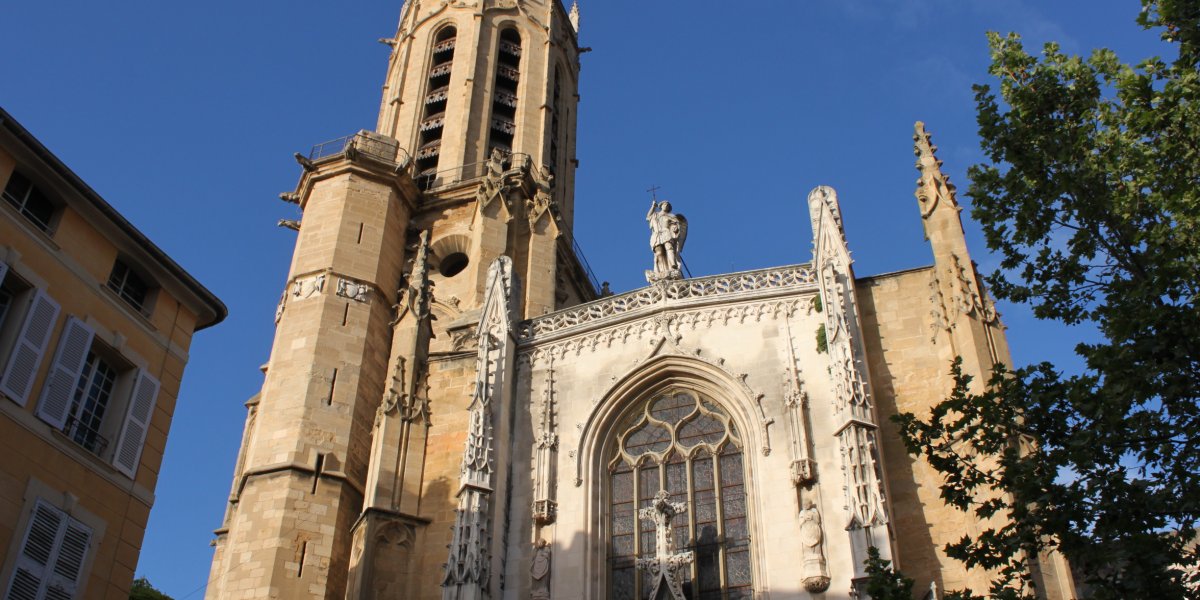
Walk north from Rue Mignet for 4 minutes along Rue Gaston de Saporta — a cobbled street of bookbinders and tapestry shops — and the cathedral's octagonal baptistery rises on your right. Saint-Sauveur is one of France's great architectural palimpsests: a 5th-century baptistery fed by the same Roman hot spring as Cours Mirabeau, a 12th-century Romanesque nave, and a 13th-century Gothic nave glued together into one building that tells 1,500 years of Provencal history in a single floor plan. Entry is free; the Romanesque cloister alongside is 4€ and worth every cent for ten minutes of silence.
Tip: The cathedral's masterpiece is the "Buisson Ardent" triptych by Nicolas Froment (1476) — but it's protected behind a shutter that only opens on request. Ask the sacristan at the left-side office ("Est-ce possible de voir le Buisson Ardent?") between 14:00 and 17:00; they open it in 30 seconds, no charge, and you get 5 minutes alone with one of the finest panels in France.
Open in Google Maps →14:15
Landmark
Exit the cathedral and walk due north along Avenue Pasteur, which becomes Avenue Paul Cezanne — a 25-minute uphill climb through a quiet residential hillside lined with the same pale-ochre walls Cezanne painted. At number 9, the Atelier des Lauves sits behind a wrought-iron gate in a garden of chestnuts and olives; Cezanne built it in 1902 and worked here until his death in 1906. Even from outside, the north-facing window he designed for his painter's light is visible through the trees. Continue 10 more minutes uphill to the Terrain des Peintres, a free terraced viewpoint where Cezanne set his easel dozens of times — and where Mont Sainte-Victoire rises before you across the valley, exactly as it sits in thirty of the world's most famous canvases.
Tip: Time your arrival at Terrain des Peintres for 16:30-17:30 — the late-afternoon sun hits the western face of Mont Sainte-Victoire (the face you see from Aix) and turns the limestone the exact pink-gold Cezanne chased for thirty years. Stand at the lowest terrace, not the top: that's the angle he actually painted from, and the cypress on the right edge will frame the mountain the way it does in the 1904 Philadelphia version.
Open in Google Maps →19:00
Food
Walk 30 minutes downhill back into the old town and thread into Rue du Puits Juif, a narrow medieval lane two blocks from the cathedral. At number 8, Chez Feraud has been run by the same family for over 40 years and serves the Provencal classics no tourist menu dares anymore: pieds et paquets (slow-braised lamb tripe and trotters, 24€), daube provencale with its day-old black-olive gravy (22€), and a house aioli on Fridays that arrives as a mountain of cod, carrots, and fennel. Budget 40-50€ a head with a pichet of Cotes de Provence rose. This is the meal that tells you you were actually in Provence, not just near it.
Tip: Reserve the day before by phone (+33 4 42 63 07 27) — they only have 30 seats and walk-ins are turned away by 19:30. Ask for the small back room, not the front terrace. A genuine Aix pitfall to avoid: the restaurants lining Place des Cardeurs and the south side of Cours Mirabeau (the ones with English menus at the door and photos of the dishes) are tourist-graded and charge Paris prices for microwaved ratatouille — every local eats two streets inland, never on the main drag.
Open in Google Maps →Aller au jour
09:00
Shopping
Begin beneath the plane trees of Place Richelme, five minutes north of the Rotonde. This is the city's daily food market — tomatoes still warm from the sun, olives from Nyons, goat cheese from the Haut-Var, eight or nine vendors sourcing within 50 km of Aix. Locals come to stock Sunday lunch; stalls wrap at 13:00. No souvenirs, no lavender sachets, only what people actually eat.
Tip: Go straight to the olive stall on the south side — he lets you taste before you buy. Ask for 'tapenade verte à l'ancienne'; it comes in small jars perfect for the train home.
Open in Google Maps →10:30
Religious
From the market, walk four minutes up Rue Gaston de Saporta — a pedestrian lane of 17th-century hotels particuliers, the best preserved in the old town. Three churches in one: a 5th-century baptistery with re-used Roman columns, a Romanesque cloister, and a Gothic nave. The treasure is Nicolas Froment's 'Burning Bush' triptych (1476), depicting King Rene of Anjou kneeling before Moses — still kept shuttered to protect the pigments.
Tip: The Burning Bush panels are opened only on request by the sacristan, between 10:00 and 11:30 Tuesday through Saturday. Most visitors never ask; this is the single most important painting in Aix and costs nothing to see.
Open in Google Maps →12:30
Food
Double back down Rue Gaston de Saporta, then duck right into Passage Agard — a covered 19th-century arcade opening onto Cours Mirabeau. Laurent Corti's cheese and charcuterie room occupies the first floor: stone walls, long wooden tables, no tourist menu. The 'ardoise du fromager' (20€) rotates seven cheeses from small Provencal producers with house bread and fig chutney; pair it with a glass of Bandol rose (8€).
Tip: Ask specifically for the 'Banon AOP' — a creamy goat cheese wrapped in chestnut leaves, made only in this corner of Provence. Lunch service ends at 14:30; arrive by 13:00 to secure a window table over the arcade.
Open in Google Maps →14:30
Landmark
Exit Passage Agard at its southern mouth — you emerge directly onto Cours Mirabeau. Turn right and walk the full 440 meters: plane trees shading a carriageway since 1649, 17th-century hotels particuliers on the shaded north side, cafes on the sunlit south side. End at the Fontaine de la Rotonde, the city's 1860 showpiece — three tiers, three bronze statues facing Avignon, Marseille, and Nice.
Tip: Afternoon is when light threads through the plane-tree canopy onto the sandstone facades. The best photo is looking east from the Rotonde fountain with the sun behind you around 15:00 — the avenue compresses into a tunnel of green and gold.
Open in Google Maps →15:45
Museum
From the Rotonde, walk seven minutes east through Place Saint-Jean-de-Malte, into the Mazarin quarter — aristocratic Aix, laid out on a 17th-century grid. An unexpectedly great museum for a city this size: nine Cezannes (including the portrait of his father reading), a small Giacometti hall, and European masters from Ingres to Rembrandt. The Cezannes were donated by the French state only after the city refused them in 1894 — a snub Aix still quietly apologises for.
Tip: The Cezanne room is ground floor, second door left after the ticket desk — go there first before museum fatigue sets in. Closed Mondays; free entry first Sunday of the month, but crowded then — pay the 8€ on any other day.
Open in Google Maps →20:00
Food
Walk six minutes west from the museum down Rue Cardinale — a quiet street of mansions now housing antiquarians — then right on Rue Espariat, left on Petite Rue Saint-Jean. Aix's standout Michelin-starred table, cooking contemporary Provencal with the precision of Parisian training. The 95€ 'Signature' menu moves through five courses; the pigeon with figs (late summer) and the line-caught loup de mer with bouillabaisse jus are the pillars. Twelve covers, stone walls, low light.
Tip: Reserve two weeks out for weekends. The 19:30 seating is harder to get than 21:00 — locals dine late. Beware the 'menu touristique 25€' boards along Cours Mirabeau: frozen ratatouille, microwaved duck. Walk a single block off the Cours and prices halve while quality doubles — Place des Cardeurs is the other trap to skip.
Open in Google Maps →10:00
Museum
Take bus 5 from the Rotonde or walk 20 minutes uphill north along Avenue Paul Cezanne — a leafy residential climb that mirrors the painter's daily commute from his last apartment in town. The studio he built to his own specifications in 1902, where he worked until days before his death in 1906. His son left it exactly as his father did: the easel by the north window, the bottle of absinthe, the skulls on the shelf, the paint-spattered coat on the hook. Every still-life object you know from the canvases is here — the same ginger jar, the same blue apron, the same plaster cupid.
Tip: Book the 10:00 slot online — the room holds 15 people maximum and the north light at that hour is exactly what Cezanne worked in. Photography is forbidden; English audio guides are free at the desk. Allow a full hour; most visitors leave too soon to notice the floor paint stains mapping where each still life stood.
Open in Google Maps →11:30
Landmark
Continue uphill from the Atelier, nine minutes along Avenue Paul Cezanne — the road climbs through cypresses until it opens onto a stone terrace. The exact spot where Cezanne planted his easel to paint Mont Sainte-Victoire more than sixty times. A small public belvedere of olive trees and benches, ceramic reproductions of his canvases mounted at the angles from which he painted them. Directly ahead: the mountain itself, 20 km east, limestone white against the Provencal blue.
Tip: Midday is when the limestone face of Mont Sainte-Victoire is at its most defined — no haze, no shadow tricks. Sit on the second bench from the left (facing the mountain); it lines up precisely with the 'Mont Sainte-Victoire vue des Lauves' (1904) panel — the view Cezanne saw on his last working day.
Open in Google Maps →13:00
Food
Walk back down Avenue Paul Cezanne for 15 easy downhill minutes, or take bus 5 in six. Turn into Rue de l'Aumone Vieille in the old town. A local favourite for galettes and tartines since the 1980s — rustic stone-walled room, chalkboard menu, no-nonsense lunch. The 'tartine Provencale' with tapenade, chevre and sundried tomatoes (14€) is the signature; the buckwheat galette with duck confit and cepe cream (17€) is the indulgent pick.
Tip: No reservations — arrive at 13:00 sharp or you wait 30 minutes at the door. Order the house rose by carafe (pichet 25cl, 9€); it comes from a cousin's vineyard in Puyloubier, directly below Mont Sainte-Victoire.
Open in Google Maps →15:30
Landmark
The shuttle leaves from the Aix Tourist Office at the Rotonde, ten minutes on foot from the restaurant — check in 15 minutes early. The ochre sandstone quarries east of town where Cezanne rented a cabanon from 1895 to 1904 and painted eleven canvases. The guided walk threads between walls of burnt-orange rock that seem to have been cut by the same brushwork he used on canvas. The final clearing frames Mont Sainte-Victoire exactly as in his 'Bibemus Quarry' (1898).
Tip: The afternoon tour has the best light — slanted sun igniting the ochre walls (morning tours are in shadow). Wear grippy shoes; the path is loose stone. The tour runs in French only — ask for the laminated English notes at check-in; nobody offers them unprompted.
Open in Google Maps →18:00
Landmark
The shuttle returns to the Rotonde; walk seven minutes north through Cours Sextius, then right onto Rue Celony. A 1667 country pleasure-pavilion inside the city — bright ochre stucco, two weathered sphinxes on the facade, a formal French garden behind. Built by the Duc de Vendome for his mistress Lucrece de Forbin Sole. Inside, 18th-century Provencal furniture and rotating contemporary exhibitions; outside, the garden is free and stays open past the museum's closing.
Tip: The west-facing facade catches golden hour around 19:00 in summer — the ochre stucco turns almost blood-red for eight minutes. Enter through the small side gate on Rue de la Molle, not the grand front door; the garden stays accessible from that gate even after the museum shuts at 18:00.
Open in Google Maps →20:30
Food
Walk eight minutes south through Rue Celony and Rue des Cordeliers, into the heart of the old town — Rue du Puits Juif, a lane you would walk past if you didn't know. Third-generation family bistro in a cramped stone-vaulted room behind the Hotel de Ville: handwritten menu, nine tables, grandmother's recipes. Order the 'pieds et paquets' (tripe parcels in white wine, 24€) if you're brave, the 'daube provencale' (slow-braised beef in Cassis red, 22€) if you're not. Finish with 'calissons glaces' — almond-apricot ice cream, the Aix specialty.
Tip: Reserve by phone only — they don't do email or booking sites. Ask for a table in the vaulted back room, not the front two street tables. And one final warning for Aix: avoid the touts on Place des Cardeurs and Place Richelme after dark who wave menu boards at passers-by — those are the worst-value meals in the city; any restaurant that needs to hunt for customers isn't feeding the locals.
Open in Google Maps →
Trip builder
Plan this trip around Aix-en-Provence
Turn this guide into a bookable rail itinerary with FlipEarth.
Keep exploring
Related cities
More in the same country
FAQ
Frequently asked questions
How many days do you need in Aix-en-Provence?
Most travelers enjoy Aix-en-Provence in 1 days, with enough time for headline sights and a slower meal or museum stop.
What's the best time to visit Aix-en-Provence?
The easiest season for most travelers is Apr-Jun, Sep-Oct, especially if you want good weather and manageable crowds.
What's the daily budget for Aix-en-Provence?
A practical starting point is about €95 per person per day before hotels, then adjust based on museums, dining, and transport.
What are the must-see attractions in Aix-en-Provence?
A good first shortlist for Aix-en-Provence includes La Rotonde & Cours Mirabeau, Atelier Cezanne (Exterior) & Terrain des Peintres Viewpoint.