City Guide
Bordeaux
France · Best time to visit: May-Oct.
Day-by-day plan
Choose your pace
Durée du voyage
09:00
Landmark
Start on the right bank at Place Stalingrad and cross Bordeaux's oldest bridge on foot — seventeen stone arches over the Garonne, one for each letter in 'Napoléon Bonaparte.' The morning sun hits the limestone quays head-on from this direction, turning the entire left-bank waterfront into a wall of gold. Pause at the midpoint for the single best panoramic shot of Bordeaux: the needle spire of Saint-Michel to the left, the crescent of 18th-century façades dead ahead, and the Cathedral towers peeking above the rooftops to the right.
Tip: The best photo position is the third stone alcove from the left-bank end — it frames the Basilique Saint-Michel's 114-meter spire perfectly between the bridge arches. Arrive before 09:30 and the pedestrian lane is nearly empty; by 10:00 the first tour groups start crossing. Shoot facing west (toward the city) for the golden façade panorama, then turn around for a moody upstream river shot.
Open in Google Maps →10:15
Landmark
Step off the bridge onto Quai Richelieu, turn left along the embankment, and within five minutes a 35-meter Gothic tower appears between the rooftops — Porte Cailhau, the triumphal gate built in 1495 to celebrate Charles VIII's Italian campaign. The carved angels, crown motifs, and delicate tracery on the river-facing side survived centuries of war and flood. Walk through its arch and you emerge into Place du Palais, a quiet cobblestoned square ringed by honey-coloured townhouses — one of the most photogenic small squares in the city.
Tip: Shoot the gate from the quay side first for the full tower against the sky, then walk through the arch and look straight back up — the conical turrets framed from below is the shot most visitors miss. Morning light illuminates the carved eastern face at this hour. The small café tables on Place du Palais are perfect for a quick espresso if you need fuel before the next stretch.
Open in Google Maps →11:15
Landmark
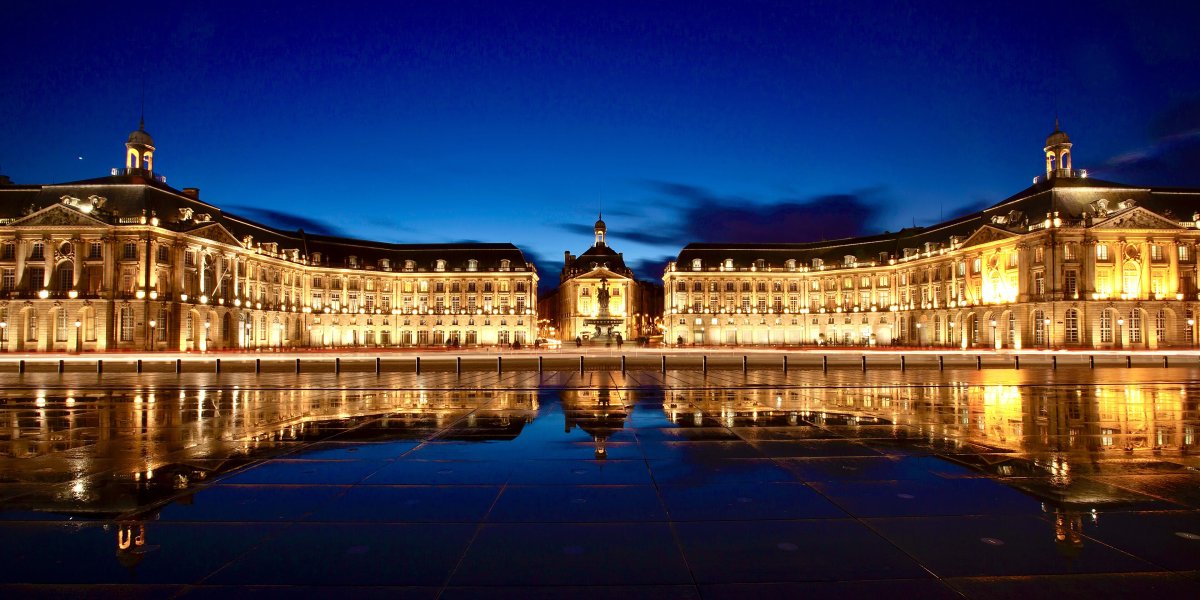
Continue north along the quay for eight minutes, passing the stone warehouses that once held casks of wine bound for the colonies. The grand semicircular Place de la Bourse reveals itself gradually — and then, spread before it, the Miroir d'Eau: 3,450 square meters of shallow water creating a flawless mirror of the 18th-century façade. Every fifteen minutes the surface cycles between a still reflection and a billowing cloud of mist, each phase offering a completely different photograph. This is the image that defines Bordeaux, and standing at its edge with the palace doubled in the water is the moment you understand why the entire city center is a UNESCO site.
Tip: The mirror effect is sharpest in the two minutes just after the mist cycle ends and the water goes perfectly still — that is your window for the reflection shot. Stand on the far edge (river side) and shoot toward the palace for the full symmetrical frame. Between 11:00 and 12:30 the sun is high enough to light the façade evenly without harsh shadows. The Miroir d'Eau operates roughly late March through October and is drained in winter.
Open in Google Maps →12:45
Food
Walk south from the Miroir along Rue Fernand Philippart, cutting through the narrow lanes of the Saint-Pierre quarter — ten minutes of medieval streets lined with wine bars, each one tempting you to stop. Resist: the city's legendary covered market is your destination. Marché des Capucins is where Bordeaux chefs shop at dawn and locals come for their ritual weekend brunch. Head straight to the oyster counters and eat standing at the bar: a dozen briny Arcachon basin oysters (€8-10) with a glass of cold Entre-Deux-Mers white wine (€3-4). Total budget: €12-18 per person.
Tip: Chez Jean-Mi is the most famous oyster stand — look for the longest local queue, the line moves fast. Locals skip the lemon and use only the house mignonette vinegar with minced shallots. If oysters are not your thing, the charcutier two stalls down sells hot grilled Toulouse sausages with frites for €6. The market is closed on Mondays and shuts by 14:00 most other days, so do not linger past 13:30.
Open in Google Maps →14:00
Religious
Exit the market from its western side onto Rue Élie Gintrac and walk northwest for ten minutes through the quiet residential blocks of the Capucins neighbourhood — a pleasant contrast to the tourist waterfront. The twin spires of the cathedral appear above the roofline two blocks before you arrive. Cathédrale Saint-André is Bordeaux's answer to Notre-Dame de Paris: a massive Gothic structure where Eleanor of Aquitaine married Louis VII in 1137. The freestanding bell tower, Tour Pey-Berland, rises 66 meters beside it. Circle the building to admire the Royal Portal on the north transept, where the carved Last Judgment tympanum rivals anything in the capital.
Tip: The north portal facing Rue des Trois Conils has the finest stone carvings — afternoon light falls directly on the sculpted apostles at this hour, perfect for detail shots. Stand back across Place Pey-Berland for the best angle of the tower and cathedral together. Before you leave, walk to the corner of the square and buy a canelé from Baillardran (€2.50) — Bordeaux's signature rum-and-vanilla pastry with a crackling caramelized crust. This is the original shop and the benchmark by which every other canelé in the city is judged.
Open in Google Maps →19:00
Food
From the cathedral, stroll north through pedestrianized Rue Vital Carles and across the elegant Place Gambetta — an eight-minute walk past the finest shopping streets in the city. Your destination is the Grand Théâtre de Bordeaux, arguably the most beautiful neoclassical building in France, and tucked inside its colonnade is Le Quatrième Mur, the celebrated brasserie by chef Philippe Etchebest. Order the entrecôte grillée sauce bordelaise (€32) — this is the definitive version of Bordeaux's signature dish, the beef seared over vine cuttings and the red wine-and-shallot sauce enriched with bone marrow. Finish with the canelé soufflé (€14) for a reinvention of the pastry you tried this afternoon. Budget: €45-60 per person with a glass of Saint-Émilion.
Tip: Reserve at least 24 hours ahead at lequatriememur.com or by phone — walk-ins face a 45-minute wait most evenings. Request a table under the exterior colonnade: you dine between Corinthian columns with the illuminated Place de la Comédie spread before you. Avoid the tourist brasseries flanking the theatre on either side — they charge €22 for a mediocre croque monsieur and serve microwaved duck confit. If you want a post-dinner stroll, walk down Cours de l'Intendance where locals promenade, not Rue Sainte-Catherine where overpriced crêpe stands target day-trippers.
Open in Google Maps →Aller au jour
09:00
Religious
Start your morning on Place Pey-Berland, where the freestanding bell tower rises beside the cathedral like a stone exclamation mark against the sky. Step inside the cathedral first — the soaring Gothic nave and the 14th-century Royal Portal where Eleanor of Aquitaine married Louis VII are free and nearly empty before 10:00. Then, the moment Tour Pey-Berland opens, climb its 231 stone steps for a 360-degree panorama of terracotta rooftops, the Garonne's silver ribbon, and the distant Médoc vineyards — a mental map you'll reference for the rest of the trip.
Tip: Enter the cathedral from the north door on Rue des Trois Conils — it's always unlocked and queue-free. The tower opens at 10:00 year-round; the line rarely exceeds 5 minutes before 10:15. Once on top, look southwest for the best angle of the rooftops with the Pont de Pierre framing the Garonne. Before you leave the square, buy a still-warm canelé from Baillardran on the corner (€2.50) — the original shop and the benchmark for Bordeaux's signature pastry.
Open in Google Maps →10:45
Landmark
Walk northeast through Rue Sainte-Catherine — Europe's longest pedestrian shopping street — for 10 minutes until the twelve Corinthian columns of the Grand Théâtre announce themselves on Place de la Comédie. Designed by Victor Louis in 1780, this is the building that inspired Charles Garnier when he designed the Paris Opéra staircase. Join a guided tour to see the gilded auditorium, the sky-painted ceiling, and the monumental marble staircase — among the finest neoclassical interiors in France.
Tip: Guided tours run throughout the day but are cancelled on performance days — check the Opéra National de Bordeaux website the morning of your visit. The late-morning slot has the fewest visitors. If tours are unavailable, the lobby and staircase are still visible from the entrance and worth a 15-minute stop. Photograph the full colonnade from across the square for scale.
Open in Google Maps →12:00
Food
Walk south for 8 minutes through the narrow cobblestoned lanes of the Saint-Pierre quarter — shutters lean in overhead, wine bars beckon from every corner — until the lively café terraces of Place du Parlement appear. Le Petit Commerce on Rue du Parlement Saint-Pierre is the city's beloved no-frills seafood institution: Arcachon oysters arrive ice-cold at the table (dozen, €15), and the sole meunière comes crackling in brown butter (€24). Half the seats are held by regulars who eat here weekly. Budget: €20–35 per person.
Tip: No reservations — arrive at noon sharp or face a 20-minute wait. Grab one of the sidewalk tables on Place du Parlement for prime people-watching. Order the No. 3 Arcachon oysters — they have the best flavor-to-texture ratio. Skip dessert here; you'll find better along the quays.
Open in Google Maps →13:30
Landmark
From Place du Parlement, walk east toward the river for 5 minutes — as the narrow streets open up, the full spectacle of Place de la Bourse reveals itself against the Garonne. The Miroir d'Eau — the world's largest reflecting pool — cycles every 15 minutes between a razor-thin sheet of still water producing flawless reflections of the 18th-century façade and a billowing cloud of mist. In the early afternoon, sunlight strikes the golden limestone at its warmest angle, turning the water into liquid gold. This is the image that defines Bordeaux, and it hits harder in person than any photograph prepares you for.
Tip: For the iconic reflection shot, stand at the dead center of the pool during the mirror phase and shoot low — the two minutes just after the mist ends and the water goes perfectly still are your window. Take off your shoes and wade in; from toddlers to grandparents, everyone does. The fog phase makes for equally dramatic silhouette portraits. The cycle runs roughly 10:00–22:00, March through October; in winter the pool is drained.
Open in Google Maps →15:00
Landmark
Walk south along the quays for 3 minutes — the pointed turrets and pale stone of Porte Cailhau rise from the cobblestones like a page from a medieval manuscript. Built in 1495 to celebrate Charles VIII's victory at Fornovo, this 35-meter gate was Bordeaux's triumphal river entrance for centuries. Climb the narrow spiral staircase to the rooftop terrace for an unobstructed view of the Pont de Pierre, the Garonne, and the Right Bank — a vantage point that captures Bordeaux's transition from medieval fortress to Enlightenment showpiece.
Tip: The rooftop terrace fits only about 10 people — visit right after the Miroir d'Eau when most tourists are still at the water. The best exterior photo of the gate itself is from Quai Richelieu, slightly to the south, where you can frame the full tower with the stone bridge behind it. Afternoon light illuminates the carved western face beautifully at this hour.
Open in Google Maps →19:00
Food
From Porte Cailhau, follow the quays south past the Pont de Pierre and turn right onto Rue Porte de la Monnaie — a 10-minute stroll through the lively Saint-Michel riverfront. La Tupina has cooked over an open wood fire since 1968, and walking in feels like entering a farmhouse kitchen that happens to serve some of the finest Southwest French food in existence. Start with the tourin blanchi à l'ail — a white garlic soup with egg (€12) — then the duck confit à la cheminée (€28), roasted slowly beside the flames and paired with a glass of Pessac-Léognan from their deep cellar. Budget: €45–65 per person.
Tip: Reserve 2–3 days ahead and request a table near the fireplace — this is the soul of the restaurant. Finish with pastis landais, their homemade brioche cake soaked in orange blossom. Skip the prix fixe menu; à la carte gives you the greatest hits. ⚠️ The tourist-trap restaurants ringing Place Saint-Michel nearby charge double for microwaved duck confit — La Tupina is the only reason to eat in this pocket of the city.
Open in Google Maps →09:00
Park
A 10-minute walk north from the city center along Cours de Verdun brings you through wrought-iron gates into Bordeaux's most beautiful park — eleven hectares of English-style gardens designed in 1746. In the morning calm, joggers trace the lake, ducks glide under weeping willows, and light filters through century-old plane trees at the angle that landscape painters live for. After yesterday's packed itinerary, this is a deliberate exhale before the day's wine immersion begins.
Tip: Walk to the southeast corner to find the Jardin Botanique — a hidden garden-within-a-garden that most Bordelais themselves have forgotten. The best bench for morning sun is beside the lake, facing south, under the third plane tree from the small bridge.
Open in Google Maps →10:00
Neighborhood
Exit the park from the northeast gate and walk east for 7 minutes — as you cross Cours de Verdun, the neighbourhood shifts from grand limestone boulevards to converted wine warehouses and artist studios. Rue Notre-Dame is the spine of the Chartrons quarter: once the domain of powerful wine merchants who shipped Bordeaux worldwide, it is now a quiet procession of antique shops, independent galleries, and wine caves where free tastings await behind every other door. This is where Bordelais come to browse on a morning off — no tour buses, no queues, just the clink of glasses and the smell of old oak.
Tip: Duck into any wine cave along Rue Notre-Dame offering free tastings — ask specifically for a small-production Saint-Émilion or Pessac-Léognan you won't find in supermarkets back home. On Sunday mornings, the Quai des Chartrons hosts one of France's finest flea markets, stretching a full kilometre along the river.
Open in Google Maps →11:15
Museum
Continue south along Rue Notre-Dame for 5 minutes and turn onto Rue Ferrère — the massive stone archway of the Entrepôt Lainé announces one of Europe's most striking contemporary art spaces. This 19th-century warehouse once stored coffee, spices, and cotton from the colonies; today its vaulted 25-meter-high central nave holds works by Keith Haring, Richard Long, and Annette Messager. The raw industrial architecture — exposed stone, iron beams, cathedral-like proportions — gives the art a physical weight that white-cube galleries simply cannot replicate.
Tip: Stand at the far end of the central nave and shoot toward the entrance for a dramatic one-point-perspective photo — the scale is genuinely cathedral-like. CAPC opens at 11:00, is closed on Mondays, and stays open until 20:00 on Wednesdays. Free admission on the first Sunday of each month.
Open in Google Maps →12:30
Food
Step out of the CAPC and walk 3 minutes east toward the Quai des Chartrons, where Symbiose sits on the riverside that once hummed with barrel traffic. This modern French bistro sources directly from regional producers and rotates its short menu with the seasons. Order the plat du jour (€16–19) — it always reflects what arrived fresh that morning — and pair it with a glass of white Graves (€7) for an effortless, deeply local lunch. In warm weather, the terrace faces the Garonne with the same river view the wine merchants once contemplated. Budget: €25–35 per person.
Tip: No reservations needed at noon on weekdays; on weekends, arrive by 12:15. Ask the server which wine they'd drink today — the answer is always more interesting than the list. The short menu means everything is strong; trust the plat du jour over the à la carte.
Open in Google Maps →14:00
Museum
From the quays, walk north along the Garonne for 15 minutes — or hop on Tram B from the Les Hangars stop for two stops — and the twisting golden tower of La Cité du Vin materializes like a giant decanter rising from the riverbank. This is not a dusty wine museum: the permanent exhibition is a multi-sensory journey through wine civilizations, terroirs, and craft across 20 countries, with interactive stations that let you smell, hear, and virtually taste your way through history. Your ticket includes a glass of wine on the 8th-floor Belvedere — a 360-degree panorama of the Garonne, the city skyline, and the Médoc vineyards fading into the horizon. It is the single best view in Bordeaux.
Tip: Buy tickets online to skip the ground-floor queue — the 14:00 entry slot is quieter than morning. Allow 90 minutes for the exhibition and 30 minutes for the Belvedere. At the top, ask for a Sauternes or a single-estate Saint-Émilion rather than the generic pours — the sommeliers enjoy guiding curious visitors. Save this for a clear day; the panorama loses its magic in fog.
Open in Google Maps →19:30
Food
Take Tram B south from La Cité du Vin back to Place de la Comédie — 15 minutes, your last tram ride of the weekend. Le Quatrième Mur occupies the ground floor of the Grand Théâtre itself, a setting so grand it almost upstages the food. Chef Philippe Etchebest — one of France's most celebrated toques — runs a precision brasserie here: the entrecôte bordelaise is seared to a perfect crust over vine cuttings (€34), the seasonal vegetables are handled with fine-dining technique, and the canelé soufflé (€14) is a reinvention of Bordeaux's signature pastry that rivals the original. Budget: €45–65 per person.
Tip: Reserve 3–4 days ahead online — this is the hardest table in Bordeaux. Request a seat under the exterior colonnade facing Place de la Comédie for the evening theatre of the city strolling past between Corinthian columns. Order the entrecôte and finish with the canelé soufflé — non-negotiable. ⚠️ The café terraces flanking the Grand Théâtre charge tourist premiums for unremarkable croque monsieurs and microwaved duck — Le Quatrième Mur is the only place on this square worth your last dinner in Bordeaux.
Open in Google Maps →Aller au jour
09:30
Landmark
Take Tram B to Hôtel de Ville — the detached bell tower rises behind the cathedral across Place Pey-Berland. Climb the 233 steps for the finest panoramic view in Bordeaux: the crescent of the Garonne, the limestone rooftops stretching to the horizon, and the distant spire of Saint-Michel. Step inside the cathedral afterward to catch the morning light streaming through the Gothic nave and to see the Royal Portal's medieval carvings.
Tip: The tower opens at 10:00 — explore the cathedral interior first (free, opens 9:00), then be first in line for the climb. The staircase is single-file and after 10:30 you'll spend more time queuing than climbing. Best photo angle is from the south-facing platform, where you can frame the cathedral's flying buttresses with the river beyond. Closed Mondays.
Open in Google Maps →11:30
Landmark
Walk 10 minutes north through the Cours de l'Intendance, lined with luxury boutiques — Bordeaux's 18th-century grandeur at street level. The Grand Théâtre is one of Europe's most beautiful neoclassical buildings: twelve Corinthian columns crowned by statues of nine muses and three goddesses, a facade Charles Garnier studied before designing the Paris Opéra. The surrounding Place de la Comédie and tree-lined Allées de Tourny form the city's most refined promenade.
Tip: The Tourist Office on the opposite corner of Place de la Comédie runs guided interior tours (€8) on select days — the Grand Staircase and auditorium in blue, white, and gold are breathtaking. Check availability when you arrive as schedules change weekly. Even without the tour, the exterior and the Allées de Tourny are worth 30 minutes of slow admiration.
Open in Google Maps →12:30
Food
Walk 5 minutes southeast through the pedestrian streets of the Saint-Pierre quarter — the most atmospheric dining neighborhood in Bordeaux, with stone facades and café terraces spilling across narrow lanes. Le Petit Commerce is a seafood institution where locals come for impeccably fresh Arcachon oysters and simply grilled whole fish. No-frills tile interior, brisk waiters, zinc bar — Bordeaux dining at its most honest.
Tip: No reservations accepted — arrive at 12:00 sharp or expect a 30-minute wait. Order the dozen oysters from Arcachon Bay (€15) and the sole meunière (€22). Skip the meat dishes entirely; you come here for the seafood. Budget €25-40 per person with a glass of crisp Entre-Deux-Mers white.
Open in Google Maps →14:30
Landmark
Walk east through Place du Parlement — a hidden Italianate square worth a pause at its sculpted fountain — then continue 5 minutes to the riverfront. Place de la Bourse is Bordeaux's architectural masterpiece: a symmetrical 18th-century palace embracing the Garonne, with the Miroir d'Eau before it — the world's largest reflecting pool, cycling between a thin mirror of water and clouds of mist. In the afternoon sun, the golden stone doubles in the water; this is the photograph of Bordeaux.
Tip: The mirror effect is strongest in the 2-3 minutes after the water sheet settles and before the mist cycle begins — watch one full cycle (about 15 minutes) to time your shot. Stand at the south end looking north for the iconic reflection. The Miroir d'Eau operates March through November and is drained in winter. After your visit, stroll the Quais — the riverside promenade stretches for kilometers and is Bordeaux's living room.
Open in Google Maps →19:30
Food
Walk 10 minutes back through the quiet streets behind the Grand Théâtre to Rue Montesquieu — the route passes elegant townhouses that glow amber in the evening light. Le Chapon Fin has been feeding Bordeaux since 1825: the dining room is a listed monument, a fantastical rock-grotto interior with carved stone walls and soft lighting that feels like dining inside a Baroque dream. The kitchen delivers refined Bordelaise cuisine with seasonal precision — this is where Bordeaux's golden age never ended.
Tip: Reserve 3 days ahead and request the main grotto room — the side rooms lack the drama. The seasonal tasting menu (€65) is the best way through the kitchen, but à la carte also shines: the ris de veau (sweetbreads, €32) is the signature. Budget €55-80 with wine. Avoid the tourist-trap restaurants ringing Place du Parlement — most charge premium prices for mediocre food aimed at visitors who won't return.
Open in Google Maps →09:30
Landmark
Catch the TER train from Bordeaux-Saint-Jean to Saint-Émilion (35 minutes, €10 return), then walk 25 minutes from the station through vineyard-lined lanes — the vines on both sides and the bell tower drawing you forward is your first taste of wine country. The 13th-century Tour du Roy, the only remaining keep of the medieval castle, rewards a short climb with a view that explains Saint-Émilion's UNESCO status: vineyards rolling to every horizon, punctuated by château spires. Descend through steep cobblestone streets and carved stone doorways into the medieval village.
Tip: Arrive before 10:30 for soft morning light on the vineyards — the westward view from the tower is the most photogenic. After descending, walk down the steep Rue de la Cadène and look for the carved facade of the Maison de la Cadène (14th century) — most visitors walk right past it. The walk from the train station through vineyards is genuinely beautiful; do not take a taxi.
Open in Google Maps →11:30
Religious
Descend 3 minutes through narrow medieval lanes to Place de l'Église Monolithe — you'll recognize it by the bell tower above and the worn stone steps leading below ground. This is Europe's largest underground church, carved from a single limestone mass between the 9th and 12th centuries: a vast subterranean nave, faded medieval frescoes, and catacombs where centuries of history are etched into the walls. Only accessible by guided tour — dark, cool, and quietly astonishing.
Tip: Book your tour at the Tourist Office on Place des Créneaux (50 meters uphill from the church entrance) the moment you arrive in Saint-Émilion — midday English-language slots sell out fast. Tours depart every 45 minutes in English and French. The underground stays a constant 14°C even in summer; bring a light layer.
Open in Google Maps →12:30
Food
Walk 2 minutes uphill to Place du Marché — the social heart of Saint-Émilion, shaded by plane trees and framed by golden stone arcades. L'Envers du Décor is a wine bar and bistro where local winemakers actually eat, with a terrace overlooking the square and a wine list that reads like a map of the surrounding appellations. Southwestern French cooking without pretension — hearty, seasonal, and built entirely around duck.
Tip: Grab a terrace table and order the magret de canard (duck breast, €18) or confit de canard (€16) — both are definitive versions. Pair with a glass of Saint-Émilion Grand Cru (€8-12). Budget €20-30 per person. Skip dessert here — walk 3 doors down to Nadia Fermigier for the original Saint-Émilion macaron, baked from the same recipe since 1620 (nothing like a Parisian macaron — crumbly, almond-rich, and unforgettable).
Open in Google Maps →14:30
Entertainment
Walk 4 minutes east along Rue de la Porte Brunet — the lane opens onto the ruins of a 14th-century Franciscan monastery draped in wisteria and ivy. The Cloître des Cordeliers is a roofless Gothic cloister surrounding a peaceful garden, with underground limestone cellars carved deep into the hillside where Crémant de Bordeaux ages in the dark. The cellar tour ends with a tasting in the cloister garden — the Crémant Rosé in this setting is one of Saint-Émilion's most memorable moments.
Tip: The cellar visit with tasting is €10 and lasts about 40 minutes — ask for the Crémant Rosé specifically. Afterward, sit in the cloister garden with a glass and let the afternoon slow down. Leave Saint-Émilion by 16:30 to catch the train back. Watch out for the tourist shops on the main streets selling mass-produced 'artisan' wine accessories at triple the price — the real artisan shops hide on the quieter back lanes.
Open in Google Maps →19:30
Food
Back in Bordeaux, take the tram from Gare Saint-Jean toward the center and walk to Rue Abbé de l'Épée — a quiet street in the university quarter, far from the tourist flow. Garopapilles is half wine cellar, half restaurant: you enter through shelves of curated bottles before reaching a candlelit 20-seat dining room where the chef creates a single set menu each evening from the day's market finds. You don't choose here — you trust the kitchen, and it is always the right decision.
Tip: Reserve at least 4 days ahead — with only 20 seats, walk-ins are nearly impossible. The daily market menu is 4 courses for €42, and the sommelier's wine pairing (€28) is among the best values in Bordeaux. Budget €45-60 with wine. Avoid the flashy wine bars clustered around Place de la Victoire near the station — they target students and tourists with low-quality pours at inflated prices.
Open in Google Maps →10:00
Museum
Take Tram B to La Cité du Vin stop — the swirling golden tower, inspired by wine in a glass and the gnarled trunk of a vine, announces itself from a distance. This is not a museum about Bordeaux wine but about wine as a civilization: twenty immersive galleries take you through 8,000 years of wine culture worldwide, from interactive scent stations to historical trade-route maps and projection rooms. The visit ends on the 8th-floor Belvedere with a panoramic glass of wine overlooking the Garonne and the city skyline.
Tip: Arrive at 10:00 opening — the sensory galleries are best experienced without crowds pressing around the scent stations. Your ticket includes one glass of wine at the Belvedere; choose the local Bordeaux option for the full circle. Skip the gift shop wines (overpriced); you'll find far better bottles along Rue Notre-Dame in Chartrons. Allow a full 2 hours. Closed Mondays in low season.
Open in Google Maps →12:30
Food
Walk south along the Garonne quays for 20 minutes — the waterfront promenade passes converted wine warehouses and the Pont Chaban-Delmas (Europe's tallest vertical-lift bridge) before delivering you into the heart of the Chartrons quarter. Le Flacon is a wine bar and bistro on Rue de la Devise where the chalkboard menu changes daily and the wine list is chosen with genuine passion. Locals fill this room at lunch; tourists rarely find it.
Tip: Order the plat du jour (€14-16) — it's always the best thing on the menu because it's whatever the chef chose at the market that morning. Pair with a glass of lesser-known Bordeaux — Côtes de Bourg or Fronsac (€5-7) — instead of the usual suspects. Budget €18-28 per person. The walk south along the quays from Cité du Vin is one of Bordeaux's best-kept pleasures, almost entirely local with no tour groups.
Open in Google Maps →14:00
Neighborhood
Step outside and turn onto Rue Notre-Dame — the spine of the Chartrons, Bordeaux's historic wine-trading district where Dutch, English, and Irish merchants lived and worked for three centuries. Their elegant townhouses now hold antique dealers, independent wine shops, vintage boutiques, and small galleries at street level. The pace here is slower than the city center; this is where Bordelais come to browse without a plan and where you take your thirty free minutes of the afternoon.
Tip: The best antique shops cluster between Rue Borie and Rue Rode — look for Art Deco glassware and maritime curiosities. For wine, skip the shops with flashy window displays and find the ones where bottles are stored on their sides and the staff can tell you the winemaker's name. On Sunday mornings, the Marché des Chartrons takes over the quay — if your schedule allows, it is Bordeaux's finest open-air market.
Open in Google Maps →15:30
Park
Walk 8 minutes southwest along Rue Fondaudège, lined with handsome 18th-century townhouses and specialty food shops — a residential street that feels like discovering a quieter city. The Jardin Public is Bordeaux's most refined park: an English-style landscape garden with mature plane trees, a boating pond, and a botanical garden hidden behind a low stone wall. In the late afternoon light, the park fills with families, joggers, and readers on benches — no monument, just Bordeaux as the Bordelais live it.
Tip: Find a bench near the pond on the eastern side — the light filtering through the plane trees in late afternoon is painterly and worth lingering for. The Natural History Museum at the park's northern edge is free and delightfully old-fashioned if you want a quiet 20 minutes. A 5-minute detour north reveals the Palais Gallien, the atmospheric ruins of a 3rd-century Roman amphitheater that most visitors never learn about.
Open in Google Maps →19:00
Food
Take Tram B south to Grand Théâtre (5 minutes) or walk 15 minutes through the tree-lined Cours de Verdun — the evening light on the stone facades makes the stroll worthwhile. Le Quatrième Mur occupies the ground floor of the Grand Théâtre itself, beneath the Corinthian columns you admired on Day 1 — chef Philippe Etchebest (Meilleur Ouvrier de France) runs a brasserie that takes Bordelaise classics seriously without a trace of pretension. Soaring ceilings, theatrical service, the clink of glasses — this is the farewell dinner Bordeaux deserves.
Tip: Reserve 3-4 days ahead for dinner and request a table near the tall windows for the best atmosphere. Order the entrecôte grillée aux sarments de vigne (€28, grilled over vine cuttings — the definitive Bordeaux steak) and finish with the cannelé soufflé (€12), a playful reinvention of the city's signature pastry. Budget €40-55 with wine. For authentic cannelés to bring home, buy from Baillardran (multiple locations) — never from the tourist shops near the cathedral.
Open in Google Maps →
Trip builder
Plan this trip around Bordeaux
Turn this guide into a bookable rail itinerary with FlipEarth.
Keep exploring
Related cities
More in the same country
FAQ
Frequently asked questions
How many days do you need in Bordeaux?
Most travelers enjoy Bordeaux in 1 days, with enough time for headline sights and a slower meal or museum stop.
What's the best time to visit Bordeaux?
The easiest season for most travelers is May-Oct, especially if you want good weather and manageable crowds.
What's the daily budget for Bordeaux?
A practical starting point is about €80 per person per day before hotels, then adjust based on museums, dining, and transport.
What are the must-see attractions in Bordeaux?
A good first shortlist for Bordeaux includes Pont de Pierre, Porte Cailhau, Place de la Bourse and Miroir d'Eau.