City Guide
Timisoara
Roumanie · Best time to visit: Apr-Oct.
Day-by-day plan
Choose your pace
Durée du voyage
09:00
Landmark
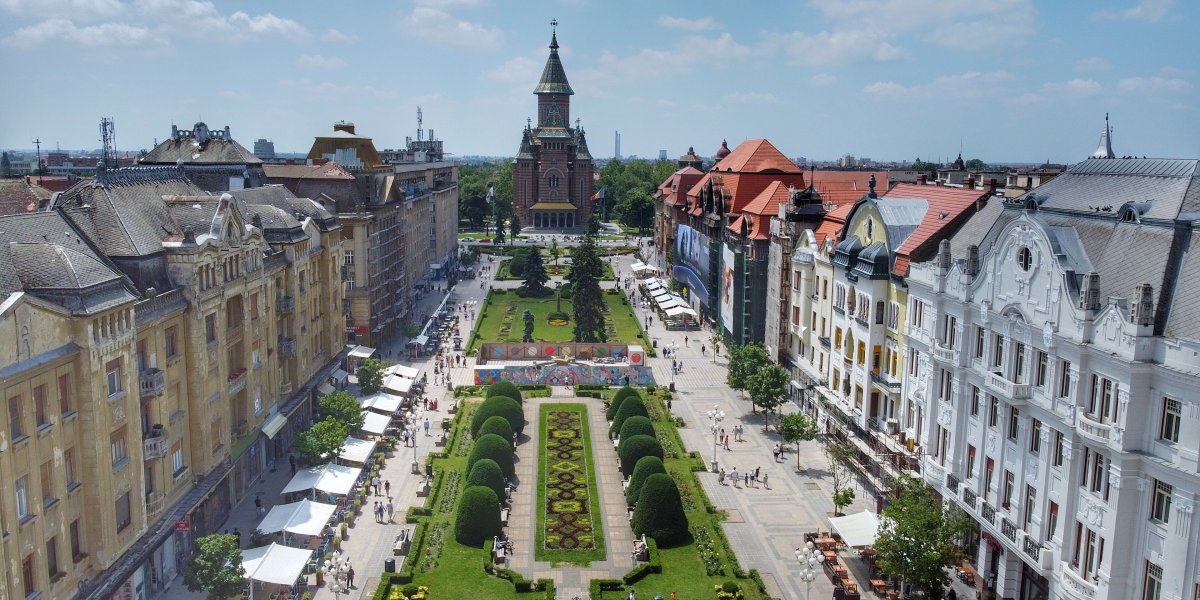
Start at the south end of the square in front of the Metropolitan Cathedral — its seven copper spires catch the morning sun first, and its steps are where the army opened fire on protesters in December 1989. Walk slowly north up the 750-meter pedestrian boulevard, past the Capitoline Wolf statue (Rome's gift marking the city's Roman roots) and the Memorial of the Revolution, all the way to the cream-and-gilt Romanian National Opera at the far end. This single avenue is the spine of the city — and the spine of the revolution that ended communist Romania, declared from the Opera balcony on December 20, 1989.
Tip: Climb the Metropolitan Cathedral bell tower (5 RON / ~1 EUR, entrance through the small side door right of the nave) before 10:00 — you'll have the gallery alone and a clean axial view 750m straight up the boulevard to the Opera, the only spot in town where you see the full line at once. Skip the lift queue after 10:30 — tour groups arrive from Belgrade.
Open in Google Maps →11:15
Landmark
From the Opera, cut diagonally northwest one block on Strada Alba Iulia — 4 minutes through a pedestrian alley framed by two cream Art Nouveau facades — to the smallest of the three squares. Piața Libertății is the civic and military heart: the buttercream former Old Town Hall (a 15th-century Turkish military headquarters), the bronze Saint John of Nepomuk and the Virgin Mary monument, and the cobblestones where Pandur outlaw Iancu was executed in 1737.
Tip: Stand on the northwest corner facing the Town Hall — the yellow facade glows in late-morning sun and the Nepomuk statue lines up dead-center in front of it for the photo. Don't sit at the cafés on this square (double-priced for tourists with no view) — keep walking three minutes to Piața Unirii where lunch is better and the view is unbeatable.
Open in Google Maps →12:15
Food
Continue north on Strada Vasile Alecsandri for 3 minutes — you emerge onto Piața Unirii under the pink Serbian Orthodox Cathedral; Caruso is at the southwest corner under the green awning. The kitchen is fast but the food is real: order the ciorbă de burtă (creamy tripe soup, 22 RON / ~4.5 EUR) and a plate of mici cu muștar (Banat's grilled minced-meat rolls with mustard and bread, 28 RON / ~6 EUR) — these were invented in this region and travel poorly, so eat them at the source.
Tip: Sit at the outdoor tables, not inside — the entire Baroque ensemble of Piața Unirii unfolds in front of you while you eat, and locals consider this the best free seat in town. Arrive before 12:30 or after 13:30; the square office workers fill it in the middle hour and the kitchen slows. Pay in cash (lei) — card tips disappear, cash ones reach the server.
Open in Google Maps →13:30
Landmark
Stand up from Caruso and walk twenty paces into the center of the square — you don't visit Piața Unirii, you stand inside it. On three sides: the salmon-pink Serbian Orthodox Cathedral, the buttercream Roman Catholic Cathedral of Saint George, and the deep-red Baroque Palace of the Banat Museum; the fourth side opens onto a row of Habsburg-yellow town houses. Walk slowly around the perimeter, sit at the base of the Plague Column fountain, then duck briefly into the small Serbian Cathedral interior — the only one whose painted ceiling rewards a glance — before continuing east.
Tip: Stand at the foot of the Plague Column (the obelisk in the center of the square) and shoot the Roman Catholic Cathedral with the column in the foreground — that's the iconic Timișoara postcard, and the 14:00-15:00 light puts gold on the cathedral pediment without backlight. The Banat Museum exterior is more photogenic than its interior — don't waste time on the entrance queue.
Open in Google Maps →16:15
Neighborhood
Exit Union Square east on Strada Emanuil Ungureanu and drop down to the Bega Canal — turn left onto the south-bank promenade and follow the green water for 15 minutes east under the willows. You cross under the iron Decebal Bridge into Fabric, the old industrial-Jewish quarter where the textile factories and the magnificent Fabric Synagogue (cream-and-rust striped Moorish facade, never fully restored, all the more haunting for it) still stand. Loop back along the north bank as the light turns golden — the water goes pink before dusk and the cathedral spires of the old town glow on the western horizon.
Tip: Shoot the Fabric Synagogue from across Strada Ștefan cel Mare at 17:30-18:00 in summer — the eastern stripes light up just before sunset and the cracked plaster looks heroic rather than sad in this light. The synagogue is not safely open to visitors, don't try to enter. Skip the gypsy cab drivers loitering by Decebal Bridge — they triple the meter on tourists; if you're tired, walk back along the canal, it's the most beautiful kilometer of the day.
Open in Google Maps →19:00
Food
Walk back along the north bank of the Bega for a final 15 minutes — sunset washes the canal pink — then turn right onto Strada Alba Iulia. Casa cu Flori is the wooden-shuttered yellow house at number 1, serving Banat classics in a courtyard hung with vines since the early 1990s. Order the sarmale cu mămăligă (cabbage rolls with cornmeal and sour cream, 35 RON / ~7 EUR), the pulpă de miel la tavă (oven-roasted lamb leg with garlic potatoes, 75 RON / ~15 EUR), and finish with papanași — golden fried cheese doughnuts in sour cream and sour-cherry jam, 25 RON / ~5 EUR. Wash it down with a half-liter of Timișoreana, the pilsner brewed two blocks away since 1718.
Tip: Reserve the courtyard (not the indoor dining room) for after 19:00 by phone the day before — the inner garden seats 40 and fills by 19:30. Final-day pitfalls: do NOT eat at the Lloyd or Opera restaurants on Piața Victoriei — they cater to tour buses, the same dishes cost double, and the meat quality drops sharply; and ignore anyone offering 'fixed-price tourist menus' on Piața Unirii after dark, they are not licensed restaurants but front operations charging in euros at three times the rate.
Open in Google Maps →Aller au jour
09:00
Landmark
Start your morning at the historical zero of Timisoara, the pastel Baroque ensemble where the Roman Catholic Dome and the Serbian Orthodox Cathedral face each other across cobblestones. At 9am the eastern light hits the Catholic Dome's salmon facade head-on while the square is still empty of tour groups, so you get the postcard photograph before the crowds claim the cafe tables. Step inside both churches: most visitors only photograph the exteriors and miss the Dome's astonishing trompe-l'oeil ceiling and the icon-heavy Serbian sanctuary.
Tip: Shoot from the southeast corner near the 1740 Plague Column - it's the only angle that frames both cathedrals and the column in one composition. The Catholic Dome opens at 8:30; the Serbian Cathedral at 9:00. If a wedding is in progress at the Serbian Cathedral (common on Saturdays), wait outside on the steps - you are welcome to peek in once the recessional begins.
Open in Google Maps →10:30
Museum
Cross the square 80 meters to its eastern side - the buttery-yellow Old Prefecture (1754) is one of the most important Baroque palaces in southeast Europe and now houses Romania's best art collection outside Bucharest. Skip the temporary shows on the ground floor and head straight upstairs to the Corneliu Baba rooms; his dark, anguished peasant portraits are the soul of 20th-century Banat painting. The original 18th-century ceiling frescoes in the eastern wing survived three regime changes and are easy to miss if you don't look up.
Tip: Tuesday closed. Buy the combo ticket (15 lei extra) that includes the upstairs balcony - it gives you a private elevated view of Union Square that no cafe terrace can match. The English audio guide is weak; the printed gallery sheets at each entrance are better.
Open in Google Maps →12:30
Food
Walk six minutes south down Strada Vasile Alecsandri, the lantern-lit Baroque corridor that connects Union Square to Victory Square - the locals just call it 'the corridor.' Beraria 700 sits on the southwestern edge of Victory Square in a 1900s vaulted cellar, and it's where city-hall office workers eat ciorba de burta on their lunch break. The summer terrace faces the Metropolitan Cathedral; the basement is a stone-arched beer hall that feels like Habsburg-era Vienna.
Tip: Order the ciorba de burta (sour tripe soup, 32 lei / ~7 EUR) - it's Timisoara's signature dish and they make it better than anywhere else in the center. Pair it with mici (grilled minced-meat rolls, 28 lei for five) and the unfiltered house pilsner 'Bere de Banat' on tap, which you cannot buy bottled. Arrive by 12:30 - by 13:15 the lunchtime queue spills onto the terrace.
Open in Google Maps →14:00
Landmark
Three minutes north from lunch through the corridor, you arrive at Liberty Square - the smallest and most lived-in of the three squares, where Timisoara's medieval Town Hall (1734) sits on the south side. This was once the Ottoman fortress's parade ground; for 164 years until 1716 the city was the westernmost outpost of the empire. After a heavy lunch the post-prandial light here is perfect for slow walking - the square has benches under the lindens and locals come to read the paper.
Tip: Find the bronze plaque on the Town Hall facade marking the spot where, on October 13, 1716, Prince Eugene of Savoy accepted the Ottoman surrender - it's at eye level just left of the main door and 90 percent of visitors walk past it. The Saint Nepomuk column in the center is original Baroque (1756); the bench facing it is the best free seat in the city.
Open in Google Maps →15:30
Landmark
From Liberty Square head one block south back onto Victory Square's 700-meter promenade, which unfurls from the Opera House at one end to the Metropolitan Cathedral at the other. This is where, on December 16, 1989, the first cries against Ceausescu were shouted from the cathedral steps - the bronze plaques set into the pavement mark each martyr who fell here. Walk it slowly south as the afternoon light shifts behind you, then enter the cathedral; its mosaic-glazed spires (1936-46) make it one of the most distinctive Orthodox churches in Europe, and the crypt below houses an under-visited Treasury of Byzantine icons.
Tip: Pay the 15 lei crypt fee at the back-left of the cathedral nave - you get the Treasury plus access to the basement where the 1989 protesters sheltered from gunfire. Climbing the south spire (separate 20 lei ticket, last entry 17:00) is the only elevated view of all three squares; don't skip it. The fountain in front of the Opera switches on at 18:00 in summer - linger if you can.
Open in Google Maps →19:30
Food
Twelve-minute walk north up Strada Alba Iulia from near the Opera - the prettiest residential stretch in the city, all wrought-iron balconies and trailing geraniums. Casa cu Flori ('House of Flowers') has been the most beloved old-school Romanian restaurant in Timisoara since 1929, hidden behind a discreet courtyard door at number one. Live folk-fiddle music Thursday through Saturday from 20:30; the menu is unapologetically Banat - pork-heavy, paprika-spiked, served family-style at communal wooden tables under the vines.
Tip: Reserve a courtyard table for summer (phone +40 256 435 080, two days ahead for weekends) - the indoor cellar is atmospheric but the courtyard with the strung lights is the experience. Must-order: Banat sarmale wrapped in pickled cabbage (48 lei / ~10 EUR), ciolan afumat (smoked pork knuckle on sauerkraut, 65 lei), papanasi with sour cream and forest-berry jam for dessert (22 lei). Pitfall warning: skip the cluster of tourist-menu cafes on Union Square's south arcade ('Italian-Romanian-Hungarian fusion!') - they're 40 percent more expensive than identical food two blocks away, and the photo-menu with stock images is the giveaway. Locals never eat there.
Open in Google Maps →09:00
Religious
Fifteen-minute walk east from Union Square along Strada Andrei Mocioni - you cross from creamy Habsburg into the russet-brick industrial-era streets of the Fabric district, where the city's Jewish, Hungarian, and German working class lived together for two centuries. The 1899 synagogue is a Moorish-Art Nouveau jewel reopened in 2022 after a magnificent multi-year restoration, and arriving at 9 lets you have the sanctuary almost to yourself before the late-morning bus tours. Inside, the stenciled blues and golds explode upward to a rose window above the women's gallery - it's the most beautiful interior in Timisoara.
Tip: Closed Saturdays for Shabbat. Pay the 20 lei entry plus 15 lei for the audio guide - it's the only way to understand the symbolism of the rosette window and the Hebrew inscriptions on the Ark. Photography is allowed without flash. The custodian will let you step onto the women's gallery upstairs if you ask politely - the view down into the sanctuary is the photograph you came for.
Open in Google Maps →10:30
Religious
Three minutes walk northeast through Piata Romanilor, where Fabric's old Hungarian community gathered. The red-brick neo-Romanesque basilica was built in 1901 for the millennium of Hungarian Catholic settlement in the Banat and its twin spires (65 meters) still dominate every Fabric rooftop view. Inside, the nave is hushed and devotional - twelve Stations of the Cross painted by Hungarian masters line the side aisles, and the stained glass casts colored pools onto the worn flagstones late morning, which is exactly when you arrive.
Tip: The verger sometimes opens the choir loft for a small donation (10 lei) - climb it for the only elevated view of Fabric's rooftops and the Bega bend. Mass is at 11:00 daily; if you arrive during it, slip in quietly through the side door on Strada Stefan cel Mare and stand at the back. The terracotta exterior glows best from the southwest corner of the square at 11:30.
Open in Google Maps →12:30
Food
Walk eight minutes west along Strada Stefan cel Mare and you arrive at the working courtyard of the Timisoreana brewery, which has been operating on this exact site since 1718 - making it the oldest continuously operating brewery in Romania. The restaurant sits inside the 300-year-old courtyard under giant chestnut trees, with the brewing copper visible through one wall and pilsner pouring at the bar that has not moved in a century. This is where Fabric's brewery workers have eaten lunch for six generations.
Tip: The unfiltered 'Burgarska' pilsner brewed on-site (12 lei / ~2.5 EUR) is poured only here and goes flat in two hours - drink it where it's made. Order ciorba radauteana (sour chicken soup with garlic, 28 lei) and mici with house mustard (32 lei for five). No reservation needed on weekdays - sit in the inner courtyard under the chestnuts, not the street-front terrace which is for smokers. Saturday lunch fills by 12:30, so arriving on the hour matters.
Open in Google Maps →14:30
Museum
Twenty-minute walk back west toward the center via the Bega-side path - cross the canal at Mihai Viteazu Bridge and then duck north onto Strada Oituz, where the museum hides behind the Catholic seminary in a building you'd never notice without looking. This is the original archive of the revolution that began in Timisoara on December 16, 1989, and ended Ceausescu's regime nine days later. Photos, bullet-holed clothing from cathedral steps, the smuggled video that first reached western television. The volunteer custodians are often revolution survivors who will narrate personally in English if you ask.
Tip: If the door looks closed, ring the bell beside it - the museum is volunteer-staffed and someone will open. There is no fixed ticket; the donation box expects around 25 lei (~5 EUR). The third-floor video room shows uncut footage of the Opera House balcony declarations and the cathedral steps massacre - sit through it, it's why you came. Allow the full 90 minutes; it is emotionally heavy but essential context for everything you saw on Day 1.
Open in Google Maps →16:30
Park
Twelve-minute walk south, crossing the Bega Canal at Maria Bridge - the canal-side path between the bridge and the park is the most photogenic green stretch in Timisoara, with willows trailing into the water and the white footbridges reflecting in still afternoon light. Rose Park itself was laid out in 1891 and now holds 1,200 rose varieties; peak bloom is mid-May to mid-June, then a second flush in September. The Habsburg-era pergolas and bandstand make it feel like a Viennese garden transplanted, and the late-afternoon light through the chestnut canopy is the cinematic close to your two days.
Tip: The northwest corner near the Bega has the best benches - shaded by chestnuts, with the canal visible and the open-air summer theater behind you. The rose collection's signage is in Romanian only; the 'Banat' variety (deep red, planted in section B-4) was bred locally in the 1970s and is the only rose in the world named for this region. Free public yoga classes on the bandstand lawn Saturday mornings at 09:00 May-September.
Open in Google Maps →19:30
Food
Twenty-minute walk back to Victory Square along the Bega's north bank - take it slowly, the sunset reflections in the canal are the city's best free show, and you arrive at the Lloyd Palace just as the Metropolitan Cathedral's mosaic spires are catching the last gold light. Lloyd Restaurant occupies the Belle Epoque ground-floor halls of the 1912 Lloyd Palace on Victory Square's eastern facade - chandeliers, original plasterwork ceilings, frescoed corner medallions. The cuisine is refined Romanian with Hungarian and Austrian influence and it remains the most elegant dining room in Timisoara without being stuffy.
Tip: Phone +40 256 294 949 two to three days ahead and ask specifically for 'masa la fereastra spre Catedrala' (window table facing the Cathedral) - watching the cathedral's spires turn from gold to floodlit white as you eat is the entire reason to come at dusk. Order veal medallions with Banat smoked-paprika sauce (105 lei / ~22 EUR) and the Tokaj-poached pear for dessert (42 lei). Pitfall warning: as the sun sets on Victory Square, costumed photographers will approach with 'Take a picture with our traditional Banat dancers - only 25 lei!' The 25 lei becomes 250 lei (~50 EUR) by the time they release your phone with the photo. Real Banat folk performance happens inside the Opera House, never on the square - walk past politely and don't engage.
Open in Google Maps →
Trip builder
Plan this trip around Timisoara
Turn this guide into a bookable rail itinerary with FlipEarth.
Keep exploring
Related cities
More in the same country
FAQ
Frequently asked questions
How many days do you need in Timisoara?
Most travelers enjoy Timisoara in 1 days, with enough time for headline sights and a slower meal or museum stop.
What's the best time to visit Timisoara?
The easiest season for most travelers is Apr-Oct, especially if you want good weather and manageable crowds.
What's the daily budget for Timisoara?
A practical starting point is about €70 per person per day before hotels, then adjust based on museums, dining, and transport.
What are the must-see attractions in Timisoara?
A good first shortlist for Timisoara includes Victory Square (Piața Victoriei), Liberty Square (Piața Libertății), Union Square (Piața Unirii).