City Guide
Brasov
Roumanie · Best time to visit: May-Oct.
Day-by-day plan
Choose your pace
Durée du voyage
09:00
Landmark
From the southern edge of the old town, follow Aleea Tiberiu Brediceanu uphill for 5 minutes to the Telecabina Tampa cable car station. Ride the gondola to the summit, then follow the signed ridge trail west for 10 minutes to the Hollywood-style BRAȘOV letters — the entire city of terracotta roofs unfolds below you with the Carpathian peaks stretching to the horizon. Morning light from the east turns the Saxon rooftops amber and keeps the sign front-lit for photos. Ride the cable car back down.
Tip: Board the first cable car at 09:00 sharp — by 10:30 a queue of 20+ builds at the base station. The best photo angle is from the viewing platform 15 meters to the left of the sign, where you get the letters with the old town below and no railing in the frame. Round-trip ticket is about 18 RON (€3.60), payable by card at the machine.
Open in Google Maps →11:30
Religious
Exit the cable car station and walk northwest through the leafy Livada Poștei park — a gentle 10-minute downhill stroll as the Black Church's darkened spire rises steadily into view ahead. This is the largest Gothic church between Vienna and Istanbul, its limestone walls still scorched black from the Great Fire of 1689 that gave it its name. Walk around to the south courtyard at Curtea Johannes Honterus for the most dramatic angle: the full 65-meter tower framed by Renaissance-era school buildings, with the forested slope of Tampa behind.
Tip: The south courtyard (Curtea Honterus) is where you get the unobstructed wide-angle shot — most tourists cluster at the front entrance on the square side and never walk around. Stand in the far corner of the courtyard for the full facade plus tower in one frame.
Open in Google Maps →12:15
Food
Walk 2 minutes northwest from the Black Church courtyard through a stone archway to Piața George Enescu, a quiet square hidden from the main tourist flow — the café terraces appear on your left. This local-favorite bistro is where Brașov's young professionals eat lunch. Order the ciorbă de burtă (tripe soup, ~22 RON / €4.40) — tangy, peppery, and the real Romanian test of courage — or the chicken schnitzel with mashed potatoes (~32 RON / €6.40) if you want something fast and generous. Budget: €8–12 per person.
Tip: Arrive before 12:30 to grab an outdoor table without waiting — this square fills fast with office workers by 13:00. Order at the counter for faster service. Skip the Italian-sounding items on the menu; the Romanian dishes are why this place has regulars.
Open in Google Maps →13:15
Landmark
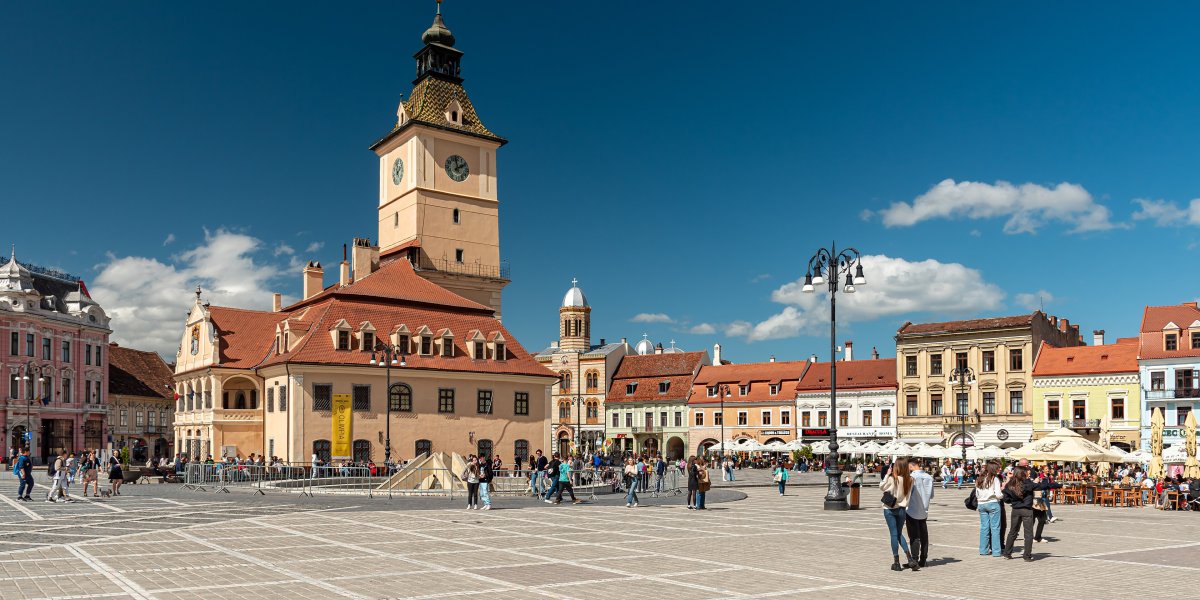
From the café, cut north through the narrow Strada Apollonia Hirscher — in 3 minutes you emerge onto the grand trapezoid of Council Square, the medieval heart of Saxon Brașov since the 15th century. The mustard-yellow Old Town Hall (Casa Sfatului) anchors the center with its baroque clock tower, while pastel merchant houses ring the square in every shade from coral to mint. Before leaving, duck 80 meters south of the square's southeast corner into Strada Sforii (Rope Street) — at 111 centimeters wide, it is one of the narrowest streets in Europe and a perfect 30-second photo detour.
Tip: The best photo of the full square is from the southeast corner, where you can frame the Town Hall tower against the mountain backdrop. For Rope Street, go now — by 15:00 every tourist group in town squeezes through for selfies. Shoot it vertically from one end with a person walking through for scale.
Open in Google Maps →14:30
Landmark
From the southwest corner of Council Square, walk down Strada Poarta Schei — this was the only road ethnic Romanians were permitted to use to enter the Saxon city. The gate reveals itself at the end of the street like a framed postcard after a 7-minute walk. Built in 1559 by the tailors' guild, its four slender corner turrets once symbolized the city's judicial authority. Beyond the gate lies the Schei neighborhood, the historically Romanian quarter — wander a block or two past the gate for a glimpse of a quieter, less touristy Brașov.
Tip: Stand about 15 meters back on Strada Poarta Schei for the classic centered vertical shot — afternoon light from the west illuminates the facade cleanly. Next to it, Schei Gate (Poarta Schei) is the newer 19th-century archway and not nearly as photogenic — don't confuse the two. Avoid the souvenir shops flanking the gate; the same fridge magnets are half-price on Strada Republicii.
Open in Google Maps →19:00
Food
Walk back north through the old town along Strada Republicii, Brașov's main pedestrian boulevard lined with cafés and evening buskers — a 10-minute stroll to Strada Mureșenilor. Sergiana is the definitive Transylvanian restaurant: a stone-walled cellar with folk-art décor where locals celebrate and travelers discover that Romanian cuisine is one of Europe's best-kept secrets. Order the sarmale (cabbage rolls braised for hours with pork and rice, served with sour cream and polenta, ~35 RON / €7) and the bulz ciobănesc (grilled polenta filled with melted sheep cheese, ~30 RON / €6) — a shepherd's mountain dish you won't find outside Transylvania. Budget: €15–22 with a local Ciucaș beer.
Tip: Reserve for 19:00 by phone or website — the cellar fills by 19:30 in season. Ask for 'sala de jos' (the lower vaulted room) for the best atmosphere. A warning for the area: avoid the restaurants on the north side of Council Square with laminated photo menus and door touts — they charge double for reheated food aimed at day-trippers. Brașov's real restaurants are tucked on side streets like this one.
Open in Google Maps →Aller au jour
09:00
Landmark
Begin your Brasov story from above. Take the cable car from the base station on Aleea Tiberiu Brediceanu — the four-minute ride lifts you 400 meters over the old town. At the summit, follow the paved path to the Hollywood-style BRASOV sign where the entire medieval city unfolds below: terracotta rooftops, Gothic spires, and the Carpathian ridgeline beyond. Morning light rakes across the old town from the east, painting every roof tile gold — this is the shot you came for.
Tip: The cable car runs Tuesday–Sunday from 09:30 (09:00 on weekends) and is closed Mondays — plan accordingly. Arrive 15 minutes early to board the first car and have the summit nearly to yourself. If you prefer to hike, the forest trail behind the base station takes 45 minutes through beech canopy with glimpses of ruined watchtowers the cable car crowd never sees.
Open in Google Maps →11:00
Religious
Ride the cable car down and walk north through the small park along Aleea Tiberiu Brediceanu, past fragments of the old city wall — 8 minutes until the enormous dark Gothic hulk of the Black Church rises above the rooftops. The largest Gothic church between Vienna and Istanbul, it earned its name from the soot stains left by the Great Fire of 1689. Inside, one of Europe's finest collections of Anatolian rugs hangs from the gallery railings — donated by Saxon merchants over centuries, an unexpected treasure you will not find in any other church on the continent.
Tip: Enter through the side door on Str. Gheorghe Barițiu — rarely a queue. The church's 4,000-pipe organ plays summer concerts; if your dates align, the Tuesday 18:00 recital is worth rearranging your evening for. The church is closed Sundays until midday for services. Stand in the center nave and look up — the vaulted ceiling soaring 20 meters above is the most dramatic angle.
Open in Google Maps →12:30
Food
Exit the Black Church from the main entrance and walk north up Str. Mureșenilor — a narrow cobblestone lane lined with pastel Baroque facades — just 3 minutes until you spot the stone archway entrance on your right. Sergiana is Brasov's definitive traditional Romanian kitchen, beloved by locals for over two decades: stone-vaulted cellar, wooden beams, and plates of food your Romanian grandmother would recognize.
Tip: Order the sarmale — cabbage rolls stuffed with pork and rice, served with sour cream and polenta (28 RON/€5.50), made from a family recipe that has not changed. The tocitură transilvăneană — Transylvanian pork stew with polenta, fried egg, and sheep cheese (38 RON/€7.50) — is the other essential. Budget €10–15 per person with a drink. Arrive before 12:30 to grab a table without waiting; the lunch rush peaks at 13:00.
Open in Google Maps →14:00
Landmark
Step out of Sergiana and walk 2 minutes north into the grand Council Square — Brasov's medieval heart, ringed by merchant houses in sherbet yellows and terracotta pinks, with the old Town Hall and its trumpet tower at the center. After soaking in the square, duck west into the side alleys to find Strada Sforii, one of the narrowest streets in Europe at just 1.3 meters wide, squeezed between two 17th-century buildings. Originally a firefighters' passage, it is now a charming 80-meter corridor that feels like slipping through a crack in time.
Tip: Stand at the south end of Council Square facing north for the classic photograph — the Town Hall tower centered between colorful facades with Tampa Mountain rising behind. For Rope Street, enter from the south side on Str. Poarta Schei; the light filters down between the walls best between 14:00 and 15:00. The street is easy to miss — look for the small blue sign at knee height.
Open in Google Maps →15:30
Landmark
From Council Square, stroll northwest along Strada Republicii — Brasov's elegant pedestrian boulevard lined with cafés and Austro-Hungarian facades — for about 8 minutes until the only original medieval gate still standing in Brasov appears ahead. Built in 1559 by the Saxon tailors' guild, Catherine's Gate has four small corner turrets that originally symbolized the city's right to capital punishment. The late-afternoon sun catches the red tile roof beautifully against the forested hillside behind it.
Tip: Walk through the gate and continue 50 meters to find Schei Gate (Poarta Schei, 1828) right beside it — looking back through both gates toward the old town, framed by medieval walls, is one of Brasov's most underrated photo compositions. The restaurants lining Str. Republicii between the square and the gate are mostly tourist traps with inflated prices and reheated food — if a menu board has laminated photos, keep walking.
Open in Google Maps →19:00
Food
Walk 5 minutes southeast from Catherine's Gate back toward Strada Republicii, then turn right into Piața George Enescu — a quiet, leafy square tucked one block west of the main boulevard. Bistro de l'Arte occupies a candlelit corner with a terrace overlooking the square, serving modern European cooking elevated by Transylvanian ingredients: wild mushrooms from the Carpathians, local cheeses, game in season.
Tip: Reserve a terrace table for sunset — the square glows amber as the streetlights come on. Order the duck leg confit with plum sauce (55 RON/€11) or the beef tenderloin with forest mushroom ragout (75 RON/€15). Their Romanian wine list is one of the city's best — ask for a Fetească Neagră from Dealu Mare, a Transylvanian red with the depth of a good Pinot Noir. Budget €20–30 per person with wine. Avoid the currency exchange booths near Str. Republicii — they advertise zero commission but bury the fee in a terrible rate; use an ATM instead.
Open in Google Maps →09:00
Landmark
From the old town, walk south along Str. După Ziduri toward the forested hillside — look for the stone steps carved into the slope behind the fortification walls. A 10-minute climb through oak and beech trees brings you to the White Tower, a 15th-century semicircular watchtower with commanding views over the old town's rooftops and the valley beyond. Continue along the ridgeline path for 5 minutes to reach the Black Tower, built in the same era but darkened by a lightning strike in 1559. Together they formed Brasov's early warning system against Ottoman raids — you can still feel the watchman's vantage.
Tip: Visit the White Tower first — its east-facing platform catches the morning sun and gives the clearest elevated view of Council Square's rooftops, rivaling Tampa with none of the crowds. Wear shoes with grip; the stone steps are slippery after rain. The ridge path connecting the two towers passes through forest with wildflowers in spring — one of the loveliest short walks in the city.
Open in Google Maps →10:30
Religious
Descend from the towers via the forest path, walk through Schei Gate, and continue south along Str. Prundului into Brasov's oldest Romanian neighborhood — the Schei quarter. In 10 minutes the ornate neo-Byzantine facade of St. Nicholas Church appears across Piața Unirii. First built in wood in 1292, rebuilt in stone in the 15th century, and given its grand facade in the 1800s, this church was the spiritual heart of the Romanian community forbidden to live inside the Saxon walls. The interior glows with painted icons, gold leaf, and frescoed ceilings.
Tip: Enter through the main doors and immediately look up — the ceiling fresco is the most impressive angle and most visitors walk right past it. The ancient cemetery surrounding the church has headstones dating back centuries, telling the story of Brasov's Romanian elite. Visit before 11:30; by noon, tour bus groups arrive and the intimate atmosphere evaporates.
Open in Google Maps →11:30
Museum
Step out of St. Nicholas Church and walk 30 seconds to the right — the museum entrance is in the modest stone building immediately adjacent to the churchyard. Inside this 16th-century schoolhouse you will find the first classroom where Romanian was taught from 1583, a replica of the printing press that produced the first Romanian-language book, and medieval manuscripts that shaped an entire national identity. The museum is small but quietly powerful — the kind of place that changes how you see the country you are traveling through.
Tip: Ask the attendant to demonstrate the printing press replica — they are usually happy to show how it worked. The oldest Romanian-language Bible on display (Biblia de la București, 1688) is in a glass case in the back room and easy to miss. The full visit takes 30–40 minutes; spend the remaining time in the quiet churchyard garden next door.
Open in Google Maps →12:30
Food
Walk north from Piața Unirii back through Schei Gate into the old town — a pleasant 10-minute stroll along Str. Poarta Schei past artisan workshops and residential courtyards with grapevines climbing the walls. La Ceaun sits just inside the old walls, a warm and unhurried spot where Transylvanian home cooking is prepared over open flame and served on rustic wooden boards.
Tip: The bulz — a ball of polenta stuffed with sheep cheese, grilled until crusty, and topped with sour cream (25 RON/€5) — is the quintessential Transylvanian shepherd's dish; order it without hesitation. The ciorbă de burtă (tripe soup, 22 RON/€4.50) rewards the adventurous — tangy, hearty, and nothing like what you imagine. Budget €10–15 per person. No reservation needed at lunch; grab a table near the window for a view of the old walls.
Open in Google Maps →14:00
Museum
From La Ceaun, walk east through the old town along Str. George Coșbuc — a quiet residential stretch where the tourist crowds thin out — for about 12 minutes until the massive stone bastion appears on your right, anchoring the southeast corner of the old walls. The Weavers' Bastion is the best-preserved of Brasov's original seven guild bastions, built in the 15th century and maintained by the wealthy weavers' guild. Three floors of exhibits trace Saxon guild life, medieval trade routes, and the city's role as a crossroads between Europe and the Ottoman East.
Tip: Climb to the rooftop terrace — most visitors stop at the second floor, but the panorama from above shows the full crescent of the old city walls and how the seven bastions connected into a defensive ring. The 1:100 scale model of medieval Brasov on the second floor is worth lingering over; it reveals just how compact and fortified the Saxon city really was.
Open in Google Maps →19:00
Food
Walk west from the Weavers' Bastion back through the old town — 10 minutes along quiet residential streets until Council Square opens up before you one last time, the Town Hall tower glowing in the evening light. Bella Muzica sits right on the square in a vaulted medieval cellar with exposed stone walls, wrought-iron chandeliers, and candlelit tables — the kind of farewell dinner setting this city deserves.
Tip: Sit on the upstairs terrace for a final view of the illuminated Council Square at night — the Town Hall and Black Church are both lit after dark. Start with mici (grilled minced meat rolls with mustard, 20 RON/€4) as a starter, then the chicken paprikash with homemade noodles (45 RON/€9) for your main. Budget €15–25 per person with wine. Avoid the Dracula-branded souvenir shops clustered near the square — they sell mass-produced imports at a 5x markup. For genuine Transylvanian crafts, visit the small artisan workshops on Str. Poarta Schei in the Schei quarter.
Open in Google Maps →
Trip builder
Plan this trip around Brasov
Turn this guide into a bookable rail itinerary with FlipEarth.
Keep exploring
Related cities
More in the same country
FAQ
Frequently asked questions
How many days do you need in Brasov?
Most travelers enjoy Brasov in 1 days, with enough time for headline sights and a slower meal or museum stop.
What's the best time to visit Brasov?
The easiest season for most travelers is May-Oct, especially if you want good weather and manageable crowds.
What's the daily budget for Brasov?
A practical starting point is about €50 per person per day before hotels, then adjust based on museums, dining, and transport.
What are the must-see attractions in Brasov?
A good first shortlist for Brasov includes Tampa Mountain & Brasov Sign, Council Square (Piața Sfatului), Catherine's Gate (Poarta Ecaterinei).