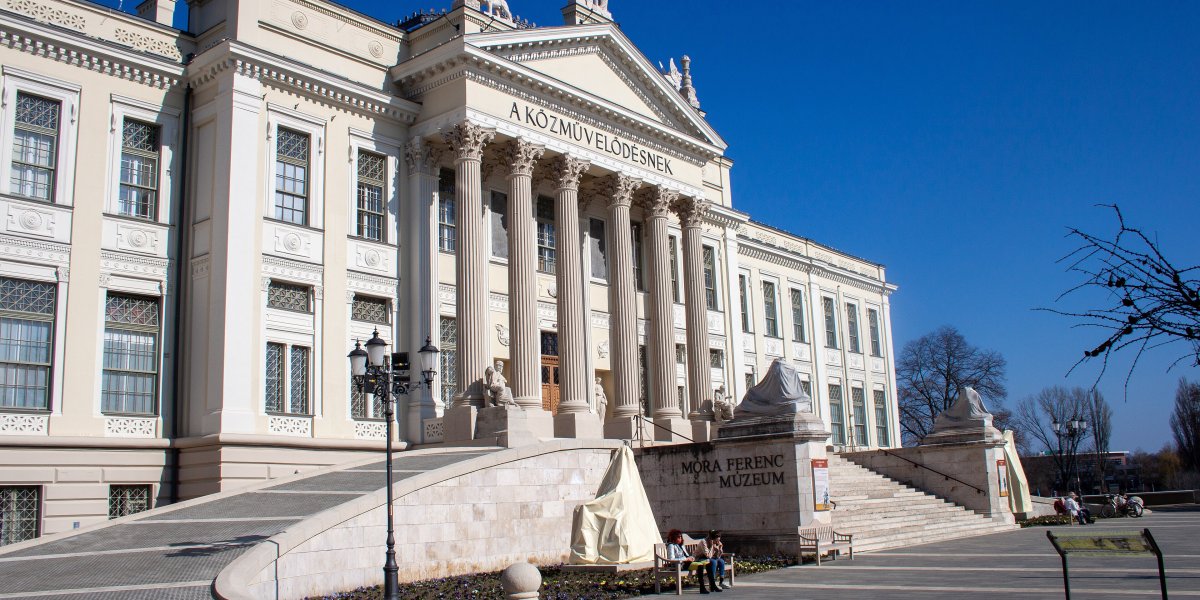
City Guide
Szeged
Hongrie · Best time to visit: Apr-Oct.
Day-by-day plan
Choose your pace
Durée du voyage
09:00
Religious
Begin in the quiet residential lanes off Hajnóczy utca — the synagogue's turquoise dome appears suddenly above the rooftops, catching the first low east light. Lipót Baumhorn's 1903 masterpiece is one of the largest Art Nouveau synagogues in the world and the building that made Hungarians call him 'the synagogue-architect of the empire': circle the perimeter clockwise to see all four facades, the 48 stained-glass rosettes ringing the rotunda, and the wrought-iron palms framing the front gate. Even with the doors shut, the exterior alone earns the early start.
Tip: Arrive at 09:00 sharp — the dome only reads true turquoise under direct east morning light and shifts grey-green by afternoon; the cleanest photo angle is from the southeast corner of the iron fence, where you frame the rose window beneath the dome without overhanging plane-tree branches.
Open in Google Maps →10:30
Landmark
Walk south on Hajnóczy utca and cross Tisza Lajos körút at the tram tracks — 8 minutes through Habsburg-era streets where every doorway still wears its original wrought-iron flourish. Reök Palace then appears like a tidal wave frozen in pale jade green: Ede Magyar's 1907 building is Szeged's purest Art Nouveau gesture, every detail organic — water-lily stems climbing the corner balcony, fish-scale tiles flowing across the gable, dragonfly handles on the inset doorway. Locals call it the Hungarian Casa Batlló and they are not exaggerating.
Tip: Stand across the boulevard at the tram stop opposite the entrance — that is the only vantage where you frame the entire wave-facade clean of overhead tram cables; the dragonfly door handle on the inset doorway is the detail no guidebook prints, lean in close to photograph it.
Open in Google Maps →12:00
Food
Walk east on Kölcsey utca through the pedestrian core, past the bronze Kossuth statue and the Klauzál tér cafés — 6 minutes. Boci Tejivó is a Communist-era 'milk bar' (tejivó) that somehow survived gentrification: laminate tables, plastic trays, hand-written menu on the wall, prices that haven't tracked inflation. Order túrós csusza (egg pasta with cottage cheese and pork cracklings, ~1,500 Ft / €4) and a glass of meggyleves (cold sour-cherry soup, ~800 Ft / €2) — this is what Hungarians actually eat for lunch.
Tip: Pay the cashier first and take your receipt to the food counter — every tejivó works this way and there is no English signage; order the túrós csusza (the dish Szeged taught the rest of Hungary), skip the dry rántott szelet, and arrive before 12:15 to beat the queue from the university campus one block away.
Open in Google Maps →13:30
Landmark
Walk five minutes east on Somogyi utca and the cathedral square opens like a cinemascope frame — 12,000 square metres of red-brick arcade with the twin 91-metre towers of the Votive Church (Fogadalmi templom) anchoring the south side. Built 1913-1930 as a vow after the 1879 flood, the church is Hungary's fourth-largest and the only major one in pure Romanesque-revival brick; the small 13th-century Demeter Tower beside it is literally the only structure on the square that survived the flood. Walk the entire National Pantheon arcade around the perimeter — 105 bronze busts of Hungarian luminaries — then stand center-square as the open-air festival stage frames the towers against open sky.
Tip: Position yourself at the northwest corner of the arcade around 14:45 — that is the precise hour the low afternoon sun lights the west facade in honey-red and the brickwork glows almost ember-orange; if you want the famous tower-pair photo with no people, the south arcade looking north gives a clean foreground because tourists cluster on the east side near the astronomical clock.
Open in Google Maps →16:30
Neighborhood
Walk south through the cathedral square's south arcade to Aradi vértanúk tere — 4 minutes — where the Heroes' Gate (Hősök kapuja) spans the boulevard with Béla Ohmann's two giant stone soldiers from 1936. Turn east on Boldogasszony sugárút to the Tisza embankment — 7 minutes — and pick up the Stefánia promenade as it curves north along the river: walk the full embankment past the bronze 1879 flood-marker (look up — the line is at chest-height on a normal-sized human), cross the iron Belvárosi híd to Újszeged for the postcard skyline view, then return across the same bridge as the light turns gold over the cathedral spires.
Tip: On the Újszeged side, walk 200 metres north to the small pier in Liget park — that is the single spot where you frame both bridges (Belvárosi híd and Bertalan híd) plus the twin cathedral towers in one shot, and at 18:30 in summer the sun sets directly behind them; time the return crossing for that exact light window.
Open in Google Maps →19:00
Food
Step off the Belvárosi bridge as its ironwork lights up over black water — Roosevelt tér opens on the right and the Halászcsárda's terrace faces the river. This fisherman's inn has fed Szeged its halászlé (the city's signature paprika-spiked Tisza carp soup) longer than most of the staff have worked here — order the soup served in a small cast-iron kettle over open flame (~4,500 Ft / €12), follow with sült harcsa túrós csuszával (fried catfish on cottage-cheese pasta, ~5,500 Ft / €14), and finish with somlói galuska, the rum-soaked sponge cake Hungary still claims as its national dessert (~1,800 Ft / €5). Budget €30-40 per person with a glass of Villányi Kékfrankos.
Tip: Reserve a Tisza-side terrace table 24 hours ahead through their phone or website — walk-ins at 19:00 in summer are turned away; eat the carp bones-in the way locals do (asking for it deboned is the universal tourist tell), and as a parting pitfall warning, never order halászlé from anywhere on the pedestrian Kárász utca where touts pull travelers in with English menus and 'authentic Szeged fish soup' boards — those are frozen-fillet operations at double the price, the real fish kitchens are only ever on the river.
Open in Google Maps →
Trip builder
Plan this trip around Szeged
Turn this guide into a bookable rail itinerary with FlipEarth.
Keep exploring
Related cities
More in the same country
FAQ
Frequently asked questions
How many days do you need in Szeged?
Most travelers enjoy Szeged in 1 days, with enough time for headline sights and a slower meal or museum stop.
What's the best time to visit Szeged?
The easiest season for most travelers is Apr-Oct, especially if you want good weather and manageable crowds.
What's the daily budget for Szeged?
A practical starting point is about €65 per person per day before hotels, then adjust based on museums, dining, and transport.
What are the must-see attractions in Szeged?
A good first shortlist for Szeged includes Reök Palace (Reök-palota), Dóm tér — Votive Church, Demeter Tower & National Pantheon.