City Guide
Sighisoara
Roumanie · Best time to visit: May-Sep.
Day-by-day plan
Choose your pace
Durée du voyage
09:00
Landmark
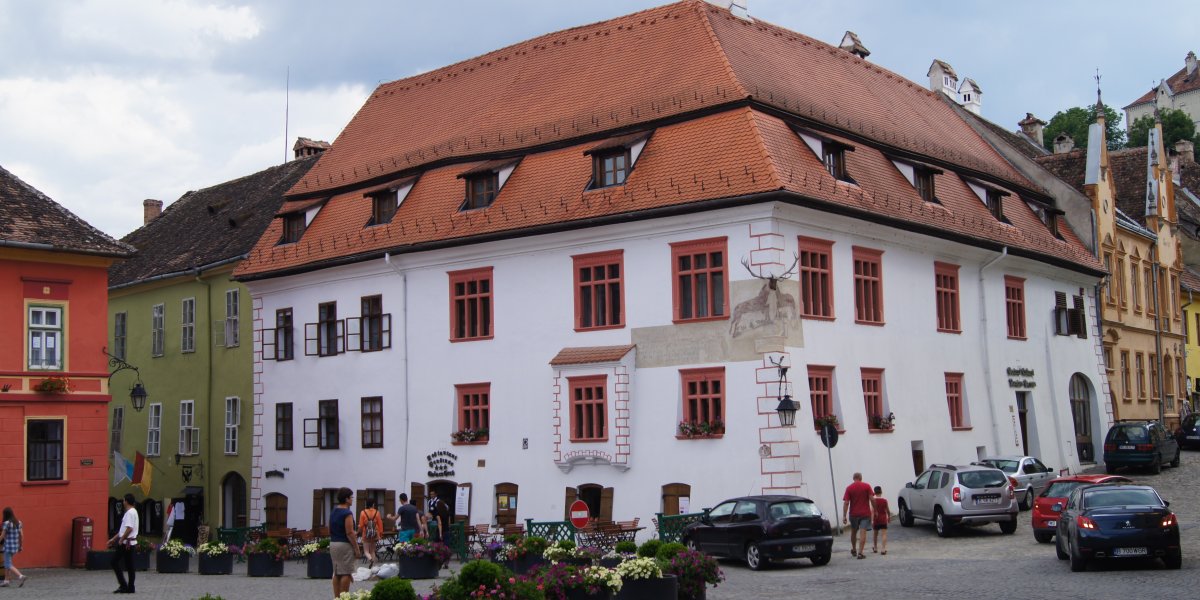
From the Lower Town gate, walk five minutes up the cobbled ramp and pass under the 64-meter Turnul cu Ceas — the painted wooden figurines on its face rotate on the hour, marking days and planets since 1648. Step out into Piata Cetatii, the small triangular square at the heart of the only continuously inhabited medieval citadel in Europe. At this hour the square belongs to bakery owners hauling crates and one or two old Saxons walking dogs; the tour buses from Brasov don't arrive until eleven. The eastern morning light hits the ochre, pistachio, and rose facades square-on — exactly the postcard frame.
Tip: Stand at the corner where Strada Cositorarilor enters the square: from here the Clock Tower spire, the painted merchant houses, and the citadel wall all stack into one shot. Skip the tower's interior museum — the climb is steep, the windows are tiny, and you'll get far better views from the Church on the Hill later.
Open in Google Maps →10:30
Neighborhood
Cross the square thirty seconds northeast — the ochre-yellow corner house with the wrought-iron dragon sign is where Vlad Tepes, the real Dracula, was born in 1431. Then drift through Strada Scolii, Strada Cositorarilor, and Piata Muzeului on foot; this cluster of pastel Saxon merchant houses, each with a guild symbol carved over its door, is the densest in Romania. Cats sun themselves on the cobbles, geraniums spill from every window, and you'll hear nothing but church bells and footsteps. This is the rare medieval town that didn't have to rebuild after the wars — what you walk through is genuinely 15th to 17th century stone.
Tip: Don't pay to enter the 'dungeon show' inside Casa Vlad Dracul — it's a recent invention with mannequins. The magic is the facade and the dragon sign. The best photograph is from the stone bench in Piata Muzeului looking back: you'll catch the yellow house, the dragon, and the Clock Tower spire rising behind in a single frame.
Open in Google Maps →12:00
Food
Two minutes south along Piata Cetatii to the corner cafe with the green awning. Run by a Belgian-Romanian couple, this is where local guides and expats actually eat — not the 'medieval feast' restaurants on the square that reheat goulash for coach groups. Order the ciorba de burta (sour tripe soup with garlic and cream, 22 RON / €4.50) and the langosi (Hungarian fried dough with sour cream and grated sheep cheese, 18 RON / €3.50). Quick service, outdoor tables facing the square, cash strongly preferred.
Tip: Order the homemade mint-and-elderflower lemonade — it's what every local table has. If tripe sounds intimidating, the ciorba radauteana (chicken sour soup) is the gentler cousin and just as authentic. Arrive by 12:00 sharp; the four outdoor tables fill by 12:30 in summer.
Open in Google Maps →13:00
Religious
Walk four minutes east from the cafe up Strada Scolii — a wooden roof appears between the trees. This is the Scara Acoperita, the 1642 covered staircase of 175 oak steps, built so children could climb to the citadel's hilltop school in winter blizzards. Inside the tunnel the light slices through slats in pale stripes; the air is cool and smells of old timber. At the top stands the 14th-century Biserica din Deal, the Gothic Church on the Hill, ringed by a Saxon cemetery whose gravestones have been weathering since the 1500s. Walk to the far end of the cemetery for the view that defines Sighisoara: the entire red-tiled citadel below, the Tarnava valley unrolling beyond.
Tip: Halfway up the staircase, turn around and shoot back down the tunnel — sunlight through the slats makes the better photograph than the entrance arch everyone queues for. In the cemetery, walk to the southwest corner near the broken stone cross: this is the only spot where the Clock Tower, the citadel walls, and the river all align in one frame.
Open in Google Maps →15:00
Landmark
Descend from the church along the southern wall path — you'll pass the Tinsmiths' Tower, the Tailors' Tower, and the Shoemakers' Tower in quick succession, three of the nine guild towers that remain from the original fourteen. Drop into the Lower Town, where Saxon craftsmen once lived outside the citadel, and follow the Tarnava Mare river east along its leafy bank. Cross the Podul Mare (Big Bridge), loop back west along the opposite shore, then climb Strada Morii back up to the citadel. Roughly 6 kilometers in total; the climb at the end is steeper than it looks. This long arc is the only way to see the citadel from the angle the medieval traveler saw it — stacked walls rising out of the river valley like a single fortified ship.
Tip: Time the loop so you're crossing Podul Mare around 17:30 — western light turns the citadel walls a deep amber and the river reflects every roofline. Almost nobody photographs from this bridge; it is Sighisoara's quietest postcard angle. Carry water — there are no shops along the lower riverbank.
Open in Google Maps →19:30
Food
Eight minutes back up Strada Scolii to Piata Cetatii — Casa cu Cerb, the Stag House, is the corner building with the enormous fresco of a stag's head painted across its facade in 1568. The dining rooms occupy the original vaulted patrician chambers, beams blackened by five centuries of fires. Order the bulz ciobanesc (shepherd's baked polenta with smoked telemea cheese and a fried egg, 48 RON / €10) and the mititei (grilled garlic-and-pepper minced-meat rolls, 42 RON / €8.50), with a glass of Feteasca Neagra from the Tarnave vineyards twenty kilometers north. The walk back to Piata Cetatii afterward, with the Clock Tower lit honey-gold against a dark sky, is the moment you will remember from this town.
Tip: Reserve a table in the upstairs vaulted room (call ahead or ask at the door before 19:00) — the window seats look directly onto the illuminated Clock Tower. Sighisoara's biggest tourist trap is the 'Dracula menu' offered on every square-front terrace: it's frozen platters at triple the price, trading on a name. Casa Vlad Dracul the restaurant — inside Vlad's actual birth house — falls into the same trap. Stick with Casa cu Cerb; the building is older and the kitchen is real.
Open in Google Maps →
Trip builder
Plan this trip around Sighisoara
Turn this guide into a bookable rail itinerary with FlipEarth.
Keep exploring
Related cities
More in the same country


FAQ
Frequently asked questions
How many days do you need in Sighisoara?
Most travelers enjoy Sighisoara in 1 days, with enough time for headline sights and a slower meal or museum stop.
What's the best time to visit Sighisoara?
The easiest season for most travelers is May-Sep, especially if you want good weather and manageable crowds.
What's the daily budget for Sighisoara?
A practical starting point is about €70 per person per day before hotels, then adjust based on museums, dining, and transport.
What are the must-see attractions in Sighisoara?
A good first shortlist for Sighisoara includes Clock Tower & Piata Cetatii, Saxon Defensive Walls & Lower Town Loop.