City Guide
Saaremaa
Estonie · Best time to visit: May-Sep.
Day-by-day plan
Choose your pace
Durée du voyage
09:00
Landmark
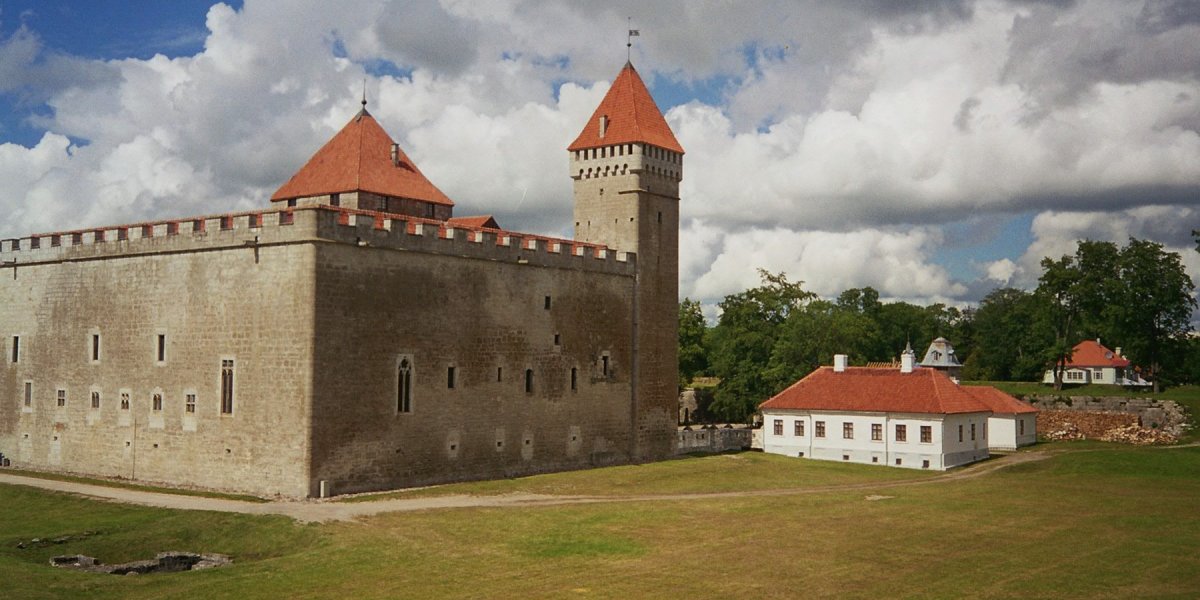
Estonia's only intact medieval castle rises from a star-shaped moat at the south edge of town — begin at the southwest bastion (Sturmschanze), where the 9 a.m. sun rakes across the pale dolomite walls and throws the keep's silhouette into the still water. Walk the full rampart loop clockwise, then drop into the moat-side meadow for the mirror shot every Estonian postcard imitates. Skip the museum interior — the walls and the moat are the soul of the place.
Tip: Enter the moat path through the small unmarked gate on the southwest corner — most tour groups go straight to the ticket gate on the north side and miss the reflection angle entirely. The keep mirrors cleanest in the moat between 9:15 and 9:45, before any breeze picks up.
Open in Google Maps →11:00
Park
Cross the wooden footbridge directly east of the castle and follow the seaside boardwalk for five minutes under the lindens of Spa Park. The buttercream-yellow Kursaal pavilion (1889) catches the late-morning sun head-on — this was the social hub of Russia's tsarist mud-cure aristocracy, and the public terrace is still where Kuressaare's older locals take their second coffee of the day. Continue along the curving seawall to Tori Bay for an unobstructed Baltic horizon.
Tip: The free benches behind the Kursaal (sea side, not park side) are the locals' spot — paid spa-hotel deck chairs in front cost €8 for the same view. Walk all the way to the Tori bay headland and look back: this is the only angle that frames the castle keep, the Kursaal, and the Baltic in a single shot.
Open in Google Maps →12:30
Food
Backtrack west three minutes through the chestnut alley along Lossi street — the leaping-frog sign appears just before the castle gate. Lonkav Konn ("Limping Frog") is where the castle staff and harbor fishermen actually eat; the smoked Saaremaa flounder on the plate landed in the bay that morning. Service is quick, the terrace faces the keep, and the kitchen never closes between meals.
Tip: Order the smoked flounder with juniper potatoes (€14) and a small glass of Saaremaa-brewed Pihtla beer (€4) — the unfiltered farmhouse style brewed only on this island. Sit on the upper terrace on the right; the lower one is in castle shade by 13:00 and gets cold even in July.
Open in Google Maps →13:30
Neighborhood
Head north from the pub up Lossi street — three minutes of pastel cottages and you arrive at Keskväljak, the cobbled central square. Loop it counterclockwise: the 1670 Town Hall (Raekoda) with two wooden lion sculptures flanking the door — the best-preserved Baroque civic sculpture in Estonia — then the squat Weighing House (Vaekoda) opposite, then drift south down Tallinna street past the painted merchant facades. Between 14:00 and 15:30 the eastern row glows gold while the western row sits in clean shade — the cleanest light of the day for facade photography.
Tip: The Raekoda lions are originals, not replicas — kept outside through 350 winters because dolomite-island weather treats them gently. The narrow alley Pikk käik between Lossi 9 and 11 is a shortcut locals use to reach the square; tourists invariably walk the long way around the block.
Open in Google Maps →15:30
Religious
From Keskväljak, cross north and turn right onto Põhja street — five minutes brings you to the five powder-blue onion domes of St. Nicholas (1907), startling on this stubbornly Lutheran island. The church was built for the families of the tsarist garrison; the late-afternoon sun lights the western wall and turns the domes against the sky around 16:30. Wander into the Sõle quarter directly behind it, where 19th-century timber-merchant cottages line streets so narrow two carts could not pass.
Tip: Stand at the southwest corner of the churchyard at 16:30 — the five domes line up perfectly against the open sky, no power lines in frame. Liiva tänav, two blocks east, is the narrowest surviving wooden lane in Saaremaa; the leaning blue cottage at #4 has stood at that exact angle since 1873.
Open in Google Maps →19:00
Food
From St. Nicholas, cut west across the linnapark — twelve minutes through the lime-tree avenue and a 19th-century wooden post-mill rises above Pärna street: this is Veski Trahter, where Kuressaare actually celebrates. The original mill machinery and millstones still hang above the dining floor; the upper gallery sits inside the cap of the mill itself. The kitchen does the island classics properly — wild game, smoked meats, and the homemade ales no mainland restaurant can source.
Tip: Reserve at least a day ahead and ask specifically for the upper gallery (ülakorrus) — only six tables, ringed by the mill's original gearing. Order the wild boar stew with juniper berries (€19) and finish with a glass of farm sahti (€5), the unfiltered farmhouse ale brewed legally only on Saaremaa. Pitfall warning: avoid any bar offering 'island moonshine' or 'saaremaa viin' along Tallinna street after dark — most is mainland vodka double-priced for tourists. Real sahti is served only at licensed farm taverns like Veski; if it isn't cloudy and slightly sweet, it isn't real.
Open in Google Maps →Aller au jour
09:30
Museum
From Kuressaare's main square, walk south down Lossi Street for eight minutes — the limestone castle reveals itself across the moat as you approach. Estonia's only fully intact medieval castle is a squat 14th-century bishop's fortress with vaulted halls, a chilly dungeon, and a defensive tower you can climb. The Saaremaa Museum inside leads you through Viking-era artefacts and the bishop's living quarters.
Tip: Doors open at 10:00 sharp — arrive at 09:30 to be first up the spiral tower stair before tour groups land around 11:00. Buy the €10 combo ticket (tower included); the stair is too narrow for two-way traffic and once a group enters, you wait 20 minutes for them to come down.
Open in Google Maps →11:45
Park
Exit the castle's south gate and circle clockwise along the grassed bastion star, moat on your right and the Baltic ahead. The castle sits inside a 17th-century star-shaped earthwork — a 1.2 km loop that gives you the only angle from which the full limestone silhouette frames against the sea. Swans nest in the moat year-round; locals jog the loop in the morning.
Tip: Walk the south ramparts last and look for the small wooden footbridge crossing the moat to a hidden grass islet — most visitors miss it, and it's the only spot where the castle's full reflection appears in calm water.
Open in Google Maps →13:00
Food
Leave the castle moat and walk four minutes up Lossi Street — Classic is the cream-coloured building at number 9, with the small terrace out front. A long-running Kuressaare lunch institution where office workers and town elders gather; the chanterelle soup (€7) in summer and the elk stew with juniper potatoes (€16) are the daily classics. Budget €15-22 per person, house rye bread included.
Tip: Ask for the daily lunch board, not the printed menu — the kitchen's best work is there and it sells out by 14:00. No reservation needed before 13:30; after that, expect a 15-minute wait for a table.
Open in Google Maps →15:00
Landmark
Continue up Lossi Street for six minutes — it widens into Raekoja plats, with the yellow Baroque town hall facing the square. Estonia's only Baroque town hall outside Tallinn, guarded by two stone lions; step inside the first-floor gallery (free) for changing local exhibits, then look up at the painted wooden ceiling. The Tuesday-Friday produce market fills the square until 15:00.
Tip: Skip the souvenir shops on the square — markups run 40% above town — and buy juniper-wood spoons and Saaremaa rye crackers from the elderly stallholder in the market's southeast corner before she packs up at 15:00.
Open in Google Maps →17:00
Neighborhood
From the square, walk south through the linden-lined Town Park for 10 minutes until the boardwalk picks up at the spa lawn. A 1.5 km wooden walkway threads the reed-fringed shoreline out to a small stone pier, with the castle ramparts visible from a low angle that no postcard uses. Swans nest in the shallows; local kids fish off the end of the pier on summer evenings.
Tip: Walk it from 17:30 onwards — the western sun gilds the castle towers from behind your shoulder, the single best photo angle of the whole town. Bring mosquito spray if it has rained in the past two days; the reed beds breed midges at dusk and locals never go without.
Open in Google Maps →19:30
Food
Walk back north through the park for 12 minutes, then turn left onto Pärna street — the old windmill stands at number 19. Dinner inside a working 19th-century windmill, three timber storeys with the original wooden cogs visible above your head; order the wild boar with juniper (€22) and a glass of Pihtla õlu (€5), finishing with kama mousse. Two courses and a drink run €35-45 per person.
Tip: Call ahead and book the upstairs round table by the millstone — the website's reservation form is unreliable. Pitfall: skip the touristy harbour-front restaurants along Sadama Street — most charge €30 for boiled potatoes and frozen fish that any honest place inland here serves fresh for €12.
Open in Google Maps →09:00
Landmark
Drive 25 minutes east from Kuressaare on Road 10 — the last 2 km is a pine forest lane signposted 'Kaali kraater'. A 110 m water-filled crater punched into Saaremaa by a meteor 3500 years ago, one of Europe's only impact lakes you can walk up to. The rim trail takes 25 minutes; the small on-site Külastuskeskus lays out the impact physics clearly.
Tip: Arrive at 09:00 — tour buses out of Kuressaare hit Kaali around 11:00, and morning steam off the lake surface is the spookiest atmosphere. Descend the south-rim footpath 5 m below the lip — the reflection there shows the bowl shape that the official 'viewing platform' completely flattens.
Open in Google Maps →10:45
Entertainment
Drive eight minutes south from Kaali on Road 76 — the beer farm is the converted timber barn signed off the village road. A small family brewery making Saaremaa koduõlu (home beer) by traditional wood-fired methods, with the rare sahti among the tasting flight of four (€10). The brewmaster usually pours himself and walks you through the juniper-water step in slightly broken English.
Tip: Ask for 'kadakaõlu' if today is a juniper-branch brew day — this beer is sold only at the farm gate, never in Tallinn shops or supermarkets. Bring cash; the card reader works only half the time and the brewer will just shrug if it fails.
Open in Google Maps →12:30
Food
Drive 35 minutes north on Road 80 — open Saaremaa meadow country opens up, then five windmills appear together on the low ridge ahead. The cafe at the base of the heritage hill serves rural Saaremaa home cooking: barley porridge with smoked pork (€9), Saaremaa salt herring with potatoes (€11), and the famous house kringel pastry. Budget €12-18 per person; wood-fired oven bread comes with every dish.
Tip: Eat before touring the windmills, not after — the cafe fills with tour bus groups from 13:30 and the kitchen runs out of pork by 14:00. No reservations taken; ask for the back-window table facing the mills, and arrive by 12:30 sharp.
Open in Google Maps →14:30
Landmark
Step out of the cafe and cross the gravel courtyard 80 m to the ridge — the five timber windmills line up against the open sky. Four are traditional Saaremaa trestle mills and one a Dutch-style smock mill, all from the late 1800s and the largest such collection in the Baltics. Climb the central mill to see the original wooden gears turn; a small smithy and granary round out the heritage site.
Tip: Walk an extra 200 m past the last windmill toward the sheep pasture — the lone fifth mill against open meadow, with no fence in frame, is the shot that beats the road-sign-cluttered standard view from the entrance. 14:30 westerly light catches the wooden sails head-on.
Open in Google Maps →17:00
Landmark
Drive 50 minutes west across north Saaremaa — pine forest opens at the coast and you'll see the gravel lot just inland of the cliff edge. A 21 m sheer limestone wall dropping straight into the Baltic, the tallest sea cliff in the Estonian islands, with a 1.5 km cliff-top trail along a low wooden railing. A small Iron Age sacrificial site is signed halfway along — locals still leave coins on the stone.
Tip: 17:00 is the right hour — the cliff faces west-northwest and afternoon side-light brings out the horizontal limestone layering that midday sun flattens completely. Drop down the unmarked path 30 m south of the main viewpoint to the rocky beach for an up-angle shot that doubles the apparent height.
Open in Google Maps →20:00
Food
Drive 1 hour 10 minutes back to Kuressaare through Kärla — pine forest most of the way, with deer often on the verges at dusk. Dinner at the 1889 Kuursaal, a wooden spa pavilion in Kuressaare park with painted gables and a wraparound veranda; the kitchen runs a tight Saaremaa menu — pike-perch with dill butter (€22), local lamb with juniper (€26), and a sea-buckthorn parfait locals come back for. Budget €40-55 per person.
Tip: Book the veranda table facing the lawn for a 20:00 seating — dusk over the park (sky still strong until 22:30 in June) is the room's entire point. Pitfall: tipping is not auto-added in Estonia and the card terminal does not pass tips to staff — round up 10% in cash and hand it directly to your server, otherwise it never reaches anyone.
Open in Google Maps →
Trip builder
Plan this trip around Saaremaa
Turn this guide into a bookable rail itinerary with FlipEarth.
Keep exploring
Related cities
More in the same country
FAQ
Frequently asked questions
How many days do you need in Saaremaa?
Most travelers enjoy Saaremaa in 1 days, with enough time for headline sights and a slower meal or museum stop.
What's the best time to visit Saaremaa?
The easiest season for most travelers is May-Sep, especially if you want good weather and manageable crowds.
What's the daily budget for Saaremaa?
A practical starting point is about €75 per person per day before hotels, then adjust based on museums, dining, and transport.
What are the must-see attractions in Saaremaa?
A good first shortlist for Saaremaa includes Kuressaare Episcopal Castle (exterior & ramparts).