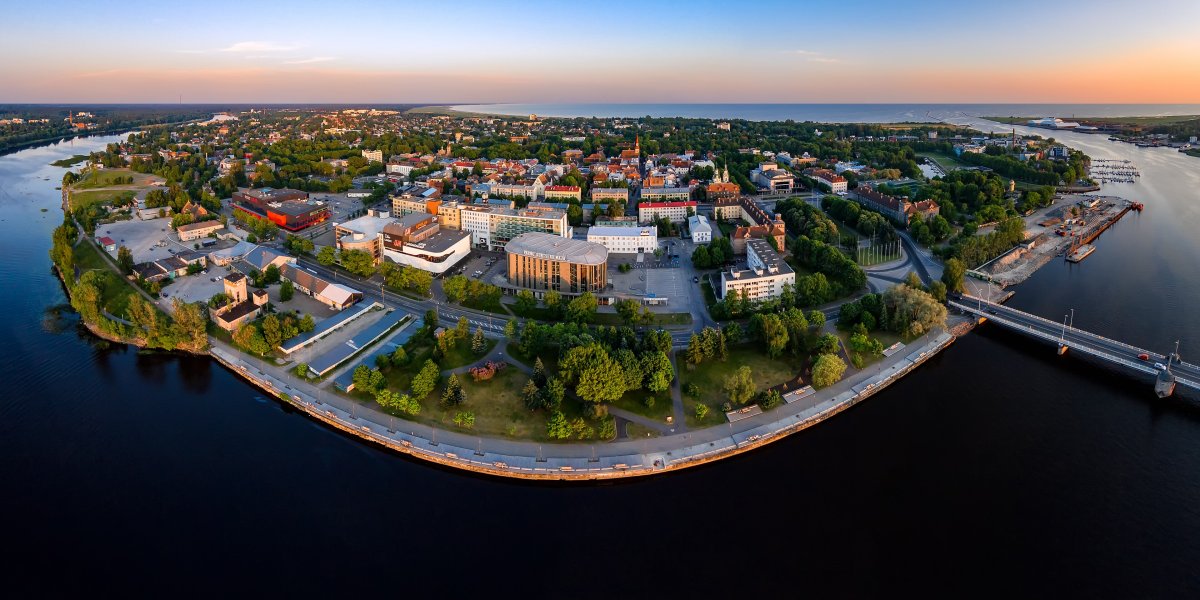
City Guide
Parnu
Estonie · Best time to visit: Jun-Aug.
Day-by-day plan
Choose your pace
Durée du voyage
09:00
Landmark
From the bus station, walk five minutes south down Aia Street until a long green earthwork rampart rises in front of you — the small white limestone tunnel cut through its center is your gate. This is the only surviving city gate from Pärnu's 17th-century Swedish-era fortifications, and the very last city gate left standing anywhere in the Baltic states. At 09:00 the eastern sun strikes the chalk-white facade straight on, giving you a shadow-clean shot a full hour before the first day-tripper coaches roll in from Tallinn.
Tip: Skip the obvious head-on photo everyone takes from Kuninga Street. Walk through the tunnel, turn around, and shoot back through the arch — the avenue of linden trees framing the white wall is the angle locals actually share. The lawn directly to the right of the gate is also where a 1944 Soviet bombing crater once stood — now grassed over, but a quiet moment to take in before the day really starts.
Open in Google Maps →09:45
Neighborhood
Walk straight south from the gate down Kuninga Street for two minutes and you'll spill onto Rüütli Street, Pärnu's pastel-painted pedestrian spine. Stroll its full 600 metres east, then loop one block north to the salmon-pink Baroque cube of St. Catherine's Church (1768) and the squat Red Tower on Hommiku Street — the oldest building in town and the last stub of the medieval wall. Mid-morning is when the cafés set out their wicker chairs and the low Baltic light still rakes softly across the painted clapboards; by noon it goes flat and the colors die.
Tip: The Red Tower (Punane Torn) is tucked inside a tiny courtyard off Hommiku Street and is genuinely easy to miss — there's no signage from Rüütli. Shoot it from the rear corner where the medieval red brickwork meets the modern white stucco extension; that exact contrast is the whole story of Pärnu's preservation philosophy in one frame.
Open in Google Maps →11:30
Food
Cut one block north from Rüütli onto Nikolai Street — Supelsaksad's pale-pink wooden cottage sits behind a low picket fence at number 32, with hand-painted lettering on the gable. Estonians have come here since 2006 for the cardamom kringel buns and the warm beetroot-and-goat-cheese salad (€11); add a smoked-trout open sandwich (€9) and a flat white and you've eaten the Pärnu summer-café experience in one tray. It's fast enough for a power-walk day and immeasurably more charming than anything you'll find on Rüütli.
Tip: The interior is tiny and books up by 11:45 in July. Walk through the side passage to the back garden — there are picnic tables under the apple trees that take walk-ins only. Order your cardamom kringel the moment you sit down; they bake them in batches and the 12:30 tray sells out by 13:00 sharp.
Open in Google Maps →12:45
Landmark
Return to Rüütli and bear southwest down Mere Puiestee for 15 minutes — you'll pass the Endla Theatre and the Concert Hall before the cream-yellow Art Nouveau silhouette of Ammende Villa rises behind its rose garden. Built in 1905 as a Pärnu merchant's wedding gift to his daughter, it's the single most theatrical building in Estonia outside Tallinn — twin turrets, wrought-iron balconies, hand-carved owls in the gables. Early afternoon backlights the southern turret cleanly against the sky, and the rose garden is at its strongest scent between 12:30 and 14:00.
Tip: You don't need to pay to enter — the garden gate is open to anyone and that's where every good photo is taken anyway. Stand at the southeast corner of the lawn around 13:00, sun just behind your right shoulder, and the tower throws a clean diagonal shadow straight across the cream facade. The hotel lobby will quietly let you use the toilet if you walk in confidently — last clean restroom before the beach.
Open in Google Maps →13:45
Park
Cross Mere Puiestee directly south from the villa and within four minutes the cream-and-white wedding-cake silhouette of the old Mud Bath Palace (now Hedon Spa, operating since 1838) appears — the heart of Pärnu's spa heritage and worth a full slow circle around the exterior. From there the dune-grass boardwalk drops onto the sand; walk the kilometre-long beach east until it narrows into the granite Pärnu Mole, a near-two-kilometre breakwater that runs straight out into the Gulf of Riga. The Baltic light between 16:00 and 19:00 turns the water a pale silver-blue that doesn't exist anywhere else in Europe — this is the single most photographed stretch of coast in Estonia for good reason.
Tip: Walk all the way to the small green lighthouse at the mole's end — about 25 minutes one-way over uneven granite blocks. Most day-trippers turn back at the lifebuoy halfway out, but the final stretch is where local fishermen set up and the 18:00 light is unreal. Bring a windbreaker even in July; the breeze on the breakwater drops the felt temperature by a full 8°C with no warning.
Open in Google Maps →19:30
Food
Walk back along the beach promenade — Lime Lounge sits one block inland on Mere Puiestee 22, a glass-fronted dining room with a quiet courtyard terrace facing the lindens. Order the pan-fried Baltic herring with new potatoes and lemon-dill butter (€18) and the slow-braised elk shoulder with juniper jus (€26); the wine list leans Baltic, Georgian, and natural-Estonian. The kitchen sources from Pärnu County farms and the herring is landed that morning at the local port — eating here is the closest a one-day visitor gets to actual Pärnu cooking.
Tip: Reserve from your phone before 18:00 the same evening and ask for a courtyard table — that's the side that catches the late linden-filtered light until 21:30 in midsummer. PITFALL WARNING: do not stop at any of the brightly painted beachfront restaurants further down Side Tänav with laminated English-and-Russian menus on sandwich boards — they're priced for cruise-coach overflow from Tallinn, the herring there comes pre-frozen from Latvia, and €15 cocktails are routine. Also ignore anyone offering 'taxi to Tallinn' in the beach parking lot; the legitimate Lux Express coach leaves from the central bus station for €11.
Open in Google Maps →Aller au jour
09:00
Landmark
Begin your morning at the eastern end of Kuninga street, where the moss-green earthen rampart rises before you and a small brick-vaulted tunnel opens through it. This is Pärnu's only surviving 17th-century town gate — spared by Swedes, Russians, and Soviet planners alike. Walk through twice: the eastern arch frames the old town in raking morning light, the western opens onto a quiet residential lane that locals still use as a shortcut.
Tip: Be inside the tunnel before 09:30 for the backlit silhouette shot facing east — the coach group from Tallinn rolls up like clockwork at 10:45 and you'll lose the empty frame. Touch the original 17th-century brickwork on the inner wall; it's the one stretch the restorers left untouched.
Open in Google Maps →10:00
Museum
Walk 4 minutes north along the rampart park to Hommiku street — the chubby red-plastered cylinder is jammed between two modern apartment blocks like an embarrassed relative at a wedding. This is Pärnu's oldest stone structure, a 15th-century Hanseatic defence tower that outlived every fire and siege thrown at it. Three tight floors of medieval weapons and a cellar of original arrow slits.
Tip: Photograph from the courtyard garden behind the tower, not from Hommiku street — the apartment blocks disappear from frame and you get the tower in isolation as it stood 500 years ago. The spiral stair is too narrow for two-way traffic; pause at each landing and listen for footsteps coming down before climbing.
Open in Google Maps →11:30
Religious
Turn left out of the tower onto Vee street and walk 4 minutes north through a row of pastel wooden cottages — the dome of pale-pistachio plaster and white Corinthian columns rises behind a small linden square. Empress Catherine the Great commissioned this 1768 Baroque-Orthodox church when she summered nearby, and it became the template for every Orthodox church in the Baltic. The gilt icon screen, blackened by two centuries of incense, is the most beautiful interior in Pärnu.
Tip: Enter through the side door on the left — the main entrance is for liturgy only and you'll be turned around. If you can stretch your morning to a Sunday at 09:30, the all-male choir sings in Russian for 20 minutes and the air thickens with frankincense; ten minutes inside is enough to feel it.
Open in Google Maps →12:45
Food
Exit the church south onto Nikolai street and walk 5 minutes — look for the cream-coloured wooden villa wrapped in a rose garden behind a low picket fence. A Pärnu institution set in a 19th-century summer residence: elderly locals book the same window seat every Saturday, and the kitchen still bakes at dawn. Order the herring on dark rye with dilled sour-cream potatoes (€9) and the rhubarb tart with vanilla cream (€5.50) — the tart vanishes by 14:30.
Tip: No lunch reservations are accepted — arrive at 12:35, walk straight through the dining room, and ask for the garden table beside the lilac bush. If the ground floor looks packed, the upstairs salon is almost always empty and serves the identical menu with a better view down the rose garden.
Open in Google Maps →14:45
Museum
Walk east along Aida street for 8 minutes — you'll pass the old Hanseatic warehouses now converted to galleries, finishing at a renovated 19th-century granary on the riverbank. Skip the prehistoric ground floor (worthy but slow); the upstairs Hanseatic trading hall and the 1920s-30s 'Summer Capital golden era' rooms — sepia photos of corseted ladies at the mud baths, original spa-brochure typography — are the rooms you came for.
Tip: The English audio guide is included in the ticket but the desk often forgets to hand it over — ask specifically. The free riverside café on the top floor (no museum ticket needed to enter from the side stair) has the only non-touristy Pärnu River view in town; ideal for a 10-minute reset before tackling the second floor.
Open in Google Maps →19:00
Food
Walk 9 minutes back along Aida and onto Rüütli, the pedestrian main street — the restaurant sits in a restored 1840s manor at the head of the boulevard, lanterns lit by 19:00 in summer. Estonia's farm-to-table movement made flesh: they butcher their own lamb from a farm 30 km south, and the smoked Baltic dorado with sea-buckthorn cream (€19) is the dish you'll still be thinking about on the flight home. Pair with a glass of Pihtla farmhouse ale from Saaremaa (€6).
Tip: Reserve a day ahead for an 8 pm slot and ask for the corner booth by the fireplace — it's the one table not visible from the street. Pitfall warning: avoid every 'Tourist Menu' restaurant on Hommiku street and around Tallinn Gate — they serve €25 microwaved herring plates aimed at coach tours from Tallinn. Real Estonian places never advertise their menu in English on the sidewalk.
Open in Google Maps →09:00
Landmark
Walk south down Supeluse, the linden-lined boulevard built for tsarist spa guests in 1900 — in 12 minutes the villa appears like a frosted cake at the boulevard's end. Estonia's grandest Jugendstil mansion, completed in 1905 for a merchant's daughter's wedding and now a hotel that keeps the ground-floor public rooms open to anyone who walks in with confidence. The green-velvet drawing room, mirrored ballroom, and library with original 1905 silk wallpaper are the three rooms to find.
Tip: Walk straight through the front door past reception — no one checks for non-guests in the morning. Order a single espresso at the bar (€3.50), settle into the green drawing room for 20 minutes, and watch the wisteria garden through the bay window. Morning light through the eastern stained glass between 09:15 and 09:45 is the photograph; by 10:30 the sun moves and the colour is gone.
Open in Google Maps →10:30
Park
Continue south on Supeluse for 5 more minutes; the dunes appear at street's end and you step onto 2 km of soft pale sand — the longest stretch in northern Europe. The seabed shelves so gently that you can walk 100 metres out and still be knee-deep, and in July the water climbs to 22°C — genuinely the warmest sea in the Baltic. Walk west along the wooden boardwalk toward the small white lighthouse for the iconic shot with the dunes in foreground.
Tip: Bring a swimsuit even in May or September — the water is honestly swimmable for a 10-minute Baltic dip and the experience is half the point. The blue-flag changing huts in the central section are free and clean; skip the row beside the spa hotel which charges €3 for the same service. Walk the boardwalk west, not east — the eastern stretch toward the river mouth is shallower but the dunes flatten out.
Open in Google Maps →12:30
Food
Walk 5 minutes north off the sand onto Mere puiestee — the enormous wooden pavilion painted in resort-yellow rises among the lindens of the beach park. Built in 1880 as the spa town's grand ballroom and still serving the same crowd, just with beer steins now. The kitchen is honest bistro food at fair prices: order the Estonian black bread soup with smoked pork (€8) and the elk meatballs with juniper-cream gravy (€14), and a half-litre of A. Le Coq Premium (€4.50) brewed 50 km away in Tartu.
Tip: Sit on the south veranda under the lindens rather than inside the cavernous ballroom — the sea breeze cuts the kitchen heat and you'll catch the brass band that plays Friday and Saturday from 13:00. The black bread soup sells out by 14:00 on weekends; order it the moment you sit.
Open in Google Maps →14:30
Entertainment
Walk 4 minutes west along Ranna puiestee to the white classical-revival building facing the sea — the original 1927 Pärnu Mud Baths, restored in 2014 and still pumping the same therapeutic Haapsalu seabed mud the Romanovs took the train down for. Buy the 2-hour 'Symphony of Saunas' pass: seven thematic saunas, a heated outdoor seawater pool facing the dunes, and the original tiled mud-bath halls where you can book a 20-minute single mud wrap.
Tip: Book the mud-wrap add-on (€18 on top of the pass) at the reception desk the moment you arrive — the historic original mud-bath halls take only six bookings per hour. The outdoor pool faces due west; if you time your float for 17:00 in summer you'll watch the light shift across the dunes from inside the heated water.
Open in Google Maps →17:00
Park
Exit the spa east onto Mere puiestee — the beach park unfolds across the street, 200 metres deep of mature lindens, oaks, and gravel paths laid out in 1882. Stroll the central allée past the 19th-century bandstand (still used for free Sunday concerts in summer) and the bronze bust of Lydia Koidula, Estonia's national poet, who summered here. The park is where the city's evening light is best — gold filtering through the linden canopy onto crushed-shell paths.
Tip: Find the small wooden tea pavilion (Tervisepaviljon) at the park's western edge — it sells local Estonian honey ice cream (€3.50) from a tiny window, and almost no tourists find it. The bench facing the bandstand to the south catches the last hour of sunlight through the trees; it's the spot every local couple knows.
Open in Google Maps →19:30
Food
Walk 5 minutes north through the park onto Mere puiestee — you return to the villa you peeked into this morning, this time entering as a paying guest. The dining room is the original 1905 ballroom: mirrored walls, restored crystal chandeliers, white linen, and a kitchen that takes Baltic ingredients seriously. Order the Saaremaa lamb saddle with chanterelle reduction (€32) and the cloudberry parfait with juniper meringue (€11); ask for the local Tori Sparkling Apple wine (€8 a glass) instead of imported Champagne — it's better and made 20 km from your table.
Tip: Reserve at least three days ahead and ask specifically for table 7 in the conservatory facing the garden — it's the table the villa's original owner used himself. Pitfall warning: ignore the touts on the beach in July offering 'sunset boat tours' from the river mouth — they charge €40 for a 25-minute loop, but a local sailor at the marina office (Lootsi 6) will do the same hour-long route for €15 if you ask in person the morning of.
Open in Google Maps →
Trip builder
Plan this trip around Parnu
Turn this guide into a bookable rail itinerary with FlipEarth.
Keep exploring
Related cities
More in the same country
FAQ
Frequently asked questions
How many days do you need in Parnu?
Most travelers enjoy Parnu in 1 days, with enough time for headline sights and a slower meal or museum stop.
What's the best time to visit Parnu?
The easiest season for most travelers is Jun-Aug, especially if you want good weather and manageable crowds.
What's the daily budget for Parnu?
A practical starting point is about €120 per person per day before hotels, then adjust based on museums, dining, and transport.
What are the must-see attractions in Parnu?
A good first shortlist for Parnu includes Tallinn Gate (Tallinna Värav), Ammende Villa.