City Guide
Polignano a Mare
Italie · Best time to visit: May-Sep.
Day-by-day plan
Choose your pace
Durée du voyage
09:00
Landmark
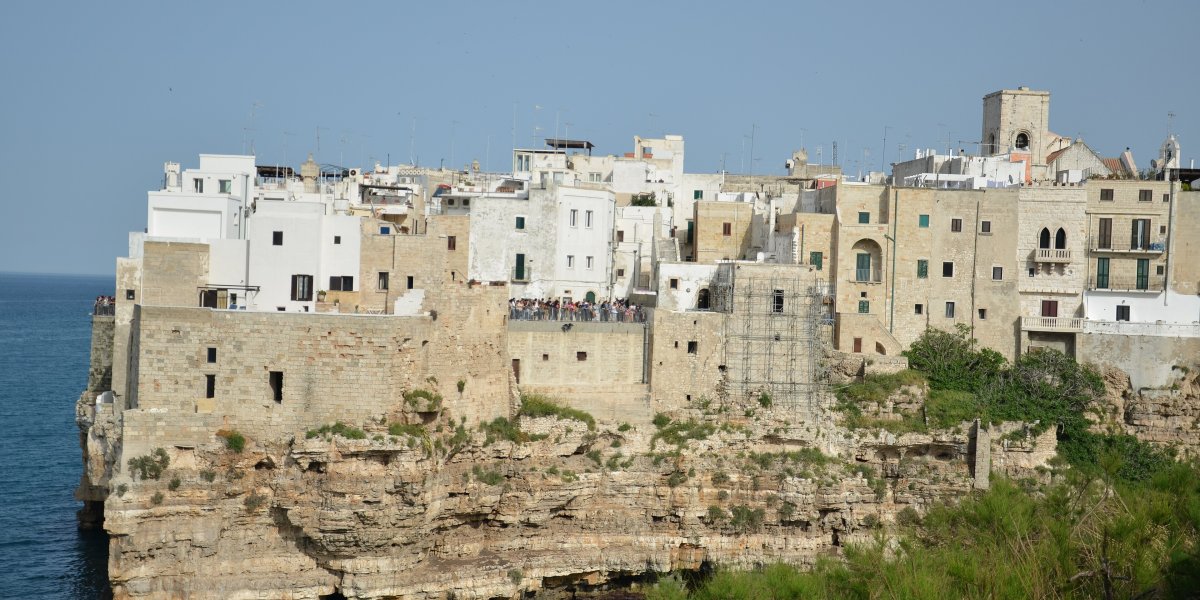
From Polignano a Mare train station, walk south down Via Roma for 8 minutes — the road dips, then the limestone ravine cracks open under your feet and stops you mid-step. At 9 AM the morning sun rakes the whitewashed houses on the far cliff and the buses from Bari haven't yet unloaded, so the eastern parapet — the postcard angle — is yours alone. This is the single photo every traveler comes for: the cove of Lama Monachile wedged between two cliffs, the cobalt water flooding in below.
Tip: Stand at the eastern parapet, third lamppost from the cliff side — frame the beach with both cliff walls visible and the white town stacked above. By 10:45 the day-trippers from Bari fill every inch of railing; come back at 9 PM and the cliffs are theatrically uplit, a totally different shot.
Open in Google Maps →10:00
Landmark
Cross the bridge and take the worn limestone steps down on the right — a 4-minute descent into the ravine where the old Roman road, the Via Traiana, once met the sea. The pebbles are still cool at this hour and only a handful of locals are swimming; by noon you'll fight for a square meter. Wade in: the water is so clear you can see your toes against the white stones, and looking up the cliff walls fold around you like an amphitheatre.
Tip: Wear sandals you can swim in — the beach is round pebbles, not sand, and barefoot entry hurts. Calmest water is before 11 AM, before the afternoon meltemi-style breeze kicks in. Skip the right-side lounger concession (€20/day for two chairs); the free public stretch on the left is identical sea.
Open in Google Maps →12:00
Food
Climb back up the steps and walk one minute west to Piazza Aldo Moro — Pescaria is the white-fronted shop with the line already forming. This is Puglia's most famous fish panino; the founders went viral on national TV, and by 13:00 the queue is half a block. Order the Tonno e Cipolla (seared tuna with stewed red onion on warm focaccia, €11) or the Polpo Arrosto (slow-roasted octopus with smoked stracciatella, €13), grab a glass of cold Negroamaro for €5, and eat it on the low sea wall two doors down — that's where the locals go.
Tip: Pay at the cassa first (paper ticket), then queue at the counter — newcomers waste 10 minutes in the wrong line. Arrive by 12:15 sharp; at 12:45 the wait stretches to 30 minutes. The indoor tables are cramped and noisy — take your panino to the sea wall facing Lama Monachile and eat with the view that costs €250 at Grotta Palazzese.
Open in Google Maps →13:30
Neighborhood
Walk 5 minutes south along the cliff road — Arco Marchesale rises ahead, the only surviving medieval gateway, with its small Madonna fresco watching over you as you pass through. Step inside and the white labyrinth begins: blue-painted doorways, geraniums in olive-oil tins, sudden gaps in the alleys that frame the sea like paintings. Drift south through Via San Benedetto to Piazza dell'Orologio for the 16th-century clock tower, then onward to the terrazze that hang directly over the cliffs — Terrazza Santo Stefano and Pietra Piatta.
Tip: The most photogenic alley is Via San Benedetto, second left after the arch — a tunnel of whitewash with a perfectly framed sea view at the end. Many side lanes dead-end onto cliff terraces with no railings; that's the feature, not a wrong turn. Look for the painted poetry on the stairs and walls — verses by local poet Guido il Flâneur cover half the old town.
Open in Google Maps →16:00
Landmark
Exit the old town south through Vico Castello and you'll spot him on the new promenade — Domenico Modugno cast in bronze with arms flung wide, the exact pose from the 1958 chorus of 'Volare,' which he wrote about flying over this very coast. Continue south along Lungomare Domenico Modugno for 6 minutes to Pietra Piatta, the flat limestone shelf where locals come for aperitivo as the day cools. The cliffs face east, so the sun sets behind you over the land — but the low golden light bouncing off the white facades turns the whole town the color of warm honey.
Tip: For the iconic Volare shot, stand 4 meters back and shoot upward so the bronze arms break the horizon line — most tourists shoot too close and miss the sea behind. Pietra Piatta has no rails and the rock is genuinely flat; you can lie on it and read until dinner. Sit on the southern edge for the full panorama back over the cove.
Open in Google Maps →19:30
Food
Walk back into the old town through Vico Castello for 6 minutes — Antiche Mura sits on Via Roma in a 17th-century house with a vaulted stone ceiling and one small outdoor terrace tucked into a quiet alley. This is where Polignano locals bring their visiting parents; the food is honestly better than the famous cave restaurant down the cliff at a third of the price. Order the orecchiette al sugo di polpo (handmade pasta with octopus ragù, €17) and the crudo di pesce misto (raw seafood platter, €24 for two), open a bottle of Salice Salentino for €22, and finish with a pasticciotto and a shot of cold limoncello on the house.
Tip: Reserve 24 hours ahead in summer — there are only six terrace tables and they all turn over once. The pitfall here is Grotta Palazzese, the cave restaurant 200 meters down the cliff: €250+ per head for forgettable food, you are paying purely to sit in the cave. Walk past, take the photo from the public viewing platform on Via Narciso, then eat real Pugliese cooking up here. Also avoid the touts in Piazza Aldo Moro flogging 'sunset boat tours' for €80 — the same trip is €25 if you book directly at the harbor kiosk.
Open in Google Maps →
Trip builder
Plan this trip around Polignano a Mare
Turn this guide into a bookable rail itinerary with FlipEarth.
Keep exploring
Related cities
More in the same country
FAQ
Frequently asked questions
How many days do you need in Polignano a Mare?
Most travelers enjoy Polignano a Mare in 1 days, with enough time for headline sights and a slower meal or museum stop.
What's the best time to visit Polignano a Mare?
The easiest season for most travelers is May-Sep, especially if you want good weather and manageable crowds.
What's the daily budget for Polignano a Mare?
A practical starting point is about €110 per person per day before hotels, then adjust based on museums, dining, and transport.
What are the must-see attractions in Polignano a Mare?
A good first shortlist for Polignano a Mare includes Ponte Borbonico (Lama Monachile Bridge Viewpoint), Lama Monachile Beach, Statua di Domenico Modugno & Pietra Piatta Cliff Walk.