City Guide
Pécs
Hongrie · Best time to visit: Apr-Oct.
Day-by-day plan
Choose your pace
Durée du voyage
09:00
Religious
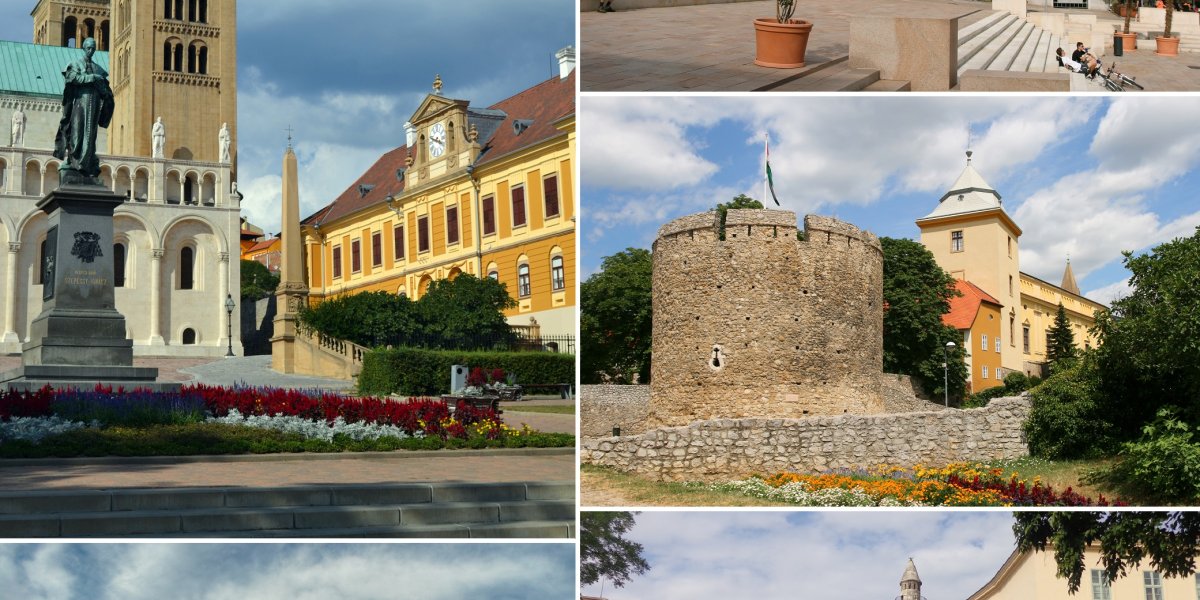
Begin at Dóm tér, where the four neo-Romanesque spires of the basilica catch low side-light from the east — the only hour all four towers photograph cleanly against a pale sky, and the square is empty before tour groups land around 10:00. Circle the apse to the rear gardens to see Roman foundations exposed at ground level; a church has stood on this exact spot since the 4th century. No interior visit needed — the silhouette and the rose-pink stone are the story.
Tip: Best photo: stand at the western edge of Dóm tér looking northeast — all four spires fit in one frame with morning side-light warming the rose-pink stone. The interior doesn't open until 10:00 anyway, so exterior-only timing is forced and ideal.
Open in Google Maps →10:30
Landmark
From the cathedral's south side, cross Dóm tér through the rose garden — the Cella Septichora visitor center sits 2 minutes south, marked by the white UNESCO plaque at the door. Stay outside: a glass-floored pavilion at the western end lets you peer straight down into the 4th-century painted burial chambers without paying for the full underground tour. The Christogram frescoes beneath your feet are among the most important Late Roman finds north of the Alps.
Tip: Skip the 90-minute underground tour you don't have time for — the free glass-floored viewing pavilion at the western end shows the painted chambers for nothing. Walk the open-air courtyard too: stone sarcophagi and a 4th-century mausoleum wall sit exposed under morning light.
Open in Google Maps →12:30
Food
Walk south down Janus Pannonius utca, then left onto Király utca — 8 minutes through Pécs's main pedestrian artery, past pastel facades and gelato windows the locals queue at. Korhely Faloda is the canteen-style faloda that the office crowd actually eats at, not a tourist spot; order csülök pékné módra (roasted pork knuckle with potatoes, ~9 EUR) or chicken paprikás with nokedli dumplings (~7 EUR). Plates arrive in under 10 minutes — exactly the rhythm a layover day needs.
Tip: Arrive before 12:30 — by 13:00 the lunch shift fills the place and tables get scarce. Order the csülök if you've never had Hungarian pork knuckle; it's the dish Pécs grandmothers grew up on. Cash clears faster than card here.
Open in Google Maps →13:30
Religious
Step out of the restaurant and walk west along Király utca — the green-tiled dome of Pasha Qasim's mosque rises directly at the end of the street, 3 minutes away. Built around 1580 over a destroyed Catholic church and reconverted to Catholic use in 1702, it is the largest surviving Ottoman building in Hungary; the Mecca-facing mihrab is preserved on the south wall right beside the modern altar. Then walk Széchenyi tér end to end — the sloping square is the social heart of southern Hungary, framed by the Trinity column and the Hunyadi equestrian statue.
Tip: Pay the ~4 EUR entry just to step inside — seeing the Ottoman mihrab and Catholic altar on the same wall is a layered history you won't find anywhere else in Europe. Photograph the dome from the southeast corner of the square with the Hunyadi statue in the foreground; closed to tourists during Mass (typically 11:00 Sunday and weekday 18:00).
Open in Google Maps →15:30
Neighborhood
Head back east on Király utca past your lunch spot, then continue onto Felsőmalom utca and Zsolnay Vilmos út — 18 minutes total, passing the Pécs Synagogue on your right and crossing the old industrial belt. The late-afternoon sun is the entire reason to come now: the iridescent eosin-glazed roof tiles for which Zsolnay is famous worldwide turn metallic gold-green between 16:00 and 17:30. Wander the manufactory courtyards, photograph the porcelain-tile fountain, and watch a ceramicist at the wheel through the open workshop windows.
Tip: Don't buy museum tickets — the most photogenic spots are all free outdoors: the porcelain-tile fountain on the central square, the eosin-glazed roof tiles of the M28 workshop building, and the brick manufactory chimney. The eosin glaze 'turns on' only with low-angle sun — show up by 16:30 or you'll miss the metallic green-gold shift that makes the place famous.
Open in Google Maps →19:30
Food
Walk west out of the Zsolnay Quarter, retracing Felsőmalom and Király utca for about 20 minutes — the pedestrian street is now lit by warm lamps, buskers are out, and it feels like a completely different city from the afternoon. Cellárium occupies a tunnel-vaulted 18th-century wine cellar one block off Széchenyi tér, with stone arches and candles on every table. Order the gulyás served in a hollowed-out bread loaf (~14 EUR) with a glass of Villányi Cabernet Franc from a winery 30 km south — the wine region that beats Tokaj at red.
Tip: Reserve from your phone before leaving Zsolnay — walk-ins after 20:00 wait 30+ minutes for a cellar table. Order the gulyás in the bread bowl, not the schnitzel, and ask for Villányi Cabernet Franc by the glass. Pitfall: avoid the restaurants directly on Széchenyi tér that wave laminated English-only menu boards at the door — they charge double for half the quality, targeting tour buses; locals never eat there.
Open in Google Maps →Aller au jour
09:00
Religious
Begin the morning at the top of Dom ter, where the four neo-Romanesque towers rise against a soft southern Hungarian sky before any tour bus has arrived. Right at the 9:00 opening you'll have the nave to yourself, with the eastern stained glass catching the first low light. Step down into the 11th-century crypt under the apse — the original Arpad-era foundations are still there, holding up everything above.
Tip: The combined ticket with the Bishop's Palace lapidary is only 800 HUF more and lets you climb the south tower for a rooftop view of the Mecsek hills — most visitors skip it because the entrance is a side door to the right of the main altar.
Open in Google Maps →10:45
Museum
Exit the cathedral, walk south across Dom ter for 90 seconds — the glass-roofed Cella Septichora pavilion is the modern structure sunk into the lawn. Arriving at 10:45 means the chambers have just opened at 10:00 but the first tour groups haven't filtered down yet, so you'll stand under 4th-century burial vaults in near-silence. The Peter and Paul Burial Chamber's frescoes — a Christogram, a peacock, biblical scenes — are the only Roman painted tombs of this scale surviving north of the Alps.
Tip: Go down to the Wine Pitcher Burial Chamber last — it's a 30-meter detour off the main loop and almost everyone misses it; the painted vessel on its north wall is the symbol the whole UNESCO inscription is built around.
Open in Google Maps →12:45
Food
From the Cella Septichora exit, walk three minutes downhill along Janus Pannonius utca to Hunyadi Janos utca — the entrance is a low stone arch leading into an 18th-century vaulted cellar. This is where Pecs lawyers and university faculty actually eat lunch; the goulash (gulyas) here is the Mecseki version with smoked sausage, and the marha porkolt with nokedli is the dish to order if you've only had one Hungarian meal in your life. Budget around 7,000-9,000 HUF for a main, drink, and small dessert.
Tip: Sit in the deepest cellar room on the left, not the front section near the door — it's three degrees cooler in summer, and the bread basket gets refilled faster because the waiters loop through that side first.
Open in Google Maps →14:30
Religious
Walk south on Hunyadi utca for six minutes — the green copper dome of the mosque appears above the rooftops long before you reach Szechenyi ter, the heart of Pecs. Built in 1579 over a demolished Gothic church and now serving as a Catholic parish (Belvarosi templom), it is the largest standing Ottoman structure in Hungary. Afternoon is the right hour: the western light pours through the windows onto the mihrab, the only original Ottoman prayer niche still visible on the right wall.
Tip: Most visitors face the Catholic altar and never turn around — but the Arabic inscriptions and the mihrab are behind you, on the southeast wall; the 600 HUF leaflet at the entrance has the only translation you'll find anywhere.
Open in Google Maps →16:15
Religious
Cross Szechenyi ter and walk four minutes east on Kossuth Lajos utca to Kossuth ter — the synagogue's ochre Romantic facade fills the south side of the square. Built in 1869 for what was then one of Hungary's largest Jewish communities, it survived the war partly intact and still holds occasional services. Late afternoon sun comes through the rose window above the ark and lights the gold-blue ceiling — climb the spiral stair to the women's gallery for the photograph everyone else gets wrong from the floor.
Tip: Closes 17:00 sharp and the ticket desk stops selling at 16:30 — if it's already 16:35 when you arrive, knock on the side office door rather than waiting at the closed counter; the caretaker often still lets you in if you're alone.
Open in Google Maps →19:30
Food
From Kossuth ter walk back west through Kiraly utca for seven minutes — the pedestrian street is now strung with lights and busking violinists — then turn right at Tereza utca; Aranykacsa is the white-shuttered building with the duck silhouette over the door. This has been the Pecs special-occasion restaurant for three decades, and the kacsa meggyszosszal (duck breast with sour cherry sauce, 6,900 HUF) and the Mecseki vadragu (Mecsek venison stew, 7,800 HUF) are why it stays full. Reserve a day ahead through their website — walk-ins after 19:00 get the back room without windows.
Tip: Pitfall warning — do not eat dinner at any of the patio restaurants directly on Szechenyi ter with English photo menus and waiters waving from the door; they charge double, the goulash is from a tureen kept warm since lunch, and locals call them 'turistakelepce' (tourist traps) for a reason. Aranykacsa is six minutes away and a different universe.
Open in Google Maps →09:30
Neighborhood
Begin at Szechenyi ter and walk east along Kiraly utca for 20 minutes — pause at the eosin-glazed Zsolnay fountain at the eastern end of the pedestrian zone, the iridescent green-gold piece you'll have seen on every Pecs postcard. Continue under the original 1853 factory archway into the Quarter, 86,000 square meters of restored kilns, courtyards, and the family villas of the Zsolnay dynasty. The morning is the right time: the brick chimneys throw long shadows across the cobbles and the place is yours before the school groups arrive at 11.
Tip: Buy the combined Quarter ticket (Bonbon-Card, 4,500 HUF) at the visitor centre by the main gate — it covers the Pink Zsolnay, the Gyugyi Collection, and the Mausoleum, and saves about 2,000 HUF over paying separately.
Open in Google Maps →11:00
Museum
From the Quarter's main square walk three minutes past the chimney monument to Building E2, the cream-coloured former Sikorski villa with arched windows. Laszlo Gyugyi's private collection — 600 of the rarest Zsolnay pieces, the eosin-glazed vases that won gold at the 1900 Paris Exposition Universelle — is the museum that finally makes you understand why Pecs is a porcelain city, not just a city with a porcelain factory. The Art Nouveau pieces on the upper floor are where most visitors stop breathing.
Tip: Go straight to the back room on the second floor first — the experimental eosin pieces from 1893-1905 are the highlight of the collection, and the natural light from the western windows hits them best between 11:30 and 12:30.
Open in Google Maps →13:15
Food
Exit the Quarter west and walk 15 minutes back along Zsolnay Vilmos utca and Kiraly utca — by now the pedestrian street is in full lunch rhythm, with paprika smoke drifting from the open kitchens. Jokai Bisztro on the small Jokai ter is the Pecs locals' weekday lunch spot, a tiled brasserie where the halaszle (Baja-style fisherman's soup, 2,400 HUF) and the toltott kaposzta (stuffed cabbage with smoked pork, 3,200 HUF) are the order. Lunch menu of the day (napi menu) runs 2,900 HUF for soup and a main — the only way under 3,000 forints to eat this well in Pecs.
Tip: The napi menu chalkboard is in Hungarian only and rotates daily — point at it and ask 'mai menu' (today's menu); the kitchen plates it within five minutes because it's pre-portioned, so you'll be out by 14:15 even on a busy Saturday.
Open in Google Maps →15:00
Museum
Walk west along Kiraly utca to its end at Szechenyi ter, turn right uphill onto Janus Pannonius utca — six minutes; the cream-yellow corner building with the small black plaque is the museum. Tivadar Csontvary Kosztka is the painter Picasso said he 'knew nothing of until I saw him' — and most of his major canvases, including the 7-meter-wide 'Baalbek' and the haunting 'Pilgrimage to the Cedars of Lebanon,' live in these four rooms. Afternoon light through the skylights is what the curators designed the hanging around.
Tip: Start in Room 4 (the back room) and work backward — the curator's intended sequence ends with 'Baalbek,' but Room 4's smaller Sicilian landscapes are what give 'Baalbek' its emotional weight; visitors who enter front-to-back miss the build-up entirely.
Open in Google Maps →17:00
Park
Exit the museum and walk north up Kaptalan utca — the cobbled lane curves uphill past hidden gardens into Tettye for 12 minutes; the cathedral falls behind you and the Mecsek hills open ahead. The 16th-century Renaissance ruin in the park was Bishop Gyorgy Szatmari's summer pleasure palace, later used by Ottoman dervishes; the stone arches frame Pecs's rooftops perfectly. Late afternoon is the right hour: the sun drops behind the hills to the west and lights the city below in warm orange — locals come up here at this time, sit on the grass, and let the day end.
Tip: Walk 100 meters past the ruins to the small lookout terrace on the eastern edge of Tettye ter — the panorama there frames the cathedral towers, Szechenyi ter, and the Mecsek tv tower in a single shot; the ruins themselves photograph better from the south side at this hour, with the sun behind the arches.
Open in Google Maps →19:30
Food
Walk back downhill via Tettye ut and Hunyadi utca for 12 minutes through the quieting old town — you'll cross under the cathedral's floodlit towers — to Irgalmasok utcaja just south of Szechenyi ter. Afium is the quiet locals' favourite for a final Hungarian dinner: vaulted rooms, candlelight, and a kitchen that still cures its own szalonna. Order the kacsamaj rosti (duck liver on potato rosti, 4,800 HUF) as a starter and the borjupaprikas (veal paprika stew, 6,500 HUF) as the main — and finish with a glass of Villany cabernet franc, the wine from the village 30 km south that locals are proudest of.
Tip: Pitfall warning — the 'Zsolnay souvenir' shops along Kiraly utca sell mostly factory-second pieces and Czech-made imitations; if you want a real piece to take home, the only place is the official Zsolnay Manufactura shop inside the Quarter (the one with the certification stamp on every box) — keep the receipt, customs in some EU countries spot-check antiques over 50 EUR.
Open in Google Maps →
Trip builder
Plan this trip around Pécs
Turn this guide into a bookable rail itinerary with FlipEarth.
Keep exploring
Related cities
More in the same country
FAQ
Frequently asked questions
How many days do you need in Pécs?
Most travelers enjoy Pécs in 1 days, with enough time for headline sights and a slower meal or museum stop.
What's the best time to visit Pécs?
The easiest season for most travelers is Apr-Oct, especially if you want good weather and manageable crowds.
What's the daily budget for Pécs?
A practical starting point is about €80 per person per day before hotels, then adjust based on museums, dining, and transport.
What are the must-see attractions in Pécs?
A good first shortlist for Pécs includes Early Christian Necropolis (Cella Septichora) — UNESCO Site Exterior.