City Guide
Marianske Lazne
Tchéquie · Best time to visit: May-Sep.
Day-by-day plan
Choose your pace
Durée du voyage
09:00
Landmark
From Marianske Lazne train station, ride the spa town's quiet electric bus seven minutes north to the spa park gate, then walk three minutes through the linden trees — the white neo-baroque rotunda of Cross Spring rises like a small temple in front of you. At this hour the porcelain-cup ritual is in full swing: guests in robes drift between the columns sipping the sulfurous mineral water through curved porcelain spouts, exactly as Goethe and Edward VII once did. Morning light is soft on the white columns and the day-trippers from Karlovy Vary haven't arrived yet.
Tip: Buy a traditional curved porcelain spa cup (lazensky poharek, about 6 EUR) at the kiosk just outside the pavilion — it's the only proper way to taste the water and doubles as the most authentic souvenir from this town. Take one sip only: the water is heavily mineralized and meant to be drunk slowly over weeks, not gulped.
Open in Google Maps →10:30
Religious
Walk five minutes south-west out of the spa park, past the Forest Spring kiosk — Goethovo namesti opens up, with the unmistakable mustard-yellow octagonal Church of the Assumption commanding the square and the Goethe House (where the 74-year-old poet stayed in 1823 chasing 19-year-old Ulrike von Levetzow) facing it across the cobbles. The morning sun hits the church's eight-sided facade head-on, making the saffron walls glow against the surrounding pine hills — this is the only hour where the light strikes both buildings at once.
Tip: Stand at the south-east corner of the square in front of Goethe House for the iconic photo — this is the only angle where the church's octagonal geometry reads clearly, with two facades visible at once. Skip going inside (we're on a power walk); the exterior in this light is the icon.
Open in Google Maps →11:00
Landmark
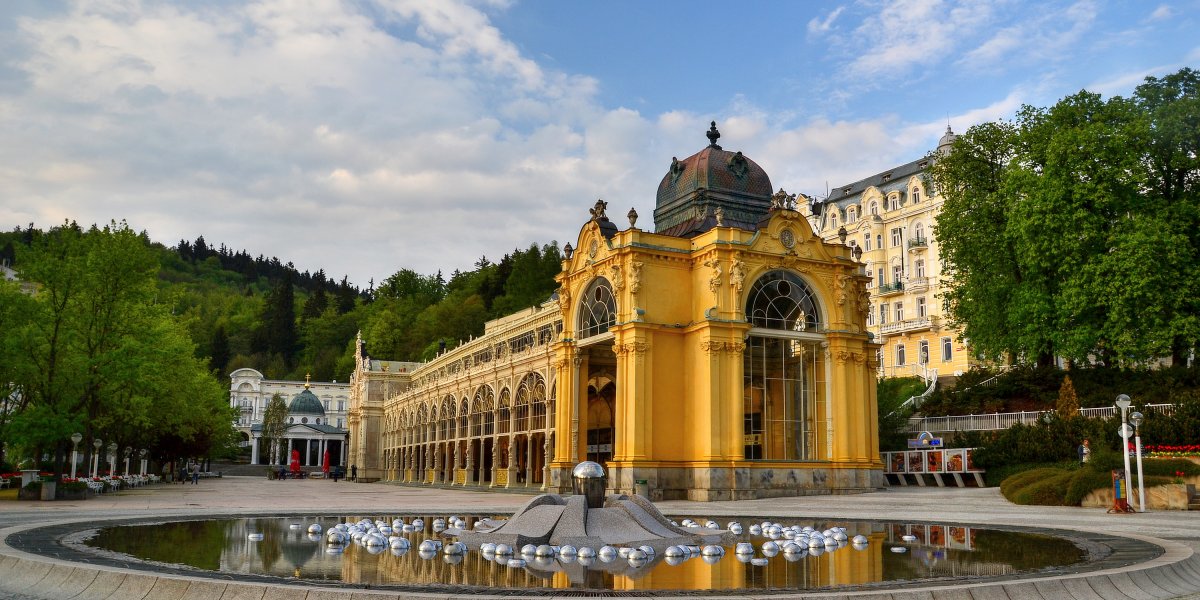
Cut three minutes back east — all 119 metres of pastel cast-iron arches and frescoed ceiling unfold in front of you, the most photogenic colonnade in Bohemia, built in 1889 from Belgian iron. Walk its full length first (your timing is deliberate: the 11:00 musical fountain show is ten minutes away), then claim the south end facing the Singing Fountain by 10:55. At exactly 11:00 the jets begin a choreographed dance to classical music — Smetana, Dvorak, sometimes a Queen medley — and the late-morning sun is high enough to backlight the spray into a silver curtain.
Tip: The fountain only performs at odd hours (7, 9, 11, 13, 15, 17, 19, 21) from May through October — outside this window it's just a quiet pool. Stand on the southern rim facing north and the colonnade arcs in behind the fountain, giving you the postcard frame with no power cables in shot; the 11:00 show is also the only one where you have shade from the colonnade's western awning.
Open in Google Maps →12:30
Food
Walk six minutes south down Hlavni trida — the spa promenade lined with pistachio, salmon, and butter-yellow facades — to Hotel Polonia's ground-floor cafe-restaurant, a locals' table that hasn't been redrawn for spa-tourist menus. Order the bramboracka (creamy potato-and-mushroom soup, 95 CZK / 4 EUR), beef svickova with bread dumplings and cranberry cream (245 CZK / 10 EUR), and a half-litre of unfiltered Pilsner Urquell (65 CZK / 2.7 EUR) — under 18 EUR with tip, served in twenty minutes flat.
Tip: Czech kitchens close sharp at 14:00 for the afternoon break — arrive by 12:45 to be safely seated and order in one go. Skip the goulash (it's the tourist default); the svickova is what locals order and it's one of the best in town. Tip 10% in cash rounded up — cards work but cash clears your bill in half the time.
Open in Google Maps →15:00
Religious
After lunch take a deliberate eighteen-minute walk south down Hlavni trida — past the spa-wafer (lazenske oplatky) bakeries with their warm vanilla steam and the colonnaded shopfronts of the lower promenade — then turn west onto Ruska. The golden onion dome of St. Vladimir rises above the rooflines, the most photogenic surprise in the whole town: built 1900–1902 for the Russian aristocrats who came en masse for the cure, with the western afternoon sun now igniting both the gold dome and the russet brickwork an hour before the dome falls into shadow.
Tip: Walk one block further west on Ruska, then turn back facing east — the dome rises clear of the lime trees framed against the wooded hills, the only angle that gives you both the dome and the brickwork in one frame. Skip going inside (despite the world's largest porcelain iconostasis, displayed at the 1900 Paris Expo before being shipped here) — it eats thirty minutes you don't have on a power-walk day.
Open in Google Maps →19:00
Food
Walk five minutes south to Mirove namesti and the ground-floor Le Bistrot Pacifik — the most consistently lauded kitchen in Marianske Lazne and the address that keeps reappearing in the Michelin Guide for Czech regions. Order the Sumava trout with brown butter and toasted almonds (525 CZK / 21 EUR), the Bohemian roast duck with red cabbage and karlovarsky knedlik (495 CZK / 20 EUR), and a glass of Moravian Palava (160 CZK / 6.5 EUR); this is modernised Czech cooking, what locals book for anniversaries — not what tour buses are funnelled into.
Tip: Reserve 24 hours ahead in summer (+420 354 651 111) — walk-ins after 18:30 are routinely turned away because the dining room is small. Pitfall warning: Hlavni trida's southern stretch has a known trap — cheap-looking 'Czech traditional' restaurants with five-language menus pinned to the railing, almost always serving frozen food at double the price and adding 'service' (10%) that bypasses the waiters. Le Bistrot is the rare exception worth its bill on this end of town; everything else here that markets to tourists in five flags should be avoided.
Open in Google Maps →Aller au jour
09:00
Landmark
Begin the day at the heart of the spa town — walk north into the park from any direction and the cast-iron Neo-Baroque arcade reveals itself through the trees. At 9 AM locals in dressing gowns are already at Rudolf and Cross springs, sipping warm mineral water from porcelain cups under the painted ceiling rotunda. Stand at the central rotunda where the morning light pours through the open-air arches — this is the postcard frame everyone misses by arriving at noon.
Tip: Buy a porcelain 'lazensky poharek' spa cup (150 CZK) at the kiosk — drinking through its built-in straw spout is the local ritual. Try Rudolf Spring first (sweetest, lowest iron), skip Ferdinand if you dislike a metallic aftertaste.
Open in Google Maps →11:00
Landmark
Walk 50 meters south from the colonnade to the circular fountain pool — you'll already hear the music starting. The 11:00 show runs seven minutes: choreographed jets dance to Dvorak or contemporary scores while the cast-iron colonnade frames the backdrop. The performance plays every odd hour (7, 9, 11, 13, 15, 17, 19, 21) from May through October only.
Tip: Stand on the upper colonnade steps for the elevated angle that captures both fountain and the arcade in one frame. The Saturday 9 PM show adds illuminated water and fire effects — but the 11:00 visit gives you golden morning light on the gilded pavilion.
Open in Google Maps →12:30
Food
Walk five minutes south through the spa park to Goethe Square — the yellow Empire-style cafe (1898) is the town's oldest confectionery, named after the young Ulrike von Levetzow whom Goethe famously fell for here. Order the lazenske oplatky spa wafers (25 CZK each, ironed fresh on cast-iron molds in front of you — the hazelnut is the local favorite) plus a bowl of hot kulajda mushroom-and-dill soup (120 CZK). Lunch budget around 12-15 €.
Tip: Ask for an upper-floor window table facing the square. Skip wafers sold from kiosks along the colonnade — most are factory-made; only Cafe Ulrika and a handful of historic bakeries still iron them on site, and you can hear the press hissing from the doorway.
Open in Google Maps →14:00
Museum
Cross Goethe Square — the museum occupies the very house where Goethe lodged in 1823 and, at 74, wrote his Marienbad Elegy after his hopeless attachment to 17-year-old Ulrike. Two floors trace 200 years of spa history: original 19th-century bathing rooms, the geological cabinet explaining why this valley produces 100 mineral springs within 2 km, and Goethe's preserved study with his desk facing the square. Closed Mondays.
Tip: Skip the audio guide and ask for the English paper booklet at reception (30 CZK) — it is better organized and lets you set your own pace. Don't miss the wooden cabinet on floor two with handwritten letters from Edward VII to the head physician.
Open in Google Maps →16:00
Landmark
Walk three minutes north from the museum — the gilded Empire-style pavilion (1818) is the town's oldest standing structure, sheltering the very spring that put Marianske Lazne on the map in 1779. At 16:00 the afternoon sun strikes the gold-leaf dome from the southwest, the angle for the postcard photo from the path below. Loop south afterward past Caroline Spring and Ferdinand Colonnade through the chestnut-lined promenade.
Tip: All three springs along this loop taste different: Cross is sulphate-heavy and mildly laxative (small sip only), Caroline is the smoothest, Rudolf the most pleasant for drinking. Locals never sip Cross water on the morning of a long walk — you'll understand why within the hour.
Open in Google Maps →19:00
Food
Walk eight minutes south through the park past the Singing Fountain to the New Baths (1896) — a Habsburg-era palace that hosted Edward VII and the Austrian Emperor Franz Josef. Even without booking a spa treatment, dining in its Belle Epoque hall is the closest you will get to the marble-and-stucco interior. Order the Bohemian roast duck with red cabbage and bread dumplings (390 CZK, around 16 €) or the local trout from Marianskolazenske ponds (340 CZK), paired with Pilsner Urquell on tap.
Tip: Reserve 24 hours ahead and ask specifically for the original Belle Epoque dining room (not the modern glass annex). Decline the upsold bottled water — the spa water at the colonnade three blocks away is free and tastes better. Avoid restaurants along the Lazenska promenade with English-only laminated menus: identical Czech food runs 30-40% costlier than two streets inland, and several add 'service charges' that should be tips.
Open in Google Maps →09:00
Religious
A ten-minute walk south from the spa center down Ruska trida — the street name nods to the Tsarist officers who wintered here in the 1880s — and the single golden onion dome rises behind a wrought-iron gate. Arrive at 9 AM sharp when doors open and tour groups have not yet arrived; you may have the candlelit nave to yourself. The interior centerpiece is the gilded majolica iconostasis crafted for the 1900 Paris World Exposition — one of only three of its kind worldwide.
Tip: A 40 CZK donation buys you a candle to place before the icon screen — the local custom. Photography requires a separate 50 CZK fee paid to the matron at the door; ask before lifting your camera, or she will politely but firmly intervene.
Open in Google Maps →10:30
Entertainment
Walk twelve minutes east along the wooded Lesni cesta path from the church — this is the very forest trail Edward VII took for his morning constitutionals, lined with park benches dedicated to past spa guests. The 1912 funicular (the second-oldest still operating in Czechia) climbs 200 m through beech forest to the Krakonos plateau. The six-minute ride passes a single switchback where you can wave to the descending car.
Tip: Buy a one-way ticket up only (60 CZK) — you will walk down through the woods later. The cabin holds 18; if a queue forms, wait the 15 minutes for the next car rather than packing in standing, otherwise you lose the rear window seat that frames the view back across the town's spires.
Open in Google Maps →11:00
Park
Walk three minutes along the marked path from the upper funicular station — the open-air miniature park spreads across a forest clearing under the pines. Around 60 of Czechia's most beautiful landmarks rendered at 1:25 scale: Karlstejn Castle, Prague's Charles Bridge, the Telc town square, Hluboka Chateau. Each model took 1,500 to 3,000 hours by hand, and the forest setting with wandering butterflies feels worlds away from any indoor miniature park.
Tip: Grab the free audio guide at the ticket booth — without it you will breeze past the obscure castles that are the real treasures (the story of Sychrov is the best). The Karlovy Vary colonnade model lets you compare it directly with the one you saw yesterday. Skip the on-site cafe: mediocre food at 30% premium.
Open in Google Maps →13:30
Food
Walk five minutes back past the funicular station — the timber mountain lodge sits in a forest clearing with smoke rising from its open grill stack. Order the grilled trout (cerstvy pstruh, 280 CZK) caught from local ponds, or the Slovak halusky with sheep's cheese and bacon (220 CZK) — the most authentic Carpathian dish you will find for hours in any direction. Wash it down with Kofola, the Czech cola Czechs swear is better than the American one.
Tip: Sit on the outdoor terrace facing the forest, never the dim interior — but order drinks the moment you sit because the terrace service runs slow. The 'myslivecka specialita' hunter's plate for two (590 CZK / about 24 €) is the best value on the menu and feeds two hungry walkers easily.
Open in Google Maps →15:30
Landmark
Walk 25 minutes downhill from Koliba via the marked yellow trail — a gentle descent through beech and pine that drops you into the northeastern corner of the spa park. The white neo-classical pavilion (1818) shelters one of the most drinkable springs in town; Goethe took the waters here daily during his stays. At this hour the afternoon light slants through the tall windows in golden bars across the marble floor — the photographer's reward.
Tip: This spring has the lowest mineral content of all 100 in the valley — locals say it is the only one safe to drink in any quantity, so fill a bottle for the walk back into town. The pavilion's reading nook holds first editions of Goethe's Marienbad Elegy in glass cases; almost every visitor walks past without noticing.
Open in Google Maps →19:00
Food
Walk ten minutes south along Hlavni trida — the town's commercial spine — to this family-run institution that locals choose over every colonnade tourist trap. Order the svickova na smetane (beef sirloin in cream sauce with bread dumplings and cranberry, 280 CZK) — named the best in West Bohemia by Czech food magazine Apetit — or the venison goulash (310 CZK). Finish with the homemade plum dumplings dusted in poppy seeds (140 CZK).
Tip: Reserve for 7 PM; by 8 PM the room fills with Czech regulars and the wait can stretch 40 minutes. The English menu omits the daily-special board (Czech-only) on the wall by the bar — ask your server to translate it for the freshest, cheapest plate of the night. One last warning: every evening, the Lazenska colonnade restaurants run 'tourist menus' 50% costlier with identical food, and several add hidden 'cover charges' that should be voluntary tips — read every line of the bill before paying.
Open in Google Maps →
Trip builder
Plan this trip around Marianske Lazne
Turn this guide into a bookable rail itinerary with FlipEarth.
Keep exploring
Related cities
More in the same country
FAQ
Frequently asked questions
How many days do you need in Marianske Lazne?
Most travelers enjoy Marianske Lazne in 1 days, with enough time for headline sights and a slower meal or museum stop.
What's the best time to visit Marianske Lazne?
The easiest season for most travelers is May-Sep, especially if you want good weather and manageable crowds.
What's the daily budget for Marianske Lazne?
A practical starting point is about €95 per person per day before hotels, then adjust based on museums, dining, and transport.
What are the must-see attractions in Marianske Lazne?
A good first shortlist for Marianske Lazne includes Cross Spring Pavilion (Krizovy pramen), Main Colonnade & Singing Fountain (Hlavni kolonada).