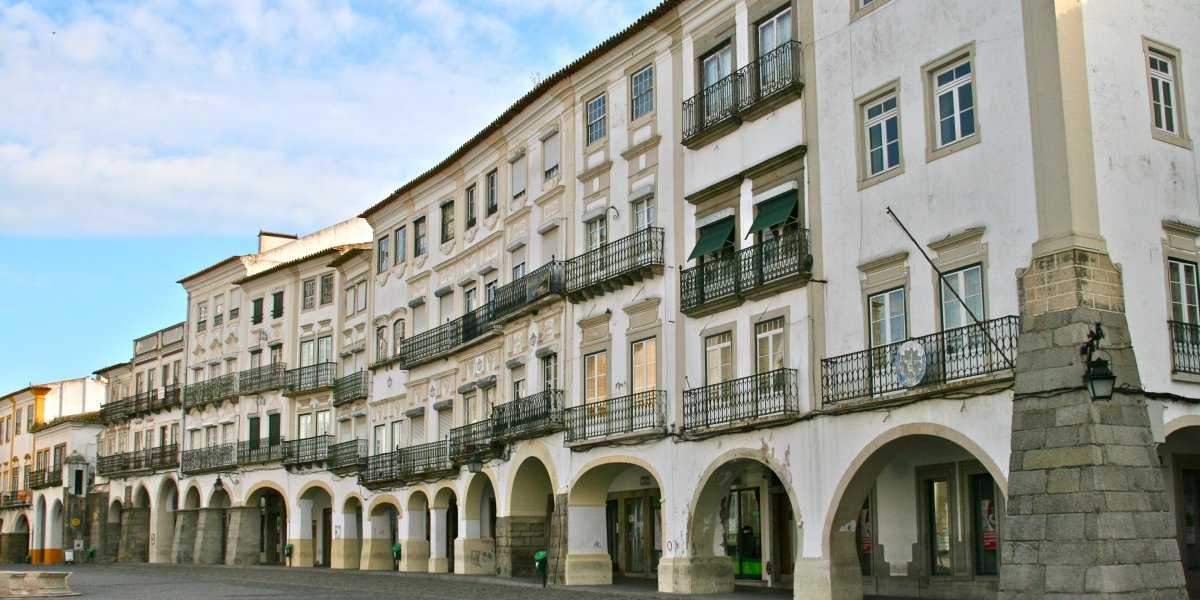
City Guide
Évora
Portugal · Best time to visit: Mar-May, Sep-Nov.
Day-by-day plan
Choose your pace
Durée du voyage
09:30
Landmark
From the train station, walk twenty minutes north through the old town — climbing gently past whitewashed houses banded in yellow, laundry overhead — until the street narrows and a 16th-century stone aqueduct appears directly above your head. This is Rua do Cano, where centuries ago locals built their homes directly into the arches of the Água de Prata aqueduct, creating a surreal streetscape found nowhere else in Portugal. Walk the full length beneath the channel that once carried spring water eighteen kilometres into the city.
Tip: Stand at the northern end of Rua do Cano facing south: the aqueduct arches frame the cathedral towers in the distance, and morning sun lights up the eastern face of the stone — this is the shot. The arches with embedded houses are the unique part; skip the freestanding section outside the walls unless you have spare time.
Open in Google Maps →10:15
Landmark
Walk south from Rua do Cano through quiet cobbled lanes for eight minutes — the temple columns appear above the roofline before you reach the square, and that first glimpse is the moment Évora clicks. Fourteen Corinthian columns of local granite still stand on this hilltop, the best-preserved Roman temple on the Iberian Peninsula. They survived only because the temple was sealed inside a medieval slaughterhouse for centuries, rediscovered by accident in the 1870s.
Tip: Walk into the garden terrace of the Pousada Convento de Évora — the hotel directly across the square, freely accessible — and photograph back toward the temple. You get the columns framed against the cathedral's crenellated towers behind them, the definitive Évora postcard. Mid-morning light from the east is ideal for this angle.
Open in Google Maps →10:55
Religious
Two minutes south from the temple, the cathedral rises like a granite fortress. Built between 1186 and 1250, the Sé is more military stronghold than church — crenellated walls, cone-topped turrets, and a Romanesque portal flanked by fourteen stone apostles that rank among the finest medieval carvings in Portugal. Circle the full exterior to absorb the scale: this building was designed to double as a defensive keep during the Reconquista, and every angle reveals a different personality.
Tip: The south side is the most dramatic angle — the fortress roofline with its turrets looks lifted from a Crusades film. The apostle figures on the west portal are slowly eroding; see them now while the detail still holds. For one clean exterior photo, stand on the Largo do Marquês de Marialva with the full west facade filling the frame.
Open in Google Maps →12:00
Food
Walk five minutes south from the cathedral down Rua 5 de Outubro — lined with cork boutiques and hand-painted ceramics — into Praça do Giraldo, the main square since Roman times. Café Arcada sits under the Renaissance arcade on the square, where locals have taken their morning bica for generations. Order a bifana — the Alentejo version hits harder with garlic and white pepper — for €4.50, a glass of house red from a Reguengos cooperative (€3), and finish with a queijada de Évora, a tiny sheep-cheese tart baked to a recipe the nuns guarded for centuries (€1.80).
Tip: A bifana, a glass of tinto, and a conventual pastry costs under €10 and is the most authentic quick lunch in the Alentejo. Skip any restaurant on the square advertising a 'tourist menu' with photos on the board — you will overpay for frozen ingredients reheated in a microwave.
Open in Google Maps →13:00
Religious
Walk eight minutes south from Praça do Giraldo down the broad Rua da República to the Igreja de São Francisco complex. The Chapel of Bones is behind the main church: three naves lined floor-to-ceiling with the skulls and femurs of over 5,000 Franciscan monks, arranged in geometric patterns by three brothers in the 1500s who wanted to jolt their city into confronting mortality. Above the entrance, the inscription reads: 'Nós ossos que aqui estamos, pelos vossos esperamos' — We bones that are here await yours.
Tip: Look for two desiccated corpses — one adult, one child — hanging from chains on the left wall; local legend says they were a father and son cursed by a wife. Fifteen minutes is enough to absorb the chapel fully; spend the rest in the attached Igreja de São Francisco, a cavernous Gothic church that is free and nearly always empty. Warning: the restaurants directly facing the church square are tourist traps with inflated prices and indifferent cooking — walk back toward Praça do Giraldo or east into Rua da Mouraria for honest food.
Open in Google Maps →19:00
Food
The afternoon is yours — wander backstreets where no two doors are the same shade of blue, sit in the Jardim Público watching white storks nest on church ruins, or browse cork workshops on Rua 5 de Outubro. When evening comes, walk five minutes north from the São Francisco area to Travessa das Mascarenhas. Fialho has served definitive Alentejo cooking since 1945, three generations of the same family behind the stove. Begin with açorda alentejana — a bread soup thick with coriander, garlic, and olive oil, crowned by a poached egg (€12). Follow with secretos de porco preto, grilled cuts from free-range Iberian black pigs raised on Alentejo acorns (€19). A glass of Esporão Reserva tinto from vineyards thirty kilometres south costs €6.
Tip: Reserve at least two days ahead — Fialho fills with local families by 20:00 on weekends. Ask for the back dining room where the original 1945 tile panels are still intact. After dinner, it is a gentle fifteen-minute downhill walk south to the train station; the last departure to Lisbon leaves around 20:44.
Open in Google Maps →
Trip builder
Plan this trip around Évora
Turn this guide into a bookable rail itinerary with FlipEarth.
Keep exploring
Related cities
More in the same country
FAQ
Frequently asked questions
How many days do you need in Évora?
Most travelers enjoy Évora in 1 days, with enough time for headline sights and a slower meal or museum stop.
What's the best time to visit Évora?
The easiest season for most travelers is Mar-May, Sep-Nov, especially if you want good weather and manageable crowds.
What's the daily budget for Évora?
A practical starting point is about €60 per person per day before hotels, then adjust based on museums, dining, and transport.
What are the must-see attractions in Évora?
A good first shortlist for Évora includes Silver Water Aqueduct, Roman Temple of Diana.