City Guide
Lisbon
Portugal · Best time to visit: Apr-Jun, Sep-Oct.
Day-by-day plan
Choose your pace
Durée du voyage
09:00
Landmark
Begin at the western edge of Lisbon where the Tagus meets the Atlantic — Torre de Belém stands alone on the waterline like a stone sentinel from the Age of Discovery. Circle the tower from the riverside promenade for the full silhouette against the morning sky, then walk onto the small jetty for the classic straight-on photograph with the river stretching behind. The Manueline carved-rope balconies and corner watchtowers are best captured in the soft eastern light before 10 a.m., when the limestone glows warm and the tour buses have not yet arrived.
Tip: Stand on the wooden boardwalk directly west of the tower at 09:15 — the sun is behind you, the tower is front-lit, and you get a clean shot with zero tourists in frame. The south-facing side photographs beautifully in morning light with the river as backdrop.
Open in Google Maps →10:15
Religious
Walk east along the waterfront gardens from Torre de Belém, passing the massive Padrão dos Descobrimentos monument on your left — a 15-minute stroll through palm-lined lawns with the river breeze at your back. The south façade of Jerónimos Monastery is one of the most extravagant pieces of Manueline architecture on earth: a vast limestone wall carved with maritime ropes, armillary spheres, and fantastical creatures. Stand in the Praça do Império gardens directly opposite for the widest shot, then move close to the south portal to photograph the sculptural details above the entrance — layers of saints, prophets, and navigators stacked like a stone wedding cake.
Tip: The western portal facing the garden is less photographed but equally stunning — look for the statue of Henry the Navigator above the doorway. Skip the interior queue entirely; the exterior carvings are the real masterpiece, and you will save 45 minutes and €10.
Open in Google Maps →12:00
Food
Exit the monastery grounds onto Rua de Belém and turn right — three minutes past blue-tiled shopfronts, the perpetual queue at number 84 tells you that you have arrived. This is the original bakery that has been making pastéis de nata from a secret monastic recipe since 1837. Order at the long marble counter in the back room to skip the seated-table wait entirely. Grab two warm pastéis de Belém straight from the oven (€1.30 each), dust them liberally with cinnamon and powdered sugar, and pair with a bifana — a tender garlic-marinated pork sandwich on a soft roll (€4.50). Budget €8–12 per person.
Tip: The queue outside is for the sit-down dining rooms. Walk past it and enter through the main door — the standing counter deep in the back room serves the same pastéis with almost no wait. Eat them within 30 seconds of receiving them; the contrast of shattered-glass crust and warm egg custard only exists at that temperature.
Open in Google Maps →14:00
Landmark
Head east from Belém along the Tagus riverfront — this 6-kilometer power walk is one of Lisbon's hidden pleasures. You will pass the angular MAAT museum shimmering on the waterline, the Doca de Santo Amaro marina lined with converted warehouse restaurants, and the 25 de Abril suspension bridge towering overhead like a red twin of the Golden Gate. The walk takes about 75 minutes at a brisk pace and delivers you to Lisbon's grand civic square: a vast sun-drenched plaza open to the river, framed by lemon-yellow arcaded buildings and anchored by the equestrian statue of King José I. Walk under the triumphal Arco da Rua Augusta for the classic framed view from the square toward the Baixa grid.
Tip: Stand at the center of the square facing north — the Arco da Rua Augusta frames a perfect symmetrical corridor up through the Baixa. For a riverfront photo without the car park intruding, walk to the western end of the Cais das Colunas marble steps at the water's edge.
Open in Google Maps →15:30
Landmark
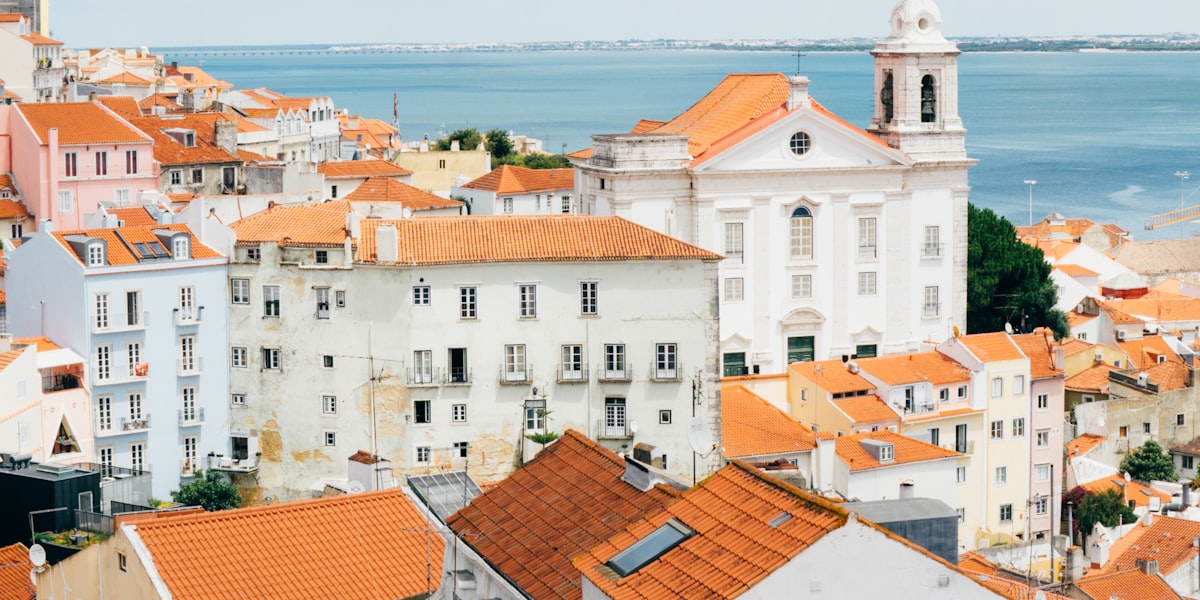
From Praça do Comércio, walk north into the Alfama's tangled medieval lanes — follow Rua da Alfândega uphill past laundry-strung balconies and the sound of fado leaking from open windows. The 20-minute climb is steep but every turn reveals a new tiled façade or a cat sleeping on a doorstep. Portas do Sol is the terrace that prints on every Lisbon postcard: a cascading quilt of terracotta rooftops tumbling toward the Tagus, the white dome of the National Pantheon rising on the right, and ferries crossing the blue water below. The afternoon sun is behind you here, front-lighting the entire scene — this is the single best viewpoint photograph in all of Lisbon. Walk two minutes south to Miradouro de Santa Luzia for the bougainvillea-draped pergola and blue-and-white tile panels depicting pre-earthquake Lisbon.
Tip: Between 15:00 and 16:30 the light hits the Alfama rooftops at the perfect angle — warm, directional, no harsh shadows. After photos, wander downhill through the alleys rather than retracing your steps; the neighbourhood reveals itself only to those who get slightly lost. Skip the Tram 28 queue near the cathedral — the 40-minute wait is not worth it for a one-day visit.
Open in Google Maps →19:00
Food
Walk uphill from the Alfama viewpoints along Costa do Castelo — a quiet cobblestone lane hugging the castle walls with sunset views opening up to the west — a 10-minute stroll to this restaurant perched on the edge of the hill. Chapitô à Mesa is built into a former circus school, and its terrace hangs over the rooftops with a panoramic sweep from the 25 de Abril Bridge to the Alfama below. Order the polvo à lagareiro — a whole roasted octopus tentacle with crushed potatoes drowning in fruity Alentejo olive oil (€19) — or the arroz de pato, a rich duck rice baked golden and crispy on top (€17). Pair with a glass of Alentejo red. Budget €25–35 per person with wine.
Tip: Reserve the terrace table by calling ahead — without a booking you will be seated inside, which misses the entire point. Request the railing table for the widest sunset view. Beware the Alfama restaurant touts on Rua de São Miguel offering 'traditional fado dinner' packages — these are overpriced tourist traps with frozen fish and indifferent singing. If you want real fado, ask your Chapitô waiter where the locals go tonight.
Open in Google Maps →Aller au jour
09:00
Landmark
Take bus 737 from Praça da Figueira or climb through Alfama's winding lanes to arrive right at the nine o'clock opening, when the ramparts are nearly empty. Walk the outer walls counterclockwise for a slow-reveal panorama — the Alfama cascading in terracotta, the Tagus widening toward the Atlantic, and the 25 de Abril Bridge catching the first warm light of the day.
Tip: Go right immediately after entering — most visitors drift left toward the archaeological ruins, leaving the ramparts empty for ten minutes. The best photo frame is from the northeast tower where the entire Alfama fits below you. The castle's resident peacocks gather near the old cistern before 10:00.
Open in Google Maps →10:45
Neighborhood
Exit the castle's lower gate and follow Rua de Santa Cruz do Castelo downhill — eight minutes past crumbling azulejo facades and laundry lines strung between windows. This bougainvillea-draped terrace has two blue-and-white tile panels depicting Lisbon before the 1755 earthquake; from here, wind through Alfama's narrowest alleys — Beco do Carneiro and Rua de São Miguel — where walls nearly touch overhead.
Tip: Stand at the far right of the terrace railing for a shot of the São Vicente de Fora dome perfectly framed by bougainvillea — this is the single most photographed angle in Alfama. Then walk down Beco do Carneiro, the most photogenic alley in the district, best lit before noon when the sun slants between the buildings.
Open in Google Maps →12:00
Food
A three-minute walk from Beco do Carneiro down to Rua de São Miguel brings you to this small family-run tasca where half the tables are weekday regulars. Order the Bacalhau à Brás — shredded salt cod with crispy potatoes and scrambled eggs, the definitive Lisbon comfort dish — with a cold glass of white Alentejo wine.
Tip: Bacalhau à Brás (€14) is non-negotiable. If you're hungry, add the Arroz de Polvo — octopus rice slow-cooked until the grains absorb every drop of the sea (€16). Arrive right at noon; by 12:30 every table is taken and there is no waiting area. Budget €15-25 per person with wine.
Open in Google Maps →13:15
Entertainment
Walk two minutes uphill to Largo das Portas do Sol and board the yellow tram heading west — grab a right-side window seat. The carriage threads through impossibly narrow Alfama streets where balconies nearly brush the roof, descends into the Baixa grid, then grinds uphill through Chiado. Get off at Largo do Chiado — one of Europe's great urban rides in under thirty minutes.
Tip: Board at Portas do Sol, not Martim Moniz — it's one stop later but the Martim Moniz queue often exceeds 30 minutes. Use a Viva Viagem card (€0.50 deposit + €1.65 per ride) instead of paying €3.00 cash on board. Keep your bag in front of you at all times; pickpockets work the crowded trams daily.
Open in Google Maps →14:15
Landmark
From the Chiado tram stop, walk south down Rua do Carmo and through the pedestrianized Rua Augusta — ten minutes of mosaic cobblestones before you emerge through the triumphal arch into Lisbon's grandest square. The vast waterfront plaza, rebuilt after the 1755 earthquake, opens directly onto the Tagus; walk to the Cais das Colunas marble steps at the water's edge, where the afternoon sun turns the yellow arcades golden.
Tip: Pay €8 to climb the Arco da Rua Augusta for the best elevated view of the square and the river — the rooftop is tiny and rarely crowded, with ideal light from 14:00 to 16:00. Skip every restaurant lining this square — they are tourist-priced and uniformly mediocre. Your dinner tonight is worth the wait.
Open in Google Maps →19:30
Food
Walk north through Chiado along Rua Garrett — ten minutes uphill past Livraria Bertrand, the world's oldest bookshop — then turn left onto Rua das Flores to this tiny tavern with no printed menu and no website. The waiter recites whatever arrived at the market that morning; the room seats thirty, the wine list is short and all Portuguese, and every plate lands on the table looking like it belongs in a food magazine.
Tip: No reservations — arrive at 19:00 and put your name on the informal list by the door. The tuna tartare (€14) and salt cod croquettes (€8) appear almost nightly and are exceptional. Budget €25-40 per person with wine. Tourist trap warning: avoid any restaurant on Rua Augusta or around Praça do Comércio with photos on the menu and someone beckoning you from the doorway — you'll pay triple for frozen seafood.
Open in Google Maps →10:00
Religious
Take Tram 15E from Praça do Comércio or the train from Cais do Sodré — fifteen minutes to Belém. Arrive by 9:30 to queue at the south entrance; the doors open at ten and the Manueline cloister is otherworldly in the first hour, every column carved with maritime ropes, armillary spheres, and sea monsters in a style that exists nowhere else on earth.
Tip: Buy tickets online at patrimoniocultural.gov.pt to skip the queue, which reaches 45 minutes by 11:00. Enter the cloister and go directly upstairs — the upper gallery has the best directional light from 10:00 to 11:00 and most visitors linger below. The free church entrance is separate and always jammed; see it on the way out, not going in.
Open in Google Maps →11:45
Food
Cross Rua de Belém from the monastery gate — two minutes to the bakery that has guarded the original pastel de nata recipe since 1837. Skip the takeaway queue snaking out the door and walk straight through the archway to the tiled back rooms where a table is always free; order pastéis fresh from the oven, dust them with cinnamon and powdered sugar, and pair with a galão.
Tip: Ask for 'acabados de sair' (just out of the oven) — the difference between fresh and counter-sitting is night and day. Two pastéis (€1.40 each) and a galão (€1.60) run under €5; add a salgado savory pastry (€2.50) if you want a fuller meal. The tiled back rooms seat 200 and are part of the original 19th-century bakery — most tourists never discover them.
Open in Google Maps →13:00
Landmark
Walk west along the flat riverfront promenade for fifteen minutes — the Tagus on your left, the Jardim de Belém on your right, and the tower growing slowly more dramatic as you approach. Built in 1515 to guard the harbor entrance, this Manueline-Gothic keep stands in the water with Moorish watchtowers, rope-carved balconies, and a famous rhinoceros gargoyle peering from the western base.
Tip: The interior is tiny and only admits 20 people at a time — if the queue exceeds 20 people, skip it. The tower photographs far better from outside: the best angle is from 50 meters east along the waterfront, catching the full profile with the river behind it. Early afternoon light (13:00-14:00) hits the south facade at the most flattering angle.
Open in Google Maps →14:15
Landmark
Retrace east along the waterfront from the tower — a pleasant fifteen-minute riverside walk with the afternoon sun warming the limestone. Take the elevator to the rooftop of this 52-meter monument shaped like a caravel's prow for the best aerial view of the giant compass rose mosaic below and the Jerónimos Monastery spread out behind it. Henry the Navigator leads 32 figures at the bow — find Vasco da Gama, Magellan, and Queen Philippa of Lancaster, the lone woman.
Tip: The rooftop terrace is the real reason to visit — the ground-floor exhibition is skippable. Shoot straight down at the compass rose mosaic from the top; the pattern reads best when the sun is nearly overhead (13:00-15:00). The west-facing side of the monument has the best detail of the 32 figures — Henry at the prow, the navigator's astrolabe in hand.
Open in Google Maps →15:30
Shopping
Walk east from Padrão toward the 25 de Abril Bridge — twenty minutes along the waterfront, or hop Tram 15E for two stops. This converted 19th-century textile compound lives in the bridge's shadow: street art on every surface, design studios in old warehouses, and Ler Devagar — one of the world's most beautiful bookshops, built into a former printing press with a flying bicycle suspended from the ceiling.
Tip: Ler Devagar bookshop is the anchor — look up for the flying bicycle installation. If your visit falls on a Sunday, the outdoor market (10:00-18:00) is excellent for ceramics and vintage. The best coffee is at Landeau Chocolate — their single-recipe chocolate cake (€5.50) is a citywide obsession among locals.
Open in Google Maps →19:00
Food
Take Tram 15E from LX Factory to Cais do Sodré, then the green metro line to Intendente — twenty-five minutes and a world away from Belém's monuments. Lisbon's seafood temple since 1956: a bright, loud, no-frills hall where the ritual is sacred — start with tiger prawns, move to percebes (gooseneck barnacles), and finish with the legendary Prego no Pão, a garlic-butter steak sandwich that exists to prove Portugal does everything better.
Tip: No reservations — queue from 18:30 to be seated by 19:00. Tiger prawns (€25), percebes (€28-35 by season), and the Prego steak sandwich to close (€10) are the holy trinity; budget €40-60 per person with beer. Tourist trap warning for Belém: avoid any restaurant facing the monastery with laminated photo menus and someone waving you inside — they exist solely to empty tourist wallets with reheated cod.
Open in Google Maps →Aller au jour
09:00
Landmark
Arrive right at opening when the ramparts are nearly empty and the morning sun turns the Tagus into liquid gold. Walk the full perimeter of the outer walls — the eastern terrace offers the widest panorama over Alfama's terracotta rooftops, the Ponte 25 de Abril, and the river stretching toward the Atlantic. This is the view that will define your memory of Lisbon.
Tip: Turn right immediately after entering — most tourists go left toward the inner courtyard, so you'll have the eastern ramparts to yourself for the first 30 minutes. The camera obscura in Torre de Ulisses runs every 20 minutes; the 09:20 session has the fewest people.
Open in Google Maps →11:15
Religious
Descend from the castle through Alfama's labyrinth of narrow alleys — follow Rua de Santa Cruz do Castelo downhill for 10 minutes until the cathedral's fortress-like twin towers appear between the rooftops. Built in 1147, Lisbon's oldest church hides a Gothic cloister where Roman and Moorish foundations lie excavated beneath your feet — layers of civilizations stacked underground.
Tip: The nave is free; pay the €5 for the cloister to see the lower-level archaeological excavation — Roman, Visigothic, and Islamic Lisbon layered underground. Skip the treasury (€2.50 extra, underwhelming collection).
Open in Google Maps →12:30
Food
Walk two minutes downhill from the cathedral along Calçadinha de Santo Estêvão — you'll spot outdoor tables tucked into a bougainvillea-shaded courtyard. No printed menu: the waiter announces what fish came in today, and it arrives whole, charred over coals. Order the dourada (gilt-head bream, €12) or polvo grelhado (grilled octopus, €14) with a half-liter of house vinho verde (€5).
Tip: Arrive by 12:30 — only about 10 outdoor tables with no reservation system. If full, a table opens within 15 minutes. Order only grilled fish; it's the sole thing this kitchen does perfectly.
Open in Google Maps →14:30
Landmark
Spend 30 minutes strolling freely through Alfama's backstreets after lunch — azulejo facades, laundry lines between windows, fado drifting from half-open doors. Then catch iconic Tram 28 at Largo das Portas do Sol and ride it three stops uphill to Graça (€1.65 with Viva Viagem card). The pine-shaded terrace frames the castle across the valley with the river behind it — the postcard view of Lisbon at its most golden in the afternoon light.
Tip: Board Tram 28 heading toward Graça — the uphill direction is far less crowded than toward Baixa. For an even higher panorama, walk 5 minutes past the church to Miradouro da Senhora do Monte, Lisbon's highest viewpoint where locals gather for sunset.
Open in Google Maps →19:30
Food
Walk 10 minutes from Graça back toward the castle along Costa do Castelo — the restaurant sits atop Chapitô, a performing-arts school perched on the hillside, with a terrace overlooking the Tagus and the Ponte 25 de Abril glowing at dusk. Start with açorda de gambas (shrimp bread stew, €16), then secretos de porco preto ibérico (Iberian black pork, €19). Budget €30–38 per person with wine.
Tip: Reserve a terrace table 2 days ahead (+351 218 867 334) and request the upper terrace — the lower one has a partially blocked view. Avoid the tourist restaurants on Rua Augusta in Baixa below; they charge double for half the quality and none of them serve food this honest.
Open in Google Maps →09:30
Landmark
Take the 08:15 train from Rossio station to Sintra (40 minutes, €2.30), then bus 434 up the mountain (15 minutes). Pena Palace is a Romanticist fever dream: acid-yellow walls, Moorish arches, coral-red towers perched in clouds above the forest. Head directly to the Queen's Terrace for views stretching to the Atlantic on a clear day, then explore the royal apartments where everything remains as if the family just stepped out.
Tip: Buy timed-entry tickets online at least a day ahead — walk-up visitors face 45+ minute waits. Enter through the main gate and climb to the terraces first; tour groups go through the rooms first, so you'll have the panoramic walkways nearly to yourself.
Open in Google Maps →12:00
Landmark
Take bus 434 back to Sintra town center (15 minutes), then walk 10 minutes west on Rua Barbosa du Bocage. Behind a stone wall lies Portugal's most mystical garden: a neo-Gothic palace, underground tunnels, and the famous Initiation Well — a 27-meter inverted tower spiraling into the earth. Descend the spiral staircase in near-darkness, cross a tunnel beneath a lake, and emerge at a waterfall. It feels like entering a novel.
Tip: Head to the Initiation Well immediately upon entering — by midday the line exceeds 30 minutes. Descend from the top entrance (far more dramatic than climbing up from below). The smaller, unfinished well nearby has no queue and its own eerie beauty.
Open in Google Maps →13:45
Food
Walk 8 minutes back toward the town center on Rua Sotto Mayor — the restaurant is on a quiet side street off the main square. Chef Luís Santos uses Sintra's forest ingredients brilliantly: order cogumelos salteados com ovo a 63° (wild mushrooms with slow-cooked egg, €12) to start, then bochechas de porco preto (braised Iberian pork cheeks, €18). The small, warmly lit dining room is a welcome rest after a morning of climbing. Budget €25–32 per person with wine.
Tip: Book ahead by phone — the dining room seats about 30. Avoid the tourist restaurants lining the main road to the National Palace; they survive on foot traffic and serve reheated food at Lisbon prices.
Open in Google Maps →15:00
Landmark
Walk 3 minutes to the main square — the National Palace dominates it with two giant conical chimneys, Sintra's most recognizable silhouette. This is Portugal's best-preserved medieval royal palace, in continuous use from the 15th to the 19th century. The Swan Room ceiling has 27 gilded swans; the Magpie Room is decorated with chattering birds allegedly mocking the court's gossips. After Pena's fairy-tale excess, this palace's restraint feels grounded and human.
Tip: Visit the kitchen last — the enormous chimneys visible from outside tower directly above this room, and looking straight up from inside is one of Sintra's most unexpectedly striking moments. Buy tickets online to skip the entrance queue.
Open in Google Maps →19:30
Food
Catch the 16:30 train back to Lisbon (arrive Rossio ~17:10), rest at your hotel, then walk to Avenida Almirante Reis near Intendente metro. Lisbon's most legendary seafood hall: tanks of live shellfish, shouting waiters, tables overflowing with tiger prawns. Order camarão tigre grelhado (grilled tiger prawns, €28/kg to share), amêijoas à Bulhão Pato (clams in garlic and coriander, €18), and finish with a prego no pão (steak sandwich, €7) as every local does. Beer, not wine.
Tip: Arrive by 19:00 — by 20:00 the queue stretches down the block. Prices are by weight; set a budget before ordering. Skip the crab (sapateira) — dramatic but overpriced for the meat. The seafood restaurants near Rossio and Praça do Comércio are tourist traps with stale shellfish at double the price; Ramiro is worth the walk.
Open in Google Maps →09:00
Religious
Take Tram 15E from Praça do Comércio to Belém (20-minute scenic ride along the Tagus). The monastery's 300-meter Manueline façade commands the skyline — stone carved into ropes, coral, armillary spheres, and sea creatures, built with the wealth of Vasco da Gama's spice trade. Enter the church first (free) to see Da Gama's tomb, then the cloister where every column is a sculptor's love letter to the sea. Arrive at opening for 20 quiet minutes before tour groups flood in.
Tip: Enter the church through the south door on Rua de Belém (free, opens 09:00) before the cloister ticket office — you'll have Da Gama's tomb and the stunning nave nearly to yourself. Closed Mondays; if your Day 3 falls on Monday, swap with Day 2.
Open in Google Maps →11:30
Landmark
Walk 15 minutes west along the Tagus waterfront promenade, passing the Padrão dos Descobrimentos — the 52-meter stone prow listing Portugal's great explorers (worth a photo stop, but skip the €10 rooftop). Belém Tower stands alone in the river like a stone chess piece. Climb the narrow spiral staircase to the rooftop for a direct view downriver toward the Atlantic — the same horizon navigators faced when they departed for the unknown five centuries ago.
Tip: Arrive mid-morning after the first rush clears but before the midday crush — the tower limits visitors inside simultaneously. The spiral staircase is extremely narrow with no overtaking; if claustrophobic, the view from outside is nearly as good. Best photo angle: from the garden to the east, shooting westward. Closed Mondays.
Open in Google Maps →12:45
Food
Walk 10 minutes east from the tower along Rua de Belém — the queue spilling out of number 84 is unmistakable, but skip it: walk straight through to the azulejo-covered sit-down rooms in the back. These pastéis de nata, made from a secret recipe since 1837, arrive warm with crackling caramelized tops. Order six pastéis (€1.30 each) with a bica (espresso, €1), plus croquetes de carne (€2.50 each) for something savory. This is a Lisbon rite of passage.
Tip: Never wait in the takeaway queue outside — walk directly to the sit-down restaurant in the back where tables are almost always available. Eat each pastel within 30 seconds of arrival while the caramelized top still crackles. Dust with cinnamon, not just sugar. Buy a box of six for the flight home; they hold for about 24 hours.
Open in Google Maps →14:30
Museum
Walk 10 minutes east along the waterfront — MAAT's sweeping white-tiled roof curves like a wave rising from the Tagus. The rotating contemporary exhibitions inside are worth the entry, but the revelation is the rooftop: a gently sloping walkway over the building's curved shell with an unobstructed panorama from the monastery to the Ponte 25 de Abril. This is the last great view of your trip — the river, the bridge, the light. Let it sink in.
Tip: Even if you skip the exhibitions, walk the rooftop for free — it's the best wide-angle view of Belém's entire waterfront. The ground-floor permanent exhibition on Portuguese energy history is unexpectedly engaging and usually empty. Closed Tuesdays.
Open in Google Maps →19:00
Food
Take Tram 15E back from Belém toward Cais do Sodré as the sun gilds the river one last time, then walk 5 minutes uphill along Rua das Flores into the heart of Chiado. This tiny wine bar's chalkboard menu of petiscos changes daily: order ceviche de peixe do dia (fish ceviche, €11), pica-pau de vitela (veal in garlic and pickles, €14), and a glass of Douro red (€5). Small, communal, loud — the perfect farewell to a city that never whispers. Budget €25–32 per person.
Tip: No reservations — arrive at 18:45 and put your name on the list; by 19:30 the wait exceeds an hour. Sit at the counter if offered, that's where the action is. Watch for street scammers near Cais do Sodré station selling 'free' friendship bracelets that suddenly cost €10 — a firm 'não, obrigado' and keep walking.
Open in Google Maps →Aller au jour
10:00
Religious
Take tram 15E from Praça da Figueira — the 25-minute ride hugs the Tagus riverbank and is the most scenic commute in Lisbon. Step off at the Belém stop and walk 50 meters east to Pastéis de Belém first: order a warm pastel de nata dusted with cinnamon at the counter (€1.30 each) while you wait for the monastery doors to open at 10:00. The Jerónimos Monastery is the pinnacle of Manueline architecture, commissioned by King Manuel I with spice-trade wealth brought home by Vasco da Gama — whose tomb rests just inside the entrance. Linger in the cloisters: the late-morning sun pours through carved limestone arches and casts lattice shadows across the courtyard floor.
Tip: Enter through the west door (left side of the façade) to skip the main entrance queue. The upper gallery of the cloisters is often half-empty — climb the staircase in the northeast corner for the best overhead angle on the courtyard. Closed Mondays.
Open in Google Maps →12:30
Food
Exit the monastery's south gate, cross Rua de Belém, and walk 5 minutes toward the marina at Doca do Bom Sucesso. Vela Latina sits right on the dock with unobstructed views of the Tagus and the 25 de Abril Bridge — this is where Belém's office workers eat lunch, not where tourists end up. Order the arroz de marisco (seafood rice for two, ~€32) or the grilled robalo (sea bass, ~€18); both arrive tasting like the Atlantic is still in them.
Tip: Ask for a terrace table facing the river. No reservation needed on weekdays; call ahead on weekends. Budget €20-30 per person with wine. Skip the restaurants directly facing the monastery — they charge double for half the quality.
Open in Google Maps →14:00
Landmark
Walk west along the riverside promenade from the marina — a flat, scenic 10-minute stroll past joggers and fishermen casting lines into the Tagus. The Tower of Belém was built in 1515 as the last thing Portuguese sailors saw before departing into unknown waters. The afternoon sun hits the western façade head-on, turning the limestone honey-gold — this is the postcard angle, and it only works after 14:00. Climb the narrow spiral staircase to the rooftop terrace for a 360-degree panorama of the estuary.
Tip: The interior staircase is single-file and claustrophobic with a crowd. If the door queue is longer than 30 people, photograph the exterior instead — it is far more beautiful than the inside — and save your energy for the Padrão. Closed Mondays.
Open in Google Maps →15:30
Landmark
Turn back east along the waterfront — a 10-minute stroll retracing your steps past the marina. The Monument to the Discoveries is a 52-meter concrete prow jutting into the river, carved with 33 figures led by Henry the Navigator. Take the elevator to the rooftop terrace: the massive marble compass-rose mosaic on the plaza below — a gift from South Africa in 1960 — comes into full view. At this hour the western sun backlights the monument against the river, ideal for silhouette photography from the east side.
Tip: After descending, stroll east along the riverfront past MAAT's undulating mirrored rooftop (free to walk on), then catch tram 15E from the Belém stop back to Cais do Sodré and wander uphill through Chiado before dinner. Avoid the kiosk vendors along the waterfront selling 'traditional' souvenirs at triple the price — identical items cost a third as much in Baixa's shops.
Open in Google Maps →19:00
Food
From Cais do Sodré, walk 12 minutes uphill through Chiado's tiled streets to Rua das Flores — a narrow, lantern-lit pedestrian lane that feels like Lisbon distilled to its essence. Taberna da Rua das Flores is a standing-room-sized restaurant that serves Portuguese petiscos with creative flair — the couple at the next table is always local. The menu changes daily; order three to four plates to share: the tuna tataki with wasabi (~€14), slow-cooked pork cheeks (bochechas de porco, ~€16), and whatever cured meat board is on offer.
Tip: No reservations accepted — arrive by 19:00 or face a 30-45 minute wait. If the queue is long, put your name down and walk 2 minutes to Largo do Carmo for sunset views over the Baixa rooftops while you wait. Budget €30-40 per person with wine. Steer clear of the restaurants on Rua Augusta in Baixa — picture menus and doorstep hosts are the surest signs of tourist-trap pricing and frozen food.
Open in Google Maps →09:00
Landmark
From Praça da Figueira, walk 15 minutes uphill through the narrow Mouraria lanes — the steep climb is worth it at this hour when the old quarter is still waking up and doorsteps are lined with potted geraniums. The castle opens at 09:00; arriving at the gate means you will have the ramparts nearly to yourself for the first half hour. Walk the full circuit of the outer walls for the single best panorama in Lisbon: the Tagus glittering to the south, the 25 de Abril Bridge to the west, and a patchwork of terracotta rooftops in every direction. At 09:00 the light rakes across the city at a low angle that makes every tile roof shimmer.
Tip: Enter from the east gate on Rua de Santa Cruz do Castelo — shorter queue and a more atmospheric approach through the medieval castle neighborhood. Visit the Camera Obscura in the Torre de Ulisses for a live 360-degree projection of the city. The peacocks in the courtyard garden are friendliest in the morning.
Open in Google Maps →11:00
Neighborhood
Exit the castle through the south gate and let gravity pull you downhill into Alfama — Lisbon's oldest quarter, where Moorish alleyways twist between laundry lines and azulejo-covered walls. There is no wrong turn here. Aim vaguely south and you will pass Miradouro de Santa Luzia (stop for the bougainvillea-framed river view), the Sé Cathedral's Romanesque fortress façade, and tiny squares where old men play cards outside corner tascas. The late-morning light filters through the narrow lanes and catches the hand-painted tiles at their most vivid — photographers call this the blue hour at noon.
Tip: For the best tile facades, take Beco do Carneiro down from the castle gate, then follow Rua de São Miguel to Largo de São Miguel — among the most photographed corners in Lisbon. To ride a section of Tram 28 without the tourist crush, board at Largo das Portas do Sol heading toward Graça — two stops, almost never full at this hour, and you get the steep descent thrill without the 45-minute queue at Martim Moniz.
Open in Google Maps →12:30
Food
From Largo de São Rafael, duck into Beco de São Miguel — a cobbled alley barely wide enough for two people — and find Santo António de Alfama tucked into the ground floor of a centuries-old building. This is where Alfama residents eat on payday. The bacalhau à brás (shredded salt cod scrambled with eggs, onions, and matchstick fries, ~€14) is definitive, and the polvo à lagareiro (roasted octopus with crushed potatoes drenched in olive oil, ~€18) will ruin you for octopus anywhere else.
Tip: Sit outside in the alley — the indoor room is cramped and poorly lit. Arrive at 12:30 sharp; by 13:00 every chair is taken. Budget €15-25 per person with a glass of chilled vinho verde.
Open in Google Maps →14:00
Museum
Walk east from Alfama along Rua dos Caminhos de Ferro — a flat, 15-minute riverside stroll past Santa Apolónia station and old warehouses reborn as galleries. The National Tile Museum is housed in the 16th-century Madre de Deus convent and is the only museum in the world dedicated entirely to azulejos. The centerpiece is a 23-meter panoramic tile panel of Lisbon's waterfront painted before the 1755 earthquake — an entire city frozen in blue and white. In the afternoon the convent's Baroque chapel catches the sun through its high windows and the gilded interior blazes.
Tip: Most visitors skip the upper floor with contemporary tile artists — it is exceptional and usually deserted. The museum café occupies the original convent refectory, still clad in floor-to-ceiling azulejos; have a coffee here just for the room. After your visit, head back to rest and change before the fado evening — it runs late. Closed Mondays.
Open in Google Maps →20:00
Food
Return to the heart of Alfama in the evening — walk down Rua dos Remédios past the sounds of televisions through open windows and the scent of sardines grilling on doorstep barbecues. Mesa de Frades is a former chapel converted into Lisbon's most intimate fado house: 30 seats, stone walls, candlelight, and a single fadista whose voice fills the room like a physical force. This is not tourist fado — this is the real thing, the sound of saudade, the untranslatable Portuguese ache for something loved and lost. The petiscos and wine are excellent, but you are here for the music.
Tip: Reserve at least 3 days ahead by phone — the website is unreliable. Arrive at 20:00 for dinner; live fado begins around 21:30 and runs until midnight. Budget €50-70 per person including wine and petiscos. Do not enter the 'fado houses' on Rua da Bica de Duarte Belo that have touts at the door — they charge €50 for frozen food and amplified singing. If Mesa de Frades is full, A Baiuca on Rua de São Miguel is the only other Alfama fado venue where the musicians play for love, not for tour buses.
Open in Google Maps →09:30
Landmark
Catch the 08:15 train from Rossio station (€2.30 each way with a Viva Viagem card, 40 minutes — sit on the left side for valley views as the train climbs into the Serra de Sintra). At Sintra station, take bus 434 (€7 hop-on-hop-off return) to the palace gates. Pena Palace is the most deliriously colorful building in Portugal: a Romantic-era fever dream of red, yellow, and blue turrets perched on a forested mountaintop. At 09:30 the morning mist often still clings to the treetops and the palace appears to float above the clouds. Walk to the Queen's Terrace for the signature view — on a clear day you can see the Atlantic.
Tip: Enter the palace interior first — it gets painfully crowded by 11:00 — then explore the surrounding park on the way down. Look up at the triton figure above the Manueline entrance, half-man half-fish, holding the weight of the world. Walk downhill through the park toward the Valley of the Lakes instead of backtracking to the bus — 30 minutes on foot to Sintra town and immeasurably more beautiful than the road.
Open in Google Maps →12:00
Food
Emerge from the palace park onto Rua Barbosa du Bocage and follow it 5 minutes downhill into Sintra's old town — the lane narrows between pastel-colored mansions trailing bougainvillea. Incomum occupies a stone-walled townhouse where a young chef reinterprets Portuguese comfort food with precision and warmth. The duck rice (arroz de pato, ~€16) arrives in a copper pot with a shattering crust, and the Iberian pork secretos (~€18) are seared just past pink. It is the best meal in Sintra by a considerable margin.
Tip: Reserve a day ahead for lunch — day-trippers fill this place fast. Ask for the table in the back room with the exposed stone walls. Budget €20-30 per person with wine.
Open in Google Maps →13:30
Landmark
Walk 10 minutes west from the old town along Rua Barbosa du Bocage, shaded by hundred-year-old trees and lined with estate walls dripping with ivy. Quinta da Regaleira is a neo-Gothic mansion surrounded by gardens designed as a mystical landscape: grottoes, underground tunnels, and a 27-meter inverted tower spiraling into the earth. The Initiation Well is the most photographed spot in Sintra — descend its nine landings, each representing a circle of Dante's Inferno, and emerge through a tunnel beneath a waterfall. In the early afternoon the sun reaches the bottom of the well for about twenty minutes — you will understand why when you see it.
Tip: Enter the well from the top — most visitors find the bottom exit first and climb up, which completely ruins the dramatic effect. After the well, follow the tunnel to the right toward the lake; the exit is theatrical and almost nobody takes it. Garden paths are uneven and sometimes slippery — wear proper shoes.
Open in Google Maps →15:30
Landmark
Walk 10 minutes back east to Sintra's main square, Praça da República, dominated by the twin white conical chimneys of the National Palace — the most recognizable silhouette in town. This is the best-preserved medieval royal residence in Portugal, inhabited by kings from the 14th to the 19th century. The Sala dos Cisnes has a ceiling painted with 27 gold-collared swans; the Sala das Pegas features dozens of magpies clutching roses in their beaks — a pointed joke by King João I about the gossiping ladies of his court. By this hour the tour groups have thinned and you can linger in the rooms.
Tip: The kitchen beneath those massive chimneys is the most atmospheric room — it still carries a faint smell of smoke after six centuries. After your visit, walk one minute to Piriquita bakery on Rua das Padarias for a travesseiro (almond-cream pastry, ~€2) — Sintra's answer to the pastel de nata and nearly as famous. Catch the 17:30 train back to Rossio.
Open in Google Maps →19:30
Food
From Rossio station, walk 12 minutes north along Avenida Almirante Reis to Cervejaria Ramiro — the fluorescent-lit, no-nonsense seafood hall that Lisboetas consider their city's greatest restaurant. There are no tablecloths, no ocean views, and no reservations. What there is: the freshest shellfish in Lisbon, served at paper-covered tables to a room of locals cracking claws with their bare hands. Order the tiger prawns (gambas, ~€25), garlic clams (amêijoas à bulhão pato, ~€16), and — this is non-negotiable — finish with a prego steak sandwich (~€8). Every local table ends with the prego. It is Ramiro's secret handshake.
Tip: Take a numbered ticket at the door and wait — the queue moves faster than it looks. Arrive by 19:30 for a 15-minute wait; by 20:30 expect 40-plus minutes. Budget €40-55 per person. Order individual plates instead of the seafood platter — you eat better for less. The seafood restaurants clustered near Rossio station look similar but serve frozen imports at premium prices — Ramiro's success has spawned many imitators and none come close.
Open in Google Maps →09:30
Religious
Board Tram 28 at the Camões stop in Chiado heading west — at 09:00 from this direction the tram is half-empty, a secret the Alfama-bound tourists never discover. Ride six stops to Estrela and step off in front of the basilica. The Basílica da Estrela is the most beautiful church most visitors never enter: a neoclassical dome in miniature with a polychrome nativity scene of over 500 cork and terracotta figures crafted by Machado de Castro. Climb to the rooftop terrace for a view across the garden and the Tagus with none of the Alfama crowds. Then cross the street into the Jardim da Estrela — Lisbon's loveliest park, where elderly couples read newspapers under century-old cedar trees and children chase ducks around a wrought-iron bandstand.
Tip: The rooftop access is through a narrow door to the left of the main altar — ask the attendant, as it is unsigned. In the garden, the café kiosk serves a proper galão (milky espresso, ~€1.50); grab one and sit on the bench facing the bandstand. This is how Lisboetas start a day off.
Open in Google Maps →11:00
Park
Walk 15 minutes northeast from Estrela through Rua de São Bento — a quiet residential street lined with antique shops and the ornate façade of the São Bento Palace, Portugal's parliament building. Turn right on Rua da Escola Politécnica and enter the Botanical Garden through its unassuming gate. This is the University of Lisbon's 19th-century living collection: subtropical palms, century-old dragon trees, and succulent greenhouses descending a steep hillside. The terraced paths are shaded and nearly empty on most mornings — you will hear birdsong and running water, nothing else. This garden is the antidote to three days of monuments.
Tip: Start at the top entrance and walk downhill — the garden descends steeply and is far easier in this direction. The central palm alley is the most photogenic section; the butterfly greenhouse at the bottom is usually empty and worth a detour. Exit through the lower gate onto Rua da Alegria to continue south.
Open in Google Maps →12:30
Food
Walk 12 minutes southwest through the quiet São Bento streets to Rua Domingos Sequeira. Tasca da Esquina is Chef Vítor Sobral's modern take on the Portuguese corner tasca — a neighborhood restaurant where the waiter knows every regular by name but the food could hold its own against any fine-dining kitchen in the city. The specials board changes with the market; order whatever fish arrived that morning (grilled with olive oil and sea salt, ~€18) or the Alentejo black pork (porco preto, ~€18). The wild mushroom risotto (~€14) is a quiet masterpiece.
Tip: Reserve for lunch — the place fills fast with regulars from the nearby parliament. Ask the sommelier about the wine of the week; the picks are obscure Portuguese labels you will never find at an airport shop. Budget €20-30 per person.
Open in Google Maps →14:30
Neighborhood
Walk 10 minutes uphill to Praça do Príncipe Real — a shaded square anchored by a massive century-old cypress whose canopy is supported by iron scaffolding that looks like a botanical cathedral. This is Lisbon's most quietly elegant neighborhood: independent boutiques, ceramic studios, and vintage shops line the surrounding streets. Browse Embaixada, a Moorish-revival palace converted into a concept mall of Portuguese designers, or simply wander. Then walk 5 minutes south to the Miradouro de São Pedro de Alcântara — a double-terraced garden with a panoramic view of the castle, Alfama, and the river. In the afternoon the sun is behind you and every rooftop in the old city glows amber. This is where you say goodbye to Lisbon.
Tip: The upper terrace has the views; the lower terrace has the shade and quiet benches. The kiosk bar serves good wine by the glass — a Douro red with this panorama is a proper farewell toast. Take your time here; there is no better way to spend a final Lisbon afternoon.
Open in Google Maps →19:30
Food
Walk 10 minutes downhill through Bairro Alto into Chiado, past the open-roofed ruins of the Carmo Convent silhouetted against the evening sky, to Rua Anchieta. Alma is Chef Henrique Sá Pessoa's Michelin-starred tribute to Portuguese cuisine — refined, seasonal, and unapologetically rooted in the traditions of this country. The tasting menu (~€110) is a seven-course love letter to Portugal; for à la carte, the scarlet prawns from the Algarve (~€35) and the suckling pig with apple and cinnamon (~€30) are unmissable. This is the farewell dinner Lisbon deserves.
Tip: Reserve at least a week ahead, especially for weekend dinner. Smart casual dress code. The sommelier's Portuguese wine pairing (~€65) may be the best single-evening education in this country's wines. Budget €50-110 per person depending on tasting menu versus à la carte. In the Chiado streets outside, tuk-tuk drivers will offer 'city tours' at wildly inflated prices — a regular taxi or Uber to the airport from here costs under €15.
Open in Google Maps →Aller au jour
09:00
Landmark
The castle opens at nine — arrive at the gate and you'll have the ramparts nearly to yourself for the first thirty minutes, with a 360-degree panorama over the Tagus, the red rooftops of Alfama, and the 25 de Abril Bridge catching morning light. Walk the full perimeter wall, then visit the camera obscura in the Torre de Ulisses for a real-time projected view of the city rotating below. The archaeological garden inside reveals layers of Moorish and Roman Lisbon beneath your feet.
Tip: Head directly to the northwest rampart for the widest panorama before tour groups arrive around 10:30. The camera obscura demonstration in the Torre de Ulisses (free with entry, every 20 minutes) projects a real-time live view of the city — most visitors walk right past it.
Open in Google Maps →11:15
Neighborhood
Exit the castle gate and descend into the Alfama labyrinth — let yourself get lost in alleys of azulejo walls, drying laundry, and fado drifting from open windows. Emerge at Miradouro de Santa Luzia, where bougainvillea frames the river, the dome of São Vicente de Fora, and the terracotta roofscape in one view. Pass the 12th-century Sé de Lisboa cathedral on your way down — its Romanesque fortress-facade is best seen from this direction, lit by late-morning sun.
Tip: Photograph from the eastern end of Miradouro de Santa Luzia where the azulejo panel, dome of São Vicente, and river align in one frame. The adjacent Miradouro das Portas do Sol, 50 meters east, is equally stunning and usually less crowded — check both before you descend.
Open in Google Maps →12:30
Food
Walk downhill from Portas do Sol along Calçada do Forte for 5 minutes — you'll pass through the quietest stretch of Alfama where the only sound is someone's radio drifting through a window. This petiscos bar is packed with locals at lunch for good reason: the bacalhau croquettes (€4) shatter at first bite, and the octopus with sweet potato (€14) is the dish regulars never skip. Natural wines by the glass from €4.50 and a chalkboard menu that changes with the market.
Tip: Arrive before 12:30 — by 13:00 every seat is taken and they don't take reservations. Sit at the bar counter if the tables are full; the bartender's wine recommendations are always on point. Budget €18-22 per person with wine.
Open in Google Maps →15:00
Landmark
From the taberna, walk south through Alfama via Rua dos Bacalhoeiros — stop at Conserveira de Lisboa (No. 34) for a look at Lisbon's most beautiful tinned-fish shop — then emerge onto the grand riverside square. The late afternoon sun turns the yellow arcades to gold; climb the Arco da Rua Augusta (€3) for a straight-shot view down Lisbon's pedestrian avenue toward Rossio. Walk to the water's edge and stand on the marble steps where ships once docked — this was the front door of an empire.
Tip: Skip the restaurants directly under the arcades — they charge double for reheated tourist menus. Café Martinho da Arcada (eastern arcade) was Fernando Pessoa's regular haunt and Lisbon's oldest café — a bica at the counter costs €0.80. Beware 'friendship bracelet' sellers in the square; politely decline and keep walking.
Open in Google Maps →20:00
Entertainment
After free time to rest at your hotel, walk back into Alfama via Rua da Alfândega — a 10-minute climb where the streets empty and the city turns blue in the twilight. This is one of Alfama's most respected fado houses, set in a medieval building with arched stone ceilings where serious fadistas perform — not tourist-circuit acts. The bacalhau à brás (€18) is excellent, and the acoustic is so intimate you can hear the singer's breath before each verse.
Tip: Reserve at least 3 days ahead — request a table near the performers rather than by the entrance. Shows begin around 21:30; the first fadista opens with a lighter piece before the night deepens. Budget €45-55 per person with dinner and wine; no separate cover charge.
Open in Google Maps →10:00
Religious
Take Tram 15E from Praça da Figueira — it runs along the river to Belém in 25 minutes. This UNESCO World Heritage Site is the pinnacle of Manueline architecture, Portugal's unique late-Gothic style dripping with maritime symbolism. Head straight to the upper-level cloister when the doors open at ten: in the first thirty minutes the galleries are near-empty and morning light pours through the carved stone tracery with its rope motifs and armillary spheres.
Tip: The free-entry church to the left of the main entrance contains the tombs of Vasco da Gama (left as you enter) and Luís de Camões (right) — visit it after the cloister, when tour groups are still queuing outside. Buy the combo ticket here (Monastery + Tower, €16 saves €4) to skip the Tower's ticket line later. Closed Mondays.
Open in Google Maps →12:30
Food
Walk 2 minutes east from the monastery exit to Rua de Belém 84, where Portugal's most famous bakery has guarded the same secret recipe since the monks traded it in 1837. The back dining rooms seat 400 and locals know to skip the street queue — walk straight past the counter into the azulejo-tiled halls. Start with a salgado or soup from the lunch menu, then finish with the ritual: two pastéis de nata (€1.30 each) dusted with cinnamon and powdered sugar, paired with a galão (€1.50).
Tip: Order at your table in the back rooms, not the takeaway counter — the tiled halls turn over fast so there's rarely a wait inside. The pastéis arrive warmest during the 11:00-13:00 baking cycle. Budget €10-14 per person for a light lunch with pastries and coffee.
Open in Google Maps →14:00
Landmark
Walk west along the waterfront promenade — a flat, scenic 15-minute stroll past the Padrão dos Descobrimentos monument, where 33 carved figures of explorers lean into the wind. The tower stands alone at the water's edge, a Manueline jewel built as a ceremonial gateway for navigators departing into the unknown. The interior is small — the real reward is the rooftop terrace, where the afternoon breeze off the river and the open Atlantic horizon make you understand why the Portuguese felt compelled to sail.
Tip: The interior staircase is single-file and the queue moves slowly — visit after 13:00 when morning tour buses have left. Use the combo ticket bought at the monastery to skip the Tower's ticket line. If the wait still exceeds 20 minutes, the exterior and waterfront view honestly deliver most of the experience.
Open in Google Maps →15:30
Museum
Walk back east along the river for 10 minutes — the undulating rooftop of the MAAT building is itself the first exhibit, a walkable wave of white tiles doubling as Lisbon's most photogenic modern viewpoint. Inside, contemporary art and technology installations rotate every few months, while the adjacent former Tejo Power Station (included in the ticket) is a cathedral-scale industrial space converted into exhibition halls. The combination of cutting-edge architecture and raw industrial heritage makes this the best reason to linger in Belém past the monuments.
Tip: Walk the building's undulating rooftop before going inside — it's free, open to all, and gives you the best perspective of Belém, the bridge, and the Cristo Rei statue across the river. The riverside café À Margem below serves good sandwiches and coffee if you need a second refuel. Closed Tuesdays.
Open in Google Maps →19:00
Food
Walk east from MAAT through the Alcântara waterfront for 20 minutes until you see the graffiti-covered walls of LX Factory — a converted printing complex of restaurants, bars, and design shops. Rio Maravilha on the top floor has a wall of windows facing the river and the bridge: the açorda de gambas (prawn bread stew, €16) is deeply Portuguese, and the grilled octopus with migas (€19) keeps regulars coming back. Browse LX Factory's ground floor before dinner — Ler Devagar is one of Europe's most beautiful bookshops, with a flying bicycle suspended from the ceiling.
Tip: Arrive by 19:00 for a window table without reserving — after 20:00 you'll wait 30 minutes or more. Budget €25-35 per person with wine. Avoid the cluster of 'riverside seafood restaurants' lining the Doca de Santo Amaro marina just east of here — they're tourist-priced and the quality has dropped sharply.
Open in Google Maps →09:30
Museum
Take the Elevador de Santa Justa from Baixa or climb the steep Calçada do Carmo from Rossio — either way you emerge at the quiet Largo do Carmo shaded by jacaranda trees. The 1755 earthquake tore the roof off this Gothic convent, and now the arches frame nothing but open sky — it is Lisbon's most hauntingly beautiful ruin. The small archaeological museum in the apse holds pre-Columbian mummies and Visigothic tombs beneath a nave that nature has reclaimed.
Tip: Visit in the first hour when morning light falls straight through the roofless arches — this is the best moment for photography. The visit takes about 45 minutes; the ruins are most atmospheric on slightly overcast days when the stone glows silver.
Open in Google Maps →11:00
Neighborhood
Exit the convent and walk south into Chiado — Lisbon's literary quarter where Fernando Pessoa drank coffee and Eça de Queirós set his novels. At Rua Garrett 73, enter Livraria Bertrand, the world's oldest operating bookshop since 1732, where interconnected rooms feel like a private library. Continue to Café A Brasileira at No. 120 — a bronze Pessoa sits at an outdoor table, and a bica at the counter costs €0.80 while the terrace charges triple.
Tip: Livraria Bertrand will stamp your book with a 'world's oldest bookshop' seal for free — ask at any register. The Art Deco interiors on the upper floor of A Brasileira are worth seeing even if you don't sit. From here, walk west along Rua da Misericórdia toward Rua das Flores — the calçada portuguesa mosaic sidewalks underfoot are works of art.
Open in Google Maps →12:30
Food
Walk 5 minutes west down Rua das Flores — a narrow street of iron balconies and independent shops that feels like it belongs in a film. The chef changes the chalkboard menu daily based on what's fresh: the cured ham with melon (€8) is always on point, the scarlet prawn rice for two (arroz de carabineiro, €16) is extraordinary, and the Portuguese cheese board (€12) could make you weep. Pair everything with a Douro red by the glass (€4.50) and don't rush — this is the meal worth reserving for.
Tip: This is the reservation-worthy meal of the trip — book at least 2 days ahead by phone (+351 213 479 418) or arrive at 12:15 and put your name on the list. They run two sittings and 12:30 is easier to score than 20:00. Budget €25-35 per person with wine.
Open in Google Maps →15:00
Entertainment
Walk 2 minutes back along Rua das Flores to No. 41-43, a wine bar run by the José Maria da Fonseca family — one of Portugal's oldest winemaking dynasties, pressing grapes since 1834. The guided tasting walks you through the country in a glass: crisp Vinho Verde from the Minho, a structured Douro red, an Alentejo blend, and the legendary Setúbal Moscatel dessert wine, each with context on terroir and grape. This is not a rushed tourist pour — settle into the velvet chairs and discover why Portuguese wine is Europe's best-kept secret.
Tip: The tasting flight of 5 wines with cheese runs €18-22 — exceptional value for the quality. Ask the sommelier to include a Periquita, the estate's flagship red produced since 1850. If you find a favorite, buy a bottle here — prices run 30-40% below airport duty-free.
Open in Google Maps →19:00
Food
Walk north from Rua das Flores through Bairro Alto's grid of narrow streets — past graffiti murals and hole-in-the-wall bars — a 12-minute climb to Príncipe Real, Lisbon's most fashionable neighborhood. Chef Kiko Martins built this restaurant around a giant octopus sculpture dangling from the ceiling: the tuna ceviche with tiger's milk (€14) is electric with citrus, and the ceviche misto (€18) showcases whatever was freshest that morning. The passionfruit caipirinha (€9) is the only correct pairing.
Tip: No reservations — arrive at 18:45 and put your name at the door; the first wave of tables turns by 19:00. After dinner, walk 2 minutes to Jardim do Príncipe Real — the enormous cedar tree at the center is a secret urban canopy. Warning: the cluster of bars on Rua da Atalaia in Bairro Alto gets rowdy after midnight with weak drinks, inflated tabs, and working pickpockets.
Open in Google Maps →09:30
Landmark
Take the morning train from Rossio station to Sintra (40 minutes, €2.30 each way with Viva Viagem) — the air cools noticeably as you walk 15 minutes south through town past the National Palace. This estate was built by a millionaire obsessed with Freemasonry and the Knights Templar: the Initiation Well, a 27-meter spiral staircase descending into darkness, is the reason you're here. At the bottom, take the underground tunnel left to emerge onto stepping-stones across a grotto lake — at 09:30, you'll have this revelation nearly to yourself.
Tip: Go directly to the Initiation Well before anything else — by 11:00 the queue to descend stretches 30 minutes. Take the left tunnel at the bottom for the full dramatic reveal: emerging from darkness onto stepping-stones across the grotto lake. Wear shoes with grip; the stone paths are slippery when damp.
Open in Google Maps →12:00
Food
Walk back into Sintra's town center — 10 minutes downhill past the twin conical chimneys of the National Palace. Chef Luís Santos reworks Portuguese classics with a modern hand: the codfish 'à Brás' deconstructed (€16) and the slow-cooked Iberian pork cheeks (€18) are standouts in a warm room of dark wood and wine bottles. The travesseiro pastry from Casa Piriquita (2 minutes away, Rua das Padarias 1) is Sintra's signature — a flaky tube of almond cream to fuel the afternoon climb.
Tip: Reserve by phone (+351 219 243 719) — Sintra has few good restaurants and this one fills fast with in-the-know visitors. If the sun is out, request the terrace table. Budget €20-28 per person with wine.
Open in Google Maps →14:00
Landmark
Take the Scotturb 434 bus from the town center (€7 return, every 15 minutes) up through dense forest to the park entrance — the 10-minute ride climbs through a microclimate of giant ferns and moss-covered boulders. This Romanticist palace looks like a fever dream: red, yellow, blue, and purple towers growing from a granite crag at 500 meters, with afternoon light making the colors more vivid than morning. Walk the forested park first (30 minutes uphill), explore the interior rooms frozen in 19th-century time, then climb to the Queen's Terrace for a view that stretches to the Atlantic.
Tip: Buy timed-entry tickets online in advance at parquesdesintra.pt to skip the queue — choose 'Palace + Park' (€14). Start heading down by 16:30 to catch the bus back; trains to Rossio run every 30 minutes and take 40 minutes. On clear days the Queen's Terrace view reaches the ocean.
Open in Google Maps →19:30
Food
Back at Rossio station, walk 3 minutes north on Rua das Portas de Santo Antão to No. 58 — a plain stone doorway that reveals nothing. Push through it. Inside is a hidden Moorish palace: horseshoe arches, azulejo walls, and a sweeping staircase that would not look out of place in Seville, with an upstairs restaurant serving food from Portugal's rural heartland. The migas alentejanas com carne de porco (bread crumbs fried with pork, €13) is soul food, and the ensopado de borrego (lamb stew, €15) tastes like it's been simmering since morning.
Tip: Most tourists walk right past the unmarked door — look for No. 58 and push through. Order the Alentejano house wine by the jug (€4 for a half-liter) — honest and good. No reservations needed. Warning: the seafood restaurants with aggressive doormen on this same street are tourist traps charging triple for mediocre grilled fish — you're already eating far better inside.
Open in Google Maps →09:30
Museum
Take bus 794 from Santa Apolónia or walk 20 minutes east along the river to the only museum in the world dedicated entirely to the art of the azulejo — the painted ceramic tile that defines Portugal's visual identity. Housed in a 16th-century convent, the collection spans 500 years from Moorish geometric patterns to an extraordinary 23-meter panorama of pre-earthquake Lisbon that wraps an entire corridor. The convent church, dripping with Baroque gold leaf, is included in the visit and alone would justify the trip.
Tip: The 23-meter panorama of Lisbon (painted before the 1755 earthquake) on the top floor is the single most important piece — find it first and look for the depiction of Terreiro do Paço to see what the earthquake destroyed. The museum is never crowded, even at peak season. Closed Mondays; the gift shop sells beautiful reproduction tiles (€8-15), the best souvenir from Portugal.
Open in Google Maps →12:30
Food
Walk west from the museum for 20 minutes through quiet residential backstreets that see almost no tourists, arriving at Avenida Almirante Reis — a nondescript facade hiding Lisbon's most revered seafood restaurant. The ritual: start with a prego (steak sandwich, €5) to line the stomach, attack the tiger prawns grilled in their shells (€15) and the percebes (goose barnacles, seasonal, market price), then close with a second prego — it's tradition. Beer is the correct drink here: an Imperial draft for €1.50.
Tip: No reservations, ever. Arrive at 12:15 — by 12:45 the queue snakes down the block. Take a number at the door and wait in the ground-floor standing area; you'll be seated within 20 minutes. Budget €30-45 per person depending on how deep into the shellfish you go.
Open in Google Maps →14:30
Neighborhood
Walk 10 minutes southwest down Avenida Almirante Reis toward Martim Moniz, the gateway to Mouraria — the neighborhood where fado was born and now Lisbon's most multicultural quarter. Bangladeshi, Chinese, and African shops line the streets alongside old tascas where elderly men play afternoon cards; the street art is the city's best — look for the Vhils portrait carved into plaster on Rua do Benformoso and the fado tribute murals on Escadinhas de São Cristóvão. Climb the escadinhas slowly — the view over Mouraria's rooftops from the chapel at the top is one of Lisbon's most authentic and least photographed.
Tip: This is not a polished tourist walk — that's the point. Mouraria is real, lived-in Lisbon. If you pass a Chinese supermarket on Rua do Benformoso, step inside — the spice selection and fresh produce reveal the overlooked Asian community that has shaped this quarter for decades.
Open in Google Maps →17:30
Landmark
Climb north from Mouraria along Calçada da Graça for 10 minutes — or catch Tram 28 if your legs protest, it stops right at the viewpoint. This pine-shaded terrace faces due west: in late afternoon the castle rises against the descending sun and the entire old city turns amber below. Buy a cold beer from the kiosk (€2.50), find a bench, and let Lisbon say goodbye the way it does everything — slowly, warmly, with a drink in hand.
Tip: The best bench is at the northwest corner where castle, Baixa grid, and river align — stay for golden hour (timing varies by season: around 17:30 in October, 19:30 in June) when the light is extraordinary. Tram 28 rattles through below you for the iconic photo. The nearby Miradouro da Senhora do Monte (5 minutes uphill) is higher but treeless; Graça has the better atmosphere.
Open in Google Maps →19:30
Food
Walk downhill from the viewpoint through Graça's quiet streets for 10 minutes, back into Mouraria. This tiny family-run restaurant on Rua João do Outeiro is everything a final Lisbon meal should be: the arroz de pato (duck rice baked until the top crust cracks like crème brûlée, €14) is magnificent, and the polvo à lagareiro (roast octopus with crushed potatoes and olive oil, €16) is a lesson in simplicity. House red arrives in a clay jug (€3) — no label, no pretension, just honest wine to close an honest trip.
Tip: Seats about 30 and barely appears in guidebooks — no reservation needed except Friday and Saturday nights. Ask for the sobremesa da casa (house dessert, changes daily, always homemade). Warning: the 'fado restaurants' near Martim Moniz square with multilingual easel menus out front are tourist operations with bad sound and worse food — you heard the real thing on Day 1.
Open in Google Maps →
Trip builder
Plan this trip around Lisbon
Turn this guide into a bookable rail itinerary with FlipEarth.
Keep exploring
Related cities
Nearby cities
More in the same country
FAQ
Frequently asked questions
How many days do you need in Lisbon?
Most travelers enjoy Lisbon in 1 days, with enough time for headline sights and a slower meal or museum stop.
What's the best time to visit Lisbon?
The easiest season for most travelers is Apr-Jun, Sep-Oct, especially if you want good weather and manageable crowds.
What's the daily budget for Lisbon?
A practical starting point is about €80 per person per day before hotels, then adjust based on museums, dining, and transport.
What are the must-see attractions in Lisbon?
A good first shortlist for Lisbon includes Torre de Belém, Praça do Comércio, Miradouro das Portas do Sol.