City Guide
Braga
Portugal · Best time to visit: Apr-Oct.
Day-by-day plan
Choose your pace
Durée du voyage
09:00
Landmark
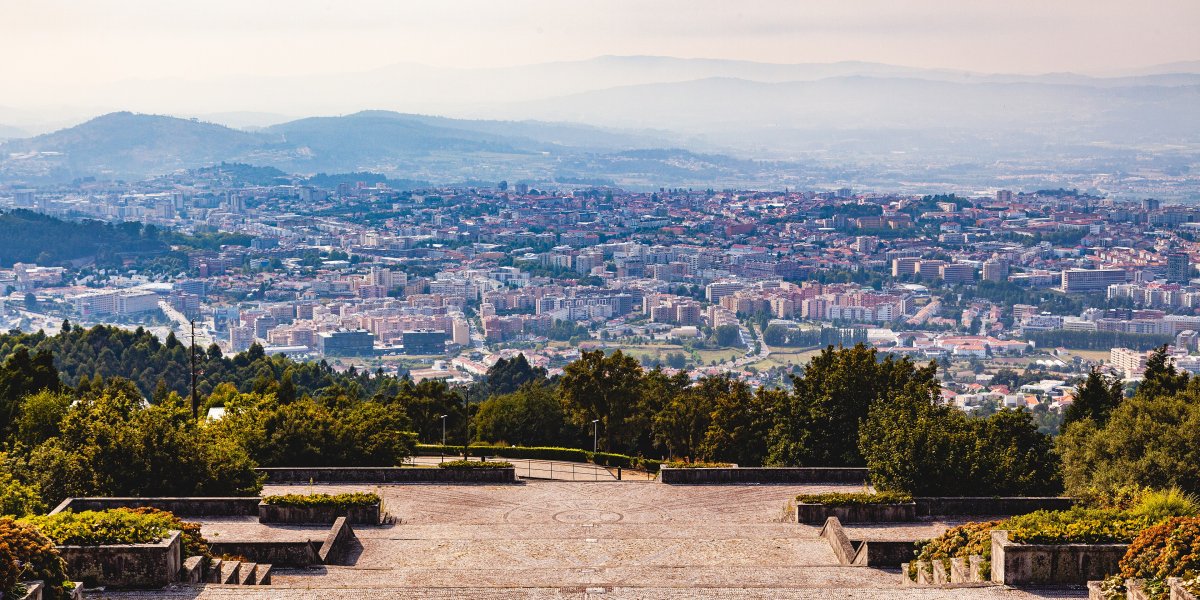
From Braga's bus terminal, Bus #2 ('Bom Jesus') leaves every 30 minutes for a 15-minute ride into the chestnut hills east of town — settle by a right-side window for the first sight of the staircase rising through the trees. Portugal's most photographed monument: 577 stone steps zigzagging up a wooded hillside in a perfect double-Baroque pattern, crowned by a neoclassical sanctuary church. Each landing along the climb stages an allegorical scene — the Fountains of the Five Senses, the Three Virtues, the Five Wounds — chapels and statuary worked into the architecture as a kind of stone catechism. Morning means cool air, soft side-light through the canopy, and you arrive before the 10:30 tour-bus convoy from Porto.
Tip: Ride the funicular UP (€2 one-way; built 1882, the oldest water-balance funicular still operating anywhere on Earth) and walk DOWN the staircase — the iconic shot is from the third landing looking up at the cascading switchbacks framed by chestnut branches. Skip the church interior; the magic is entirely on the stairs, and at 09:30 you'll have the upper landings essentially to yourself.
Open in Google Maps →11:45
Park
Bus #2 back to Avenida da Liberdade, get off at Largo São Francisco, and walk 4 minutes northwest — you'll cut through Praça da República's colonnade of café terraces; slow your pace here, this is the city's living room and the locals' morning meeting place. A 17th-century formal garden wedged against the surviving Gothic wall of the medieval archbishop's palace, with geometric boxwood beds and tight rows of seasonal flowers in pure Portuguese-Baroque symmetry. The crumbling palace's mullioned Gothic windows frame every shot — there is nowhere else in Iberia with this exact backdrop, and most visitors walk past without realising the gates are open to the public.
Tip: Stand on the south terrace with the palace's Gothic arches behind the boxwood maze for the postcard shot — get it before 12:30, when the sun crosses overhead and flattens the hedge texture into a flat green mass. Enter from Rua Dom Frei Caetano Brandão (the corner gate near the medieval tower); the iron railings close 19:00 sharp.
Open in Google Maps →12:45
Food
Exit the garden's south gate, turn right onto Rua do Anjo — 90 seconds and you'll spot the green-tiled storefront and a tail of office workers spilling onto the cobbles. Conga is a single-counter institution since 1976: no menu, no tables, no chairs, just one sandwich made the same way by the same family for four generations. The bifana — slow-braised pork in a garlic, white-wine, and piri-piri broth, slapped into a crusty papo-seco roll dunked through the cooking liquor — has fed Bragans for half a century and was singled out by Anthony Bourdain as one of Portugal's perfect bites.
Tip: Order exactly this: 'uma bifana com mostarda e piri-piri' (€3.20) plus a Super Bock mini (€1.50) — anything more elaborate marks you as a tourist. Eat standing at the marble counter elbow-to-elbow with locals; that IS the experience, and there is no English menu because there is no menu at all. Hit it 12:45 or after 14:15 — between 13:30 and 14:00 the office-worker queue stretches halfway down the street.
Open in Google Maps →13:45
Religious
Two blocks west down Rua Dom Paio Mendes — a 3-minute walk past medieval archways and silversmiths' windows, where the granite paving narrows and the temperature drops in the shade of the cathedral wall. The Sé is the oldest cathedral in Portugal, founded in 1071 on the foundations of a 6th-century Visigothic church and consecrated decades before Portugal itself existed as a kingdom; Romanesque arches, Gothic side-chapels, Manueline doorways, and a baroque sacristy are layered into the same building like geological strata. The exterior alone is enough — circle the apse to Largo do Paço, the dramatic plaza behind the cathedral, where the 18th-century archbishop's palace closes the square in pink granite.
Tip: Enter the cathedral atrium through the Romanesque north portal (free, no ticket needed) for 60 seconds of Gothic gloom, then walk clockwise to the unmarked passage at the rear of the apse — it tunnels through into Largo do Paço and most tour groups never find it. Best façade shot is from the corner of Rua Dom Diogo de Sousa at 14:30, when both bell towers catch direct afternoon sun symmetrically against blue sky.
Open in Google Maps →15:15
Landmark
Exit Largo do Paço heading west on Rua de São Marcos for 5 minutes — the rococo silhouette of the arch rises ahead as the street opens onto Campo das Hortas. The 18th-century western gateway of the old walled city, designed by André Soares in 1772 with two completely different personalities: the inward face a strict neoclassical pediment of restraint and order, the outward face an explosive rococo composition of cherubs, scrolls, and a crown of stone urns. This is the threshold every pilgrim, every Portuguese king, and every Holy Week procession has crossed for 250 years to enter the old town.
Tip: The shot is from OUTSIDE the arch looking through to the old town within — between 16:00 and 17:30 in summer the western façade catches full direct sun and glows golden against the limestone, while the framed view of granite rooftops through the opening stays cool blue in shadow. Stand roughly 30m back from the centre of Campo das Hortas to align both planes; phone-cameras here outperform anything wide-angle because the geometry compresses.
Open in Google Maps →19:30
Food
Cross Campo das Hortas directly behind the arch — 30 seconds, the restaurant is the corner building with wrought-iron balconies and the original 1956 signboard above the door. Inácio has fed Bragans for nearly seventy years and remains the city's reference point for traditional Minho cooking: thick-rimmed wooden tables, blue-and-white Coimbra tile from the opening year, and a wine list almost entirely Vinho Verde from producers within an hour's drive. The cooking is unhurried, deeply regional, and the kind of thing that genuinely does not exist outside this corner of Portugal — you eat here and you understand why Bragans look at Lisbon as if it were a foreign country.
Tip: Order the BACALHAU À MODA DE BRAGA (€16) — salt cod oven-baked with onions, potatoes, and olive oil, the dish literally named after this city — or the VITELA ASSADA À MINHOTA (€18), slow-roasted veal with cumin potatoes; pair with a half-jug of Vinho Verde Loureiro (€6). Reserve by phone at +351 253 613 235 at least 4 hours ahead — there is no online booking and walk-ins after 20:00 wait 30+ minutes on weekends. Pitfall: do NOT eat at the souvenir-menu restaurants on Rua de São Marcos right outside Arco da Porta Nova — they target day-trippers from Porto with €25 'menu turístico' of frozen bacalhau and watery vinho verde; the real Braga meal is the one you walked another 50 metres to find.
Open in Google Maps →
Trip builder
Plan this trip around Braga
Turn this guide into a bookable rail itinerary with FlipEarth.
Keep exploring
Related cities
More in the same country
FAQ
Frequently asked questions
How many days do you need in Braga?
Most travelers enjoy Braga in 1 days, with enough time for headline sights and a slower meal or museum stop.
What's the best time to visit Braga?
The easiest season for most travelers is Apr-Oct, especially if you want good weather and manageable crowds.
What's the daily budget for Braga?
A practical starting point is about €80 per person per day before hotels, then adjust based on museums, dining, and transport.
What are the must-see attractions in Braga?
A good first shortlist for Braga includes Bom Jesus do Monte, Arco da Porta Nova.