City Guide
Torun
Polonia · Best time to visit: May-Sep.
Day-by-day plan
Choose your pace
Duración del viaje
09:00
Landmark
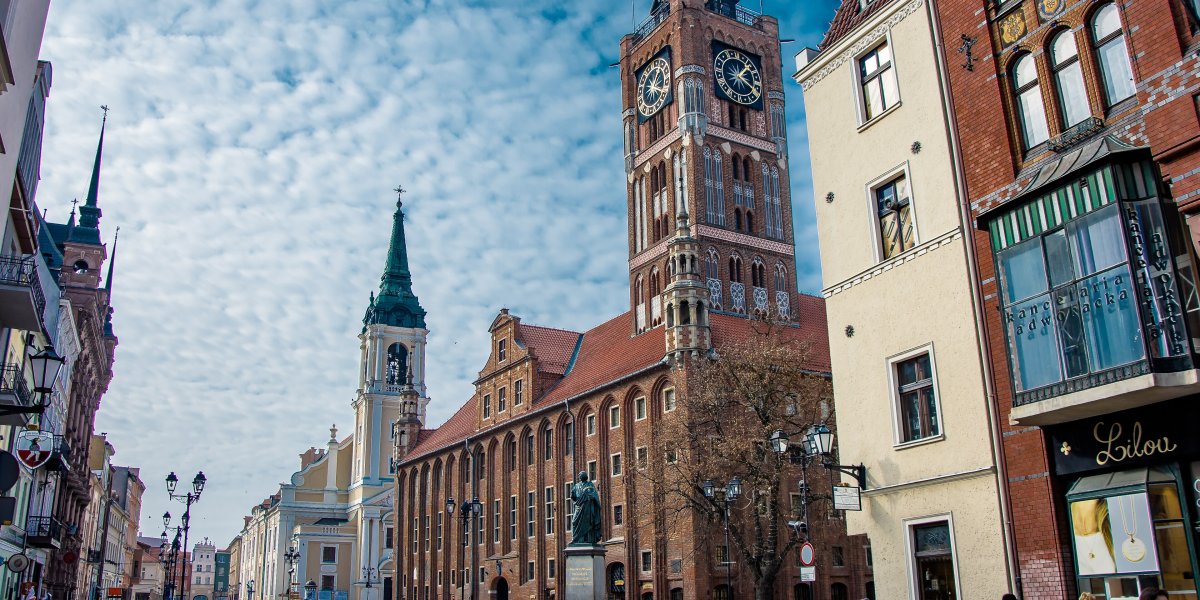
Step onto the square at 9 AM and it belongs to pigeons and shopkeepers raising shutters; soft eastern light hits the red brick of the 13th-century Old Town Hall and makes the Copernicus monument glow bronze. Circle the hall clockwise — every facade is different, and the southwest corner gives the cleanest portrait of the tower — then claim your shot before the 10:30 tour buses pour in from Warsaw and Gdansk.
Tip: The truly iconic Town Hall photo is NOT from the square itself — walk one block east to the corner of Szeroka and Różana, where you frame the full Gothic tower with zero power lines and the morning gable lit straight on. Five-minute detour, the postcard of your trip.
Open in Google Maps →11:00
Landmark
From Rynek's south side, walk down Żeglarska for 3 minutes past the brick Gothic Cathedral, then right onto Kopernika to find the stepped-gable house at number 15 where Nicolaus Copernicus was born in 1473 — a quiet plaque, no queue, just brick. Continue 80 m and round the corner to Krzywa Wieża, a 14th-century defensive tower that leans a full 1.5 m off vertical thanks to soft sandy foundations; locals swear that if you can stand heels-against-wall with arms outstretched and not topple, your conscience is clear.
Tip: Actually attempt the 'clean conscience' test — almost no one holds it past five seconds, and the photo of you fighting gravity is the trip souvenir. Shoot from the right side of the tower facing the lean; the brick batters above your head and the tilt looks twice as dramatic on camera.
Open in Google Maps →12:30
Food
Backtrack 4 minutes north on Żeglarska to Rynek's southwest corner — Manekin (Rynek Staromiejski 16) is the place every Toruń student, clerk and visiting Polish grandma actually eats. The menu is one thing only: naleśniki, Polish crepes, over 100 fillings, all 20-35 zł (€5-9). Order one savory and one sweet — the 'Maluch' with chicken, mushrooms and cheese (~€7) and the 'Toruńska' with local gingerbread crumbs and mascarpone (~€6) — and you've eaten Torun on a single plate.
Tip: Arrive by 12:25 sharp — by 13:00 the queue wraps around the staircase and you'll wait 40 minutes. Climb to the upstairs room: better light for photos, faster service, and the carved wooden beams beat the basement vault. Cash or card; no tipping expected beyond rounding up.
Open in Google Maps →14:00
Landmark
From Rynek walk east on Szeroka for 4 minutes, then right onto Przedzamcze where the ruins hide behind a low brick wall almost everyone misses. Toruń's citizens razed this Teutonic stronghold themselves in 1454 — the only major Knights' castle the locals ever destroyed — and what survives is a quiet moat, a circular dansker tower (a medieval toilet suspended on a bridge — yes, really), and brick foundations you can walk through unsupervised. At 14:00 the southwestern light rakes the dansker brick and the moat sits full of summer-green water.
Tip: Walk straight past the small ticket hut on your right — that's the optional paid basement exhibit, not the ruin grounds, which are completely free. The view back across the moat toward the medieval skyline from beside the dansker tower is the best on this side of the river — better than any drone shot you'll see on Instagram.
Open in Google Maps →16:00
Neighborhood
Drop south from the castle down Przedzamcze for 5 minutes and emerge onto the broad Vistula embankment under the medieval city wall — and suddenly the whole Gothic skyline appears at once: Cathedral spire, Town Hall tower, granary gables, all strung along the red brick of the old fortifications. At 16:00 the sun is over your right shoulder coming from the west, washing every brick gold; walk east along the Bulwar past the surviving city walls toward the Bridge Gate (Brama Mostowa).
Tip: For the postcard panorama every Polish travel poster uses, walk halfway across the pedestrian lane of the Józef Piłsudski Bridge — about 8 minutes south from the Bulwar. You can fit the entire walled skyline in one horizontal frame, something physically impossible from the embankment itself. Bring a wide-angle lens or use phone panorama mode.
Open in Google Maps →19:00
Food
From the Bridge Gate at the eastern end of the Bulwar, walk 2 minutes north on Mostowa to number 1 — Karczma Spichrz occupies a 14th-century granary that once stored Hanseatic grain bound for Gdansk, now Toruń's most beloved Polish kitchen. Exposed brick, oak beams, a working fireplace; order żurek w chlebie (sour rye soup in a hollowed bread loaf, ~€7), pierogi z kaczką (duck pierogi, ~€11), and pieczeń z dzika z żurawiną (roast wild boar with cranberry, ~€18) — a proper Polish closing chord.
Tip: Reserve a day ahead through their website — by 19:30 every table is taken by locals celebrating birthdays. Ask for the corner table by the small round window on the river side; it's the only direct Vistula view in the restaurant. PITFALL: avoid the row of restaurants with English-only menus and waiters waving you in directly on Rynek Staromiejski — they charge two-to-three times Karczma's prices for half the quality. The good kitchens in Torun are always one block back from the square.
Open in Google Maps →Saltar al día
09:00
Landmark
Begin where Torun begins — the vast red-brick Old Town Hall, one of medieval Europe's grandest civic buildings, anchors Rynek Staromiejski. Climb the 176-step tower first thing for a panorama of terracotta roofs sloping down to the Vistula and the Cathedral spire piercing the morning haze. The Copernicus statue at the southwest corner makes the perfect first photograph of your trip.
Tip: Buy the combo ticket (tower + Old Town Hall Museum) at the ground-floor desk — it costs 22 PLN versus 27 PLN bought separately, and the Gothic vaulted halls upstairs are far emptier before noon when tour buses arrive from Gdansk.
Open in Google Maps →11:00
Museum
Walk two minutes south from the square's southwest corner down Zeglarska, then right onto Kopernika — you pass the Eskens House, a 14th-century burgher mansion. Two adjoining Gothic townhouses where Mikolaj Kopernik was born in 1473 now reconstruct 15th-century burgher life and his revolutionary astronomy, including working replicas of his instruments. Do not skip the 4D Torun model show in the basement — a 12-minute light projection over a meticulous wooden city model that locals consider the best orientation to medieval Torun you can buy.
Tip: Reserve the 4D show online at muzeum.torun.pl the night before — only 30 seats per session, and Saturday tourist groups fill it by 11:00. Pick the 12:30 slot to flow straight into lunch nearby.
Open in Google Maps →13:00
Food
From the museum, walk one block west and turn onto Mostowa — the restaurant is on your right, before the river. A cellar pierogi house run by a Torun family for two decades, with dumplings hand-folded each morning. Order the pierogi z gesina (goose pierogi, 32 PLN) — Torun sits on the historic goose route to Berlin and few places outside Poland still serve this — plus a bowl of zurek (sour rye soup with white sausage, 18 PLN). Budget 60-90 PLN per person.
Tip: Ask for the half-and-half plate (pol na pol) — you get six pierogi of two different fillings for the price of one portion. The waitstaff don't advertise it on the English menu but it's always available.
Open in Google Maps →14:30
Religious
Out the front door, two minutes east along Zeglarska — the Cathedral's massive square tower is unmistakable at the end of the street. Torun's Gothic cathedral hides Tuba Dei, the second-largest medieval bell in Poland (7,238 kg), cast in 1500 and still hand-rung on holidays. Inside, look for the baptismal font where Copernicus was baptized in 1473 — a quiet plaque marks the spot most tour groups walk straight past.
Tip: Afternoon is deliberate — the western sun lights the brick interior through the chancel windows around 15:00, turning the nave amber. Climb the tower (separate 10 PLN ticket) right after; the southern parapet frames the Old Town Square against the Vistula better than any drone shot.
Open in Google Maps →16:30
Landmark
Exit the cathedral, walk west along Pod Krzywa Wieza lane (signposted) for 4 minutes — you are already inside the medieval defensive belt. A 14th-century tower that subsided into the sandy Vistula bank and now leans 1.46 m off vertical; legend blames a Teutonic knight who broke his vows, geology blames the river. After the photo, follow the wall westward along Bulwar Filadelfijski past the surviving Bridge Gate — late afternoon turns the Vistula gold and the defensive wall glows red.
Tip: The classic 'lean against the wall hands-free' photo works only from the southeast corner — stand back six paces, line up your heels with the foundation stones. Mid-week the spot is empty; on weekends a small queue forms by 17:00.
Open in Google Maps →19:00
Food
From the Bridge Gate, walk one minute east along Mostowa — the restaurant occupies a 13th-century brick granary on the corner. Dinner inside a working medieval grain warehouse, with original timber beams and four-meter-thick walls — one of the most atmospheric tables in northern Poland. Order golonka pieczona w piwie (beer-roasted pork knuckle for two, 89 PLN) carved tableside, and a bottle of local Kormoran Imperial Stout.
Tip: Reserve the eastern granary nave (sala wschodnia) — the only room where all four original timber tie-beams remain overhead. Pitfall: avoid the bar-mleczny lookalikes on Szeroka Street with laminated multilingual photo menus and aggressive doormen waving you in — they charge double for thawed supermarket pierogi and pre-poured 'house' vodka.
Open in Google Maps →09:00
Museum
Begin in a recreated 16th-century gingerbread bakery on Rabianska, where a costumed master baker leads you through the closely-guarded Torun recipe — grinding spices, kneading the rye-and-honey dough, pressing it into carved oak molds. You leave 45 minutes later with your own warm gingerbread heart wrapped in linen. This is the original interactive Living Museum; do not confuse it with the larger District Museum branch on Strumykowa, which is a static display.
Tip: Book the 09:00 first session at muzeumpiernika.pl two days ahead — afternoons are wall-to-wall school groups from May to June. Request the English-language baker when booking; it costs the same as the Polish session.
Open in Google Maps →11:00
Landmark
From the museum, head east along Rabianska, cross the Old Town Market Square, and continue down Przedzamcze — 8 minutes through the medieval grain quarter. All that remains of the 13th-century Teutonic Knights' castle: the citizens so loathed the order that in 1454 they tore it down stone by stone, leaving only the gdanisko (the iconic latrine tower spanning the moat) standing on its tall arch. Walk the rampart trail through the foundations and descend into the preserved cellars where a small exhibit explains the Knights' rule.
Tip: After the cellars, find the southwest corner of the courtyard — there's a free open viewing platform on the rebuilt wall most visitors miss, with the best angle on the cathedral spire rising over the moat. Mid-morning light hits the gdanisko arch at exactly the postcard angle.
Open in Google Maps →13:00
Food
Walk west on Przedzamcze, cross back through Lazienna into the Old Town Square — Manekin occupies a vaulted Gothic basement on the south side. Manekin was born here in Torun in 2003 and remains Poland's most loved nalesnikarnia — savory and sweet crepes folded into thick triangles. Order the Manekin Nalesnik (chicken, spinach, mozzarella, pesto, 26 PLN) and a sweet one with twarog (Polish farmer's cheese) and forest fruit (24 PLN). Budget 50-70 PLN per person.
Tip: Sit in the underground vaulted room downstairs, not the upstairs annex — this is the original 2003 location, with exposed Gothic brick and a candle alcove table. Arrive at 12:45 sharp; the basement fills by 13:15 every weekend.
Open in Google Maps →14:30
Neighborhood
Exit Manekin, head north up Szeroka Street — Torun's main pedestrian artery — for 5 minutes and you cross from the Old Town into the New Town through an invisible 13th-century border. Torun was actually two towns until 1454: the wealthy Old Town for merchants, the working New Town for craftsmen, and Rynek Nowomiejski is still quieter, less polished, far more lived-in. The brick basilica of St. James on the east side is the most lavish brick-Gothic church in northern Poland, with original 14th-century frescoes that survived only because the New Town was poor enough to be spared Reformation whitewash.
Tip: Inside St. James, walk the southern aisle to the Tree of Life fresco (1380s) hidden behind the second pillar — the colors remain vivid because the chapel was bricked over for 300 years and rediscovered in 1922. No flash; a 2 PLN coin in the wooden box keeps the church free for locals.
Open in Google Maps →16:30
Park
Return south down Szeroka, take Lazienna left to the river — 10 minutes total, ending at Brama Mostowa, the surviving Bridge Gate. Bulwar Filadelfijski is Torun's riverside promenade, and at golden hour it offers what locals call the 'million-zloty postcard': the whole medieval skyline — cathedral, leaning tower, granaries, town hall spire — reflecting in the Vistula. Walk west along the bulwar past the moored gastro-barges, then climb the Bridge Gate's outer ramp for the elevated shot.
Tip: The unbeatable sunset frame is from the small wooden pier 200 m west of the Bridge Gate — stand on the right edge facing the city. Sunset is around 20:30 in June and 18:00 in October; check the time before you walk over so you arrive 30 minutes early for the colors.
Open in Google Maps →19:30
Food
Walk back up Lazienna and right onto Szeroka — the restaurant is at house number 9, three minutes from the river. An elegant Polish restaurant in a restored burgher house, focused on Pomeranian and Kuyavian regional cooking. Order kaczka pieczona z modra kapusta (slow-roasted duck with red cabbage and gingerbread sauce, 78 PLN) — the gingerbread reduction is a true Torun signature — and zurek staropolski served in a bread bowl (28 PLN). Budget 130-180 PLN per person; reserve a window table.
Tip: Pitfall: skip the 'gingerbread' shops along Szeroka with neon signs in five languages — most sell mass-produced Kopernik-brand cookies repackaged at four times retail. Buy genuine handmade gingerbread only at the Living Museum of Gingerbread shop or at Sklep Kopernik on Zeglarska 25 (the brand's factory outlet, half the Szeroka price).
Open in Google Maps →
Trip builder
Plan this trip around Torun
Turn this guide into a bookable rail itinerary with FlipEarth.
Keep exploring
Related cities
More in the same country
FAQ
Frequently asked questions
How many days do you need in Torun?
Most travelers enjoy Torun in 1 days, with enough time for headline sights and a slower meal or museum stop.
What's the best time to visit Torun?
The easiest season for most travelers is May-Sep, especially if you want good weather and manageable crowds.
What's the daily budget for Torun?
A practical starting point is about €55 per person per day before hotels, then adjust based on museums, dining, and transport.
What are the must-see attractions in Torun?
A good first shortlist for Torun includes Rynek Staromiejski (Old Town Square & Town Hall), Copernicus House & the Leaning Tower of Torun, Teutonic Castle Ruins.