City Guide
Stuttgart
Alemania · Best time to visit: May-Sep.
Day-by-day plan
Choose your pace
Duración del viaje
09:00
Landmark
Take the S1 from Hauptbahnhof three stops to Neckarpark, then walk 6 minutes downhill — the silver double helix appears across the plaza like a landed spacecraft. UNStudio's 2006 building is one of Europe's most photographed modern structures: twin spirals of brushed aluminum folding into each other, best understood by walking the full perimeter (about 25 minutes). At this hour the eastern facade is in full sun and the plaza is empty; by 11:00 the tour buses arrive and you'll be photographing strangers.
Tip: The unmissable shot is from the southwest corner of the plaza looking up the curved facade — go between 09:30 and 10:00 when the sun first hits the aluminum and turns it gold. Skip the paid interior; the free terrace on the north side frames the Mercedes-Benz Arena across the river for a second portfolio shot.
Open in Google Maps →10:45
Landmark
Leave the museum plaza heading north, cross the König-Karls-Brücke over the Neckar, and follow the river path west through Rosensteinpark — 25 minutes of plane trees and joggers before the Moorish minarets rise through the leaves. Wilhelma is Europe's only combined zoo and botanical garden, but the unmissable part is free: King Wilhelm I's 1840s Moorish bathing palace, modeled on the Alhambra, with horseshoe arches, glazed tilework, and a long reflecting pool. Morning light hits the cream-colored facade from the east; by afternoon it falls into shadow, so timing matters.
Tip: The best free angle is from the corner of Pragstraße and the Wilhelma-Vorplatz, looking straight up the central axis — no ticket needed and almost no one stops here. Peacocks from the zoo sometimes wander out into Rosensteinpark; you'll hear them before you see them.
Open in Google Maps →13:00
Food
From Wilhelma, cut south through Rosensteinpark into the Unterer Schlossgarten — a 30-minute leafy corridor that drops you straight into the city past the planetarium, emerging at Schlossplatz. The 1914 art-nouveau Markthalle is one block southeast on Dorotheenstraße: a glass-roofed Swabian belly of Maultaschen, Spätzle, sharp Allgäu cheeses, and Trollinger wine. Order Maultaschen mit Kartoffelsalat from the Stephans Wurstwaren counter (€9) and a glass of regional Trollinger (€4), eaten standing at the bar — this is exactly how Stuttgarters lunch.
Tip: Arriving at 13:00 dodges the 12:00 office-worker rush — you'll get a counter seat without queueing. The upstairs gallery (free, accessed by the iron staircase at the south end) gives the only good architectural shot of the riveted iron beams overhead; almost no tourist looks up. Closed all day Sunday.
Open in Google Maps →14:15
Landmark
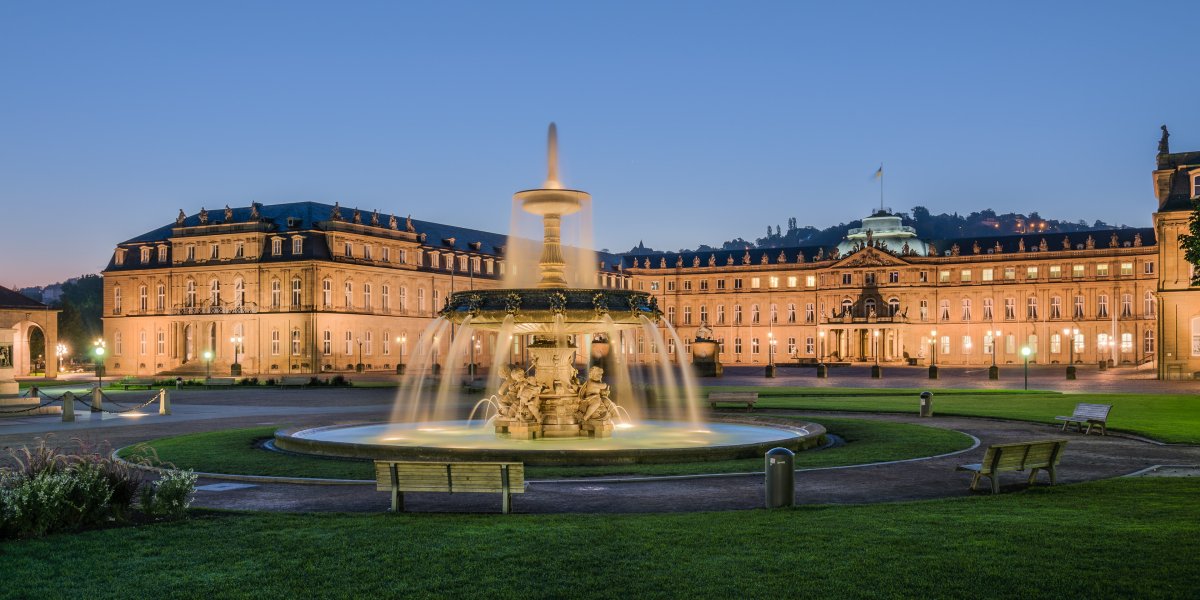
Out the Markthalle's north door, a two-minute walk and the square opens like a stage — the Neues Schloss to the right, the long Königsbau colonnade to the left, and the Jubilee Column rising in the center. The late-baroque palace (built 1746–1807) was the seat of the Württemberg kings, and the column commemorates King Wilhelm I's silver jubilee in 1841. Walk the square clockwise: at this hour the sun is high enough to fully light the Neues Schloss's east facade, and the gold ornaments glow against the cream sandstone.
Tip: The under-radar photo is from the Kunstmuseum's free outdoor terrace — climb the side stairs of the mirrored glass cube facing the square (one flight, no ticket required). It frames the column, palace, and Königsbau in a single composition that most postcards miss.
Open in Google Maps →16:00
Landmark
Slip south from Schlossplatz under the Königsbau's colonnade, two minutes through Karlsplatz, and you arrive at Schillerplatz — the medieval heart of Stuttgart, suddenly intimate after the imperial scale you just crossed. Three buildings face the cobbled square: the Renaissance Altes Schloss with its three-tiered arcaded courtyard (step inside — the courtyard is free and always open), the Stiftskirche with its mismatched twin towers rebuilt after WWII, and the slim Prinzenbau on the south side. Late afternoon, the sun drops low over Königstraße and rakes across the Altes Schloss's red sandstone — the warmest, most cinematic light of the entire day.
Tip: Inside the Stiftskirche (free entry, closes 17:30), the south transept hides a Renaissance stone row of eleven Württemberg dukes carved into the wall — almost every tourist walks straight past it to the altar.
Open in Google Maps →19:00
Food
Five minutes east from Schillerplatz, past the Markthalle, you cross into the Bohnenviertel — Stuttgart's old artisan quarter of narrow lanes and timber-framed houses. Weinhaus Stetter sits on Rosenstraße behind a hand-painted sign and a single low door: open since 1888, run by the Stetter family for four generations, with bare wooden tables, sausage hanging from the ceiling, and thirty regional wines listed in chalk. Order Maultaschen in Brühe (€11), Sauerbraten mit Spätzle (€18), and a quarter-liter of estate Trollinger (€6) — budget €40–55 per person all in.
Tip: Reserve by phone several days ahead — only forty seats and no online bookings; 19:00 is when the after-work locals arrive and the room fills with Swabian dialect, so you'll witness real Stuttgart rather than a tourist scene. Pitfall warning: a dozen 'authentic' Weinstuben have opened around Schlossplatz with English menus and Italian waiters — none of them are genuine Stuttgart wine taverns. The real ones are all in the Bohnenviertel, family-run, and have no website.
Open in Google Maps →Saltar al día
09:00
Landmark
Stuttgart's grand opening act — a baroque ceremonial square framed by the New Palace's pale yellow neoclassical facade and crowned by the 30-meter Concordia Column. Morning light hits the palace's east face cleanly, the great fountains are switched on, and tour groups haven't arrived yet. This is the moment Stuttgart introduces itself.
Tip: Stand on the steps directly below the Concordia Column for the iconic shot — the column, both classical pavilions, and the palace align in one frame. Loop behind to the Königsbau arcade on the west side for a coffee at Café Marquardt with the whole square in view; by 11:00 the angle flattens out and the square fills with school groups.
Open in Google Maps →10:00
Museum
Walk east from Schlossplatz through the chestnut-shaded Schlossgarten — 8 minutes past the Opera House. James Stirling's 1984 building is itself a postmodern masterwork in pink sandstone with electric green window frames. Inside: Picasso's late period, Beckmann's triptychs, and Oskar Schlemmer's irreplaceable Triadic Ballet costumes — the world's most important Bauhaus stage works.
Tip: Enter at 10:00 sharp and head straight to the Schlemmer Bauhaus room in the Modern wing — it fills with school groups by 11:30. The museum is closed Mondays and admission is free every Wednesday. Don't skip the rooftop terrace at the back of the Modern wing — a quiet city view nobody talks about, with Stirling's coloured pipework framing it.
Open in Google Maps →12:30
Food
Walk back west through the Schlossplatz arcades — 10 minutes to one of Germany's most beautiful covered markets. The 1914 Art Nouveau hall hides under a stained-glass roof, with wrought-iron balconies above 30 stalls of olives, charcuterie, Swabian cheese, and hand-folded Maultaschen. Eat standing at the counters where actual Stuttgarter shop.
Tip: Skip the upstairs sit-down restaurant — overpriced and slow. At the Empfinger butcher counter on the ground floor, order a plate of Maultaschen geschmälzt (€11) with a Viertele of Trollinger from the Wein Kreis stall (€4). The hall closes Sundays and at 18:30 weekdays — never come in late afternoon.
Open in Google Maps →14:00
Landmark
Two minutes south through the arcades — Stuttgart's quietest medieval pocket. Schiller's bronze statue surveys a square ringed by the Renaissance Old Castle (with a free arcaded courtyard most visitors miss), the twin-towered Stiftskirche, and the Fruchtkasten granary. The afternoon light at 14:00 grazes the sandstone arcades exactly right.
Tip: Step through the gateway into the Altes Schloss courtyard — most tourists walk straight past without realising it's open and free. Climb the spiral stair on the north side to the chapel landing for an aerial courtyard view nobody photographs. If it's a Tuesday or Thursday morning, the Schillerplatz flower market is unchanged in spirit since 1863.
Open in Google Maps →16:00
Park
Walk west through the Heusteigviertel — 25 minutes uphill through art-nouveau apartment blocks, then suddenly a working vineyard climbing the hillside. This is what makes Stuttgart unique: a state capital where you stroll from cathedral to terraced vines in half an hour. The biergarten at the summit has a 360° view of the city basin and faces directly into the sunset.
Tip: Order a Viertele (0.25L glass, €4) of Lemberger or Trollinger at the Karlshöhe biergarten and claim a spot on the western terrace before 18:00. Sunset paints the city basin red and you can pick out today's stops below — the Stiftskirche towers, the palace dome, the Staatsgalerie roofline. Avoid Friday and Saturday after 18:00 when locals queue.
Open in Google Maps →19:30
Food
Walk down the vineyard path and through the Heusteigviertel to the Bohnenviertel — 25 atmospheric minutes downhill through Stuttgart's old artisan quarter, past art-nouveau facades and lit-up Weinstuben. Fröhlich is a 130-year-old Swabian wine tavern: dark wood, paper menus, regulars at the bar. Order Maultaschen geschmälzt (€16) and Zwiebelrostbraten with hand-scraped Spätzle (€26) — full dinner with wine runs €40-50.
Tip: Reserve 24 hours ahead and ask for the small wood-paneled side Stube — the main hall fills with regulars by 19:30. Order Trollinger by the half-litre Karaffe (€10), not by glass. Pitfall warning: the so-called 'Schwäbisch' restaurants lining Königstraße and Calwer Passage are tourist traps with frozen Maultaschen at twice the price — every real Weinstube is in the Bohnenviertel or Heusteigviertel, and they all close by 23:00.
Open in Google Maps →09:00
Museum
Take the S6 from Hauptbahnhof to Neuwirtshaus (Porscheplatz) — 10 minutes — the museum is 100 metres from the station exit. Delugan Meissl's white monolith floats on three concrete pillars like a sculpture. Inside: 80 cars from the 1948 No. 1 prototype to the latest Mission X, arranged not chronologically but as a single sweeping curve through Porsche's obsession with speed.
Tip: Arrive at 09:00 opening — the museum is closed Mondays and packs out by 11:30. Take the white ramp straight to the upper level and walk back down: the crowd flows the opposite way, so you'll have rooms to yourself. The 1948 Porsche No. 1 (the very first car to wear the name) is in the second hall — most visitors speed past it chasing the 911s.
Open in Google Maps →11:00
Museum
S6 back to Hauptbahnhof, transfer to S1 to Neckarpark — 25 minutes total — then a 5-minute walk past the VfB stadium. UN Studio's silver double-helix building has you take the elevator straight to the top, then spiral down through 130 years of automotive history starting with the 1886 Benz Patent-Motorwagen, the world's first car. The Silver Arrows racing hall on the lower levels is unreal.
Tip: Take the silver Legend route (cars in chronological context), not the Collection route — the Legend rooms tell a single connected story across eight floors. Pause at the 1886 Benz Patent-Motorwagen on Level 7 for ten quiet seconds: this is where the automobile starts. Closed Mondays; pick up the free audio guide at the entrance — without it you'll miss half the storytelling.
Open in Google Maps →13:30
Food
Skip the elevator down — the in-museum restaurant occupies a glass-walled corner of the building with a view sweeping the Neckar valley and the vineyards on the far hills. After two hours of car history, sitting up here with a Württemberger glass in hand is genuinely a moment. Order Maultaschen in der Brühe (€16) and Kalbsrahmgulasch with hand-scraped Spätzle (€24) — full lunch with wine €25-30.
Tip: Sit on the south side facing the city basin — the midday light is harsh on the north terrace and the view there is of the rail yard. The two-course Tagesmenü (€25) is the smartest order; à la carte prices climb fast. Last lunch service is 14:30 sharp — don't dawdle in the museum past 13:15 or you'll be locked out of the dining room.
Open in Google Maps →15:00
Park
Walk to S-Bahn Neckarpark and take S1 one stop to Bad Cannstatt, then 8 minutes on foot to the gates. King Wilhelm I built this in 1846 as a private Moorish pleasure palace; bombed in WWII and rebuilt as Europe's only combined zoological-botanical garden. The Moorish villa, the Damascene Hall, the great greenhouse, the magnolia grove, and 11,000 animals — all in one walk through what looks like Andalusia transplanted to the Neckar valley.
Tip: Enter via the upper Pragstraße gate, not the main Wilhelma gate everyone uses — you'll skip the 30-minute summer queue at the main entrance. Walk straight to the Maurischer Garten and the Damascene Hall first; the Moorish core is what no other zoo in Europe has, and you want to see it before the late-afternoon glare. In April hit the Magnolienhain on arrival — the bloom lasts ten days only.
Open in Google Maps →18:00
Neighborhood
Exit Wilhelma's south gate and walk 10 minutes east through the Rosensteinpark to the Cannstatt old town — a half-timbered village swallowed by Stuttgart in 1905 but still intact. The 14th-century Stadtkirche, the Marktplatz fountain, and the medieval Klösterle (built 1463 — the oldest house in town). The early-evening light on the timbered facades is the best photo light of the day.
Tip: Walk Marktstraße from the Stadtkirche down to the Klösterle building, then loop south to Wilhelmsplatz — there's a free public fountain on the square pouring naturally carbonated mineral water from the Sulzerrain spring (Stuttgart sits on Europe's second-largest mineral-water reserve; locals fill bottles here). Bring a small empty bottle. The Klösterle building you just walked past is your dinner.
Open in Google Maps →19:30
Food
You're already at the door — Klösterle occupies the 1463 half-timbered Klösterle house you just photographed, the oldest building in Cannstatt. Low beams, worn wood floors, classic Swabian cuisine done seriously by a family kitchen. Order Schwäbischer Zwiebelrostbraten with hand-scraped Spätzle (€29) and Linsen mit Spätzle und Saitenwürstle (€19) — dinner with wine runs €45-55.
Tip: Reserve at least 48 hours ahead and ask for a table in the original ground-floor Stube — the upstairs rooms are pretty but lose the medieval atmosphere. Order Trollinger from the Cannstatter slopes by the Viertele (€6) — these grapes were grown 800 metres from your plate. Pitfall warning: avoid the chain beer halls around Cannstatter Bahnhof and the 'Schwäbisch' tourist menus along Königstraße on your way back — Stuttgart's real Wirtshäuser close their kitchens by 21:30, so eat early or you'll end up with a Döner.
Open in Google Maps →
Trip builder
Plan this trip around Stuttgart
Turn this guide into a bookable rail itinerary with FlipEarth.
Keep exploring
Related cities
More in the same country
FAQ
Frequently asked questions
How many days do you need in Stuttgart?
Most travelers enjoy Stuttgart in 1 days, with enough time for headline sights and a slower meal or museum stop.
What's the best time to visit Stuttgart?
The easiest season for most travelers is May-Sep, especially if you want good weather and manageable crowds.
What's the daily budget for Stuttgart?
A practical starting point is about €120 per person per day before hotels, then adjust based on museums, dining, and transport.
What are the must-see attractions in Stuttgart?
A good first shortlist for Stuttgart includes Mercedes-Benz Museum (Exterior), Wilhelma Zoological-Botanical Garden (Moorish Facade), Schlossplatz & Neues Schloss.