City Guide
Sitges
España · Best time to visit: May-Sep.
Day-by-day plan
Choose your pace
Duración del viaje
09:30
Neighborhood
Exit Sitges train station and walk straight down Carrer de Sant Francesc — five minutes of palm-shaded street that drops you into the whitewashed lanes of the old town. Begin at Plaça del Cap de la Vila, then weave through Carrer Major and the narrow Carrer d'en Bosc until the alleys break open at the seafront. Morning light slants low over the limestone walls before tour buses arrive from Barcelona, and the bakeries are still pulling coca de Sitges from the oven.
Tip: Stop at Forn de Pa Vallès on Carrer Major for a slice of coca amb pinyons (around 2.50€) — Sitges' answer to flatbread, dusted with pine nuts and sugar. Eat it standing at the counter; sitting at a table is double the price.
Open in Google Maps →11:00
Park
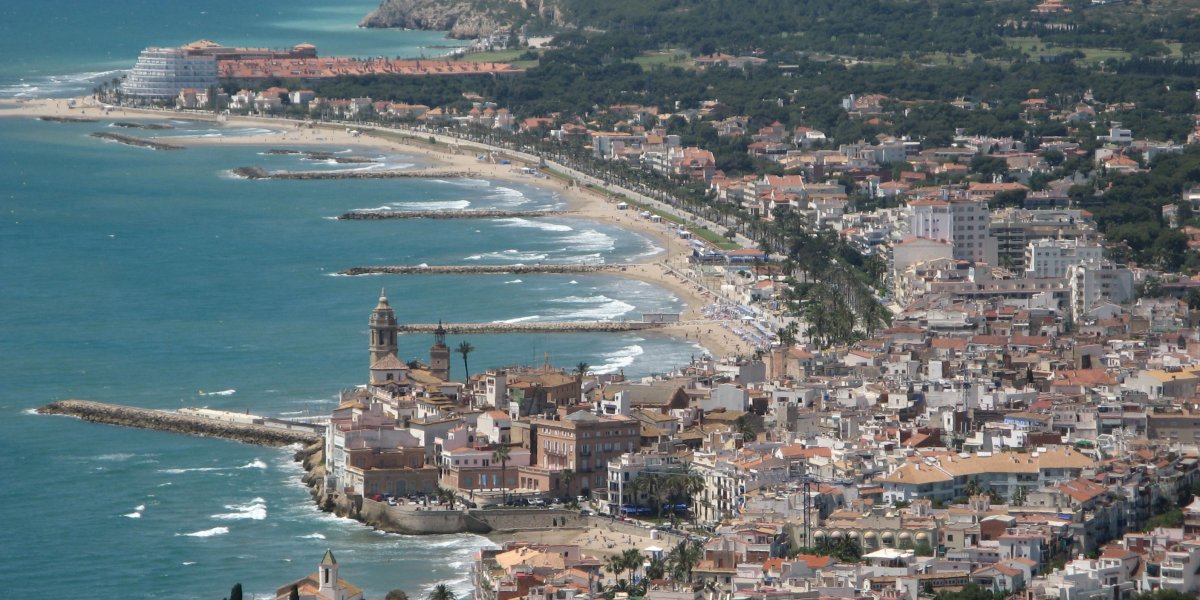
From the old-town seafront, curl left around the rocky promontory beneath the white church — a 7-minute walk along Passeig de Vilafranca with the Mediterranean opening up on your right. Sant Sebastià is the locals' beach, smaller and quieter than the showy Passeig de la Ribera stretch, with the church looming directly above you for the postcard shot. Continue east along the cliffside Camí de Ronda toward Aiguadolç marina to clock the day's first real kilometres while the sun is still kind.
Tip: Walk to the rocks at the very east end of Sant Sebastià Beach and turn back west — this is the only angle where you get the church, the bell tower and the open sea in a single frame, with morning sun lighting the facade. Most visitors stay on the Passeig side and never see it.
Open in Google Maps →13:30
Food
Loop back around La Punta to the old town — 10 minutes along Carrer de Sant Pau, the spine of Sitges' food street. El Pou is a tiny tapas counter where the chef has won the regional best-tapa prize for his mini Wagyu burger. Lunch here is built for speed: order at the bar, eat in under an hour, back on the road.
Tip: Order the mini Wagyu burger with mustard mayo (3.80€) and the bomba de patata explosiva (3.20€) — that's the whole order, do not over-fill. Arrive by 13:30 sharp; from 14:00 the wait turns into 40 minutes and they stop seating at 15:30.
Open in Google Maps →15:00
Neighborhood
Leave El Pou, cross one block south to Passeig de la Ribera and head west — the sea on your left, a parade of Modernist buildings on your right. You'll pass Casa Pere Carreras, the gabled Casa Manuel Planas, and the long sweep of Bassa Rodona, Estanyol and Riera Xica beaches before Passeig Marítim quiets into the residential Terramar stretch. Afternoon is when the Mediterranean turns its strongest blue and the white facades glow against it — this is the 17-beaches feeling Sitges sells, and you walk it end to end.
Tip: Turn around at the pink-domed Hotel Estela Barcelona (the unofficial west end of the Passeig) — anything past Terramar is suburban road, not seafront. On the walk back, cross to the beach side at Bassa Rodona for the cleanest reverse view of the church on its rock.
Open in Google Maps →19:30
Landmark
Stop walking near La Fragata on Passeig de la Ribera — the white church on its rocky outcrop is now lit edge-on by the setting sun, the Mediterranean turning copper behind it. This is the photo Sitges puts on every postcard, and it only works in the last 40 minutes before sunset, from this western angle. Climb the steps up to the Mirador del Baluard beside the church for the high-angle shot back over the bay once the sky starts burning.
Tip: Sunset in summer falls around 21:00 — arrive at Passeig de la Ribera by 20:15 to claim a spot on the low seawall before the photographers stack three-deep. Skip the horse-drawn carriages waiting by the church; they charge tourists 60€ for a 10-minute loop and the route shows you nothing you haven't already walked.
Open in Google Maps →21:00
Food
Walk three minutes inland from the church up Carrer de Sant Pau — La Salseta sits on the same street as lunch, but this is a proper sit-down where Sitges families eat. The kitchen runs slow Catalan classics with whatever the morning's boats brought in, and the dining room glows under low lamps once the sun is fully down. After a 17-kilometre day, this is the meal you sit through, not rush.
Tip: Order the arròs negre amb sípia (squid-ink rice, 22€) — it needs 25 minutes from the kitchen so ask for it the moment you sit. Reserve the same morning via their website; walk-ins after 21:00 are turned away every Friday and Saturday in summer. Tourist-trap warning: skip the chalk-board 'paella + sangria 18€' restaurants along Passeig de la Ribera — frozen rice, tetra-pak wine, and they're the reason locals eat one street back.
Open in Google Maps →
Trip builder
Plan this trip around Sitges
Turn this guide into a bookable rail itinerary with FlipEarth.
Keep exploring
Related cities
More in the same country





FAQ
Frequently asked questions
How many days do you need in Sitges?
Most travelers enjoy Sitges in 1 days, with enough time for headline sights and a slower meal or museum stop.
What's the best time to visit Sitges?
The easiest season for most travelers is May-Sep, especially if you want good weather and manageable crowds.
What's the daily budget for Sitges?
A practical starting point is about €95 per person per day before hotels, then adjust based on museums, dining, and transport.
What are the must-see attractions in Sitges?
A good first shortlist for Sitges includes Church of Sant Bartomeu i Santa Tecla — Golden Hour.