City Guide
Salamanca
España · Best time to visit: Apr-Jun, Sep-Oct.
Day-by-day plan
Choose your pace
Duración del viaje
09:00
Landmark
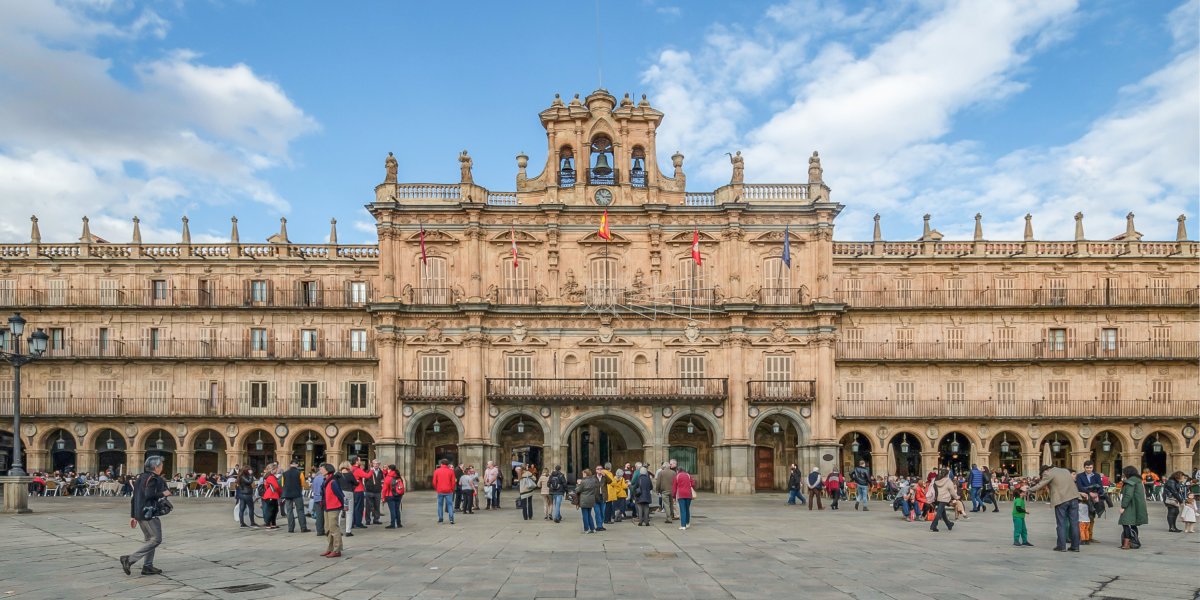
Start at the heart of the city before the tour coaches arrive. At nine in the morning the low eastern sun strikes the Ayuntamiento's clock tower and the Villamayor sandstone turns a pale, honey-gold that no other Spanish square can match — this is the single most photogenic moment of your entire day. Walk a slow full lap under the arcades and scan the medallions above each arch for portraits of Spanish kings, Cervantes, El Cid, and the small, recently added (and still controversial) Franco roundel on the east side.
Tip: Stand at the southwest corner facing the Ayuntamiento around 09:15 — you'll get the full sunlit northern facade with no one in your frame. By 10:30 the square fills with cruise groups and the flat overhead light kills the gold tone; do not come here first in the afternoon.
Open in Google Maps →10:30
Landmark
Exit Plaza Mayor through the south arch and follow Rua Mayor for five minutes — you will pass the Casa de las Conchas on your right, so pause for a photo of the 300 carved scallop shells covering its exterior before continuing. Turn right onto Calle Libreros and Spain's oldest university (founded 1218) opens out onto the small Patio de las Escuelas. The 1529 Plateresque facade is so densely carved it looks like lace turned to stone. Your one mission: find the hidden frog, a medieval good-luck charm for students sitting exams.
Tip: Hint without spoiling it: start from the crowned royal medallion in the middle tier, then track your eye to the right-hand pilaster and look for three tiny skulls — the frog perches on the rightmost one. Stand dead-center in the plaza for the classic wide shot; sunlight hits the facade straight-on until about 12:00, then falls into shadow.
Open in Google Maps →12:30
Food
Two-minute walk back up Calle Libreros and right onto Calle Compañía — this unflashy tapas bar sits on the ground floor of a 17th-century building and has fed Salamanca students and professors for four decades straight. Skip the dining room and order standing at the bar: the pincho de solomillo ibérico (€4.50) and the patatas revolconas con torreznos (€8) are the two plates regulars reach for. A caña of Mahou is €2, a glass of Toro red is €3.
Tip: Arrive by 12:45 at the latest — by 13:30 the bar is three people deep and you won't get served before 14:15. Eating standing at the counter is the point; sitting at a table means waiting 40 minutes for the same food at double the price.
Open in Google Maps →14:00
Religious
Walk three minutes south from El Bardo down Calle Calderón de la Barca to Plaza de Anaya — this tree-lined square offers the best ground-level view in Salamanca, with the full Gothic bulk of the Catedral Nueva rising above lime trees still pale-green in spring. The two cathedrals (New, 16th c., and Old, 12th c.) are fused into one continuous structure: walk counter-clockwise around the full perimeter so you can trace where Romanesque ends and Late Gothic begins. On the west-facing Puerta de Ramos, hunt for two carvings added during the 1992 restoration — an astronaut and a gargoyle eating an ice-cream cone.
Tip: The astronaut is on the left column of the Puerta de Ramos, roughly three meters up — a small figure in an unmistakably modern spacesuit. Most visitors walk straight past it because the official guides never point it out. Afternoon light between 15:00 and 16:00 hits this doorway dead-on for photos.
Open in Google Maps →17:00
Landmark
From Plaza de Anaya walk downhill via Calle Tentenecio for eight minutes, all descent — you'll pass the small verraco, a weathered Iron Age stone bull that has guarded the bridge's north end for over two thousand years. Cross the Roman bridge (built under Emperor Augustus, still load-bearing) to the southern bank and then turn around. This is the postcard of Salamanca: the twin cathedrals and the entire old city rising behind the Tormes in solid Villamayor sandstone. Golden hour is what this city was built for, and standing here between 17:30 and sunset you finally understand why.
Tip: Walk 150 meters downstream (west) from the bridge's south end — there is a small dirt path along the bank — for a clean skyline frame with no modern footbridge cutting across. Bring a light layer; wind off the Tormes picks up sharply at dusk even in summer. Ignore the horse-carriage touts at the north-end; they charge €40 for a five-minute loop that goes nowhere scenic.
Open in Google Maps →19:30
Food
Walk back across the Roman bridge and twelve minutes uphill via Calle San Pablo to Plaza del Poeta Iglesias, directly behind Plaza Mayor. This is the serious Castilian dinner of the day — white tablecloths, an open wood-fired grill at the back, the sort of place where Salamanca families come for anniversaries. Order the solomillo de retinto (€28), the free-range indigenous beef tenderloin you genuinely cannot eat outside Castilla y León, and start with the croquetas de rabo de toro (€12). Expect €45–55 per person with a glass of Ribera del Duero.
Tip: Reserve two days ahead on their website; walk-ins after 20:30 are turned away every single night. Ask specifically for a table on the upper floor — the ground level is noisier and faces the service pass. Pitfall warning: do not eat at any restaurant with a laminated photo menu on Plaza Mayor or Rua Mayor — those are pure tourist traps serving €25 microwaved paella. Every genuinely good restaurant in Salamanca sits one block off the main arteries, exactly like this one.
Open in Google Maps →Saltar al día
09:00
Landmark
Enter the square from the northern arch — before 10:00 the colonnades belong to delivery carts, sleepy students, and a handful of pigeons, and the low sun paints the whole ring of balconies a deep honey gold that the midday glare later flattens. Pick the café tables on the east side so you're facing the west-wall medallions with sunlight behind you. Start with a café con leche and a tostada con tomate while the city wakes up.
Tip: Walk the balcony ring and find the medallion of Cervantes (north wall) and the scratched-out medallion where Franco's portrait once hung (east wall, 3rd from the corner) — locals point it out but no plaque marks it. Photos are sharpest between 09:15 and 09:45.
Open in Google Maps →10:15
Landmark
Exit Plaza Mayor through the south arch and walk down Calle Rúa Mayor — in four minutes you'll pass the shell-studded wall of Casa de las Conchas on your right; duck into its patio for 60 seconds, then continue. The carved Plateresque facade of the 1218 university appears suddenly on a small plaza; stand ten meters back and hunt for the frog perched on a skull on the right-hand pillar before you go inside. Inside, Fray Luis de León's wooden classroom is preserved exactly as he left it in 1572, and the old library smells of 500-year-old parchment.
Tip: The frog is on the third column from the right, sitting on top of the largest skull at about eye level — look just left of the rightmost ornate niche. Don't buy a guidebook at the gate; the free paper map they hand you marks every room.
Open in Google Maps →12:45
Food
Walk east on Calle Libreros, cross Plaza de Anaya, and continue on Calle Gran Vía for about 8 minutes — Toño's place is small, loud, and the pincho counter is the first thing you see. This is a Michelin Bib Gourmand kitchen hiding in a neighborhood tapas bar. Order the pincho de solomillo al foie (8€), the tosta de sardina ahumada con queso de cabra (6€), and a glass of Arribes del Duero. Budget 25-30€ per person.
Tip: Stand at the bar, not at a table — bar tapas are faster, half the price, and Toño himself often plates them. Arrive before 13:00 or after 14:30; the locals-only rush fills the place solid between 13:30 and 14:15.
Open in Google Maps →15:00
Religious
Walk back west on Gran Vía then south through Plaza de Anaya — the new cathedral's carved portal rises straight ahead in ten minutes, and the astronaut hidden in the left archway (added during a 1992 restoration) is the first thing to spot. Enter through the Gothic Catedral Nueva, then slip through the side door into the 12th-century Catedral Vieja; the Romanesque-to-Gothic transition happens in two steps. Finish with the Ieronimus tower walk across the rooftops — the afternoon sun lights the sandstone pinnacles from the west at this hour, and you'll see the whole Old Town laid out below.
Tip: Buy the combined Ieronimus + cathedral ticket at the tower entrance on Plaza Juan XXIII — the main cathedral queue is twice as long and sells the same access. The rooftop walk has 200+ steps and no elevator; skip it if knees are an issue, because the Scala Coeli sunset tonight gives you the same view.
Open in Google Maps →18:30
Landmark
Leave the cathedral via Patio Chico and walk five minutes north on Calle Serranos — the twin baroque towers of La Clerecía loom directly opposite Casa de las Conchas. Climb to the upper terrace 45 minutes before sunset: you'll stand at cathedral spire height with the dome of the new cathedral to the south, Plaza Mayor's red roofs to the north, and the whole city flushing from honey to deep amber as the sun drops behind the Tormes. This is the single best viewpoint in Salamanca — chosen over the cathedral roof because the angle lets you see both cathedrals together.
Tip: Last admission is 7:30 pm in summer but shrinks to 6:00 pm Nov-Feb — check the day's closing time at the door. Go straight to the upper terrace first, then work your way down; the lower cloister stays open later and has zero crowds after sunset.
Open in Google Maps →20:45
Food
Five-minute walk north on Calle Compañía, through Rúa Antigua, and straight into Plaza Mayor — the entrance is tucked under the arcade at number 15. Ask specifically for a balcony table overlooking the square; after 21:30 the plaza floodlights switch on and the whole amber theater glows. Order the chuletón de ternera a la parrilla (22€/person, shared), pimientos de Padrón, and a bottle of Ribera del Duero. Budget 40€ per person.
Tip: Balcony tables must be reserved by phone 24 hours ahead — the website booking only releases ground-floor seats. Pitfall warning: avoid the restaurants with waiters standing outside Plaza Mayor flagging down tourists — their menús del día on the square are often 18-22€ for microwaved paella. Mesón Cervantes and Don Mauro (3 doors down) are the only two plaza-facing kitchens locals actually eat at.
Open in Google Maps →09:30
Religious
From Plaza Mayor, walk south down Calle de la Compañía and Calle San Pablo for about ten minutes — the monastery's cinnamon-gold facade appears on your left, framed by a row of plane trees. This is the most intricate Plateresque stonework in Spain after the university, and between 10:00 and 11:00 the sun hits it from the east at exactly the angle the 16th-century carvers planned for — every saint, skull, and scallop shell pops with shadow. Inside, the 17th-century gilded altarpiece by José de Churriguera is so dense with gold leaf that the word 'churrigueresque' was coined for it.
Tip: Columbus stayed here while pitching his voyage to the Dominicans; the tiny 'Sala Colón' off the upper cloister is often missed — ask the gate attendant to point it out. Enter the church by the side door on Plaza del Concilio de Trento, not the main facade, to skip the group tours.
Open in Google Maps →11:15
Religious
Walk 60 seconds directly across the plaza — Las Dueñas stands opposite San Esteban, and you've probably already seen its modest door. The reward is hidden: a two-story 16th-century cloister with columns twisted into human skulls, dragons, and screaming faces, with not a single carving repeated. You'll share it with four or five other people. On your way out, the Dominican nuns sell almendras garrapiñadas (caramelized almonds) from a small turnstile — 5€ a bag, made in their kitchen, and the best edible souvenir in Castile.
Tip: The nuns are silent — you speak your order into the wooden turnstile (torno), place cash, and it rotates. Exact change helps. They close promptly at 12:45 for midday prayer, so buy the almonds before leaving the cloister.
Open in Google Maps →13:00
Food
Ninety seconds' walk back up Calle San Pablo — number 66, on your right, a narrow stone storefront. This is where Salamanca's chefs eat on their days off: classic ingredients reworked into seven-euro plates. Order the carrillera ibérica al vino tinto (pork cheek in red wine, 6€), the huevo roto con jamón y trufa (5€), and the pulpo a la brasa (7€). Budget 22€ per person with a glass of Rueda.
Tip: The printed menu has 30 items; the chalkboard behind the bar has the day's five best. Ask 'qué hay en la pizarra?' and order only from there — that's where the chef is playing. Walk-ins only, so come at 13:00 sharp or accept a 20-minute wait.
Open in Google Maps →15:00
Museum
Walk three minutes west along the old city wall — Casa Lis sits pinned to the southern edge of the Old Town, a glass-and-iron confection that looks nothing like anything else in Salamanca. Between 15:00 and 16:30 the afternoon sun pours through the stained-glass roof and throws coloured puddles across the marble floor of the main hall — the building itself is the single best exhibit. Upstairs: Lalique glass, Fabergé, and 400 Art Deco ivory dancers. Keep the tour tight at 90 minutes.
Tip: Thursday afternoons are free from 11:00 — avoid then unless you want crowds. The café terrace on the south side is little-known and hangs over the city wall with a direct view down to the Tormes river — buy a coffee, skip the museum's indoor café.
Open in Google Maps →17:15
Park
Exit Casa Lis's terrace to the western wall and walk 90 seconds along Calle Arcediano — the literary garden hides behind an unmarked iron gate beside a stone tower. It's named for the doomed lovers of Spain's 1499 novel 'La Celestina,' and the pergola looks directly across the Tormes to the cathedral silhouette. Sit on the west bench for 20 minutes, then descend the steep path below the wall, cross the riverside promenade, and step onto the 1st-century Roman Bridge. Walk halfway across and turn back: at 19:30 in summer (17:30 in winter) the setting sun lights the entire sandstone skyline from behind and the river carries the reflection — this is the postcard shot of Salamanca, the one reason you came south today.
Tip: Don't cross the full bridge — stop at the stone bull statue halfway (the verraco, pre-Roman Celtic) and shoot back toward the city. Tripods are tolerated on the downstream side, never on the upstream pedestrian path where cyclists fly through. Pitfall warning: the 'gypsy flamenco tours' that solicit on the riverside path after dark are not official — ignore them, and keep wallets in front pockets; this is the only stretch in Salamanca where pickpocketing is ever reported.
Open in Google Maps →20:30
Food
Climb back up to the Old Town via Calle Tentenecio — a steep six-minute walk that delivers you to Plaza del Poeta Iglesias, just east of the cathedral. Gonzalo's is the farewell dinner: a modern Castilian kitchen in a stone-walled dining room where Salamanca's ibérico ham meets smoked meats from the Béjar mountains. Order the steak tartare Gonzalo-style (prepared tableside, 24€), the morcilla de Guijuelo con manzana (12€), and the tocinillo de cielo for dessert. Budget 50€ per person with wine.
Tip: Reserve at least two days ahead online — Saturdays fill a week out. Ask for the table in the inner stone-arched room, not the front room facing the plaza. They pair every dish with a specific wine by the glass if you ask; the sommelier speaks English and it's the best 3€ upgrade of the trip.
Open in Google Maps →Saltar al día
10:00
Religious
Start the trip here: arrive at the Puerta de Ramos on Plaza de Anaya for the 10:00 opening — the Villamayor sandstone is still cool and the Romanesque Torre del Gallo glows against a low sun from the east. Buy the combined ticket and head straight up the Ieronimus walkway first: you'll cross the roofs between the Old and New Cathedrals with a 360° view over the city, then descend into the 12th-century Old Cathedral cloister before the coach tours arrive around 11:30. Inside, the 53-panel altarpiece by Nicolás Florentino and the Torre del Gallo's Byzantine dome are the two things not to rush.
Tip: On the New Cathedral's Puerta de Ramos façade, look for the astronaut and the ice-cream-eating gargoyle — a 1992 restorer's signature carved into the 18th-century stone. Nobody signposts it; stand just right of the main portal and look up at the outer archivolt.
Open in Google Maps →13:00
Food
Two minutes uphill from the cathedrals on Calle San Pablo — a cool, quiet street after the bright square. This is where local professors go when they want modern Castilian cooking without theatre: chef Alberto López Oliva works with Salamanca's two signature products, Guijuelo ibérico and Morucha beef, on a short changing menu. Order the 'patata revolcona con torreznos' (smoked paprika-crushed potato with pork crackling, €12) and the slow-cooked 'carrillera de Morucha' (beef cheek in red wine, €22); average lunch with a glass of Ribera runs €28-35.
Tip: Book the day before on their website — they only seat 24 at lunch and walk-ins are turned away after 13:15. Ask for the back room by the wine library, not the front window (which gets afternoon glare).
Open in Google Maps →15:00
Museum
Walk south downhill from La Hoja 21 for 8 minutes along Gibraltar street — you'll see Casa Lis before you reach it: a cast-iron and stained-glass pavilion cantilevered over the old city wall, the only modernist building in the sandstone old town. Come now rather than morning: the afternoon sun fires through the south-facing stained-glass roof and projects coloured pools across the marble floor of the central patio, and this is the only hour it happens. Inside is the finest Tiffany, Gallé and Lalique collection on the Iberian peninsula, plus an unsettling room of porcelain dolls.
Tip: Entry is free every Thursday morning 11:00-14:00, but that's exactly when Spanish school groups visit — pay the €5 weekday afternoon ticket for an almost empty museum. The cafeteria on the city wall has the best free view in Salamanca; order a coffee even if you don't eat.
Open in Google Maps →17:30
Landmark
Walk back up Calle Meléndez for 7 minutes and enter the Plaza through the Pabellón Real arch on the south side — your first glimpse should be framed by the arcade, not from the middle of the square. This is the hour: between 18:00 and 19:30 in spring and autumn the setting sun hits only the east side's sandstone and it literally turns amber for 20 minutes while the west stays in shadow. Sit on the stone bench under the west arcade with a vermouth from Café Novelty (the oldest café in the city, 1905) and watch the light climb the clock tower of the Pabellón Real.
Tip: The best photo is from the north arcade looking south-east at 19:00 — you get the glowing façade, the clock, and the shadow line cutting diagonally across. Walk the plaza counter-clockwise and count the medallions in the arcade spandrels: the empty one reserved for Franco on the east side was deliberately left blank after 1975.
Open in Google Maps →20:30
Food
Cross the plaza to the north-east corner — Don Mauro has the only ground-floor dining room that actually opens onto the arcade with real Castilian cooking rather than tourist menus. Reserve a window table: as you eat, the plaza's uplighters switch on and the sandstone goes from amber to honey-gold. Signature dishes: 'cochinillo al horno' (suckling pig from nearby Arévalo, €26) and 'merluza a la salmantina' with garlic and smoked paprika (€24); set menu €42, à la carte around €50 per person with wine.
Tip: PITFALL WARNING: every other restaurant on Plaza Mayor with a menu-del-día sign is a tourist trap — frozen paella, €18 mediocre steaks, touts waving laminated photos. Don Mauro and Las Torres (south side) are the only two locally respected houses on the square. Never, ever sit at a plaza terrace that doesn't show prices on the menu outside; the 'cover charge' can triple your bill.
Open in Google Maps →10:00
Landmark
From Plaza Mayor walk south through the Rúa Mayor arcade for 6 minutes — at the end, turn right into Calle Libreros and the plateresque façade rises without warning, every square centimetre carved like embroidered stone. Arrive right at the 10:00 opening: the east-facing façade is lit by morning sun until about 11:30, which is the only hour the hidden frog is actually visible without squinting. Inside you'll find the Fray Luis de León lecture hall (untouched since 1577, his last lecture before the Inquisition, 'As I was saying yesterday...') and the 16th-century library upstairs with 2,800 chained books.
Tip: The frog is on a skull on the right pilaster, about two-thirds up the façade. Stand with your back to the fountain in the Patio de Escuelas, look at the right pillar between the two medallions of the Catholic Monarchs — the frog sits on the right-hand skull at the top. Student legend says spotting it unaided means you'll return to Salamanca; paying a guide to point it out voids the wish.
Open in Google Maps →12:30
Food
Four minutes' walk north on Calle San Pablo — a narrow stone room on a side street that locals actually queue for (as opposed to the tourist tapas row on Rúa Mayor). Come at 12:30 on the dot: Spanish lunch starts at 14:00, so you'll have the bar to yourself for the first 45 minutes. Order the 'huevos rotos con foie y trufa' (€9.50), the slow-braised 'carrillera ibérica' (€6.50 tapa, €14 ración), and a glass of Arribes del Duero — three tapas plus wine runs €18-22, enough for a real lunch.
Tip: No reservations, but they turn tables fast. Sit at the bar rather than a table — the chef prepares each tapa in front of you and will slip you the 'off-menu' dish of the day (usually game or offal, never on the chalkboard) if you ask politely in Spanish. Skip the sangría; this is wine country.
Open in Google Maps →14:30
Landmark
Two minutes back up Calle Meléndez — Casa de las Conchas (350 scallop shells carved into its walls for a 15th-century knight of Santiago) sits directly opposite the massive baroque bulk of La Clerecía. Visit Casa de las Conchas first (free, 20 minutes — the first-floor Mudéjar patio is the only reason to go upstairs), then cross the street for the Scala Coeli tower climb at La Clerecía. Afternoon is the deliberate choice: from the bell tower at 15:30 you're looking directly down onto the University façade you studied this morning, with the cathedrals rising behind it and the low sun painting everything honey.
Tip: The Scala Coeli tour is guided and leaves every 30 minutes; take the 15:30 slot specifically — sun angle is perfect for the south-facing terrace and the 16:00 slot tends to fill with school groups. The best photo of the University plateresque façade in the entire city is taken from the upper bell terrace, not from the ground.
Open in Google Maps →17:30
Neighborhood
Walk west from La Clerecía for 5 minutes along Calle Compañía — past the restored Renaissance façade of the Palacio de Fonseca — and the Palacio de Monterrey appears on your right: Spain's purest Italian Renaissance palace, 1539, still owned by the Duke of Alba. The interior is only open on weekend guided tours (Friday-Sunday), so on weekdays you treat this as a 15-minute exterior stop and use the remaining free hour to walk two blocks south to the Huerto de Calixto y Melibea — the romantic garden perched on the old city wall with the cleanest view of both cathedrals rising over the Tormes river.
Tip: The Huerto closes at sunset (21:00 in summer, 19:00 in winter) and gets busy with couples after 18:30 — go now while it's empty. The stone bench in the north-east corner, under the ivy arch, is the quiet photo spot with both cathedral towers perfectly framed.
Open in Google Maps →20:30
Food
Three minutes' walk back towards the University on Calle Compañía — El Bardo is a 40-year-old institution in a vaulted stone cellar where the university faculty actually dines. The style is honest Castilian with a gentle modern hand: expect warm bread, cured meats, and serious meat cookery rather than gastronomic fireworks. Must-order: 'pulpo a la brasa con cachelos' (grilled octopus with smoked potato, €19) and 'chuletón de Morucha' to share (Salamanca's native breed, €60/kg, one 800g steak feeds two); with wine about €45 per person.
Tip: PITFALL WARNING: the Rúa Mayor between Plaza Mayor and the University is lined with 'pinchos gratis con tu caña' bars — cheap beer with one free tapa. Fine for a quick drink, disastrous as dinner: portions are frozen, touts are aggressive, and the €5 beer comes with a €3 'service' charge many tourists don't notice. Eat on Calle Compañía or Calle San Pablo; drink on Rúa Mayor if you must.
Open in Google Maps →10:00
Religious
From Plaza Mayor walk south-east down Calle San Pablo for 10 minutes — you'll emerge into Plaza del Concilio de Trento with the Dominican convent's enormous plateresque façade rising like a carved altarpiece open to the sky. This is where Columbus argued his New World case in 1486 and where José Churriguera designed the gilded high altar in 1693. Arrive at 10:00 opening: the double-height cloister is empty and the façade's relief of the Stoning of St Stephen is lit by the morning sun from the east — after 12:00 it falls into shadow.
Tip: Don't miss the 'Escalera de Soto' — the convent's cantilevered stone staircase that descends in one piece without visible support. It's in the east wing, usually unmarked; ask the ticket attendant 'la escalera de Soto, por favor' and they'll point you through.
Open in Google Maps →11:45
Religious
Literally 60 seconds across the square — the entrance is the small unmarked door opposite San Esteban's façade. This is Salamanca's hidden jewel: a 16th-century pentagonal cloister carved with such strange, unsettling capitals (howling faces, contorted demons, naked figures) that scholars still argue what they mean. It's run by cloistered Dominican nuns who also sell homemade almond pastries ('amarguillos') through a wooden turnstile — go now because they usually sell out by noon.
Tip: The upper-floor gallery is the photo angle most visitors miss — climb the stairs in the south-east corner and shoot down into the pentagonal patio with the orange tree. Buy the amarguillos (€6 a box) through the torno before you leave; they're made from a recipe unchanged since the 17th century and travel well.
Open in Google Maps →13:00
Food
Eight minutes' walk back towards the centre up Calle San Pablo, turning left onto Calle del Prior — you want Bambú on a narrow street behind Plaza Mayor because it's where the old-town locals crowd in shoulder-to-shoulder for the city's best-value tapas lunch. Two floors of zinc-topped barrels and no reservations. Signature: the 'tostón' (crispy roast pork belly tapa, €3.80), 'pulpo a la plancha' (grilled octopus, €4.50), and 'solomillo al Pedro Ximénez' (beef with sherry sauce, €4.20); four tapas and a caña run €18-22.
Tip: Arrive at 13:00 sharp — the first 20 minutes after opening is the only window you'll eat standing at the bar rather than queuing on the street. Pay at the end, not per tapa; the bartender tracks your order on a chalk mark on the bar in front of you.
Open in Google Maps →15:30
Landmark
Walk south from Bambú through Calle Veracruz for 10 minutes, descending the stone ramp beside the Casa Lis — the Tormes river opens in front of you with the 26-arch Roman bridge (1st century, still load-bearing) stretching across the water. Cross to the far bank now: the single greatest view of Salamanca is from the south riverbank at 16:00-17:00, when the entire golden skyline — cathedrals, Clerecía, San Esteban, university dome — reflects in the slow-moving river with backlight from the west. Walk the 'Ribera' riverbank path east for 1 km and cross back over the modern Enrique Estevan bridge; factor 30 minutes of free strolling time, perhaps with an ice cream from Heladería Novelty.
Tip: The iconic postcard photo of Salamanca isn't taken from the Roman bridge itself — it's from the small stone pier 100 m downstream on the SOUTH bank, where the reflection is unbroken. Walk to the Iberian stone bull at the bridge's south end, then turn left along the waterline for two minutes. This is also where you'll see the least tourists and the best golden-hour reflection after 18:00.
Open in Google Maps →20:30
Food
Twelve minutes on foot from Plaza Mayor, tucked into a quiet street between the Gran Hotel and the cathedrals — chef Víctor Gutiérrez holds Salamanca's only Michelin star and builds his tasting menu around his Peruvian childhood fused with Castilian produce (Salamanca's foie and Morucha beef meeting tiradito and aji amarillo). This is the deliberate farewell: a 10-course story rather than a meal. Menus: 'Raíces' €95, 'Gran Menú' €125; wine pairing €65. Reserve at least two weeks ahead through their website — 20 covers only, one seating at 20:30.
Tip: PITFALL WARNING: on your last evening, avoid the taxi queue on Plaza Mayor — drivers regularly charge tourists €15 for the 2 km to Salamanca's bus/train station that should be €6 metered. Walk back to your hotel after dinner (the old town is safe and beautifully lit until 01:00) or book a radio taxi by phone (Tele Taxi 923 250 000) which always meters correctly. Do not change money at the Plaza Mayor exchange kiosks — their rates are 8-12% below the bank rate.
Open in Google Maps →
Trip builder
Plan this trip around Salamanca
Turn this guide into a bookable rail itinerary with FlipEarth.
Keep exploring
Related cities
More in the same country
FAQ
Frequently asked questions
How many days do you need in Salamanca?
Most travelers enjoy Salamanca in 1 days, with enough time for headline sights and a slower meal or museum stop.
What's the best time to visit Salamanca?
The easiest season for most travelers is Apr-Jun, Sep-Oct, especially if you want good weather and manageable crowds.
What's the daily budget for Salamanca?
A practical starting point is about €95 per person per day before hotels, then adjust based on museums, dining, and transport.
What are the must-see attractions in Salamanca?
A good first shortlist for Salamanca includes Plaza Mayor, Universidad de Salamanca (Escuelas Mayores Facade), Puente Romano & Tormes Riverbank.