City Guide
Bilbao
España · Best time to visit: May-Oct.
Day-by-day plan
Choose your pace
Duración del viaje
09:00
Neighborhood
Start at the edge of the Siete Calles — Bilbao's seven original streets laid down in 1300 — and walk inward toward Plaza Nueva, where neoclassical arcades frame a square that still feels like the city's living room. Wander past the Gothic portal of Santiago Cathedral, browse the old shopfronts along Calle Artecalle, and end at the Mercado de la Ribera on the riverbank, Europe's largest covered market. This is the Bilbao that existed for 700 years before the Guggenheim; let it set the baseline.
Tip: Enter Plaza Nueva from the narrow Calle del Correo — the archway frames the full square for the most dramatic reveal. Before 10:00, morning light slants through the east-facing arcades and the plaza is nearly empty; by noon the shade disappears and the tour groups fill the benches.
Open in Google Maps →12:00
Food
Walk back to Plaza Nueva from the Ribera Market — 3 minutes through the lanes you just explored. This corner institution has served its legendary tortilla de bacalao (salt cod omelette, €3.50) for decades; pair it with a txangurro (spider crab, €4) pintxo and a cold glass of txakoli. Eat standing at the zinc bar like the regulars — faster service, no terrace surcharge, and out the door in thirty minutes with a budget of €12–18.
Tip: Order the tortilla de bacalao first — it sells out by 13:00 on busy days. Stand on the left side of the bar where there's more elbow room, and ask for whatever just came out of the kitchen; the freshest pintxos are the ones the bartender is still plating.
Open in Google Maps →13:15
Landmark
Follow the river promenade west from Casco Viejo for 12 minutes — the Arriaga Theatre's Belle Époque facade guards your exit from the old quarter, and the path opens along the Nervión's south bank with views of the green hills beyond. Santiago Calatrava's white glass-and-steel footbridge arches across the water like a frozen wave, its curved walkway bowing underfoot as you cross. From mid-span, look west — on a clear afternoon, the Guggenheim's titanium glints downstream, a preview of what's coming.
Tip: Photograph the bridge from the east bank first — the white curve catches early afternoon light best against the dark river. Watch your step on the glass panels; they're notoriously slippery when wet, a design flaw locals still grumble about.
Open in Google Maps →14:00
Landmark
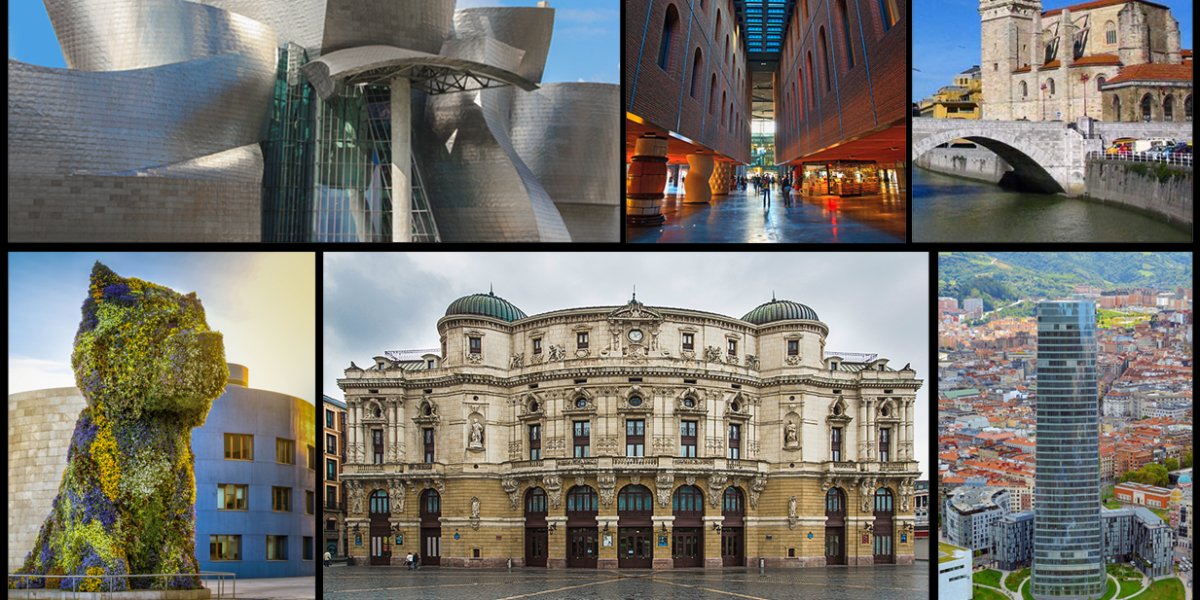
From the bridge, walk 8 minutes south through the Ensanche — Bilbao's 19th-century grid of wide boulevards and handsome stone facades. This 1909 wine warehouse was gutted and reimagined by Philippe Starck into a cultural center held up by 43 uniquely designed columns, each one a different architectural fever dream from Doric to sci-fi. Stand in the atrium center and look straight up: above the columns, swimmers glide through a glass-bottom rooftop pool.
Tip: Study the 43 columns individually — each is a completely different style, and some include hidden visual jokes that reward a slow look. The atrium is free to enter and there's a good café on the ground floor; the rooftop pool costs €12, but the view from below is genuinely more striking.
Open in Google Maps →15:30
Landmark
Head north toward the river — a 10-minute walk up Alameda de Mazarredo where the titanium curves appear above the rooftops before you arrive, and the first glimpse is electric. Frank Gehry's 33,000-panel masterpiece catches the afternoon light like liquid metal, its surface shifting color with every passing cloud. Circle the full perimeter to meet Jeff Koons's 12-meter flower-covered Puppy, Louise Bourgeois's towering Maman spider, and Fujiko Nakaya's Fog Sculpture that periodically wraps the entire building in mist.
Tip: Walk up to the Puente de La Salve — the red bridge behind the museum — for the definitive photo angle with the full building and river in the foreground. The Fog Sculpture activates roughly every 15–20 minutes in warm weather; wait for one cycle, because watching the building dissolve and reappear from mist is the kind of moment you'll describe to people for years.
Open in Google Maps →19:00
Food
Walk 10 minutes south on Alameda de Mazarredo and turn left on Calle de la Diputación — you'll pass from Gehry's future back into the elegant 19th-century Ensanche grid. This 1930s institution is where Bilbao's lawyers and bankers crowd the bar at dusk, ordering rounds of solomillo con foie (sirloin with foie gras, €4.50) and bacalao pintxo (€3.50) with glasses of Rioja. Budget €25–35 per person with wine; order in rounds of 2–3 pintxos at a time, pointing at whatever looks best on the bar.
Tip: Arrive at 19:00 sharp — by 20:00 the bar is three-deep and you'll wait 20 minutes for a spot. Avoid the restaurants on Calle Ledesma near Gran Vía with menus in six languages and food photos outside — they charge double for microwaved pintxos no local would touch.
Open in Google Maps →Saltar al día
09:30
Museum
Start your Bilbao morning at the riverside esplanade, where Jeff Koons' flower-covered Puppy and Louise Bourgeois' towering Maman spider guard Frank Gehry's titanium masterpiece. Arrive at 09:30 to photograph the exterior sculptures in soft morning light before the doors open at 10:00 — inside, the soaring atrium alone justifies the visit, and Richard Serra's massive steel spirals in The Matter of Time will recalibrate your sense of scale.
Tip: Buy tickets online the night before — the ticket line can stretch 30 minutes by 11:00. Head straight to the ground-floor gallery for Richard Serra's The Matter of Time; it's the one installation you cannot rush. The upper galleries can be covered in 60–90 minutes. Closed Mondays year-round.
Open in Google Maps →12:30
Food
Walk southeast along Alameda de Mazarredo past grand 19th-century mansions — ten minutes to this legendary 1930s bar where Bilbao's office workers crowd the zinc counter at lunchtime. The tortilla de patatas (€3.50 per thick wedge) is the city's most debated — locals argue about the ideal wobble of its center — and the croquetas de jamón ibérico (€2.50 each) shatter into creamy perfection.
Tip: Ask for the tortilla 'jugosa' (runny in the center) — that's how the regulars order it. Peak crush is 13:30–14:00; arriving at 12:30 guarantees a spot at the bar. No reservations, no tables needed — eating standing at the counter is the authentic experience.
Open in Google Maps →14:00
Landmark
Walk five minutes south down Calle de la Diputación — you'll spot the massive brick façade of a 1909 wine warehouse that Philippe Starck reimagined into one of Europe's most playful public spaces. The atrium floor is held up by 43 columns, each in a wildly different style from Babylonian to robotic, and above you a glass-bottom rooftop swimming pool lets you watch swimmers glide overhead.
Tip: Head straight to the main atrium to see the columns, then take the elevator to the third floor and look up — you can watch swimmers in the rooftop pool through the glass bottom. The whole building is free to enter and wander. The basement cinema shows arthouse films in original language with Spanish subtitles.
Open in Google Maps →15:30
Landmark
Head north back toward the river through the Ensanche grid — ten minutes along Calle Ercilla brings you to Santiago Calatrava's white glass-and-steel arch curving over the Nervión like a frozen wave. Walk slowly across and stop at the apex for the money shot: the Guggenheim's titanium sails catching afternoon light downstream, framed by the Isozaki Atea twin towers.
Tip: Photograph the bridge from the south bank (Ensanche side) before crossing — the curve against the sky is most dramatic from 20 meters back. The glass floor panels are notoriously slippery when wet; Bilbao locals joke the city has spent more on slip-and-fall lawsuits than the bridge cost to build.
Open in Google Maps →16:15
Park
Cross back to the south bank and walk eight minutes west along the riverside promenade — the University of Deusto's grand façade watches from across the water. This is Bilbao's green heart: peacocks strut past a lily-pad lake, century-old oaks arch overhead, and by late afternoon the slanting sun turns the central fountain into liquid gold.
Tip: The duck pond near the center is the most photogenic spot after 16:00 when the light softens. The eastern pergola frames the Guggenheim beautifully in the background — a hidden angle that doesn't appear in any guidebook. Benches by the fountain are the best place to rest your legs before dinner.
Open in Google Maps →19:30
Food
Walk ten minutes east through the Ensanche to Jardines de Albia — a leafy square reveals an ornate entrance that has welcomed diners since 1903. Step inside and look up: Moorish arches, hand-painted Andalusian tiles, and carved wooden ceilings make this the most beautiful dining room in Bilbao. Order the chuletón de buey a la brasa for two (€28) with blistered pimientos de Gernika (€8) and a bottle of Rioja Alavesa.
Tip: Reserve a table in the main dining room to eat under the Moorish arches — the terrace is pleasant but you miss the interior, which is the whole point. Avoid the overpriced tourist menus on Ledesma street nearby; any restaurant with photos on the menu or a sidewalk hawker is charging double for frozen food.
Open in Google Maps →09:00
Landmark
From the city center, walk ten minutes north through Jardines de Albia to the funicular station at Plaza del Funicular — the vintage 1915 railway car climbs Mount Artxanda in three minutes flat. At the summit, the entire city unrolls below: the Guggenheim's titanium gleam, green Basque hills folding into the distance, and the Nervión threading through the valley like silver wire. Morning light from the east illuminates the full panorama.
Tip: Go in the morning when east-facing light illuminates the city below — by afternoon the sun is behind you and the panorama flattens. The viewpoint directly ahead as you exit the upper station gives the classic panorama; the path slightly to the right includes the Guggenheim in the frame. The funicular runs every 15 minutes; no need to queue early.
Open in Google Maps →10:45
Religious
Ride the funicular back down and walk south across the Arenal bridge into the Casco Viejo — eight minutes with postcard views of San Antón church downstream. This 14th-century Gothic cathedral stands where Bilbao was founded; the soaring nave is impressive, but the hidden cloister is the real prize — a hushed courtyard with carved stone capitals telling biblical stories that most visitors walk right past.
Tip: Enter through the main portal and go straight to the cloister — it's the most atmospheric space and tour groups skip it entirely. The carved capitals on the columns reward a slow walk; look for the one depicting Jonah and the whale. The cathedral is free on the first Wednesday of each month.
Open in Google Maps →11:45
Neighborhood
Exit the cathedral and you're already standing in Las Siete Calles — the seven original medieval streets laid out when Bilbao was founded in 1300. Wander through narrow lanes of artisan shops and pintxos bars with zinc counters until you emerge into Plaza Nueva, a perfect neoclassical square ringed by stone arches where the city's most celebrated pintxos bars compete for your appetite.
Tip: Walk all seven streets — they're short and each has a different character. Calle Somera and Calle Artekale are the liveliest for bar-hopping. In Plaza Nueva, do a slow lap under the arches reading menus before committing to a bar. On Sundays the plaza hosts a flea market worth browsing.
Open in Google Maps →13:00
Food
You're already under the arches of Plaza Nueva — Gure Toki is at number 12, identifiable by the crowd pressed against the bar. The foie mi-cuit with apple compote (€4) dissolves on your tongue, and the txangurro gratin (€4.50) concentrates the entire Basque coastline onto a slice of bread. Order four or five pintxos with a glass of txakoli poured from height — the theatrics are part of the flavor.
Tip: Stand at the bar — table service is slower and you miss watching the bartenders assemble each pintxo to order. Point at what looks good; the staff expect it and prefer it to hesitant menu browsing. Four pintxos plus two txakolis is the sweet spot for a full lunch without a food coma.
Open in Google Maps →14:30
Landmark
Exit Plaza Nueva through the southeast arch and walk three minutes downhill toward the river — the art deco stained-glass façade of Europe's largest covered market appears ahead. Three floors of Basque abundance: whole turbot on crushed ice, mountains of guindilla peppers, txistorra sausages hanging like garlands, and a ground-floor gastro bar serving the market's own produce with a glass of cider.
Tip: The fish section on the first floor is spectacular even if you aren't buying — the displays of whole turbot and spider crabs are a sight in themselves. Visit before 15:00 when stalls begin closing. The ground-floor La Ribera gastro space serves market-sourced pintxos if you have room for a post-lunch bite.
Open in Google Maps →19:30
Food
The afternoon is yours to wander the old town's side streets or linger over a cortado in a quiet plaza. At 19:30, walk five minutes from Plaza Nueva up Calle de Perro to this no-frills institution with checkered tablecloths and absolute sincerity. The alubias de Tolosa (slow-cooked black bean stew with all the fixings, €14) is the Basque answer to cassoulet, and the bacalao al pil-pil (€18) — cod in a garlic-olive oil emulsion coaxed into existence by patient wrist-shaking — is the dish Bilbao built its culinary identity on.
Tip: Arrive right at 19:30 when they open for dinner — the small dining room fills by 20:15 and they don't take reservations. If bacalao al pil-pil is on the board, order it without hesitation; it's the definitive version in the city. Beware the tourist-trap restaurants lining the riverfront near Casco Viejo — any place with a laminated photo menu or a sidewalk hawker is charging double for microwaved food.
Open in Google Maps →
Trip builder
Plan this trip around Bilbao
Turn this guide into a bookable rail itinerary with FlipEarth.
Keep exploring
Related cities
More in the same country
FAQ
Frequently asked questions
How many days do you need in Bilbao?
Most travelers enjoy Bilbao in 1 days, with enough time for headline sights and a slower meal or museum stop.
What's the best time to visit Bilbao?
The easiest season for most travelers is May-Oct, especially if you want good weather and manageable crowds.
What's the daily budget for Bilbao?
A practical starting point is about €60 per person per day before hotels, then adjust based on museums, dining, and transport.
What are the must-see attractions in Bilbao?
A good first shortlist for Bilbao includes Zubizuri Bridge, Azkuna Zentroa, Guggenheim Museum Bilbao.